Instructions: This free practice test has 16 multiple-choice questions from our full-length AP Calculus AB practice tests. You will have 39 minutes, the same pace as the real exam.
It runs in the same test engine as our full-length tests: you can mark questions for review, cross out choices, open the calculator and move back and forth until time expires. When you finish, you will see every answer with a full explanation. No account needed.
Every question in this AP Calculus AB practice test is below. The answer and its explanation stay closed until you open them, so you can work each one first.
Question 1
If f(x)=tan(x)+2sec(x), then f′(x)=
Asec(x)+2tan(x)
Bsec2(x)−2sec(x)tan(x)
Csec2(x)+2csc(x)
Dsec2(x)+2sec(x)tan(x)
Show answer and explanation
Answer: D
dxd[tan(x)]=sec2(x) and dxd[2sec(x)]=2sec(x)tan(x), so f′(x)=sec2(x)+2sec(x)tan(x). Choice A swaps the two functions as if each were the other's derivative. Choice B attaches a minus sign to the derivative of sec(x) (the minus sign belongs to the derivative of csc(x)). Choice C gives the derivative of sec(x) as csc(x).
Question 2
If g(x)=∫1x(t2+3t)dt, then g′(x)=
A3x3+23x2−613
B2x+3
Cx2+3x
Dx2+3x−4
Show answer and explanation
Answer: C
By the Fundamental Theorem of Calculus, dxd∫1xf(t)dt=f(x), so g′(x)=x2+3x. Choice A is g(x) itself, the evaluated integral, not its derivative. Choice B differentiates the integrand once more. Choice D subtracts the integrand's value at the lower limit, 12+3(1)=4; the constant lower limit contributes nothing to g′.
Question 3
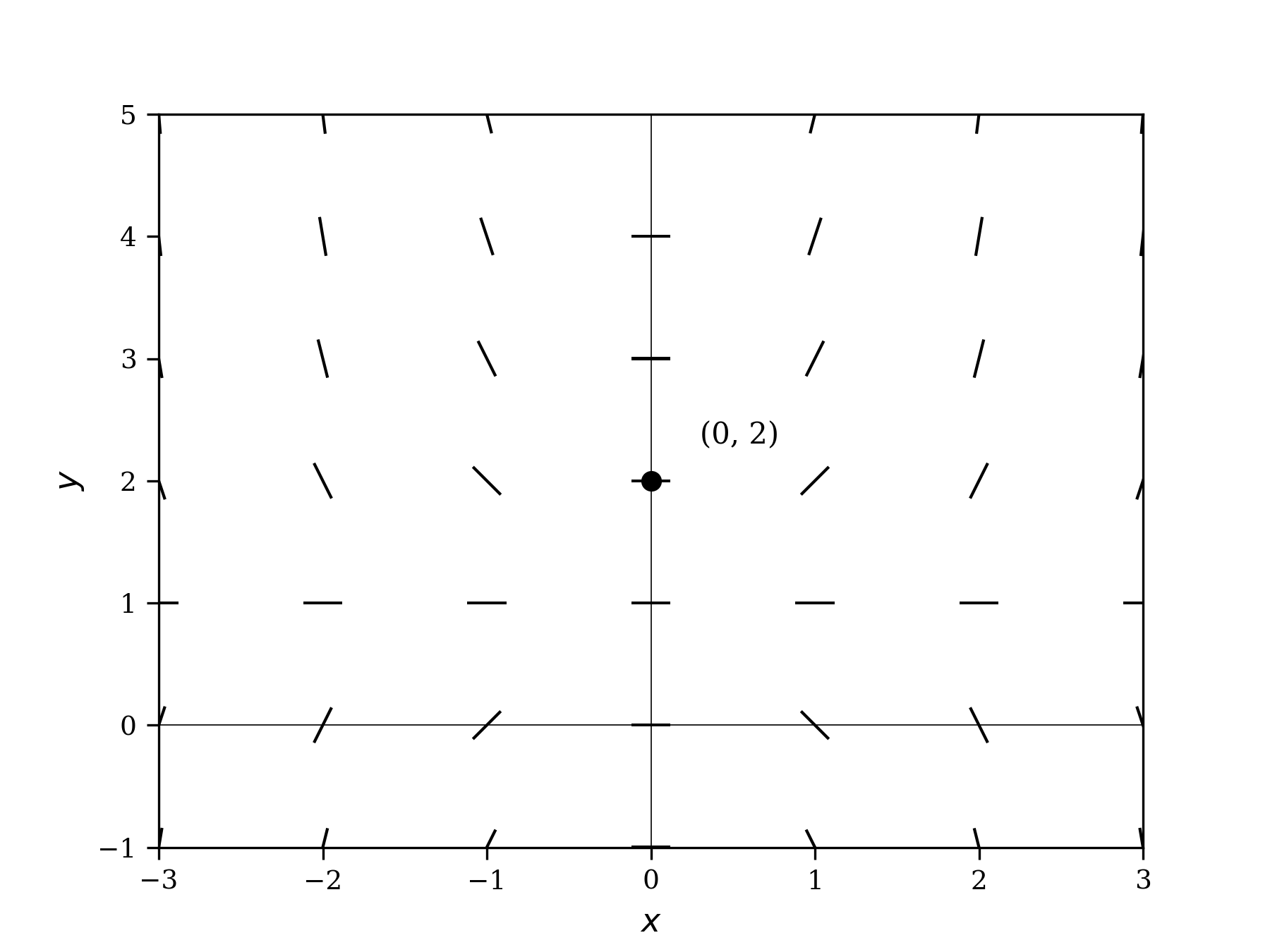
Shown above is a slope field for a differential equation with a particular solution passing through the point (0,2). Based on the slope field, the solution through (0,2) appears to be
Aincreasing and concave up for x>0
Bincreasing and concave down for x>0
Cdecreasing and concave up for x>0
Ddecreasing and concave down for x>0
Show answer and explanation
Answer: A
The segments match dxdy=x(y−1): they are horizontal along x=0 and along y=1, and at (1,2) the slope is 1. Starting at (0,2) and moving right, x>0 and y>1, so the slopes are positive and the solution increases. As it rises, both x and y−1 grow, so the slopes get steeper and the solution is concave up. Choices C and D have the solution decreasing, but the slopes above y=1 for x>0 are positive. Choice B has it concave down, but the slopes along the solution increase as x increases.
Question 4
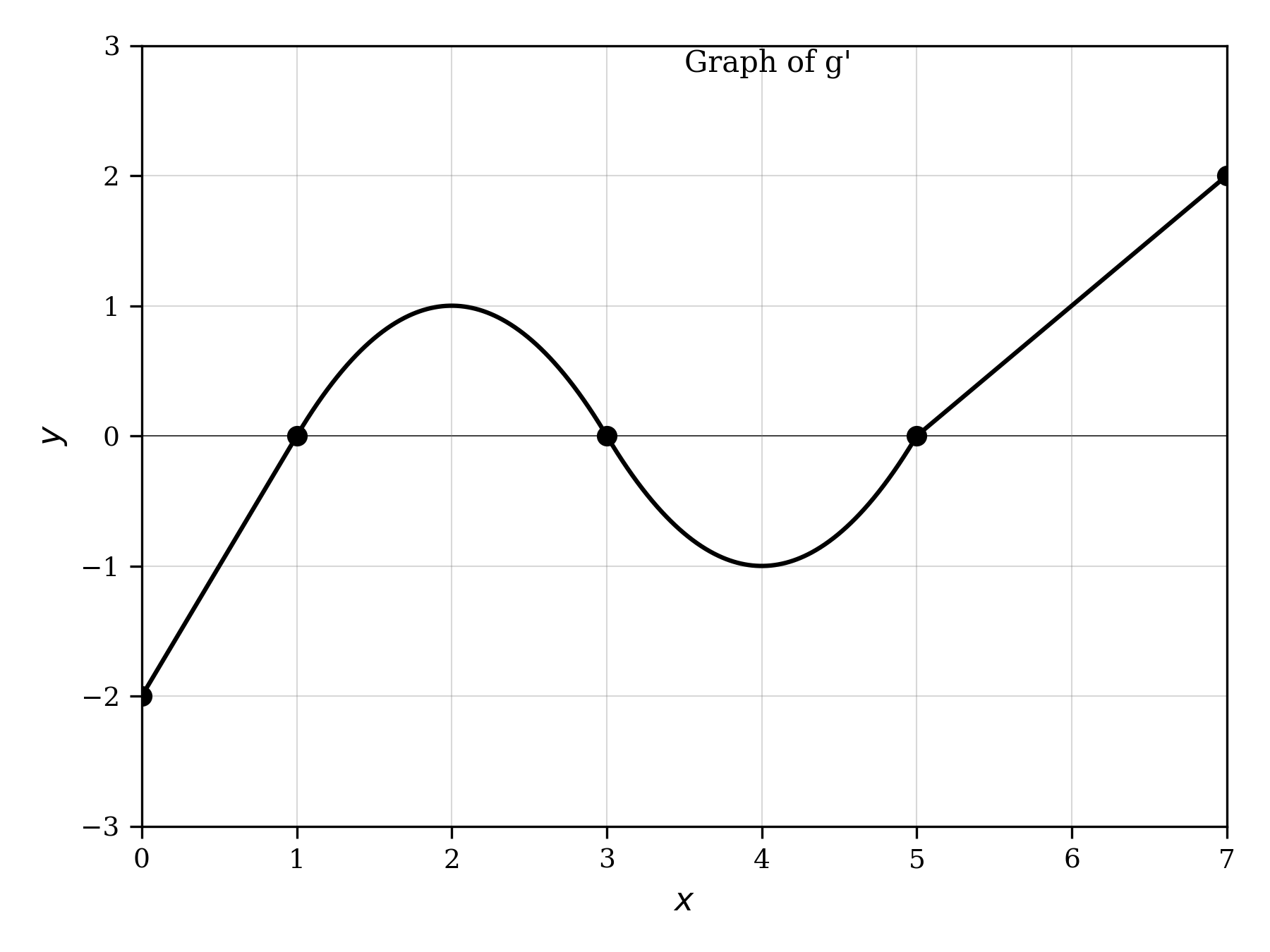
The figure above shows the graph of g′, the derivative of g, on [0,7]. The graph has zeros at x=1, x=3, and x=5. At which value of x does g have a relative maximum?
Ax=1 only
Bx=3 only
Cx=5 only
Dx=1 and x=5
Show answer and explanation
Answer: B
g has a relative maximum where g′ changes from positive to negative. From the graph, g′<0 on (0,1), g′>0 on (1,3), g′<0 on (3,5) and g′>0 on (5,7). The only change from positive to negative is at x=3. At x=1 and x=5, g′ changes from negative to positive, so those are relative minima. This rules out choices A, C and D.
Question 5
If y=sin3(2x), then dxdy=
A3sin2(2x)
B3sin2(2x)cos(2x)
C6sin2(x)cos(2x)
D6sin2(2x)cos(2x)
Show answer and explanation
Answer: D
Apply the chain rule twice: dxdy=3sin2(2x)⋅cos(2x)⋅2=6sin2(2x)cos(2x), choice D. Choice A stops after the power rule. Choice B omits the factor 2 from the inner function 2x. Choice C writes sin2(x), losing the inner argument 2x.
Question 6
What is the absolute minimum value of f(x)=x−2sin(x) on [0,2π]?
A3π−3
B0
C2π
D35π+3
Show answer and explanation
Answer: A
f′(x)=1−2cos(x)=0 gives x=3π and x=35π. Candidates: f(0)=0, f(3π)=3π−3≈−0.685, f(35π)=35π+3≈6.968, f(2π)=2π. The minimum is 3π−3, choice A. Choice B is f(0) and choice C is f(2π), endpoint values that are larger. Choice D is the absolute maximum.
Question 7
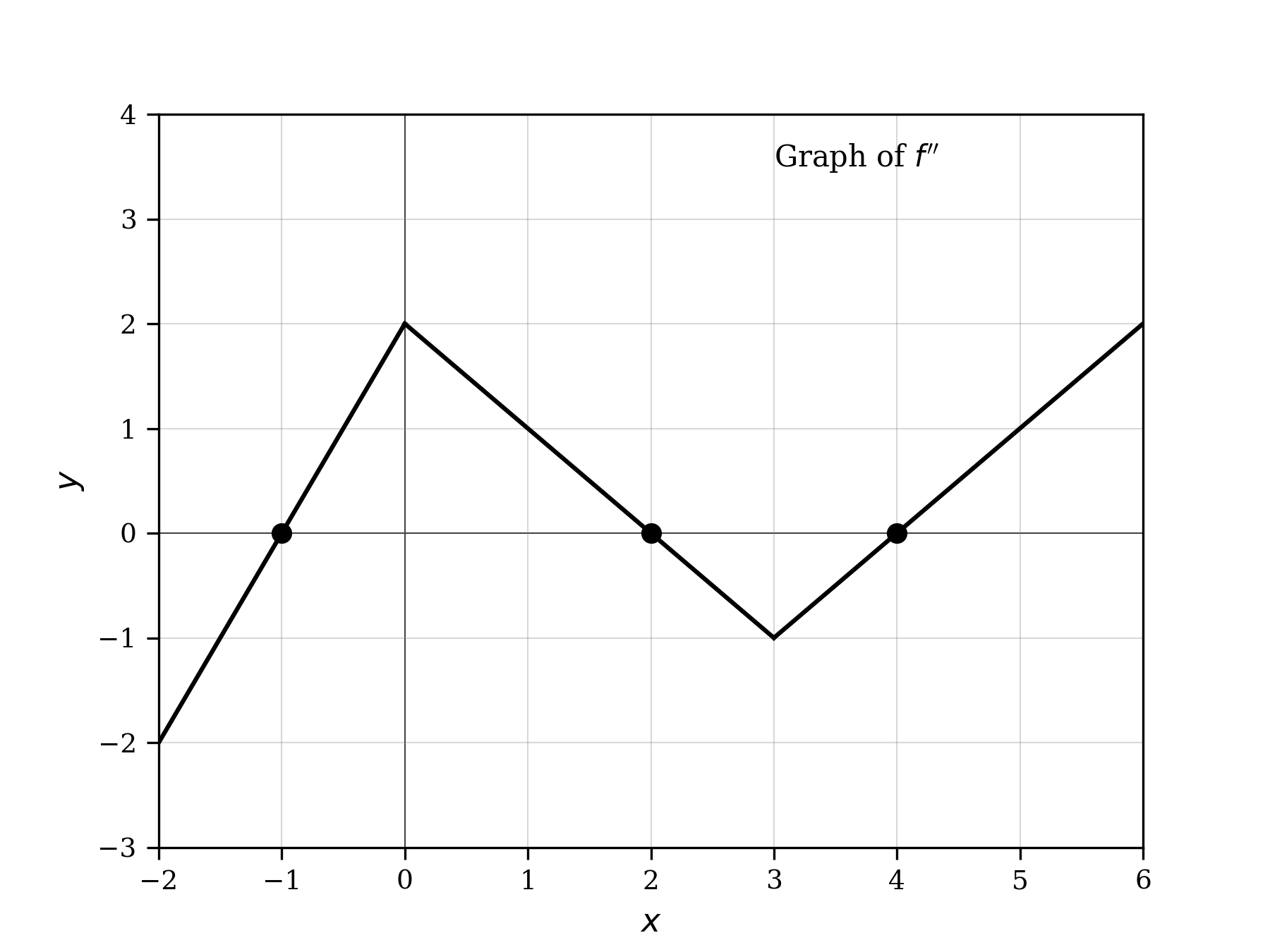
The graph of f′′, the second derivative of a function f, on the interval [−2,6] is shown in the figure above. At which of the following values of x does f have an inflection point?
Ax=−1 and x=4 only
Bx=−1, 2, and 4
Cx=0 and x=3
Dx=2 only
Show answer and explanation
Answer: B
f has an inflection point where f′′ changes sign. From the graph, f′′<0 on (−2,−1), f′′>0 on (−1,2), f′′<0 on (2,4) and f′′>0 on (4,6), so the inflection points are at x=−1, 2 and 4, choice B. Choice A keeps only the changes from negative to positive and misses x=2. Choice C gives the corners of the graph of f′′ (its extrema), where f′′ does not change sign. Choice D misses the sign changes at x=−1 and x=4.
Question 8
What is the average value of f(x)=x2+1 on the interval [0,3]?
A3
B310
C4
D12
Show answer and explanation
Answer: C
Average value =3−01∫03(x2+1)dx=31[3x3+x]03=31(12)=4, choice C. Choice A (3) drops the +1 and averages x2 only. Choice B (310) divides the endpoint value f(3)=10 by 3 instead of integrating. Choice D (12) is the integral itself, not divided by the interval length 3.
Question 9
If h(x)=∫sin(x)0t3dt, then h′(x)=
A−sin3(x)cos(x)
Bsin3(x)cos(x)
C−cos3(x)
Dsin3(x)
Show answer and explanation
Answer: A
Reverse the limits: h(x)=−∫0sin(x)t3dt. By the Fundamental Theorem of Calculus with the chain rule, h′(x)=−[sin(x)]3⋅cos(x)=−sin3(x)cos(x) (A). Choice B forgets the minus sign that comes from reversing the limits. Choice C substitutes the derivative cos(x) of the limit for t instead of the limit sin(x) itself. Choice D forgets both the chain-rule factor cos(x) and the minus sign.
Question 10
What is the area of the region bounded by the curves y=x3 and y=x on [0,1]?
A−41
B41
C21
D43
Show answer and explanation
Answer: B
On (0,1), x>x3, so the area is ∫01(x−x3)dx=[2x2−4x4]01=21−41=41 (B). Choice A subtracts in the wrong order, ∫01(x3−x)dx, which is negative and cannot be an area. Choice C is the area under y=x alone. Choice D adds the two areas instead of subtracting them.
Question 11
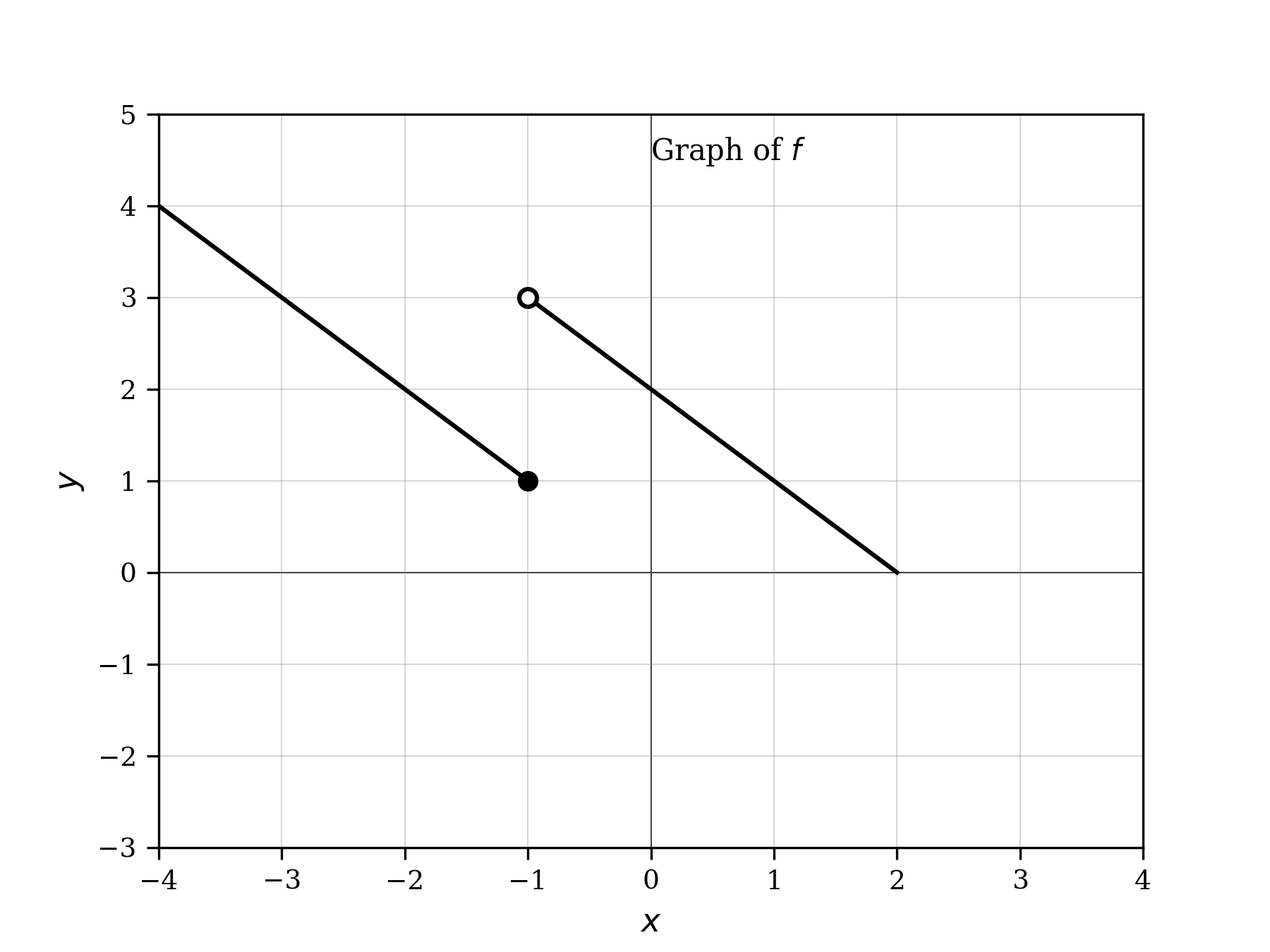
The graph of a piecewise function f is shown in the figure above. What is x→−1+limf(x)?
A1
B2
C3
Dnonexistent
Show answer and explanation
Answer: C
The right-hand limit at x=−1 is read from the piece of f for x>−1, which approaches the open circle at (−1,3). So limx→−1+f(x)=3 (C). Choice A, 1, is f(−1) and the left-hand limit, from the piece ending at the filled point (−1,1). Choice B, 2, is f(0), where the right piece crosses the y-axis. Choice D confuses the one-sided limit with the two-sided limit, which does not exist because the one-sided limits (1 and 3) differ.
Question 12
A slope field for a differential equation is described as follows: at every point (x,y), the slope equals 2x+y. What is the slope of the solution curve through (0,1) at that point, and is the solution increasing or decreasing there?
AThe slope is 0, and the solution is neither increasing nor decreasing.
BThe slope is 21, and the solution is increasing.
CThe slope is 1, and the solution is increasing.
DThe slope is −21, and the solution is decreasing.
Show answer and explanation
Answer: B
At (0,1), the slope is 20+1=21. Since the slope is positive, the solution curve is increasing there (B). Choice A uses the slope at the origin, 20+0, instead of at (0,1). Choice C forgets to divide by 2. Choice D has the sign wrong; at (0,1) the numerator x+y=1 is positive.
Question 13
Let f(x)=xe−x. Which of the following is true about f?
Af has a relative minimum at x=1
Bf has a relative maximum at x=1
Cf has a relative maximum at x=−1
Df has no relative extrema
Show answer and explanation
Answer: B
f′(x)=e−x−xe−x=e−x(1−x). Since e−x>0, f′ is positive for x<1 and negative for x>1, so by the First Derivative Test f has a relative maximum at x=1. Choice A reads the + to − sign change as a minimum; C comes from the sign error f′(x)=e−x(1+x); D wrongly concludes that because e−x is never zero, f′ is never zero.
Question 14
∫06∣x−3∣dx=
A0
B29
C9
D18
Show answer and explanation
Answer: C
The graph of y=∣x−3∣ on [0,6] forms two triangles, each with base 3 and height 3: ∫06∣x−3∣dx=21(3)(3)+21(3)(3)=9. Choice A ignores the absolute value, so the areas above and below the axis cancel: ∫06(x−3)dx=0; B counts only one triangle; D forgets the 21 in the triangle area.
Question 15
Which of the following is the limit definition of f′(a) for f(x)=sin(x)?
Alimh→0hsin(h)
Blimh→0hsin(a+h)
Climh→0hsin(a+h)+sin(a)
Dlimh→0hsin(a+h)−sin(a)
Show answer and explanation
Answer: D
The limit definition is f′(a)=limh→0hf(a+h)−f(a); with f(x)=sinx this is limh→0hsin(a+h)−sin(a). Choice A is the derivative at a=0 only; B omits the −f(a) term; C adds f(a) instead of subtracting it.
Question 16
Which of the following verifies that y=3e2x−x−1 is a solution of dxdy=2y+2x+1?
Adxdy=3e2x−1 and 2y+2x+1=6e2x−1, so they are not equal
Bdxdy=6e2x and 2y+2x+1=6e2x+1, so they are not equal
Cdxdy=6e2x−1 and 2y+2x+1=6e2x+1, so they are not equal
Ddxdy=6e2x−1 and 2y+2x+1=6e2x−1, so they are equal
Show answer and explanation
Answer: D
dxdy=6e2x−1, and 2y+2x+1=2(3e2x−x−1)+2x+1=6e2x−1. The two sides are equal, so y is a solution. Choice A forgets the chain-rule factor 2 in dxd3e2x; B differentiates −x as 0 and makes an arithmetic slip on the right side; C computes 2(−1)+1 as +1. Each reaches a false conclusion from a computation error.
Ready for the full-length tests?
Five full-length AP Calculus AB practice tests, every unit of notes and step-by-step solutions. 7 days free.