Instructions: This free practice test has 16 multiple-choice questions from our full-length AP Calculus BC practice tests. You will have 39 minutes, the same pace as the real exam.
It runs in the same test engine as our full-length tests: you can mark questions for review, cross out choices, open the calculator and move back and forth until time expires. When you finish, you will see every answer with a full explanation. No account needed.
Every question in this AP Calculus BC practice test is below. The answer and its explanation stay closed until you open them, so you can work each one first.
Question 1
Let f be a continuous function on [2,6] with f(2)=−3 and f(6)=5. Which of the following is guaranteed by the Intermediate Value Theorem?
AThere exists a value c in (2,6) such that f(c)=8.
BThere exists a value c in (2,6) such that f(c)=0.
CThere exists a value c in (2,6) such that f′(c)=0.
DThere exists a value c in (2,6) such that f′(c)=6−2f(6)−f(2).
Show answer and explanation
Answer: B
The Intermediate Value Theorem states that if f is continuous on [a,b] and N is any number between f(a) and f(b), then there exists c in (a,b) with f(c)=N. Since f(2)=−3 and f(6)=5, and 0 is between −3 and 5, there must exist c in (2,6) where f(c)=0. The value 8 is not between −3 and 5. The other choices describe the Mean Value Theorem, which requires differentiability.
Question 2
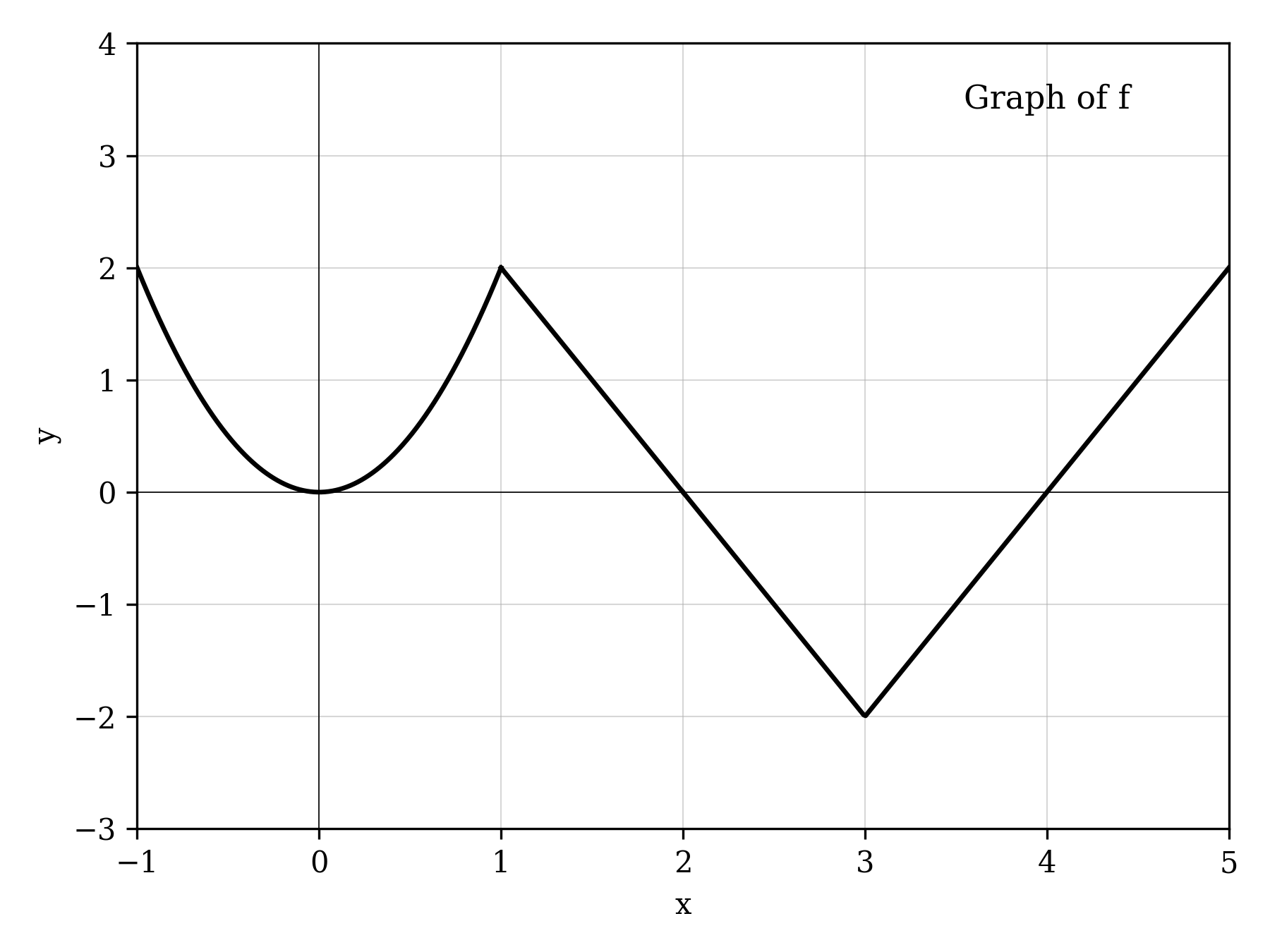
The figure above shows the graph of a function f on the interval (−1,5). At which of the following values of x is f not differentiable?
Ax=1 and x=3 only
Bx=1 only
Cx=3 only
Df is differentiable for all values of x in (−1,5).
Show answer and explanation
Answer: A
A function is not differentiable at a corner, cusp, vertical tangent, or discontinuity. At x=1 the graph turns sharply: the parabola y=2x2 arrives with slope 4, and the line leaves with slope −2, so f has a corner there. At x=3 the line with slope −2 meets a line with slope 2, another corner. Everywhere else, including the smooth bottom of the parabola at x=0, the graph has a tangent line. So f is not differentiable at both x=1 and x=3; choosing x=1 only or x=3 only misses one of the corners, and f is not differentiable everywhere because of them.
Question 3
If f(x)=arctan(3x2), then f′(x)=
A1+9x43
B1+9x46x
C1+3x26x
D1+9x41
Show answer and explanation
Answer: B
Using the chain rule with dud[arctanu]=1+u21: f′(x)=1+(3x2)21⋅6x=1+9x46x. Omitting the chain-rule factor gives 1+9x41; using 3 instead of the derivative 6x of 3x2 gives 1+9x43; and failing to square the inner function in the denominator gives 1+3x26x.
Question 4
The first three nonzero terms of the Maclaurin series for sin(x2) are
Ax2−6x6+120x10
Bx2−6x4+120x6
Cx2−2x6+24x10
Dx2+6x6+120x10
Show answer and explanation
Answer: A
The Maclaurin series for sinu=u−u3/3!+u5/5!−⋯. Substituting u=x2: sin(x2)=x2−(x2)3/6+(x2)5/120−⋯=x2−x6/6+x10/120. A common error is not raising x2 to the full power, getting x4 and x6 terms instead. Another error is using wrong factorial values or losing the alternating signs.
Question 5
What is x→∞lim5x2−x+13x2+2x?
A0
B51
C53
DThe limit does not exist.
Show answer and explanation
Answer: C
Divide numerator and denominator by x2: 5−1/x+1/x23+2/x. As x→∞, the lower-order terms vanish, leaving 53. Since the numerator and denominator have the same degree, the limit is the ratio of leading coefficients. Choice A, 0, would require the denominator to have the higher degree. Choice B, 51, keeps the denominator's leading coefficient but loses the numerator's 3. Choice D is wrong because equal degrees give a finite limit.
Question 6
∫xcosxdx=
A−xsinx+cosx+C
B2x2sinx+C
Cxsinx+cosx+C
Dxsinx−cosx+C
Show answer and explanation
Answer: C
Use integration by parts with u=x and dv=cosxdx. Then du=dx and v=sinx. Applying the formula: xsinx−∫sinxdx=xsinx+cosx+C. Differentiating choice A gives −2sinx−xcosx, not xcosx. Choice B integrates the two factors separately, which is not valid for a product. Choice D gets the sign of ∫sinxdx=−cosx wrong.
Question 7
The Maclaurin series for 1+x21 is
An=0∑∞(−1)nx2n
Bn=0∑∞(−1)nxn
Cn=0∑∞x2n
Dn=1∑∞2n(−1)nx2n
Show answer and explanation
Answer: A
Start with the geometric series 1/(1−u)=∑n=0∞un for ∣u∣<1. Substitute u=−x2: 1/(1+x2)=∑n=0∞(−x2)n=∑n=0∞(−1)nx2n for ∣x∣<1. The series alternates in sign and contains only even powers of x. A common error is forgetting to include the (−1)n factor. Choice B is the series for 1+x1. Choice C, without (−1)n, is the series for 1−x21. Choice D has the denominators 2n that integration produces; it is the series for −21ln(1+x2).
Question 8
Which of the following verifies that y=Ce2x+41 is a solution to the differential equation dxdy=2y−21?
Adxdy=2Ce2x and 2y−21=2Ce2x
Bdxdy=Ce2x and 2y−21=2Ce2x
Cdxdy=2Ce2x+41 and 2y−21=2Ce2x
Ddxdy=2Ce2x and 2y−21=Ce2x
Show answer and explanation
Answer: A
Differentiate: dy/dx=2Ce2x. Substitute into the right side: 2(Ce2x+1/4)−1/2=2Ce2x+1/2−1/2=2Ce2x. Both sides equal 2Ce2x, confirming y is a solution. Choice B drops the factor 2 from the chain rule when differentiating e2x. Choice C keeps the constant 41 in the derivative, but the derivative of a constant is 0. Choice D does not double C: 2(Ce2x+41)−21=2Ce2x, not Ce2x.
Question 9
If f(x)=4x5−3x−2+7, then f′(x)=
A20x4−6x−3
B20x4+3x−3
C20x4−3x−1
D20x4+6x−3
Show answer and explanation
Answer: D
Apply the power rule term by term: dxd(4x5)=20x4, dxd(−3x−2)=(−3)(−2)x−3=6x−3, and the constant 7 has derivative 0. So f′(x)=20x4+6x−3. Choice A has the sign wrong: the two negatives (−3)(−2) multiply to a positive. Choice B lowers the exponent correctly but drops the factor 2 from the exponent, keeping only a sign change on the coefficient 3. Choice C raises the exponent from −2 to −1 instead of lowering it to −3 and never multiplies by the exponent.
Question 10
Which of the following conditions is sufficient to guarantee that a function f attains both an absolute maximum and an absolute minimum on an interval?
Af is differentiable on (a,b).
Bf is defined for all x in [a,b].
Cf is continuous on (a,b) and defined at x=a and x=b.
Df is continuous on the closed interval [a,b].
Show answer and explanation
Answer: D
The Extreme Value Theorem: if f is continuous on the closed interval [a,b], then f attains both an absolute maximum and an absolute minimum on [a,b]. Choice A fails because differentiability on the open interval says nothing about the endpoints; f(x)=x1 on (0,1] is differentiable on (0,1) and has no maximum. Choice B fails because a function defined on [a,b] can be discontinuous, for example unbounded near an interior point. Choice C fails because f may jump at an endpoint: f(x)=x on (0,1) with f(0)=f(1)=21 attains neither an absolute maximum nor an absolute minimum.
Question 11
Which of the following is true about the series n=1∑∞n3+1n?
AIt converges by limit comparison with ∑n21.
BIt diverges by comparison with ∑n1.
CIt diverges by the nth-term test.
DIt converges by the ratio test.
Show answer and explanation
Answer: A
Use the limit comparison test with bn=n21: limn→∞1/n2n/(n3+1)=limn→∞n3+1n3=1, a positive finite number, and ∑n21 converges (p=2), so the series converges. Choice B is wrong because n3+1n<n1, so comparing with the divergent ∑n1 proves nothing. Choice C is wrong because the terms approach 0, so the nth-term test is inconclusive. Choice D is wrong because the ratio of consecutive terms approaches 1, so the ratio test is inconclusive.
Question 12
Let f′(x)=exsin(x)−2. On which of the following intervals is f increasing on [0,5]?
A(0,0.921) only
B(0.921,3.046) only
C(0,0.921) and (3.046,5)
D(0,5)
Show answer and explanation
Answer: B
f is increasing where f′(x)>0. Using a calculator, the zeros of exsinx−2 on [0,5] are x≈0.921 and x≈3.046. Checking signs: f′(0)=−2<0, f′(2)=e2sin2−2≈4.72>0, and f′(4)=e4sin4−2≈−43.3<0. So f is increasing only on (0.921,3.046). Choices A and C name the intervals where f′<0, where f is decreasing. Choice D ignores the sign changes of f′.
Question 13
If f is an invertible differentiable function with f(3)=7 and f′(3)=4, then (f−1)′(7)=
A71
B41
C31
D4
Show answer and explanation
Answer: B
By the inverse function derivative theorem, (f−1)′(b)=f′(f−1(b))1. Since f(3)=7, we have f−1(7)=3. Therefore (f−1)′(7)=f′(3)1=41. The distractor 71 uses f(3)1 instead. The distractor 4 gives f′(3) directly without the reciprocal. The distractor 31 takes the reciprocal of the input 3 instead of the reciprocal of the slope f′(3).
Question 14
∫0∞e−3xdx=
A−31
B31
C3
DThe integral diverges.
Show answer and explanation
Answer: B
Evaluate: limb→∞∫0be−3xdx=limb→∞[−31e−3x]0b=limb→∞(−31e−3b+31)=31. The distractor −31 results from only evaluating the antiderivative at x=0 with wrong sign. The distractor 3 inverts the coefficient. The integral does not diverge: e−3b→0 as b→∞, so the limit is finite.
Question 15
Let y be the function satisfying dxdy=y2x with y(0)=4. Then y=
Ax2+4
B2x2+4
C2x2+4
D2x2+16
Show answer and explanation
Answer: D
Separate variables: ydy=2xdx. Integrate: 2y2=x2+C. Apply y(0)=4: 216=C, so C=8. Then y2=2x2+16, giving y=2x2+16. The distractor x2+4 omits the factor 2 and miscomputes C. The distractor 2x2+4 uses C=2 instead of C=8. The distractor 2x2+4 integrates as if dxdy=4x, ignoring the y in the denominator; its derivative 4x does not equal 2x2+42x.
Question 16
∫024−x2dx=
A2
Bπ
C2π
D4π
Show answer and explanation
Answer: B
The integrand y=4−x2 represents the upper half of a circle of radius 2 centered at the origin. The integral from 0 to 2 computes the area of a quarter-circle: 41π(2)2=π. The distractor 2π computes a semicircle. The distractor 4π gives the full circle area. The distractor 2 gives the radius, not the area.
Ready for the full-length tests?
Five full-length AP Calculus BC practice tests, every unit of notes and step-by-step solutions. 7 days free.