Instructions: This free practice test has 16 multiple-choice questions from our full-length AP Chemistry practice tests. You will have 24 minutes, the same pace as the real exam.
It runs in the same test engine as our full-length tests: you can mark questions for review, cross out choices, open the calculator and move back and forth until time expires. When you finish, you will see every answer with a full explanation. No account needed.
Every question in this AP Chemistry practice test is below. The answer and its explanation stay closed until you open them, so you can work each one first.
Question 1
The species Na+, Mg2+, Al3+, and F− are all isoelectronic with neon. Which of the following has the smallest ionic radius?
AF−
BNa+
CAl3+
DMg2+
Show answer and explanation
Answer: C
All four species have 10 electrons, so the radius is set by nuclear charge. Al3+ has 13 protons, the most, and pulls the 10 electrons in most strongly, giving the smallest radius. Mg2+ (12 protons) and Na+ (11) are progressively larger, and F− (9 protons) is the largest of the series.
Question 2
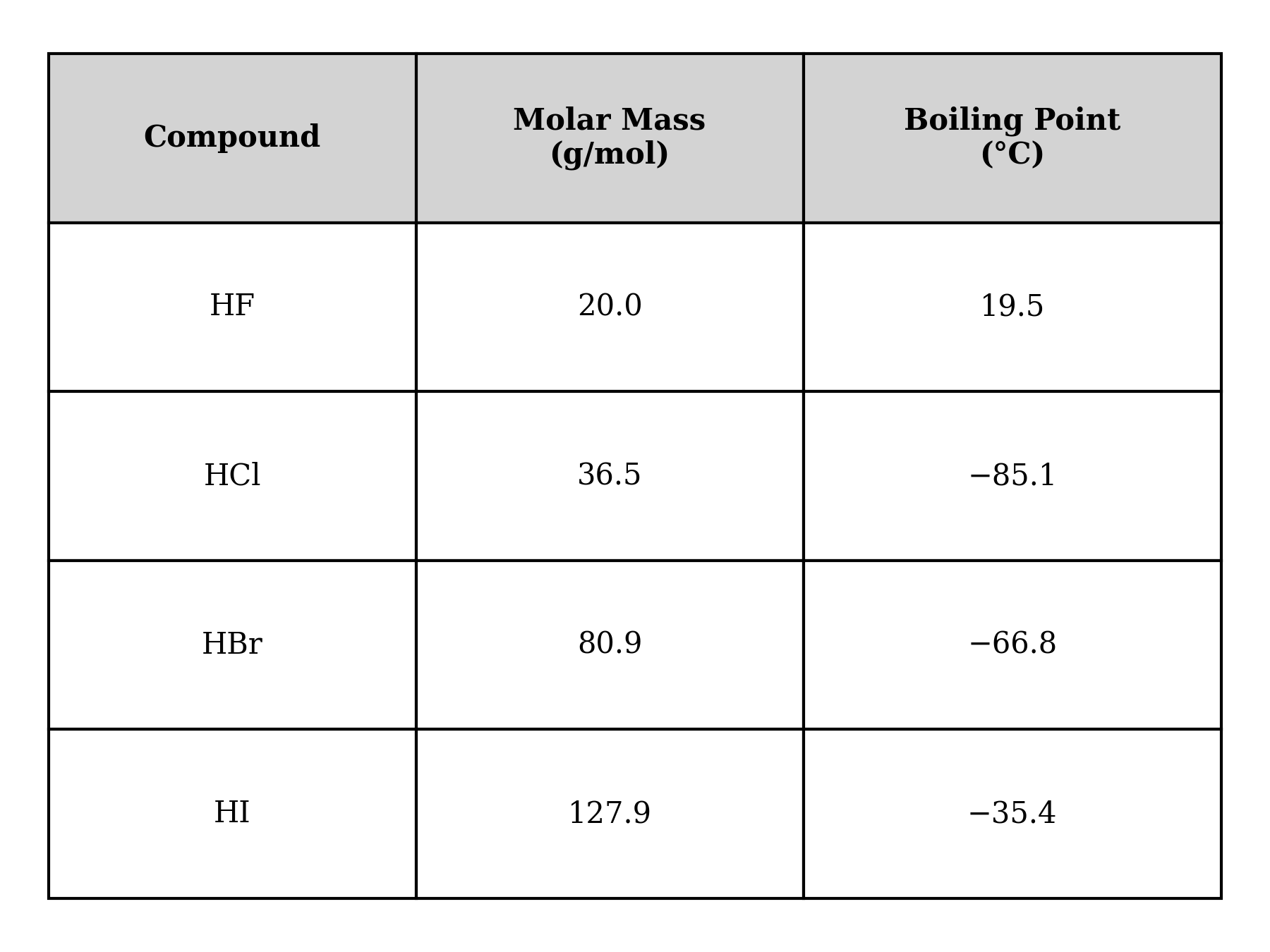
The boiling points of the hydrogen halides are given in the table above. HF has the highest boiling point despite having the lowest molar mass in the series. Which of the following best explains this observation?
AHF molecules form strong hydrogen bonds due to fluorine's high electronegativity and small size, which dominate over the London dispersion forces in the other halides
BHF has the highest bond dissociation energy of all the hydrogen halides, requiring more energy to break its intramolecular bonds during the boiling process
CThe small size of HF molecules allows them to pack more closely together in the liquid phase, significantly increasing the London dispersion forces
DHF is more polar than the other hydrogen halides, so it experiences stronger ion-dipole interactions between molecules in the liquid phase
Show answer and explanation
Answer: A
HF boils far above the trend set by molar mass because F is small and highly electronegative, so HF molecules form strong hydrogen bonds, which outweigh the London dispersion forces that increase from HCl to HI. Bond dissociation energy concerns breaking H–F bonds inside the molecule, which does not happen on boiling. Close packing does not give HF, the least polarizable molecule, the largest dispersion forces. HF molecules are neutral, so there are no ion–dipole forces in liquid HF.
An endothermic reaction absorbs heat and has ΔH>0. Reaction 2 (+181 kJ) is endothermic; Reaction 1 (−802 kJ) releases heat and is exothermic. So only Reaction 2 qualifies.
Question 4
Reaction 1 has ΔG∘=+30.0 kJ/mol and Reaction 2 has ΔG∘=−85.0 kJ/mol. If the two reactions are coupled, what is the overall ΔG∘, and is the coupled process thermodynamically favorable?
A−115.0 kJ/mol; favorable
B−55.0 kJ/mol; favorable
C+55.0 kJ/mol; not favorable
D+115.0 kJ/mol; not favorable
Show answer and explanation
Answer: B
Coupled reactions add their free-energy changes: +30.0+(−85.0)=−55.0 kJ/mol, which is negative, so the coupled process is favorable. −115.0 subtracts instead of adding; +55.0 flips the sign; +115.0 subtracts in the other order.
Question 5
Which of the following best explains why ionic solids such as NaCl have high melting points?
AThe covalent bonds within each formula unit of NaCl are very strong, requiring a large amount of energy to break the crystal apart
BThe London dispersion forces between the ions increase with the size of the crystal, requiring more energy to disrupt larger structures
CThe metallic bonding between atoms in the crystal lattice creates a sea of delocalized electrons that requires significant energy to overcome
DThe electrostatic attractions between oppositely charged ions in the crystal lattice require a large amount of energy to overcome
Show answer and explanation
Answer: D
Ionic solids consist of a regular repeating arrangement of cations and anions held together by electrostatic (Coulombic) attractions. These nondirectional attractions extend throughout the crystal lattice, and a large amount of energy is needed to overcome them. The bonding is ionic, not covalent or metallic, and London dispersion forces are negligible compared to the electrostatic interactions.
Question 6
Brass is an alloy of copper and zinc. Which of the following best explains why brass is harder than pure copper?
AZinc atoms are a different size than copper atoms, disrupting the regular lattice arrangement and making it harder for layers to slide
BZinc atoms form covalent bonds with copper atoms, creating a rigid network solid structure that strongly resists any deformation
CThe zinc atoms donate electrons to the copper atoms, increasing the strength of the ionic interactions that hold the lattice together
DZinc has a higher melting point than copper, so mixing the two metals increases the overall thermal stability and hardness of the alloy
Show answer and explanation
Answer: A
In a substitutional alloy such as brass, zinc atoms replace some copper atoms in the metallic lattice. Because zinc atoms have a different atomic radius, the regular packing is disrupted, making it harder for layers to slide past each other. The bonding in alloys remains metallic, not covalent or ionic. The relative melting points of the component metals do not directly explain hardness.
Question 7
Which of the following substances is most likely to sublime at standard pressure (1 atm)?
AH2O
BCO2
CNaCl
DSiO2
Show answer and explanation
Answer: B
Solid carbon dioxide (dry ice) sublimes at standard pressure because its normal sublimation point is -78.5 °C at 1 atm. At this pressure, solid CO2 transitions directly to the gas phase without passing through the liquid phase. Water melts to liquid at 0 °C, and NaCl and SiO2 are high-melting solids that melt before vaporizing.
Question 8
An aqueous solution of CuSO4 is electrolyzed using a current of 2.50 A for 1200 s. What mass of copper is deposited at the cathode? (Cu2++2e−→Cu; F = 96,485 C/mol; Cu = 63.55 g/mol)
A0.988 g
B1.98 g
C3.95 g
D63.6 g
Show answer and explanation
Answer: A
Charge =It=2.50×1200=3000 C. Moles of electrons =3000/96,485=0.0311 mol. Two electrons deposit one Cu, so mol Cu =0.0155 and mass =0.0155×63.55=0.988 g (A). Choice B (1.98 g) uses one electron per Cu. Choice C (3.95 g) multiplies the moles of electrons by 2 instead of dividing. Choice D (63.6 g) is the mass of a full mole of Cu, ignoring the charge passed.
Question 9
Which of the following regions of the electromagnetic spectrum has photons with the highest energy?
AGamma rays
BUltraviolet
CVisible light
DInfrared
Show answer and explanation
Answer: A
Photon energy is E=hν=hc/λ, so the shortest-wavelength, highest-frequency radiation has the most energetic photons. Gamma rays have the shortest wavelengths of the choices (A). Ultraviolet (B), visible light (C) and infrared (D) have progressively longer wavelengths and therefore progressively lower photon energies.
Question 10
Equal molar amounts of the following salts are each dissolved in separate samples of pure water. Which of the resulting solutions is expected to be basic?
ANaCl
BNH4Cl
CNaCH3COO
DKNO3
Show answer and explanation
Answer: C
In sodium acetate, CH3COO− is the conjugate base of a weak acid, so it reacts with water, CH3COO−+H2O⇌CH3COOH+OH−, and the solution is basic (C). NaCl (A) and KNO3 (D) contain only ions of strong acids and strong bases, so their solutions are neutral. NH4Cl (B) is acidic because NH4+ is the conjugate acid of the weak base NH3.
Question 11
Chloroacetic acid (ClCH2COOH, Ka=1.4×10⁻³) is a stronger acid than acetic acid (CH3COOH, Ka=1.8×10⁻⁵). Which of the following best explains this difference?
AThe C-Cl bond in chloroacetic acid is weaker than the C-H bond it replaces, which makes the O-H bond easier to break and releases a proton more readily
BChloroacetic acid has a higher molecular mass than acetic acid, and greater molecular mass directly correlates with increased acid strength in aqueous solution
CThe chlorine atom donates electron density toward the carboxyl group through resonance, which stabilizes the undissociated acid form and promotes ionization
DThe electronegative chlorine atom withdraws electron density from the carboxyl group through induction, which stabilizes the conjugate base and increases acid strength
Show answer and explanation
Answer: D
Chlorine is highly electronegative and pulls electron density through the C–C bond toward itself (an inductive effect). This spreads out and stabilizes the negative charge of the conjugate base, ClCH2COO−, so the acid ionizes more and Ka is larger (D). Choice A is wrong because the C–Cl bond is not the bond that breaks, and its strength does not set the acidity. Choice B is wrong because molar mass does not determine acid strength. Choice C has the electron flow backward: donating electron density would destabilize the anion and weaken the acid.
Question 12
A galvanic cell is constructed with a standard cell potential of Ecell∘=1.10 V. The cell operates according to the reaction Zn(s)+Cu2+(aq)→Zn2+(aq)+Cu(s) with [Zn2+]=0.010 M and [Cu2+]=1.0 M. What is the cell potential at 25 °C? (n=2)
A1.04 V
B1.07 V
C1.16 V
D1.22 V
Show answer and explanation
Answer: C
E=E∘−n0.0592logQ with Q=[Cu2+][Zn2+]=1.00.010=0.010 and logQ=−2.00, so E=1.10−20.0592(−2.00)=1.10+0.059=1.16 V (C). Choice A (1.04 V) subtracts the correction instead of adding it. Choice B (1.07 V) subtracts and uses only one power of ten. Choice D (1.22 V) uses n=1 instead of 2.
Question 13
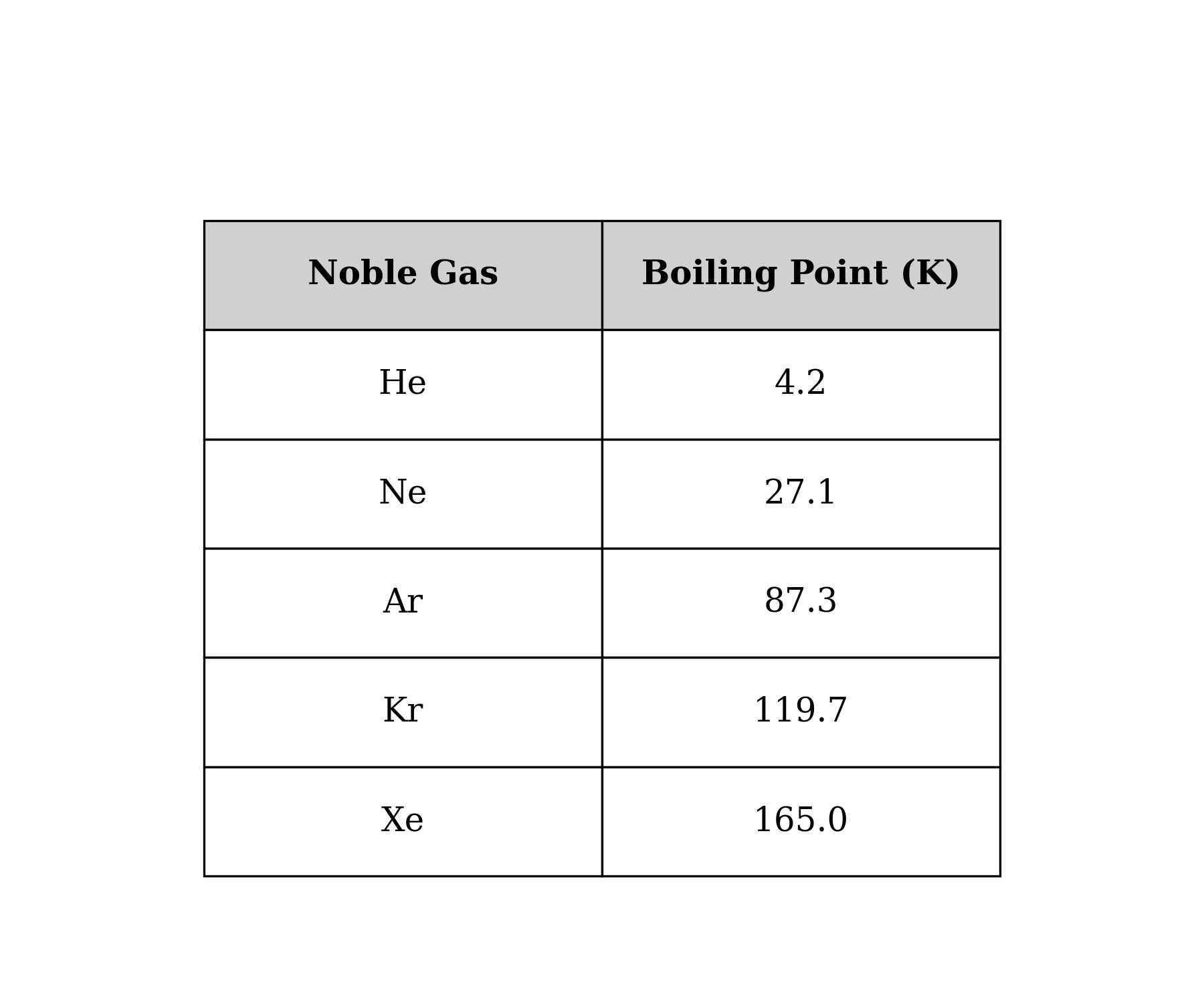
The boiling points of the noble gases are listed in the table above. Which of the following best explains the trend in boiling points from He to Xe?
ALarger noble gas atoms have more protons in the nucleus, creating stronger nuclear attraction to neighboring atoms in the liquid phase.
BHeavier noble gas atoms move more slowly at the same temperature, allowing them to condense into the liquid phase at higher temperatures.
CLarger noble gas atoms form stronger covalent bonds between neighboring atoms, requiring more energy to separate them into the gas phase.
DLarger noble gas atoms have more electrons and larger electron clouds, producing stronger London dispersion forces between neighboring atoms.
Show answer and explanation
Answer: D
Noble gases are monatomic and nonpolar, so the only forces between atoms are London dispersion forces. Going from He to Xe the atoms have more electrons in larger, more polarizable electron clouds, so the dispersion forces and the boiling points increase (D). Choice A is wrong because a nucleus does not attract the neighboring atoms' electrons enough to explain the trend; the added protons are shielded by the added electrons. Choice B is wrong because at the same temperature all gases have the same average kinetic energy; boiling point depends on the strength of the attractions, not on speed. Choice C is wrong because noble gases do not form covalent bonds with each other.
Question 14
What is the root-mean-square speed of N2 gas molecules at 300 K? (R = 8.314 J mol−1 K−1; molar mass of N2 = 28.02 g/mol)
A298 m/s
B422 m/s
C517 m/s
D731 m/s
Show answer and explanation
Answer: C
urms=M3RT with M in kg/mol: 0.028023(8.314)(300)=517m/s (C). Choice A (298 m/s) leaves out the factor of 3. Choice B (422 m/s) uses 2RT, which gives the most probable speed, not the rms speed. Choice D (731 m/s) uses 6RT, doubling the 3.
Question 15
Two acetate buffers both have pH = pKa because each has a 1:1 ratio of CH3COOH to CH3COO−. Buffer 1 contains 0.10 M of each component; Buffer 2 contains 1.0 M of each. Which of the following best explains why Buffer 2 has a higher buffer capacity?
ABuffer 1 has higher capacity because its lower concentration of components allows more added solute to dissolve before saturation.
BBoth buffers have the same capacity because they contain equal ratios of weak acid to conjugate base at the same temperature.
CBuffer 2 has higher capacity because its higher concentration of acetic acid increases the effective Ka value of the acid.
DBuffer 2 has higher capacity because it contains more moles of weak acid and conjugate base available to neutralize added acid or base.
Show answer and explanation
Answer: D
Both buffers have a 1 : 1 ratio, so both have pH = pKa. Buffer capacity, the amount of strong acid or base a buffer can absorb before its pH changes much, depends on how much weak acid and conjugate base are present. Buffer 2 holds ten times as much of each component, so it can neutralize ten times as much added acid or base (D). Choice A is wrong because buffer capacity has nothing to do with how much solute can still dissolve. Choice B is wrong because equal ratios give equal pH, not equal capacity. Choice C is wrong because Ka is a constant at a given temperature and does not change with concentration.
Question 16
Consider two reactions at 298 K: Reaction 1: A→B, ΔG∘=+30 kJ/mol Reaction 2: ATP hydrolysis, ΔG∘=−31 kJ/mol If Reaction 1 is coupled with Reaction 2, what is ΔG∘ for the coupled process, and is it thermodynamically favorable?
A−61 kJ/mol; thermodynamically favorable
B−1 kJ/mol; thermodynamically favorable
C+1 kJ/mol; thermodynamically unfavorable
D+61 kJ/mol; thermodynamically unfavorable
Show answer and explanation
Answer: B
Coupled reactions have additive Gibbs free energy changes: ΔGcoupled∘=+30+(−31)=−1 kJ/mol. Since the result is negative, the coupled process is thermodynamically favorable. ATP hydrolysis provides enough free energy to drive the otherwise unfavorable Reaction 1. Adding magnitudes (61 kJ/mol) or reversing the sign of one reaction leads to incorrect answers.
Ready for the full-length tests?
Five full-length AP Chemistry practice tests, every unit of notes and step-by-step solutions. 7 days free.