← AP Prep

AP European History Practice Test

Instructions: This free practice test has 16 multiple-choice questions from our full-length AP European History practice tests. You will have 16 minutes, the same pace as the real exam.

It runs in the same test engine as our full-length tests: you can mark questions for review, cross out choices and move back and forth until time expires. When you finish, you will see every answer with a full explanation. No account needed.

Or

Go Back

All 16 questions, with answers

Every question in this AP European History practice test is below. The answer and its explanation stay closed until you open them, so you can work each one first.

Questions 1 to 3

"We are one people, though tyrants and foreign princes have divided us. The same language falls from our lips, the same songs echo in our valleys, the same memories of ancient glory inspire our hearts. Shall we remain scattered and weak, subject to the whims of kings who care nothing for the aspirations of the nation? The time has come to forge from our shared heritage a single state worthy of our common destiny. Let every patriot take up this sacred cause, for the unification of the fatherland is not merely a political program but a moral imperative written in the blood of our ancestors."

Original educational composition in the style of an Italian nationalist appeal of the 1830s.

Question 1

The nationalist sentiment expressed in the passage most directly relates to which of the following broader cultural contexts?
  • AThe Romantic movement's celebration of national identity, folk traditions, and emotional attachment to the homeland as sources of cultural authenticity
  • BThe Enlightenment's emphasis on universal rational principles and shared human reason, which explicitly transcended and rejected particular national boundaries and cultural particularism
  • CThe Scientific Revolution's gradual demonstration that all peoples across the world share a common human nature and biological constitution governed by universal natural laws
  • DThe Realist movement's deliberate focus on objectively depicting the harsh and unglamorous material conditions of contemporary industrial and working-class society
Show answer and explanation

Answer: A

A is correct. Shared songs, inherited memories, and emotional attachment to the homeland connect the passage with Romantic cultural nationalism. B emphasizes universal rational principles rather than the particular cultural bonds foregrounded here. C concerns general explanations of nature and humanity, not the passage’s appeal to national traditions. D describes social realism rather than the Romantic treatment of collective identity.
Question 2

Which of the following best identifies the specific evidence the author uses to argue for national unification?
  • AStatistical data about economic productivity and trade volumes among the Italian states
  • BShared language, cultural traditions, and historical memory
  • CDiplomatic agreements between Italian rulers who voluntarily agreed to merge their territories
  • DMilitary victories that demonstrated Italian superiority over neighboring European powers
Show answer and explanation

Answer: B

The author builds the case for national unification by appealing to cultural and linguistic evidence of shared identity among the Italian people. References to common language, shared songs, and collective memories of past glory serve as evidence that the Italian people already constitute a nation in cultural terms, despite their political fragmentation. This approach reflects the Romantic nationalist conviction that nations exist as organic cultural entities prior to and independent of the political states that may or may not represent them, and that the political order should be adjusted to match the underlying cultural reality. A names statistics that the passage does not present. C names interstate treaties that the passage does not cite. D names military victories that the passage does not recount.

Question 3

Which of the following best describes the key concepts of nationalism expressed in the passage?
  • AThe belief that intensifying economic competition between industrializing nations is the fundamental and primary driving force behind all meaningful historical progress and change
  • BThe argument that all European peoples should abandon their separate states and voluntarily unite under a single supranational federal government capable of preventing future destructive wars
  • CThe conviction that peoples sharing a common language, culture, and historical experience constitute a nation entitled to political self-determination
  • DThe view that national identity is determined exclusively and immutably by racial or biological characteristics rather than by shared cultural, linguistic, or historical bonds
Show answer and explanation

Answer: C

The passage articulates the core principles of nineteenth-century liberal nationalism, which held that peoples united by shared language, culture, and historical experience formed natural political communities deserving of self-governance. This concept of national self-determination drew on Romantic ideas about the organic unity of peoples and combined them with liberal political principles about consent and popular sovereignty. The author's appeal to cultural heritage and historical destiny as justifications for political unification represents the dominant strain of nationalist thought that drove the unification movements in Italy and Germany during the mid-nineteenth century. A makes economic competition the whole content of nationalism, unlike the cultural argument in the passage. B erases the separate national state the author demands. D replaces shared language and memory with an exclusively biological definition.

Questions 4 to 6

"Europe today resembles a vast armed camp in which the great powers eye one another with suspicion and fear. The alliance that binds us to our partners is both a shield and a chain, for while it promises aid in time of danger, it also commits us to conflicts that may arise from disputes not our own. The armies grow larger with each passing year, and the generals speak with confidence of plans that assume war is not merely possible but inevitable. In such an atmosphere, a single spark in the Balkans or along the Rhine may set the whole continent ablaze."

Original educational composition in the voice of a European diplomatic observer before the First World War.

Question 4

The author's observation that military leaders 'speak with confidence of plans that assume war is not merely possible but inevitable' most directly supports which of the following conclusions about the origins of the First World War?
  • AMilitary planning and the assumption of inevitable conflict contributed to a diplomatic environment in which political leaders found it increasingly difficult to resolve crises peacefully
  • BEuropean generals bore greater responsibility for the outbreak of war than civilian leaders, as military planning ultimately dictated the terms and timing of mobilization decisions
  • CThe inevitability of war was recognized by all Europeans, who enthusiastically welcomed the conflict as an opportunity for national renewal
  • DMilitary planning had no significant influence on political decision-making, as civilian leaders maintained complete control over foreign policy in all European states
Show answer and explanation

Answer: A

The passage highlights how military planning created its own momentum toward war. The elaborate mobilization plans developed by European general staffs, such as Germany's Schlieffen Plan, operated on strict timetables that left little room for diplomatic negotiation once a crisis began. The assumption that war was inevitable became self-fulfilling, as military leaders pressured political decision-makers to order mobilization quickly rather than risk being caught unprepared. This dynamic illustrates how the interaction between military planning and diplomatic crisis management contributed to the escalation of the July 1914 crisis into a continental war. B ranks generals above civilian leaders in responsibility without comparative evidence. C generalizes to all Europeans what the passage attributes to military planners. D contradicts the passage’s account of the pressure exerted by military plans.

Question 5

The tensions described in the passage most directly led to which of the following postwar developments?
  • AThe establishment of a European collective security council empowered to arbitrate territorial disputes and impose binding settlements on member states
  • BThe complete and voluntary disarmament of all European military forces to agreed minimum levels, carried out as an integral part of a binding and comprehensive multilateral peace agreement
  • CThe straightforward restoration of the pre-war balance of power system in its entirety, with no significant modifications made to the existing alliance framework or territorial arrangements
  • DThe Treaty of Versailles and the creation of the League of Nations, which attempted to establish a new international order based on collective security rather than competing alliances
Show answer and explanation

Answer: D

The catastrophic war that resulted from the volatile alliance system described in the passage provoked efforts to create a fundamentally different international order. The Treaty of Versailles imposed severe terms on Germany, while the League of Nations represented an attempt to replace the system of competing alliances with a framework of collective security in which all member states would cooperate to maintain peace. The Versailles settlement reflected the widespread conviction that the pre-war diplomatic system had failed catastrophically and that new institutional arrangements were needed to prevent a recurrence of continental war. A imagines a separate European council rather than the actual League of Nations settlement. B did not occur: disarmament was neither complete nor universal. C ignores the territorial and institutional changes made after the war.

Question 6

Based on the passage, the author's description of the alliance system and military buildup is best understood in the context of which of the following?
  • AThe sustained success of the Concert of Europe in maintaining durable and essentially permanent peace among all the great powers throughout the entire nineteenth century without significant interruption
  • BThe interlocking alliance systems, imperial rivalries, and arms race that transformed European diplomacy into a volatile system in which a local crisis could escalate into a continental war
  • CThe calculated and deliberate decision by all major European governments to actively pursue general war as a coordinated means of stimulating their stagnating domestic economies through increased military spending
  • DThe simultaneous collapse of all existing European alliance structures in the decades following the unification of Germany in 1871, which left every major nation in a condition of complete diplomatic isolation
Show answer and explanation

Answer: B

The passage describes the dangerous diplomatic environment of pre-World War I Europe, in which a complex web of alliances, imperial rivalries, and military buildup created conditions where a relatively minor crisis could trigger a continent-wide conflict. The Triple Alliance linking Germany, Austria-Hungary, and Italy confronted the Triple Entente of France, Russia, and Britain, while all major powers competed in an arms race that heightened military readiness and reduced the time available for diplomatic resolution of crises. This volatile system transformed what might have remained a localized Balkan dispute into the catastrophe of World War I. A contradicts the tensions described and ignores major nineteenth-century wars. C claims a coordinated economic motive for war not established in the source. D contradicts the passage’s explicit description of binding alliances.

Question 7

The Tsar abdicated, and for a brief moment all of Russia seemed to breathe with relief. But the Provisional Government that replaced the monarchy proved unable to satisfy the demands of the soldiers who wanted peace, the workers who wanted bread, and the peasants who wanted land. Into this vacuum of authority stepped the Bolsheviks, who promised decisive action in response to these demands. 'Peace, Land, and Bread' was their slogan, and 'All Power to the Soviets.' By October, they had seized the government, and within months they had begun to remake Russian society according to their revolutionary vision, abolishing private property, nationalizing industry, and withdrawing from the Great War.

Original historical account of the Russian revolutions of 1917 and the early Bolshevik government, written for this examination.

Which of the following best describes the key political developments that characterized the Russian Revolution as described in the passage?
  • AThe collapse of the tsarist autocracy under the pressures of war, followed by a period of political chaos that enabled a disciplined revolutionary party to seize power
  • BA gradual and peaceful transition from monarchy to constitutional democracy, supported by all major political factions
  • CA military coup led by conservative army officers who sought to restore order by replacing the tsar with a new autocratic regime
  • DAn economic revolution driven primarily by the demands of industrial workers for higher wages, without significant political or ideological dimensions
Show answer and explanation

Answer: A

The passage describes the two-stage process of the Russian Revolution: first, the February Revolution that toppled the tsarist autocracy under the accumulated pressures of military defeat, economic hardship, and political repression; and second, the October Revolution in which the Bolsheviks, a highly disciplined revolutionary party, exploited the chaos and weakness of the Provisional Government to seize power. This sequence of events, from collapse of the old regime through a period of instability to the triumph of a revolutionary faction, was characteristic of the Russian revolutionary process and had enormous consequences for European and world history.

B: The transitions were neither wholly peaceful nor supported by all factions. C: The Bolsheviks were revolutionary socialists, not conservative army officers. D: Political authority and ideology are central to the account.

Questions 8 to 10

Source 1: Europe faces an unprecedented demographic challenge. Our populations are aging, our birthrates are falling, and our economies require a steady flow of skilled and unskilled labor to maintain competitiveness and fund our social welfare systems. Immigration is not merely a humanitarian obligation but an economic necessity. Those who come to our shores seeking work and opportunity bring energy, skills, and cultural richness that strengthen the fabric of our societies.

Source 2: For centuries, our nations have been defined by shared language, shared traditions, and shared values passed down through generations. Mass immigration threatens to dissolve these bonds that hold our communities together. When millions of people from vastly different cultures arrive in a short period, the result is not enrichment but fragmentation. Our citizens did not vote for this transformation of their homeland, and they have every right to demand that their government protect the identity and heritage that makes their nation unique.

Two original arguments about immigration in twenty-first-century Europe: an economic integration perspective and a nationalist perspective, written for this examination.

Question 8

Based on the two passages, which of the following best compares the competing arguments about migration and European identity?
  • ABoth authors agree that immigration is beneficial for Europe but disagree only about the optimal number of immigrants to admit and the administrative mechanisms best suited to managing population flows
  • BBoth authors oppose immigration but offer different reasons for restricting it, with one emphasizing economic concerns and the other citing cultural incompatibility between immigrant communities and European host societies
  • CThe first author frames immigration as an economic necessity that enriches European society, while the second author frames it as a cultural threat that undermines national identity and social cohesion
  • DThe first author bases the argument entirely on humanitarian principles, while the second author is concerned exclusively with border security and law enforcement rather than the cultural or economic dimensions of immigration
Show answer and explanation

Answer: C

The two passages present fundamentally different frameworks for understanding immigration's impact on Europe. The first author, the first writer, argues from an economic and demographic perspective that immigration is necessary to address labor shortages, support aging populations, and stimulate economic growth. The second author, the second writer, argues from a cultural and identity perspective that immigration threatens national traditions, social cohesion, and the distinctive character of European societies. These competing frames, economic pragmatism versus cultural preservation, represent the central fault line in contemporary European debates about immigration and identity.

A: The second argument rejects immigration as a cultural threat. B: The first argument supports immigration. D: The first stresses economics and the second culture, not only humanitarianism and security.

Question 9

The debates represented in the two passages most directly connect to which of the following broader trends in twentieth and twenty-first century European history?
  • AThe complete disappearance of national borders within Europe following the establishment of the European Union, creating a single unified political space in which citizenship, culture, and governance are fully shared
  • BThe universal rejection of all forms of cultural diversity by European populations in favor of strict cultural homogeneity, reflecting a continent-wide consensus that ethnic and national distinctiveness must be preserved at all costs
  • CThe ongoing tension between supranational cooperation and the defense of national identity, reflected in debates about EU expansion, immigration policy, and the balance between open borders and cultural preservation
  • DThe abandonment of democratic governance throughout Europe in favor of authoritarian regimes that strictly control immigration and reverse the liberal policies of the postwar period
Show answer and explanation

Answer: C

The two passages illustrate a fundamental tension that has characterized European politics since the end of World War II. The project of European integration, from the Coal and Steel Community through the European Union, has progressively reduced barriers between nations in pursuit of peace and prosperity. However, this integrationist impulse has consistently faced resistance from those who fear that supranational cooperation threatens national sovereignty and cultural identity. Immigration debates have become a primary arena for this tension, with proponents of open borders citing economic and humanitarian arguments and opponents invoking the preservation of national culture and democratic self-determination.

A: European integration did not remove all borders and national institutions. B: European opinion did not uniformly reject diversity. D: Democratic governance continued across much of Europe.

Question 10

The historical situations that influenced each author's perspective are most directly connected to which of the following longer-term developments?
  • AThe medieval Crusades and their lasting impact on European-Muslim relations across the Mediterranean world, establishing deep patterns of mutual suspicion that shaped attitudes toward immigration from predominantly Muslim countries
  • BThe Enlightenment's creation of universal cosmopolitan values that eliminated all forms of national identity in Europe, replacing parochial ethnic loyalties with a shared commitment to rational governance and human rights
  • CThe scientific revolution's transformation of European agriculture, which made immigration economically unnecessary by dramatically increasing food production and reducing pressure on labor markets throughout the continent
  • DThe legacy of European colonialism and decolonization, postwar labor recruitment, and the tensions between economic integration and national identity that have characterized European politics since 1945
Show answer and explanation

Answer: D

Both perspectives reflect long-term historical developments that converged in contemporary Europe. The first author's argument about economic necessity draws on the postwar tradition of recruiting immigrant labor, first from southern Europe and then from former colonies, to fuel economic growth. The second author's anxiety about cultural change reflects concerns rooted in the experience of decolonization, which brought former colonial subjects to the imperial metropole, and the subsequent challenges of multicultural integration. Both positions are also shaped by the broader tension between the European integration project's emphasis on open borders and the enduring power of national identity.

A: Medieval conflict is less direct than postwar labor recruitment and decolonization. B: Enlightenment cosmopolitanism did not eliminate national identity. C: Agricultural change did not remove European demand for immigrant labor.

Questions 11 to 13

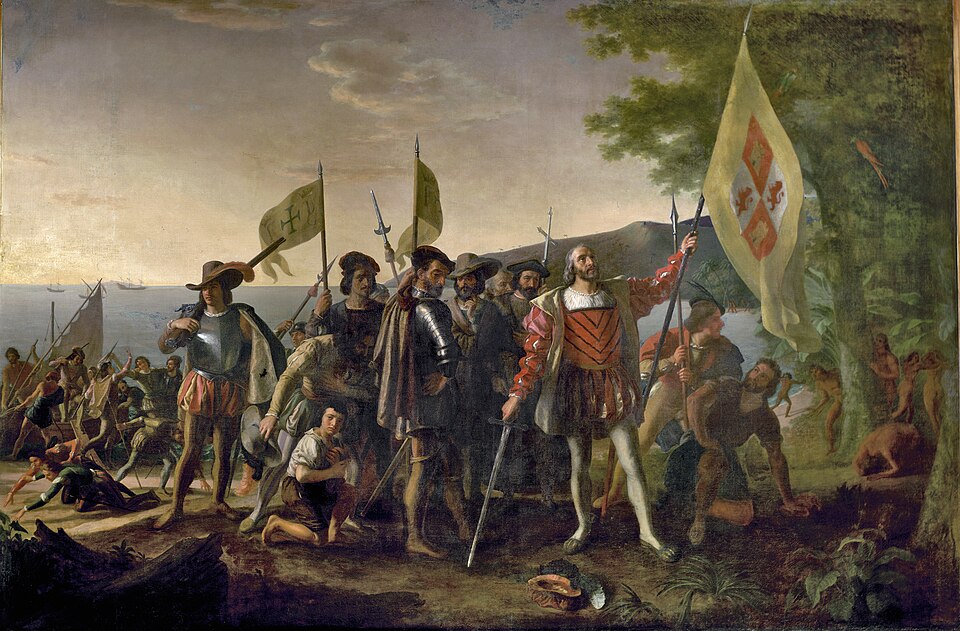
Columbus stands holding a flag and sword; companions gather on the shore, ships lie offshore, and Indigenous people watch from the right.
A nineteenth-century painting of Columbus and his companions landing in the Caribbean in 1492.

John Vanderlyn, Landing of Columbus, 1846–1847, painting in the U.S. Capitol; public-domain reproduction via Wikimedia Commons.

Question 11

Which context of the fifteenth-century exploration depicted here helps explain the explorers’ combination of inquiry and Christian symbolism?
  • AThe Protestant Reformation's emphasis on individual salvation through faith alone and its rejection of Catholic ritual as a means of challenging clerical authority
  • BThe Renaissance spirit of humanist inquiry and curiosity about the wider world, combined with the desire to extend Christian civilization
  • CThe Scientific Revolution's insistence on empirical observation, mathematical measurement, and systematic classification of natural phenomena as the foundation of all knowledge
  • DThe Enlightenment's critique of religious authority, its advocacy for religious toleration, and its promotion of rational governance over tradition and superstition
Show answer and explanation

Answer: B

The scene depicts themes rooted in the Renaissance period, when humanist curiosity about the natural world, classical models of exploration and conquest, and the desire to expand Christendom all converged to motivate European maritime ventures. Renaissance humanists celebrated the recovery of ancient geographical knowledge and encouraged the exploration of unknown lands. The painting captures the intersection of intellectual curiosity, religious mission, and political ambition that characterized the Renaissance-era mindset toward overseas expansion. A, C, and D refer to later movements and do not best explain the fifteenth-century exploration culture being represented.

Question 12

Which of the following best evaluates the usefulness of this painting as evidence about European-indigenous encounters during the Age of Exploration?
  • AThe painting is a reliable primary source because it was created by an artist who drew upon detailed written accounts and documentary evidence from exploration-era voyages
  • BThe painting is useful evidence because it accurately documents the specific appearance, customs, and material culture of the indigenous peoples encountered during the Age of Exploration
  • CThe painting is limited as evidence about actual encounters because it was created centuries later and reflects the artist's retrospective interpretation rather than contemporary observation
  • DThe painting is unreliable because it was specifically commissioned by a European government as propaganda to justify continued colonial expansion and the suppression of independence movements in the early twentieth century
Show answer and explanation

Answer: C

The painting was created in 1846–1847, several centuries after the events it depicts, making it a retrospective interpretation rather than a contemporary record. While it reveals attitudes about exploration common in the mid-nineteenth century, it cannot serve as direct evidence about what actual encounters looked like during the fifteenth and sixteenth centuries. The artist's choices about composition, the heroic posture of the explorer, and the passive depiction of indigenous peoples reflect later cultural assumptions rather than documentary accuracy. A assumes later research guarantees accuracy; B claims ethnographic precision without evidence; D asserts a particular commission and purpose not established by the source.

Question 13

The painting most directly reflects which of the following perspectives on European exploration?
  • AA European-centered view that presents exploration as a heroic act of discovery and territorial possession
  • BA critical perspective that emphasizes the devastation European contact brought to indigenous societies
  • CAn objective, documentary approach that accurately records the customs and appearance of indigenous peoples
  • DA perspective influenced by Enlightenment ideals of universal equality between European and non-European peoples
Show answer and explanation

Answer: A

The painting presents the European explorer as the central, commanding figure, highlighting the act of claiming territory through royal banners and ceremonial poses. The indigenous peoples are depicted as passive observers of this momentous event. This composition reflects a European-centered perspective that frames exploration as an act of heroism and legitimate possession. The painting does not critique colonialism or attempt ethnographic accuracy but instead glorifies the European claim to sovereignty over new lands. B finds a critique of devastation absent from the scene; C treats a later painting as documentary observation; D assigns an egalitarian view unsupported by the composition.

Questions 14 to 16

Useful knowledge is dispersed among many books, workshops, and communities. Bringing it into an organized reference work would allow readers to connect discoveries that otherwise remain apart. Such a work should preserve what earlier generations have learned and make it available for future improvement. Knowledge of the arts, sciences, and practical trades can serve the common good: better-informed people may improve their conduct and their material circumstances. A publication should therefore be judged partly by the service it renders to those who come after its authors.

Original historical composition in the style of an eighteenth-century advocate of collecting and disseminating knowledge, written for this examination.

Question 14

A historian critical of the Enlightenment would most likely challenge the assumptions in the passage by arguing which of the following?
  • AThe collection and organization of knowledge was a uniquely modern idea with no meaningful precedent in earlier European intellectual traditions, such as medieval summas or Renaissance compilations
  • BThe promise of universal progress overlooked exclusions affecting women, poorer people, and colonized populations
  • CThe Encyclopédie faced significant censorship and legal challenges from the French government and royal censors, which curtailed its distribution and limited its immediate impact on European intellectual life
  • DEighteenth-century European readers had limited interest in the scientific and practical knowledge emphasized in the Encyclopédie, preferring theological and devotional literature that addressed their primary spiritual concerns
Show answer and explanation

Answer: B

While the passage’s vision of universal human improvement through the spread of knowledge was ambitious and influential, critics of the Enlightenment have noted that its benefits were unevenly distributed. The Encyclopédie was expensive and written in French for an educated audience, effectively limiting its readership to the literate bourgeoisie and aristocracy. Women were largely excluded from formal intellectual institutions, and Enlightenment thinkers frequently held views about gender, race, and non-European cultures that contradicted their own universalist principles. A critical historian would argue that the Enlightenment's vision of progress through reason, while transformative, remained constrained by the social hierarchies and prejudices of its time.

A incorrectly denies earlier traditions of organizing knowledge. C concerns censorship, an obstacle to publication rather than a criticism of the vision of universal improvement. D is inconsistent with the interest that sustained the publication and does not establish the claimed lack of demand.

Question 15

The passage best reflects which of the following intellectual developments of the eighteenth century?
  • AThe Protestant Reformation's emphasis on individual interpretation of scripture, personal faith, and rejection of Catholic theological and institutional authority
  • BThe Scientific Revolution's development of experimental methods and mathematical models for systematically investigating the workings of the natural world
  • CThe Enlightenment's confidence in human reason, its commitment to the systematic organization of knowledge, and its challenge to traditional sources of intellectual authority
  • DThe Romantic movement's rejection of cold rationalism in favor of emotion, intuition, the power of nature, and the creative freedom of the individual imagination
Show answer and explanation

Answer: C

The original passage directly expresses core Enlightenment values: the belief that human reason can systematically organize all knowledge, the conviction that the spread of knowledge will improve society, and the implicit challenge to traditional authorities — particularly the Church — that claimed a monopoly on truth. Projects such as Diderot and d’Alembert’s Encyclopédie embodied the Enlightenment's ambition to subject all areas of human understanding to rational inquiry and to make knowledge accessible to the educated public, thereby undermining reliance on tradition, superstition, and unquestioned authority.

A focuses on scripture rather than the broad organization of knowledge. B is narrower than the passage’s social aims and attention to practical trades. D elevates emotion over reason, unlike the passage’s confidence in knowledge.

Question 16

The publication described in the passage most directly contributed to which of the following developments in eighteenth-century European society?
  • AThe expansion of a literate public sphere in which educated readers could access and debate ideas about science, politics, and society independent of church and state control
  • BThe immediate overthrow of absolute monarchies across Europe as newly literate urban populations rose up to demand representative democratic governance
  • CThe establishment of state-funded public education systems designed to extend literacy beyond the traditional scholarly and clerical elites in European societies
  • DThe Catholic Church's formal decision to embrace scientific inquiry, revise its condemnation of Galileo, and abandon its traditional opposition to the new intellectual movements
Show answer and explanation

Answer: A

Publications such as the Encyclopédie were landmarks in the development of the European public sphere. By compiling knowledge from across the sciences, arts, and trades into a single accessible reference work, Diderot and his collaborators enabled educated readers to engage with ideas that had previously been restricted to specialists, clerical authorities, or university scholars. The Encyclopédie's wide circulation among the bourgeoisie helped create an informed reading public that could discuss and debate ideas about governance, religion, and society, contributing directly to the growth of the public sphere that characterized Enlightenment culture.

B overstates the publication’s political consequences as immediate revolutionary overthrow. C attributes public education systems directly to a reference publication without evidence. D incorrectly describes a wholesale reversal of the Church’s intellectual positions.

Ready for the full-length tests?

Five full-length AP European History practice tests, every unit of notes and step-by-step solutions. 7 days free.

Start my free 7 days →