← AP Prep

AP Macroeconomics Practice Test

Instructions: This free practice test has 16 multiple-choice questions from our full-length AP Macroeconomics practice tests. You will have 19 minutes, the same pace as the real exam.

It runs in the same test engine as our full-length tests: you can mark questions for review, cross out choices and move back and forth until time expires. When you finish, you will see every answer with a full explanation. No account needed.

Or

Go Back

All 16 questions, with answers

Every question in this AP Macroeconomics practice test is below. The answer and its explanation stay closed until you open them, so you can work each one first.

Question 1

In Year 1, Country P had a nominal GDP of 500 billion dollars and a GDP deflator of 100. In Year 2, Country P had a nominal GDP of 560 billion dollars and a GDP deflator of 112. Which of the following is true about Country P's real GDP?
  • AReal GDP increased from 500 billion dollars to 560 billion dollars.
  • BReal GDP decreased from 500 billion dollars to 480 billion dollars.
  • CReal GDP increased from 500 billion dollars to 627 billion dollars.
  • DReal GDP remained unchanged at 500 billion dollars.
  • EReal GDP decreased from 560 billion dollars to 500 billion dollars.
Show answer and explanation

Answer: D

Real GDP is calculated by dividing nominal GDP by the GDP deflator and multiplying by 100. In Year 1: (500 billion dollars / 100) x 100 = 500 billion dollars. In Year 2: (560 billion dollars / 112) x 100 = 500 billion dollars. Real GDP remained unchanged at 500 billion dollars, indicating that the nominal GDP increase was entirely due to price level increases, not output growth.
Question 2

An increase in worker productivity across all industries would most likely cause which of the following changes in the short run?
  • AA leftward shift of the short-run aggregate supply curve
  • BA rightward shift of the aggregate demand curve
  • CA rightward shift of the short-run aggregate supply curve
  • DA leftward shift of the long-run aggregate supply curve
  • ENo change in aggregate supply because productivity only affects long-run output
Show answer and explanation

Answer: C

An increase in worker productivity lowers per-unit production costs, allowing firms to produce more at every price level. This shifts the short-run aggregate supply curve to the right. Higher productivity also shifts the long-run aggregate supply curve rightward, but the short-run effect on SRAS is the direct result of lower costs.

Question 3

Which of the following correctly describes a key difference between monetary policy under the limited reserves framework and the ample reserves framework?
  • AUnder limited reserves, the central bank targets the price level; under ample reserves, it targets the money supply.
  • BUnder limited reserves, the central bank uses fiscal policy tools; under ample reserves, it uses only monetary tools.
  • CUnder limited reserves, open market operations change the supply of reserves to influence the overnight rate; under ample reserves, the central bank sets administered rates directly.
  • DUnder limited reserves, the central bank has no control over interest rates; under ample reserves, it has complete control.
  • EUnder limited reserves, the money multiplier is zero; under ample reserves, the money multiplier is very large.
Show answer and explanation

Answer: C

In the limited reserves framework, the central bank adjusts the supply of reserves through open market operations to target the federal funds rate. In the ample reserves framework, banks hold abundant reserves, so changes in reserve supply have little effect. Instead, the central bank sets administered rates like interest on reserves to directly control the overnight lending rate.

Question 4

If Country Q's real interest rate decreases relative to other countries, what will most likely happen to Country Q's exchange rate and net exports?
  • ACountry Q's currency will appreciate, and net exports will decrease.
  • BCountry Q's currency will appreciate, and net exports will increase.
  • CCountry Q's currency will depreciate, and net exports will decrease.
  • DCountry Q's currency will remain unchanged, and net exports will increase.
  • ECountry Q's currency will depreciate, and net exports will increase.
Show answer and explanation

Answer: E

Lower relative real interest rates in Country Q cause capital outflows as investors seek higher returns abroad. This decreases demand for Country Q's currency and increases its supply in foreign exchange markets, causing depreciation. A weaker currency makes Country Q's exports cheaper for foreign buyers and imports more expensive for domestic buyers, increasing net exports.

Question 5

During a recession, how does a progressive income tax system act as an automatic stabilizer?
  • ATax rates automatically increase during a recession, generating more revenue to fund unemployment benefits
  • BCongress votes to lower tax rates in response to the recession
  • CThe progressive structure causes tax revenues to increase as incomes fall, increasing government savings
  • DAs incomes fall, people move into lower tax brackets, so tax payments fall proportionally more than income, cushioning the decline in disposable income
  • EThe tax system automatically eliminates the recessionary gap by shifting aggregate demand to the right
Show answer and explanation

Answer: D

A progressive income tax system charges higher tax rates on higher levels of income. During a recession, as workers' incomes decline, they move into lower tax brackets. Their tax payments fall by a larger percentage than their income falls, which means disposable income does not decrease as much as pre-tax income. This cushions the drop in consumption spending and moderates the decline in aggregate demand. Automatic stabilizers work without requiring new legislation, unlike discretionary fiscal policy changes.

Question 6

Which of the following correctly identifies a key difference between the money market model and the loanable funds market model?
  • AThe money market determines the real interest rate, while the loanable funds market determines the nominal interest rate
  • BThe money market determines the nominal interest rate, while the loanable funds market determines the real interest rate
  • CBoth markets determine the nominal interest rate but through different mechanisms
  • DThe money market reflects short-run monetary equilibrium, while the loanable funds market reflects long-run monetary equilibrium
  • EThe money market includes international capital flows, while the loanable funds market does not
Show answer and explanation

Answer: B

The money market model shows the supply and demand for money balances and determines the nominal (or short-term) interest rate. The loanable funds market model shows the supply of and demand for savings and investment and determines the real interest rate. This distinction is important because monetary policy directly affects the nominal interest rate through the money market, while fiscal policy and saving behavior affect the real interest rate through the loanable funds market.

Question 7

In a banking system with limited reserves, banks lend all excess reserves and the public redeposits all loan proceeds. After a decrease in the required reserve ratio, what happens immediately to excess reserves and lending capacity, and subsequently to the money supply?
  • AExcess reserves decrease, lending capacity decreases, money supply decreases
  • BExcess reserves increase, lending capacity decreases, money supply decreases
  • CExcess reserves decrease, lending capacity increases, money supply increases
  • DExcess reserves increase, lending capacity increases, money supply increases
  • EExcess reserves increase, lending capacity increases, money supply decreases
Show answer and explanation

Answer: D

Before deposits or total reserves change, a lower required reserve ratio reduces required reserves, increasing excess reserves and lending capacity. Under the stated lending and redeposit assumptions, subsequent lending creates additional deposits and expands the money supply. Thus D is correct. A and C incorrectly predict a fall in immediate excess reserves; B incorrectly predicts lower lending capacity; E incorrectly predicts a contraction of the money supply. The initial rise in excess reserves occurs before the additional lending and deposit expansion.

Question 8

If Country Z's currency depreciates, what will most likely happen to the prices of its imports and its export competitiveness?
  • AImport prices will decrease, and exports will become less competitive
  • BImport prices will increase, and exports will become more competitive
  • CImport prices will increase, and exports will become less competitive
  • DImport prices will decrease, and exports will become more competitive
  • EBoth import prices and export competitiveness will be unaffected
Show answer and explanation

Answer: B

When Country Z's currency depreciates, it takes more of Country Z's currency to buy foreign goods, making imports more expensive for domestic consumers. At the same time, foreign buyers need less of their own currency to buy Country Z's goods, making Country Z's exports cheaper and more competitive in international markets. This dual effect tends to improve the trade balance by discouraging imports and encouraging exports.

Question 9

Which of the following best describes the difference between a change in quantity demanded and a change in demand?
  • AA change in quantity demanded is caused by a change in the price of the good, while a change in demand is caused by a change in a nonprice determinant.
  • BA change in quantity demanded shifts the demand curve, while a change in demand causes a movement along the curve.
  • CA change in quantity demanded occurs only in the long run, while a change in demand occurs only in the short run.
  • DA change in quantity demanded applies to normal goods, while a change in demand applies to inferior goods.
  • EA change in quantity demanded and a change in demand are two names for the same concept.
Show answer and explanation

Answer: A

A change in quantity demanded refers to movement along a fixed demand curve in response to a change in the good's own price. A change in demand refers to a shift of the entire demand curve, caused by changes in nonprice determinants such as income, tastes, expectations, the number of buyers, or the prices of related goods. The distinction between movement along and shift of the curve is fundamental to demand analysis.

Question 10

Which of the following best describes the difference between a recessionary gap and an inflationary gap?
  • AA recessionary gap occurs when the price level is rising, while an inflationary gap occurs when the price level is falling.
  • BA recessionary gap occurs when unemployment is below the natural rate, while an inflationary gap occurs when unemployment is above the natural rate.
  • CA recessionary gap results from an increase in aggregate supply, while an inflationary gap results from a decrease in aggregate supply.
  • DBoth gaps refer to the same economic situation but at different points in the business cycle.
  • EA recessionary gap occurs when actual output is below potential output, while an inflationary gap occurs when actual output is above potential output.
Show answer and explanation

Answer: E

An output gap measures the difference between actual GDP and potential GDP. A recessionary gap exists when actual output falls short of potential output, meaning the economy is underperforming and unemployment exceeds the natural rate. An inflationary gap exists when actual output exceeds potential output, placing upward pressure on wages and prices as the economy operates beyond its sustainable capacity.

Question 11

If the government finances an increase in spending by borrowing, what is the most likely chain of effects on the loanable funds market and the exchange rate?
  • AThe real interest rate decreases, and the domestic currency depreciates.
  • BThe real interest rate increases, and the domestic currency depreciates.
  • CThe real interest rate decreases, and the domestic currency appreciates.
  • DThe real interest rate increases, and the domestic currency appreciates.
  • EThe real interest rate is unchanged, and the exchange rate is unchanged.
Show answer and explanation

Answer: D

Government borrowing increases the demand for loanable funds, raising the real interest rate. Higher domestic real interest rates attract foreign financial capital, increasing demand for the domestic currency in the foreign exchange market. The increased demand for the currency causes it to appreciate. This chain illustrates the link between fiscal policy, financial markets, and the exchange rate.

Question 12

If interest rates in the economy increase, what is the most likely effect on the market price of previously issued bonds?
  • AThe price of previously issued bonds will decrease.
  • BThe price of previously issued bonds will increase.
  • CThe price of previously issued bonds will remain unchanged.
  • DThe price of previously issued bonds will initially increase and then decrease.
  • EThe effect depends on whether the bonds were issued by the government or corporations.
Show answer and explanation

Answer: A

Bond prices and interest rates are inversely related. When market interest rates rise, newly issued bonds offer higher yields than existing bonds. To compete, the market price of previously issued bonds must fall so that their effective yield rises to match the new market rate. This inverse relationship holds regardless of who issued the bond.

Question 13

In an economy, 150 million people are employed, 10 million are unemployed and actively seeking work, and 5 million are discouraged workers who have stopped looking for jobs. What is the official unemployment rate?
  • A6.25%
  • B6.67%
  • C9.09%
  • D9.38%
  • E10.00%
Show answer and explanation

Answer: A

The official unemployment rate is calculated as (number of unemployed / labor force) x 100. The labor force includes only those who are employed or unemployed and actively seeking work; discouraged workers are not counted. Labor force = 150 million + 10 million = 160 million. Unemployment rate = (10 / 160) x 100 = 6.25%. Discouraged workers are excluded from both the numerator and the denominator of the official unemployment rate calculation.

Question 14

All prices in Country K are quoted in terms of the krone. This is an example of which function of money?
  • AUnit of account
  • BMedium of exchange
  • CStore of value
  • DStandard of deferred payment
  • EMeasure of liquidity
Show answer and explanation

Answer: A

Money serves as a unit of account when it is used as a common measure to express the prices of goods and services. When all prices in an economy are quoted in terms of a specific currency, that currency is functioning as the unit of account. This is distinct from the medium-of-exchange function (using money to facilitate transactions) and the store-of-value function (holding money to preserve purchasing power over time).

Question 15

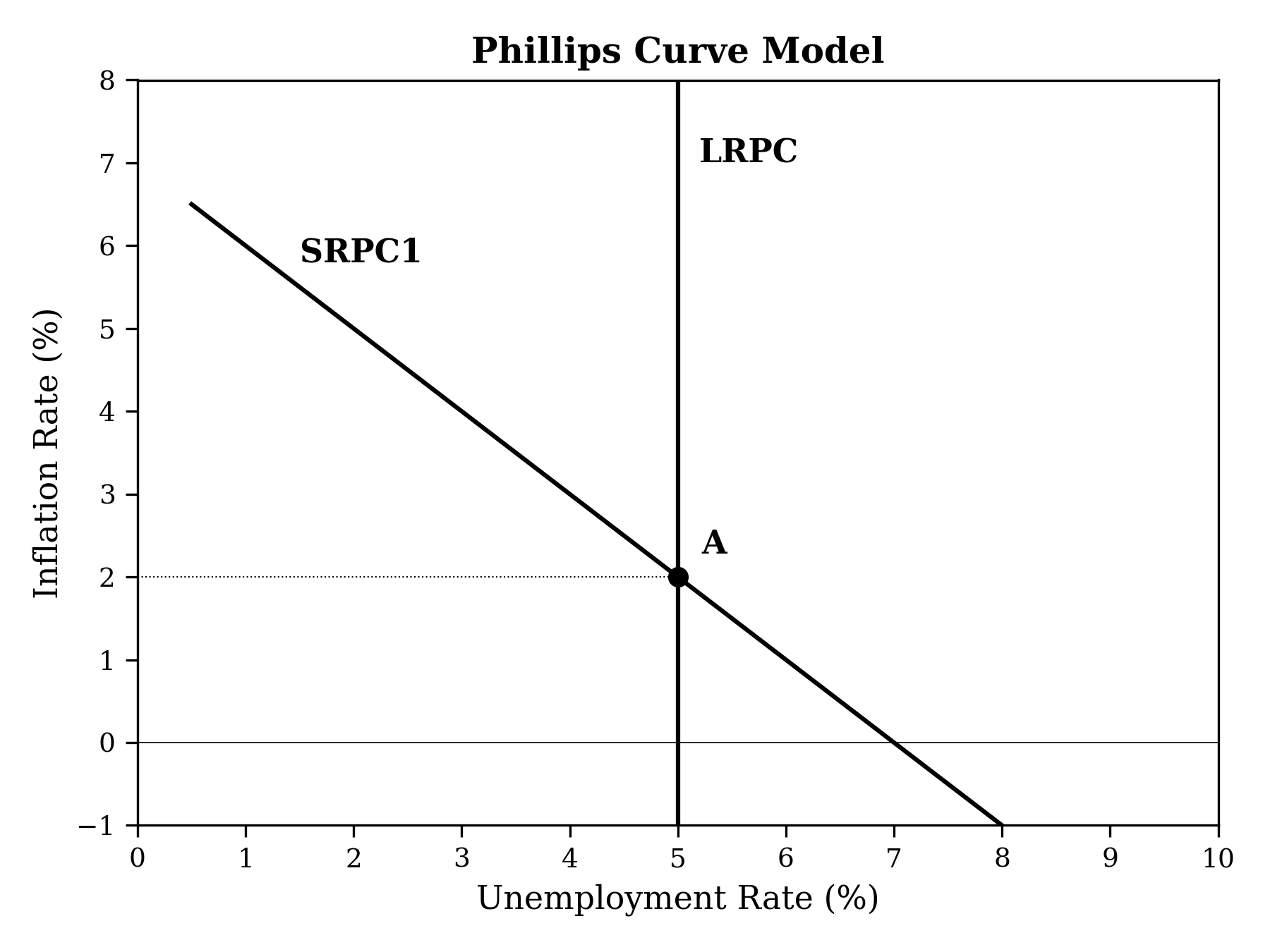
Figure specification: A Phillips Curve diagram. Axes: x-axis labeled 'Unemployment Rate (%)' (range 0 to 10), y-axis labeled 'Inflation Rate (%)' (range -1 to 8). Two curves: (1) LRPC: vertical line at unemployment rate = 5%, labeled 'LRPC'; (2) SRPC1: downward-sloping curve passing through point A at (5, 2), labeled 'SRPC1'. Point A is clearly labeled at the intersection of LRPC and SRPC1 at coordinates (5%, 2%). Title: 'Phillips Curve Model'.
The diagram above shows the short-run Phillips curve (SRPC1) and the long-run Phillips curve (LRPC) for an economy initially at point A. If the economy experiences a positive demand shock, which of the following describes the short-run effect and the subsequent long-run adjustment?
  • AThe economy moves down along SRPC1 to lower unemployment and lower inflation, then returns to point A in the long run
  • BThe SRPC shifts downward, and the economy moves to a point with lower inflation and the same unemployment rate
  • CThe economy moves up along SRPC1 to lower unemployment and higher inflation, and remains at that new point permanently
  • DThe LRPC shifts to the left, and the economy reaches a new long-run equilibrium at a higher natural rate of unemployment
  • EThe economy moves up along SRPC1 to lower unemployment and higher inflation, then the SRPC shifts upward as expectations adjust, returning unemployment to the natural rate at a higher inflation rate
Show answer and explanation

Answer: E

A positive demand shock increases aggregate demand, moving the economy up and to the left along SRPC1 to a point with lower unemployment and higher inflation. In the long run, workers and firms adjust their inflation expectations upward to match the higher actual inflation. This upward adjustment in expectations shifts the entire SRPC upward. The economy returns to the natural rate of unemployment (on the LRPC) but at a higher inflation rate consistent with the new expectations.

Question 16

Suppose the central bank unexpectedly decreases the money supply. Which of the following correctly traces the short-run effects of this contractionary monetary policy through the economy?
  • ANominal interest rates fall, investment increases, aggregate demand shifts right, real output rises, and unemployment decreases
  • BNominal interest rates rise, investment decreases, aggregate demand shifts left, real output falls, and unemployment increases
  • CNominal interest rates rise, investment increases, aggregate demand shifts right, real output rises, and the price level falls
  • DNominal interest rates are unaffected, but the price level immediately adjusts downward while real output remains unchanged
  • ENominal interest rates fall, investment decreases, aggregate demand shifts left, and the economy enters a recessionary gap
Show answer and explanation

Answer: B

When the central bank unexpectedly decreases the money supply, the supply of money in the money market shifts to the left, raising the equilibrium nominal interest rate. Higher interest rates increase the cost of borrowing for firms and consumers, reducing interest-sensitive spending such as business investment and consumer purchases of durable goods. The decrease in spending shifts aggregate demand to the left. In the short run, because wages and prices are sticky, the leftward shift in AD reduces real output below potential and increases the unemployment rate. The price level also falls, but by less than it would if wages and prices were fully flexible.

Ready for the full-length tests?

Five full-length AP Macroeconomics practice tests, every unit of notes and step-by-step solutions. 7 days free.

Start my free 7 days →