Instructions: This free practice test has 16 multiple-choice questions from our full-length AP Physics 1 practice tests. You will have 33 minutes, the same pace as the real exam.
It runs in the same test engine as our full-length tests: you can mark questions for review, cross out choices, open the calculator and move back and forth until time expires. When you finish, you will see every answer with a full explanation. No account needed.
Every question in this AP Physics 1 practice test is below. The answer and its explanation stay closed until you open them, so you can work each one first.
Question 1
A stone is thrown vertically upward with an initial speed of 20m/s. Air resistance is negligible. What is the maximum height above its release point? Use g=10m/s2.
A2m
B10m
C20m
D40m
Show answer and explanation
Answer: C
At the highest point, v=0. Thus v2=v02−2gh gives h=202/(2×10)=20m, choice C. A uses the ascent time of 2s as a height. B is half the required height. D omits the factor of 2 in the denominator and gives 40m.
Question 2
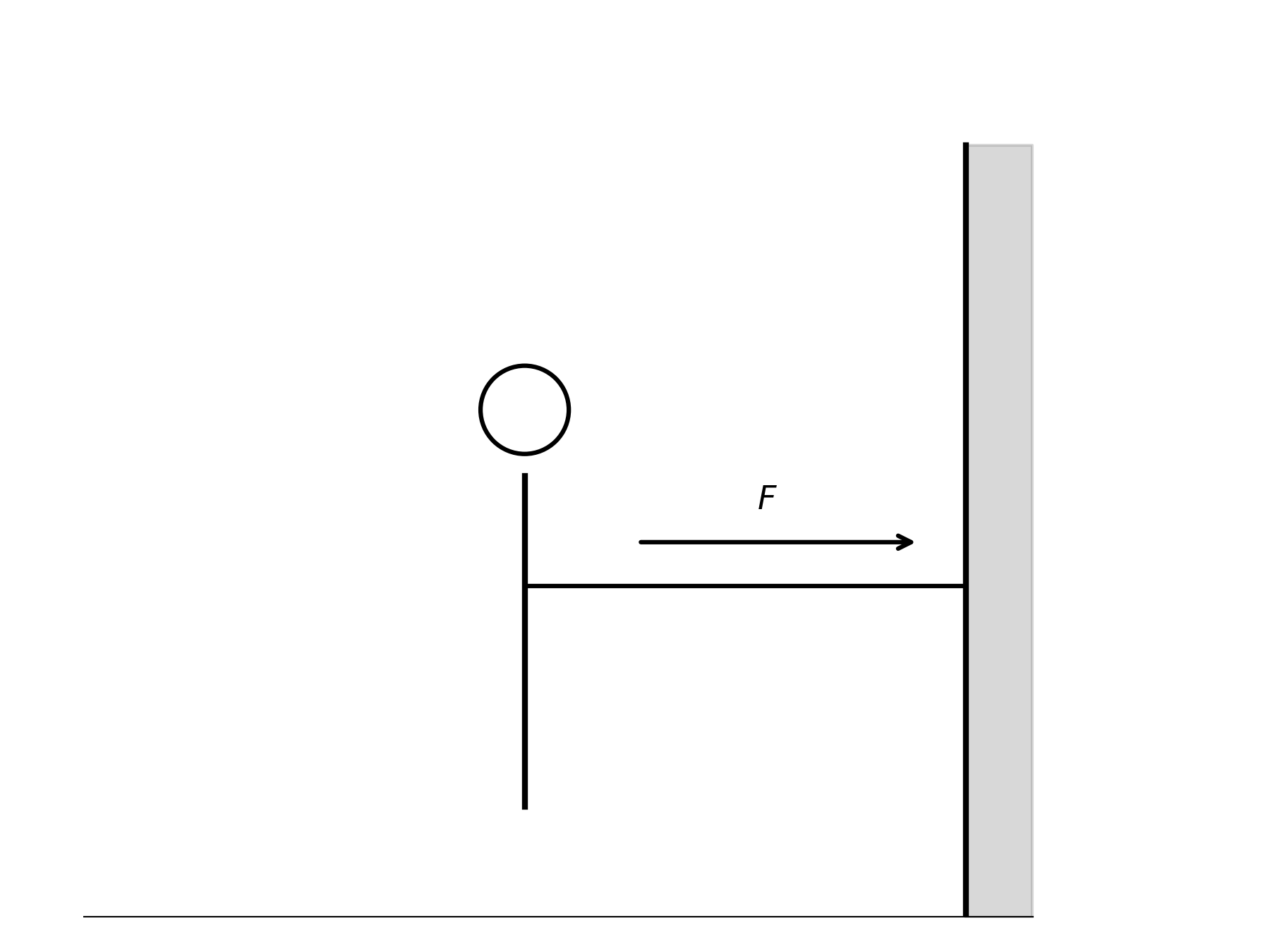
A person pushes horizontally against a wall with a force of magnitude F, as shown in the figure. The person remains stationary. Which of the following statements correctly describes the force the wall exerts on the person?
AThe wall exerts a force of magnitude F on the person, directed away from the wall.
BThe wall exerts a force of magnitude F on the person, directed toward the wall.
CThe wall exerts a force greater than F on the person, directed away from the wall.
DThe wall does not exert a force on the person.
Show answer and explanation
Answer: A
Newton's third law makes the wall's force on the person equal in magnitude and opposite in direction to the person's force on the wall. Therefore it has magnitude F and points away from the wall, choice A. B gives the wrong direction. C violates equality of the interaction forces. D omits the wall's reaction force. The person's equilibrium also involves forces from the floor; it does not alter the third-law pair.
Question 3
A ball is dropped from a height h above the floor, bounces off the floor, and rises to a height less than h. Air resistance is negligible, and the floor is stationary. Which of the following statements correctly describes the energy of the ball-Earth system during the entire process?
AThe total mechanical energy of the system is conserved throughout the process.
BSome mechanical energy becomes thermal energy during the collision.
CThe total mechanical energy increases during the collision.
DThe kinetic energy of the ball is the same just before and just after the bounce.
Show answer and explanation
Answer: B
With negligible air resistance, the lower rebound height means the ball leaves the collision with less kinetic energy than it had just before impact. Some mechanical energy becomes internal energy in the ball and floor, so B is correct. A conflicts with the reduced maximum gravitational potential energy. C predicts an increase in mechanical energy, which would produce a higher rebound rather than the stated lower one. D would imply the same rebound height as the release height. The total energy, including internal energy and any sound, remains conserved.
Question 4
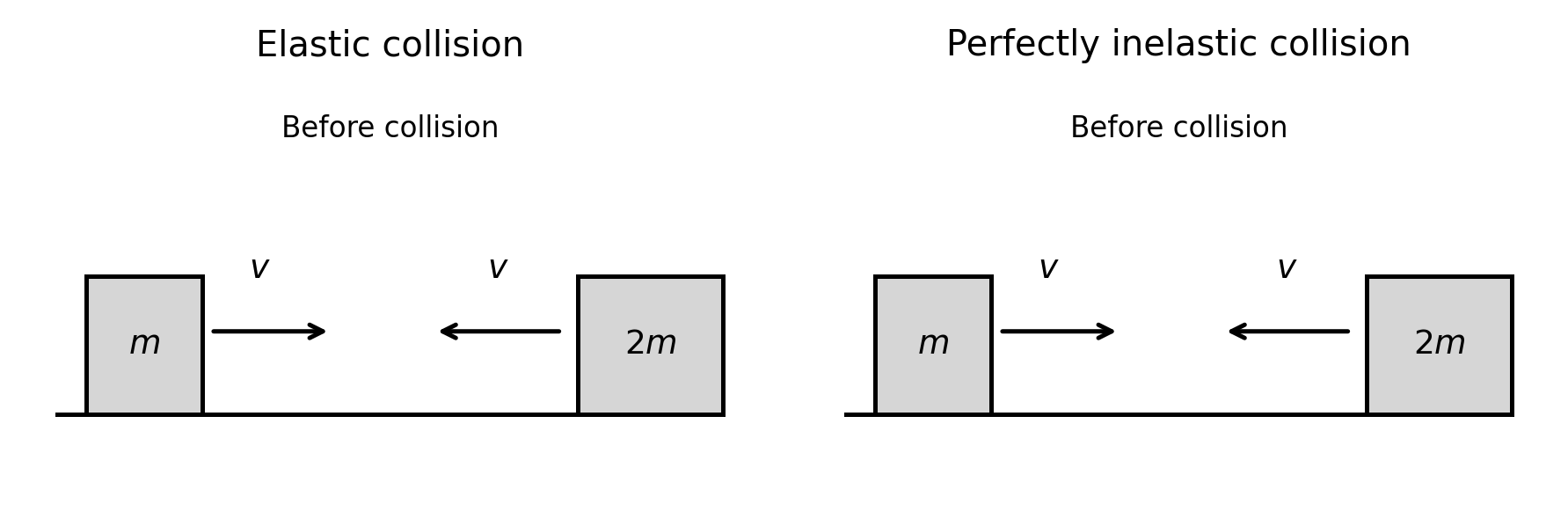
Two one-dimensional collisions on a frictionless horizontal track are shown in the figure. In both cases, a block of mass m and a block of mass 2m approach each other, each with speed v. In one case the collision is perfectly elastic and in the other it is perfectly inelastic. How does the total kinetic energy after the elastic collision compare to the total kinetic energy after the inelastic collision?
AThe kinetic energies after both collisions are equal.
BThe kinetic energy after the elastic collision is less than after the inelastic collision.
CThe kinetic energy after the elastic collision is half that after the inelastic collision.
DThe kinetic energy after the elastic collision is greater than after the inelastic collision.
Show answer and explanation
Answer: D
Both trials start with Ki=21mv2+21(2m)v2=23mv2. The elastic collision preserves this energy. In the perfectly inelastic collision, momentum conservation gives mv−2mv=3mu, or u=−v/3, so Kf=21(3m)(v/3)2=mv2/6. The elastic final energy is nine times the inelastic value, making D correct. A incorrectly conserves kinetic energy in the sticking collision. B reverses the inequality, and C gives an energy ratio of 1/2 instead of 9.
Question 5
An object moves eastward, gradually slows down, and comes to rest. Which of the following correctly explains the direction of the object's acceleration during this time?
AWestward, because the eastward velocity is decreasing.
BWestward, because the object is moving westward.
CEastward, because acceleration follows the velocity.
DZero, because the object eventually comes to rest.
Show answer and explanation
Answer: A
While the object moves east and slows, its eastward velocity decreases, so its acceleration points west. A correctly uses the change in velocity. B falsely describes the motion as westward. C confuses velocity with its rate of change. D uses the final rest state to infer zero acceleration throughout the slowing interval.
Question 6
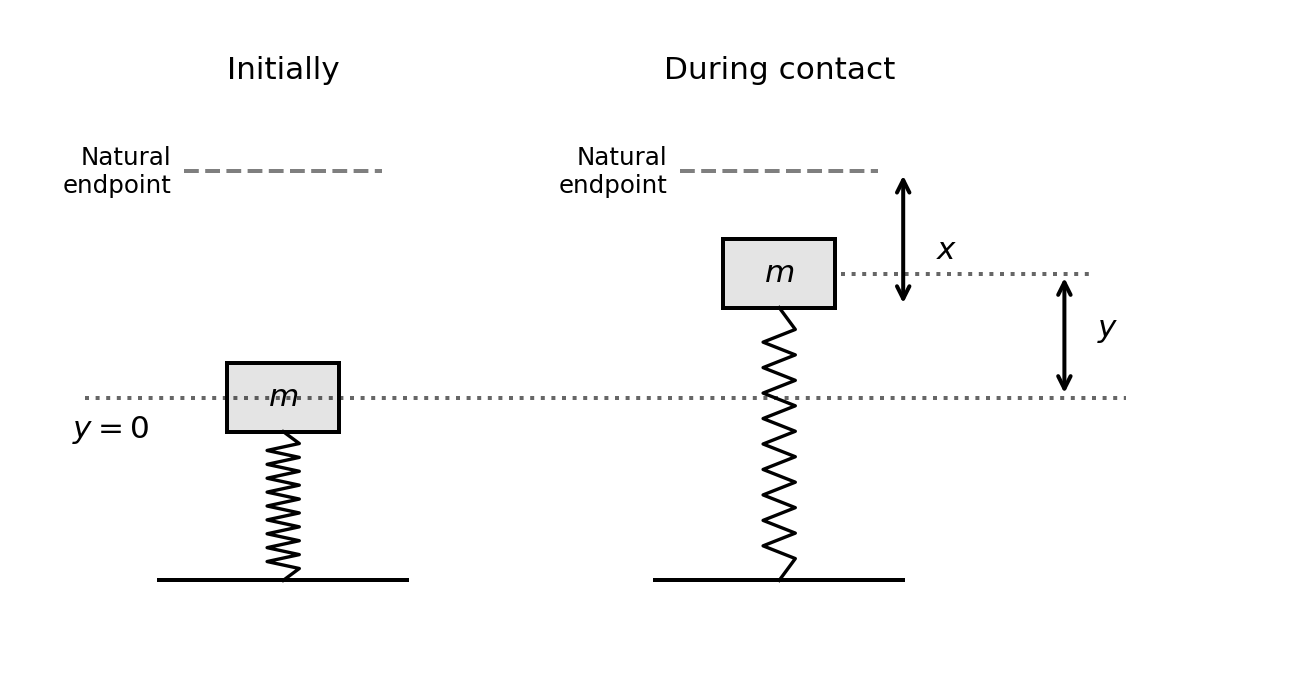
A block rests on an ideal vertical spring that is initially compressed. When released from rest, the spring launches the unattached block upward. Define gravitational potential energy to be zero at the initial height of the block. While the block remains in contact with the spring, let y be its rise and x the remaining spring compression. Which condition identifies equal gravitational and elastic potential energies?
Akx2=2mgy
Bkx=mg
Cx=0
Dkx2=mgy
Show answer and explanation
Answer: A
With the specified zero level, Ug=mgy and Us=21kx2. Equality requires kx2=2mgy, choice A. B is a force-balance condition, not a general energy-equality condition. C sets spring energy to zero without requiring gravitational energy to be zero. D misses the factor of 1/2 in spring energy. Force balance and energy equality can coincide for particular initial conditions, but they are not equivalent conditions.
Question 7
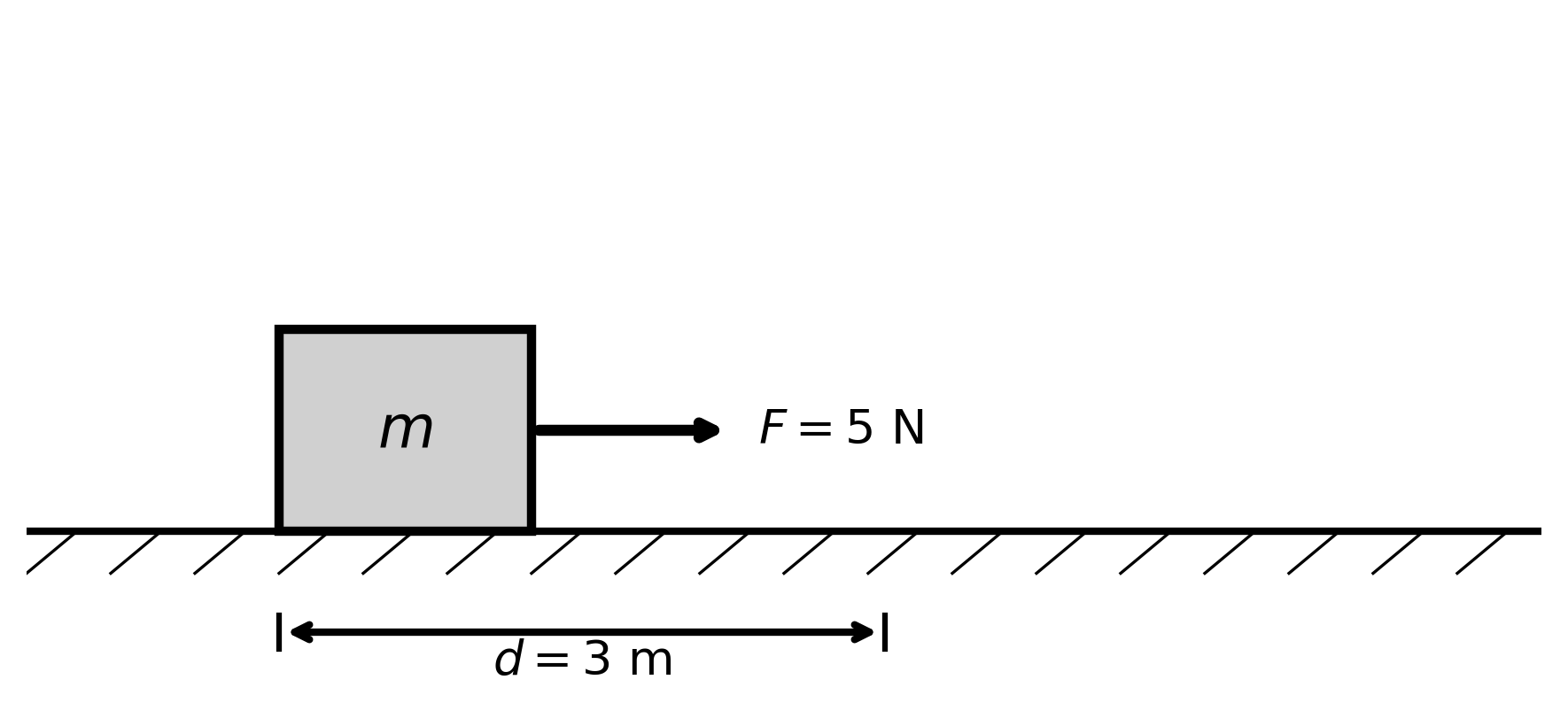
A constant force of 5N pushes a block through 3m along a frictionless horizontal surface in the direction of the force. What work does the force do?
A8J
B15J
C30J
D45J
Show answer and explanation
Answer: B
The force is constant and parallel to displacement, so W=Fd=(5)(3)=15J, choice B. A adds a force number to a distance number. C doubles the work without justification. D uses Fd2, which has the wrong units.
Question 8
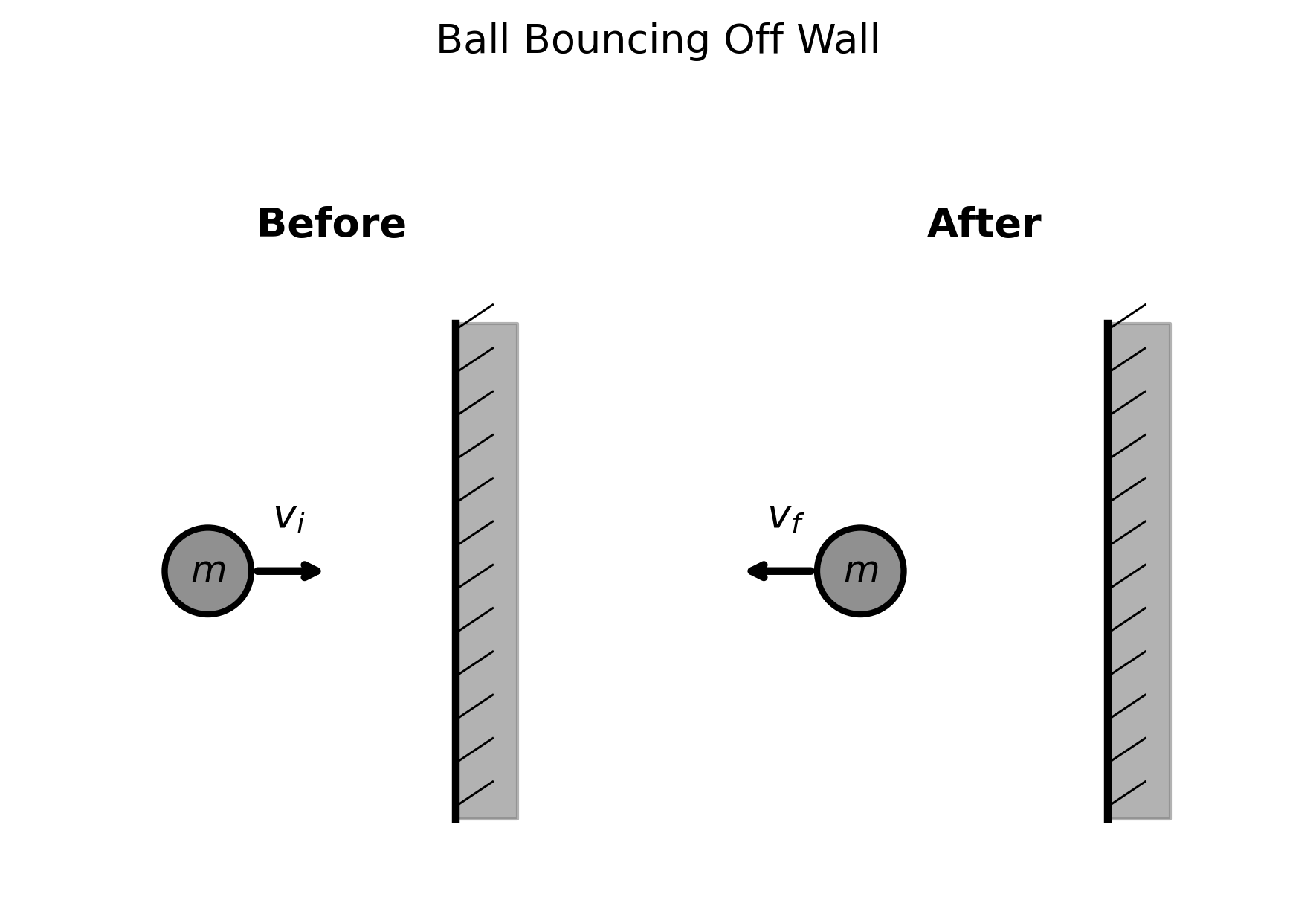
A ball of mass m bounces off a wall, reversing its direction while maintaining the same speed v, as shown in the figure. Which of the following expressions gives the magnitude of the impulse delivered to the ball by the wall? The impulse from all other forces during the collision is negligible.
A0
Bmv
C2mv
Dmv2
Show answer and explanation
Answer: C
Take the incoming direction as positive. The momentum changes from +mv to −mv, so Δp=−2mv. The wall supplies this impulse and its magnitude is 2mv, choice C. A ignores the reversal. B counts only one of the two opposite momenta. D has energy dimensions rather than momentum dimensions.
Question 9
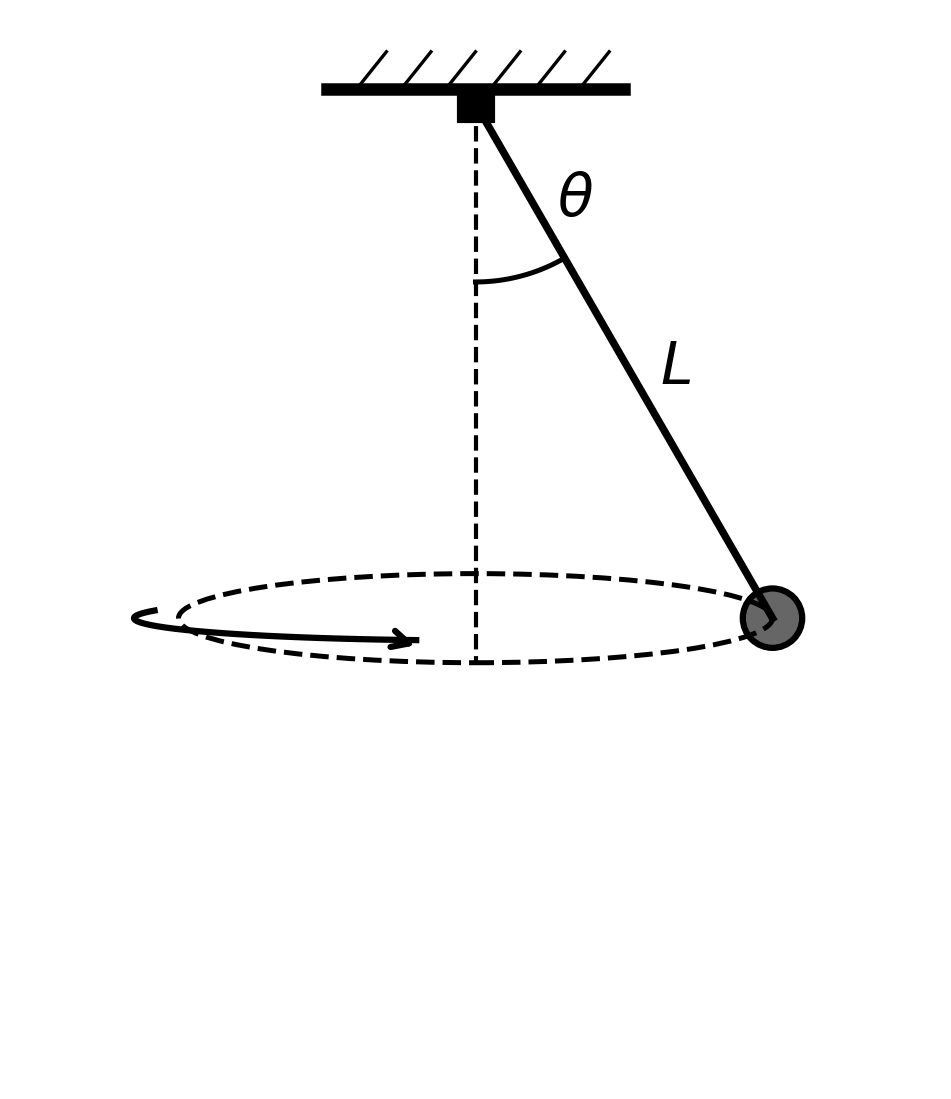
A ball of mass m on a light, inextensible string of length L moves at constant speed in a horizontal circle. The string makes an angle θ with the vertical, where 0<θ<90∘. Which expression gives the ball’s speed?
AgLsin2θ
BgLcosθsinθ
CgLsinθtanθ
DgLtanθcosθ
Show answer and explanation
Answer: C
The circle has radius r=Lsinθ. Vertical force balance gives Tcosθ=mg, and the horizontal equation is Tsinθ=mv2/r. Dividing gives tanθ=v2/(rg), so v=gLsinθtanθ, choice C. A replaces tanθ with sinθ, effectively treating T as mg. B incorrectly multiplies by cosθ instead of dividing by it in the force relation. D uses Lcosθ for the circle’s radius; that is the vertical distance below the support.
Question 10
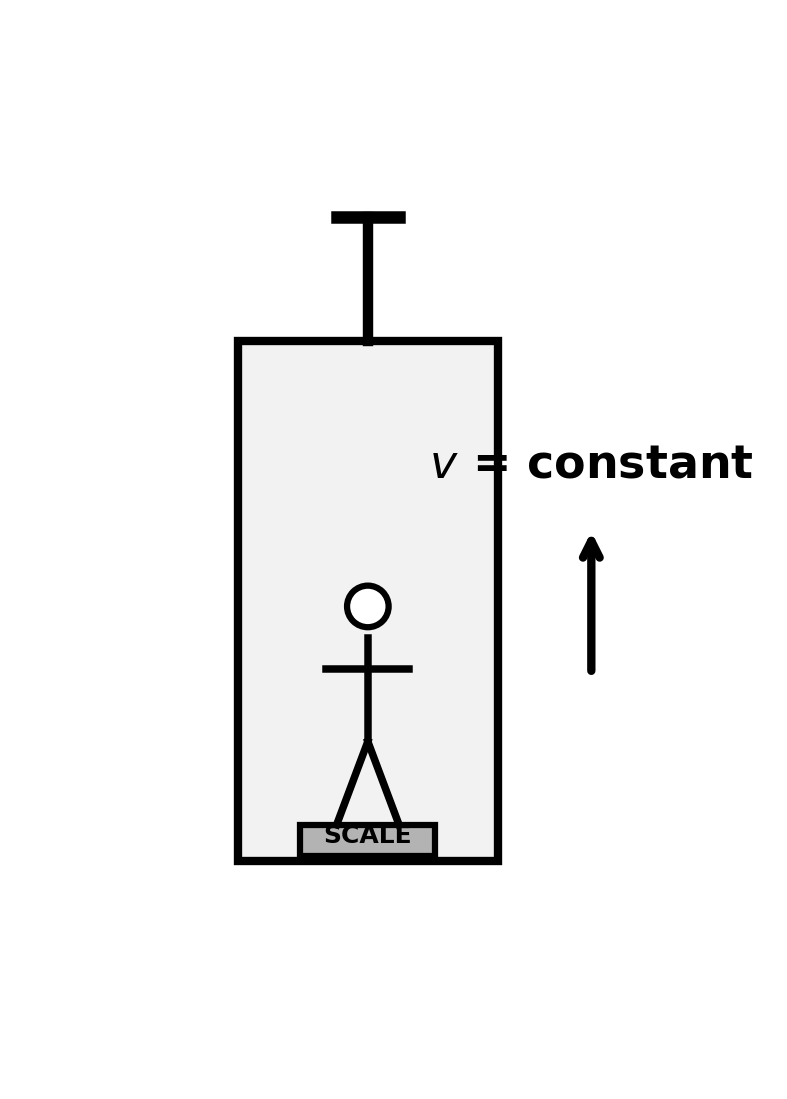
A person of mass m stands on a scale inside an elevator that moves upward at constant velocity, as shown in the figure. The scale reads a value equal to the person's weight mg. Which of the following correctly explains why the scale reading equals mg?
AUpward motion adds to the gravitational force.
BZero acceleration requires equal upward and downward forces.
CUpward motion reduces the gravitational force.
DThe forces balance only when the elevator is at rest.
Show answer and explanation
Answer: B
Constant velocity implies a=0. Newton’s second law gives N−mg=0, so the scale reads N=mg: B is correct. A incorrectly treats velocity as a force. C incorrectly makes gravity depend on the direction of motion. D is false because forces can balance during any constant-velocity motion, as well as at rest.
Question 11
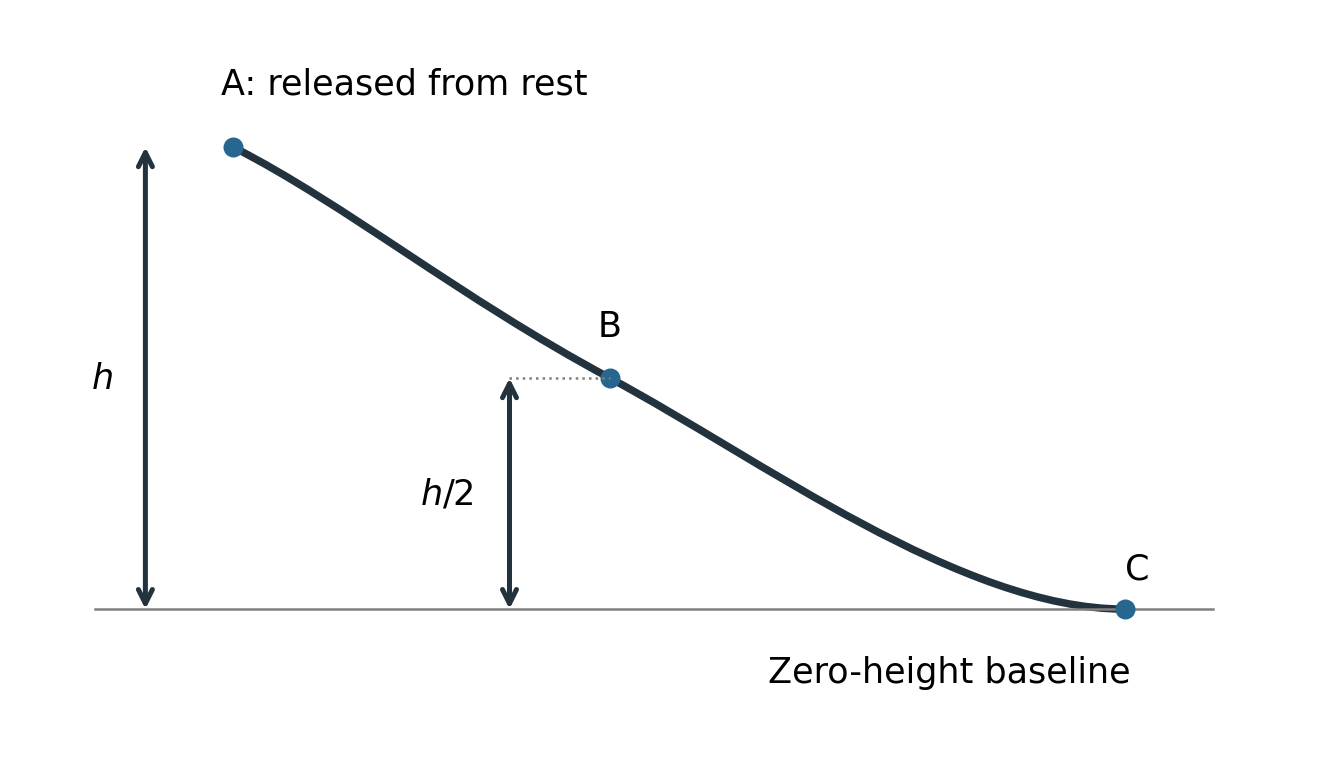
A small roller coaster car, treated as a particle, is released from rest at point A on a frictionless track at height h above point C. Point B is at height h/2 above C. Neglect air resistance. Which comparison of the speeds at B and C is correct?
AThe speed at C equals the speed at B.
BThe speed at C is less than the speed at B.
CThe speed at C is at least twice the speed at B.
DThe speed at C is between one and two times that at B.
Show answer and explanation
Answer: D
Conservation of energy gives vB2=2g(h−h/2)=gh and vC2=2gh. Therefore vC/vB=2, which lies between one and two: D is correct. A overlooks the additional loss of gravitational potential energy from B to C. B would require kinetic energy to decrease during that descent. C confuses the factor of two in kinetic energy with a factor of two or more in speed.
Question 12
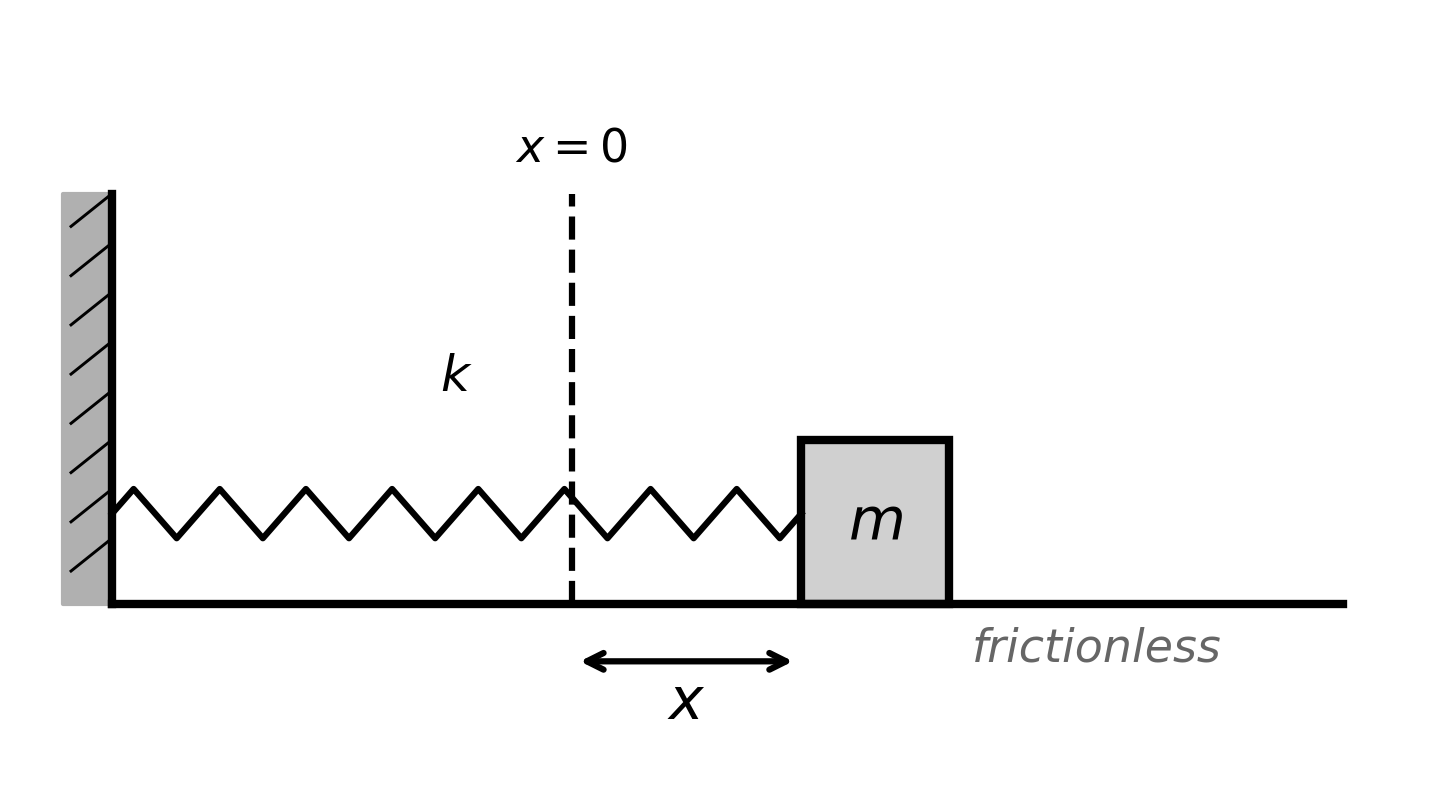
A block attached to a spring of spring constant k oscillates on a frictionless horizontal surface. At a displacement x from the equilibrium position, as shown in the figure, which of the following expressions gives the elastic potential energy stored in the spring?
Akx
B21kx2
Ckx2
D21kx
Show answer and explanation
Answer: B
For an ideal spring, the force magnitude increases linearly from zero to k∣x∣ as it is deformed from its natural length. The work stored is the triangular area under the force–deformation graph, U=21∣x∣(k∣x∣)=21kx2, choice B. A is the spring force magnitude (for positive x), not energy. C omits the factor of one-half for the increasing force. D also has units of force and is missing a factor of displacement.
Question 13
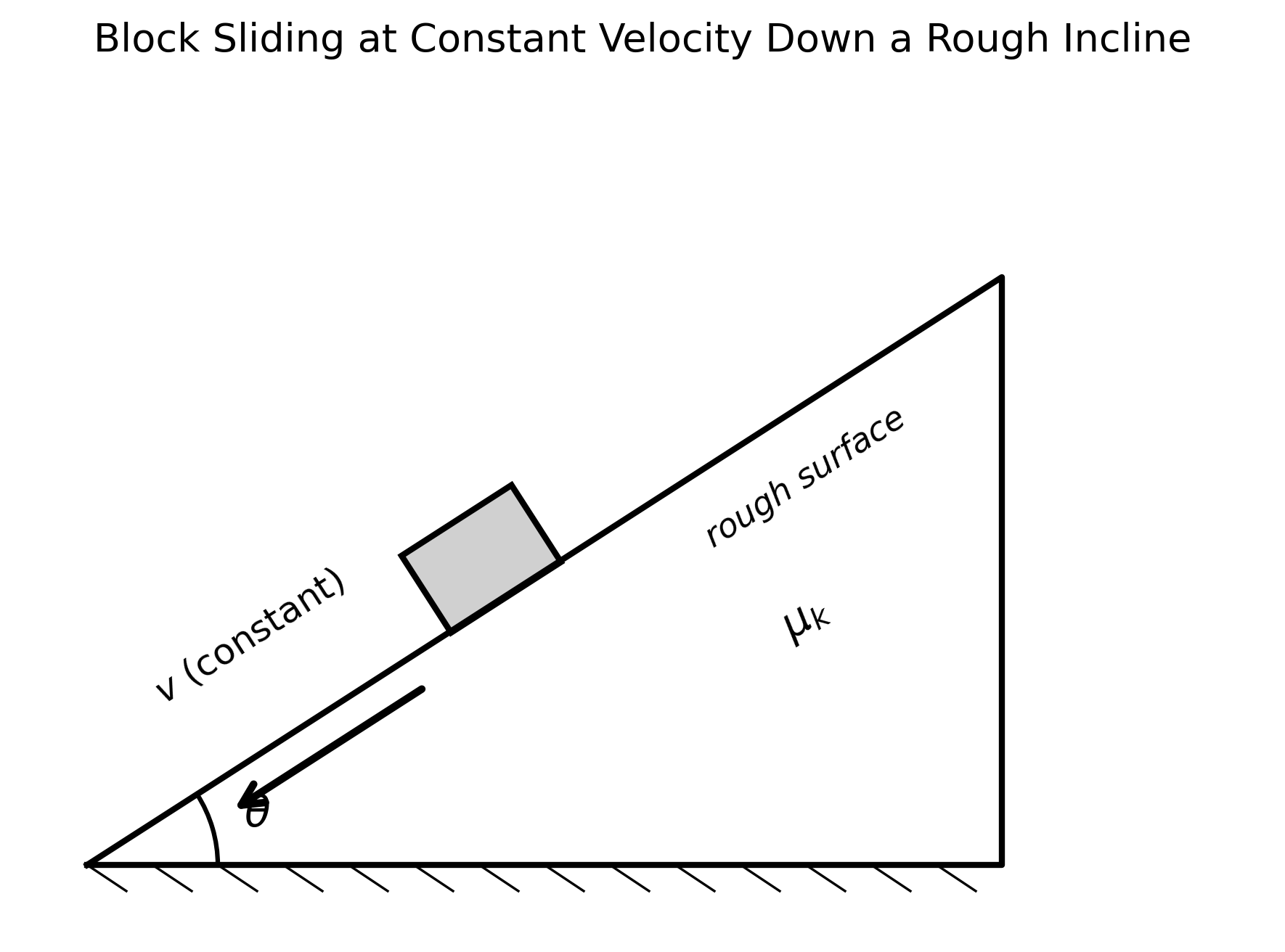
A block slides at constant velocity down a ramp inclined at angle θ above the horizontal, as shown in the figure. The coefficient of kinetic friction between the block and the ramp is μk. Which of the following gives the value of μk?
Asinθ
Bcosθ
Ctanθ
Dtanθ1
Show answer and explanation
Answer: C
C is correct. Constant velocity requires mgsinθ=μkmgcosθ, so μk=tanθ. A omits the cosine factor in the normal force. B is a component factor rather than the required ratio. D reverses the ratio of downhill gravity to normal force.
Question 14
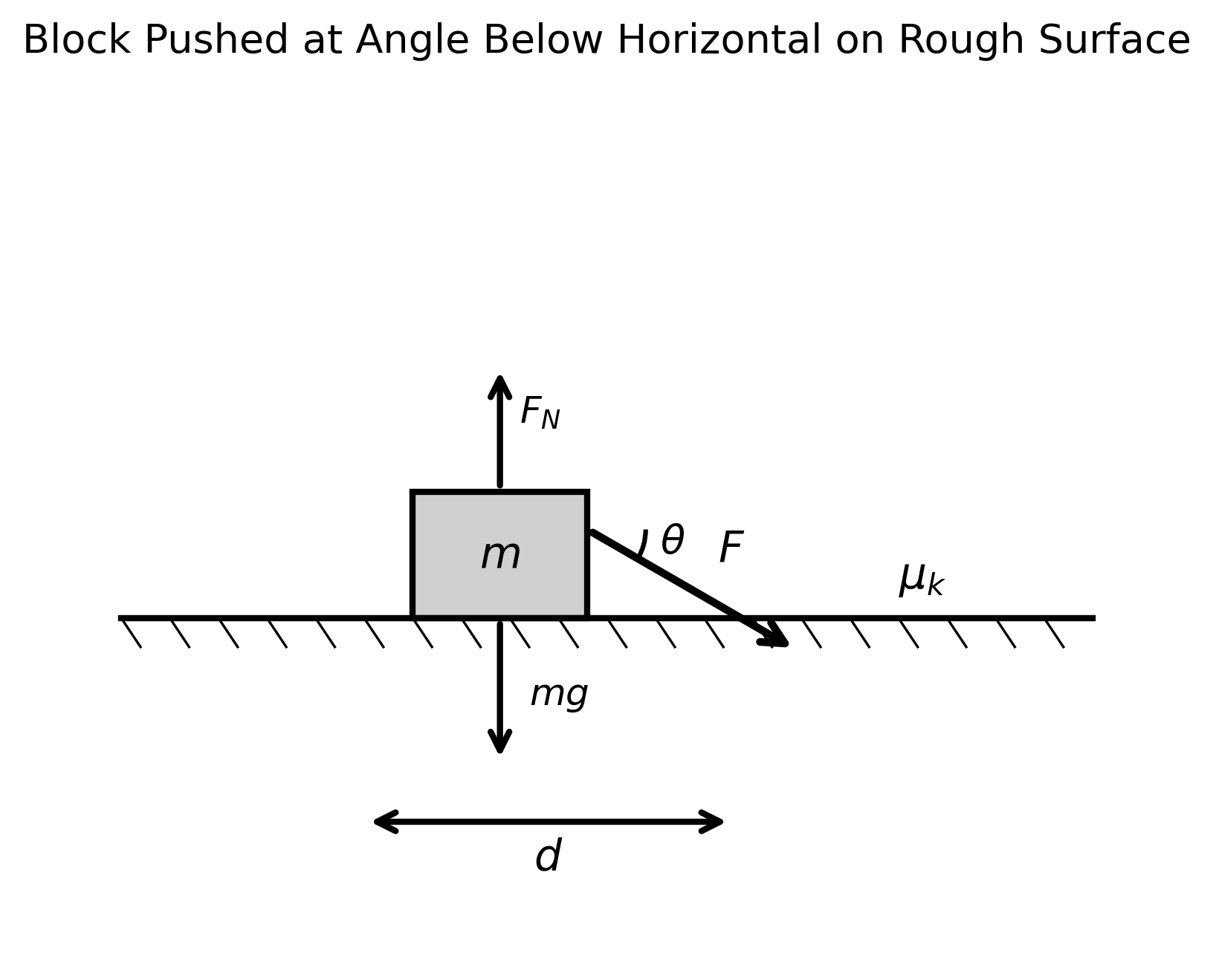
A constant force of magnitude F is applied at an angle θ below the horizontal to push a block of mass m a distance d across a rough horizontal surface with coefficient of kinetic friction μk, as shown in the figure. Which of the following gives the net work done on the block?
AFdcosθ−μk(mg+Fsinθ)d
BFdcosθ−μk(mg)d
CFd−μk(mg+Fsinθ)d
DFdcosθ+μk(mg+Fsinθ)d
Show answer and explanation
Answer: A
A is correct. N=mg+Fsinθ and Wnet=Fdcosθ−μkNd. B omits the downward force component in the normal force. C uses the full force rather than its component along displacement. D makes friction do positive work despite opposing the sliding motion.
Question 15
An astronaut floating at rest in space throws a tool in one direction. External forces are negligible during the throw. Which of the following correctly explains why the astronaut moves in the opposite direction?
ATheir momenta remain equal and opposite.
BThe tool pushes on the surrounding vacuum.
CTheir kinetic energies remain equal and opposite.
DGravity pulls the astronaut away from the tool.
Show answer and explanation
Answer: A
A is correct. With negligible external impulse, the initially zero total momentum remains zero: pastronaut=−ptool. B incorrectly treats a vacuum as a material to push on. C assigns opposite signs to kinetic energies, which are nonnegative and increase using internal chemical energy. D reverses the direction of gravitational attraction; gravity would pull the astronaut toward the tool.
Question 16
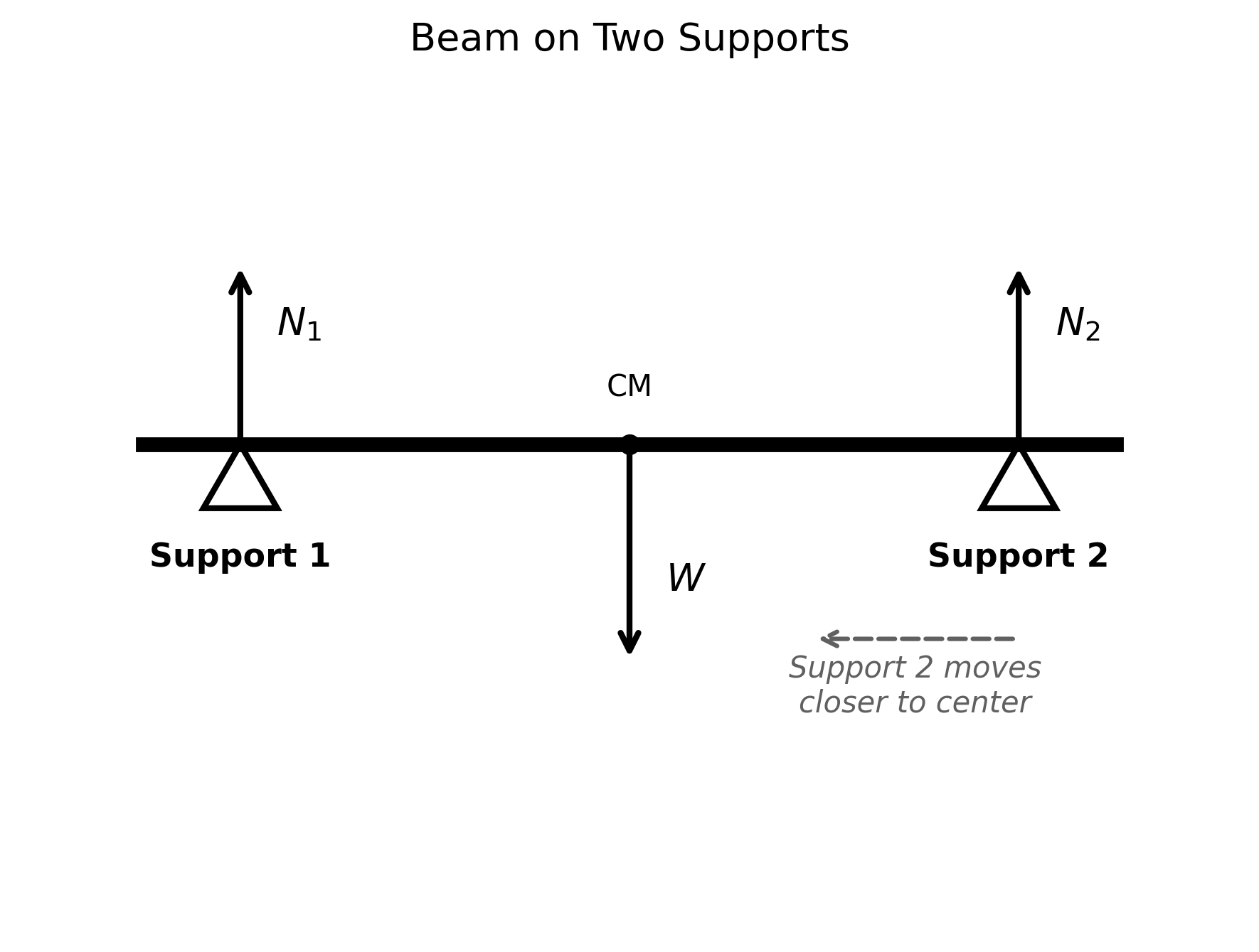
A uniform horizontal beam is supported at two points, as shown in the figure. If Support 2 is moved closer to the center of the beam while remaining to the right of the center and while Support 1 remains fixed, with the beam in static equilibrium before and after the move, how does the force exerted by Support 1 change?
AThe force at Support 1 decreases.
BThe force at Support 1 increases.
CThe force at Support 1 remains the same.
DThe change depends on the mass of the beam.
Show answer and explanation
Answer: A
A is correct. Let a be the fixed distance from Support 1 to the center and b the distance from the center to Support 2. Torque and force balance give N2=Wa/(a+b) and N1=Wb/(a+b). Decreasing positive b decreases N1. B reverses that change. C ignores the changed lever arm. D is false because mass sets the force scale but not the direction of the change.
Ready for the full-length tests?
Five full-length AP Physics 1 practice tests, every unit of notes and step-by-step solutions. 7 days free.