Instructions: This free practice test has 16 multiple-choice questions from our full-length AP Physics C: E&M practice tests. You will have 33 minutes, the same pace as the real exam.
It runs in the same test engine as our full-length tests: you can mark questions for review, cross out choices, open the calculator and move back and forth until time expires. When you finish, you will see every answer with a full explanation. No account needed.
Every question in this AP Physics C: E&M practice test is below. The answer and its explanation stay closed until you open them, so you can work each one first.
Question 1
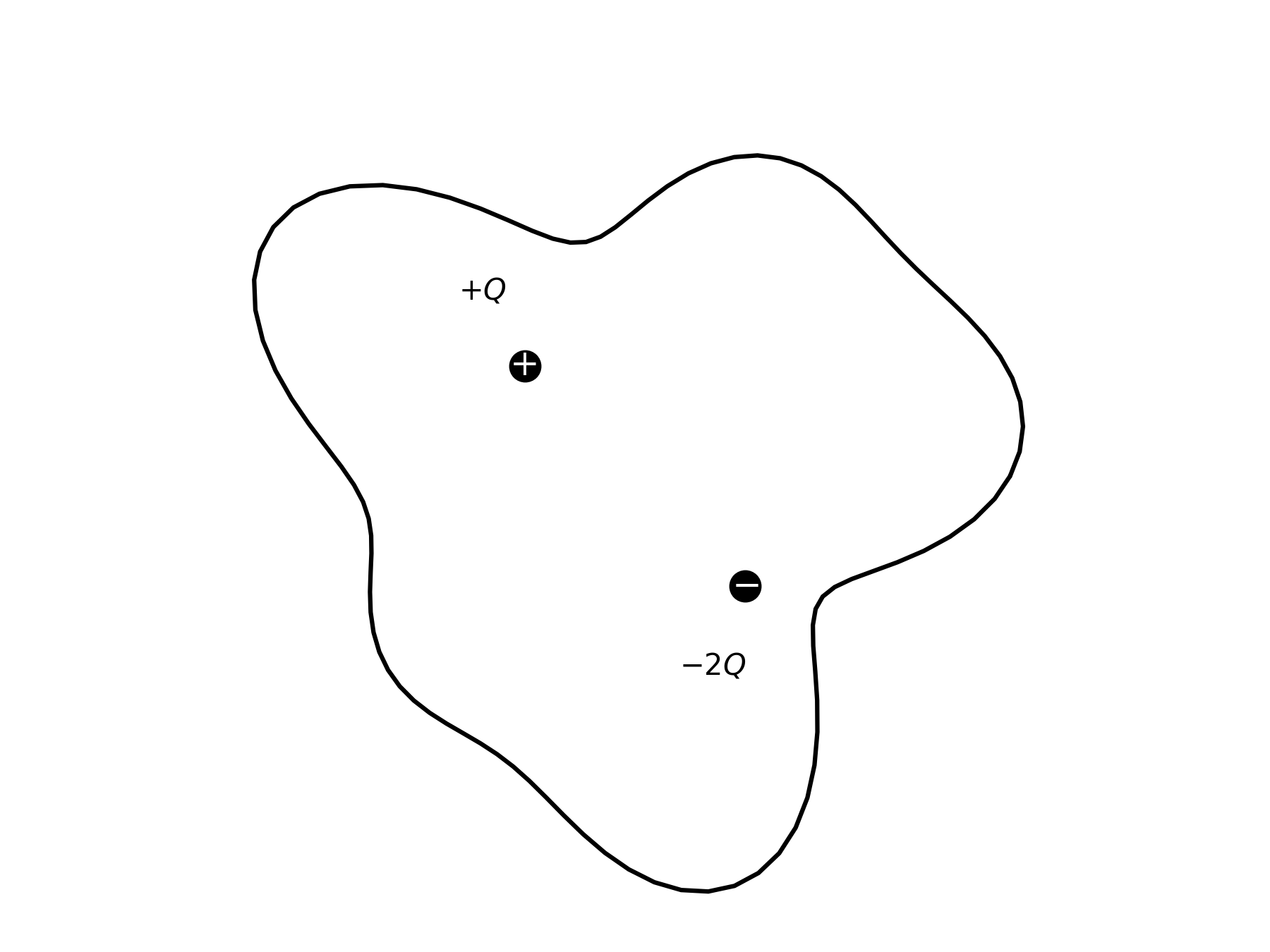
A closed surface encloses a point charge +Q and a point charge −2Q, as shown in the figure. What is the total electric flux through the surface?
Aϵ0−2Q
Bϵ0−Q
Cϵ0Q
Dϵ03Q
Show answer and explanation
Answer: B
Gauss's law: Φ=Qenc/ϵ0 with Qenc=+Q+(−2Q)=−Q, so Φ=−Q/ϵ0. (A) counts only the −2Q charge. (C) has the right magnitude but the wrong sign. (D) adds the magnitudes Q+2Q instead of the signed charges.
Question 2
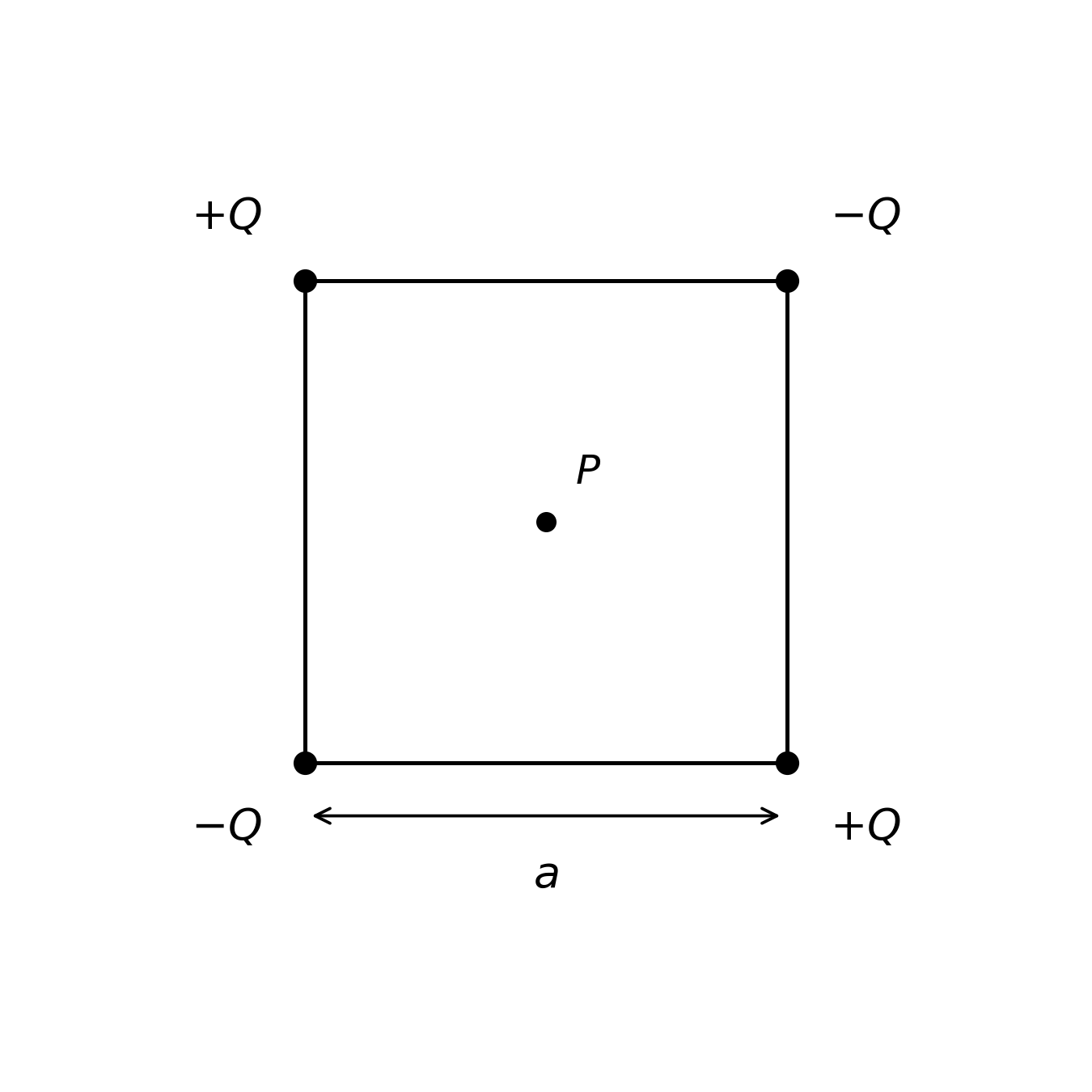
Four point charges are arranged at the corners of a square of side a as shown in the figure: +Q at the top-left and bottom-right, and −Q at the top-right and bottom-left. What is the electric potential at the center of the square?
A0
Ba2kQ
Ca24kQ
Da42kQ
Show answer and explanation
Answer: A
Each charge is a/2 from the center, and potential is a scalar sum: V=a/2k(Q−Q−Q+Q)=0. (B) and (C) count only the two positive charges ((C) with the correct distance a/2, (B) with the side length a). (D) adds the magnitudes of all four charges.
Question 3
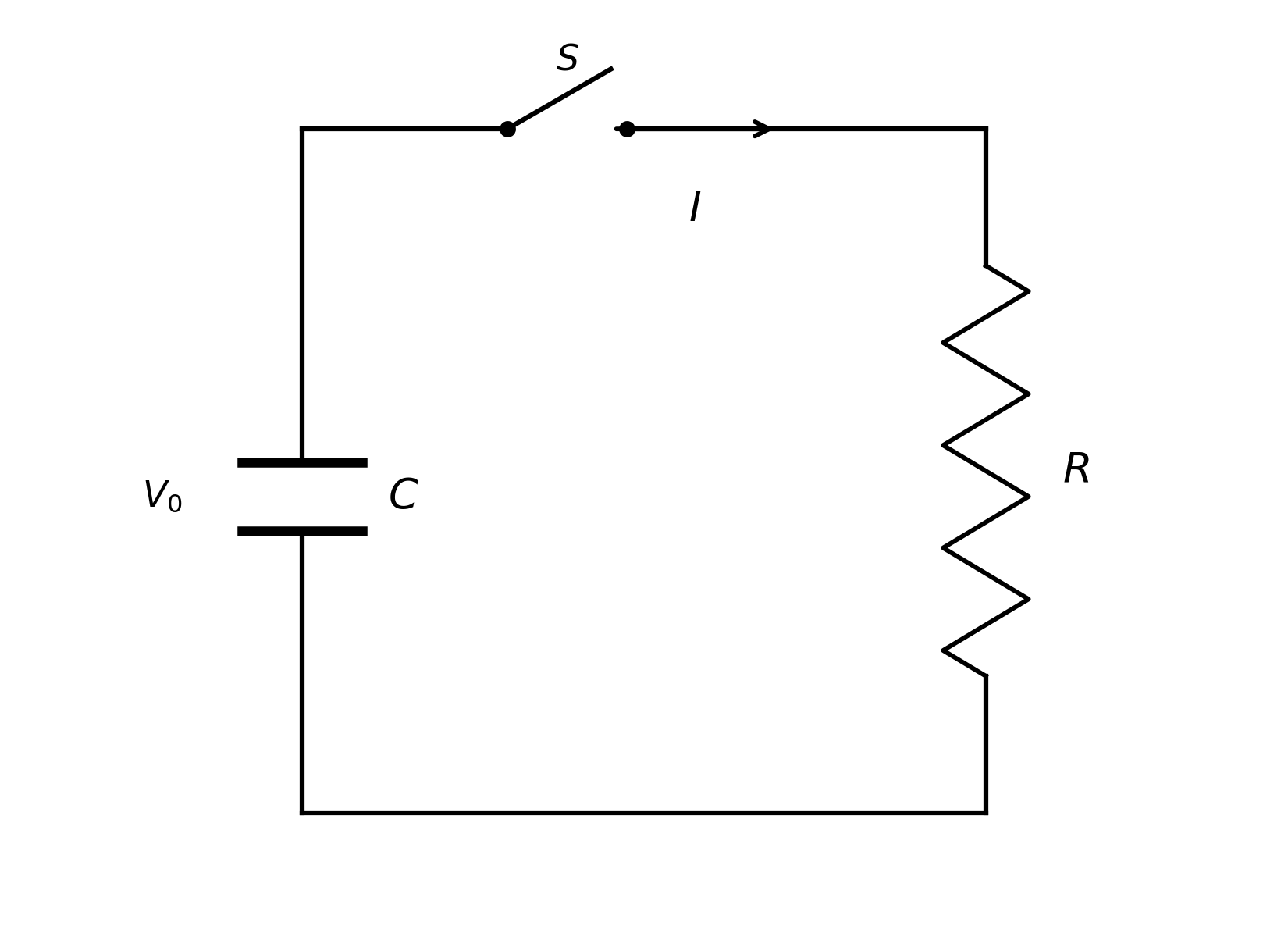
A capacitor C is fully charged to voltage V0 in an RC circuit. The switch is flipped so the capacitor discharges through resistor R, as shown in the figure. At what time has the charge on the capacitor decreased to 1/e of its initial value?
A2RC
BRC
C2RC
DRCln2
Show answer and explanation
Answer: B
During discharge Q(t)=Q0e−t/RC; Q=Q0/e when t/RC=1, i.e. t=RC, the time constant. (A) and (C) use half and twice the time constant. (D) is the time to reach half the initial charge, RCln2, not 1/e of it.
Question 4
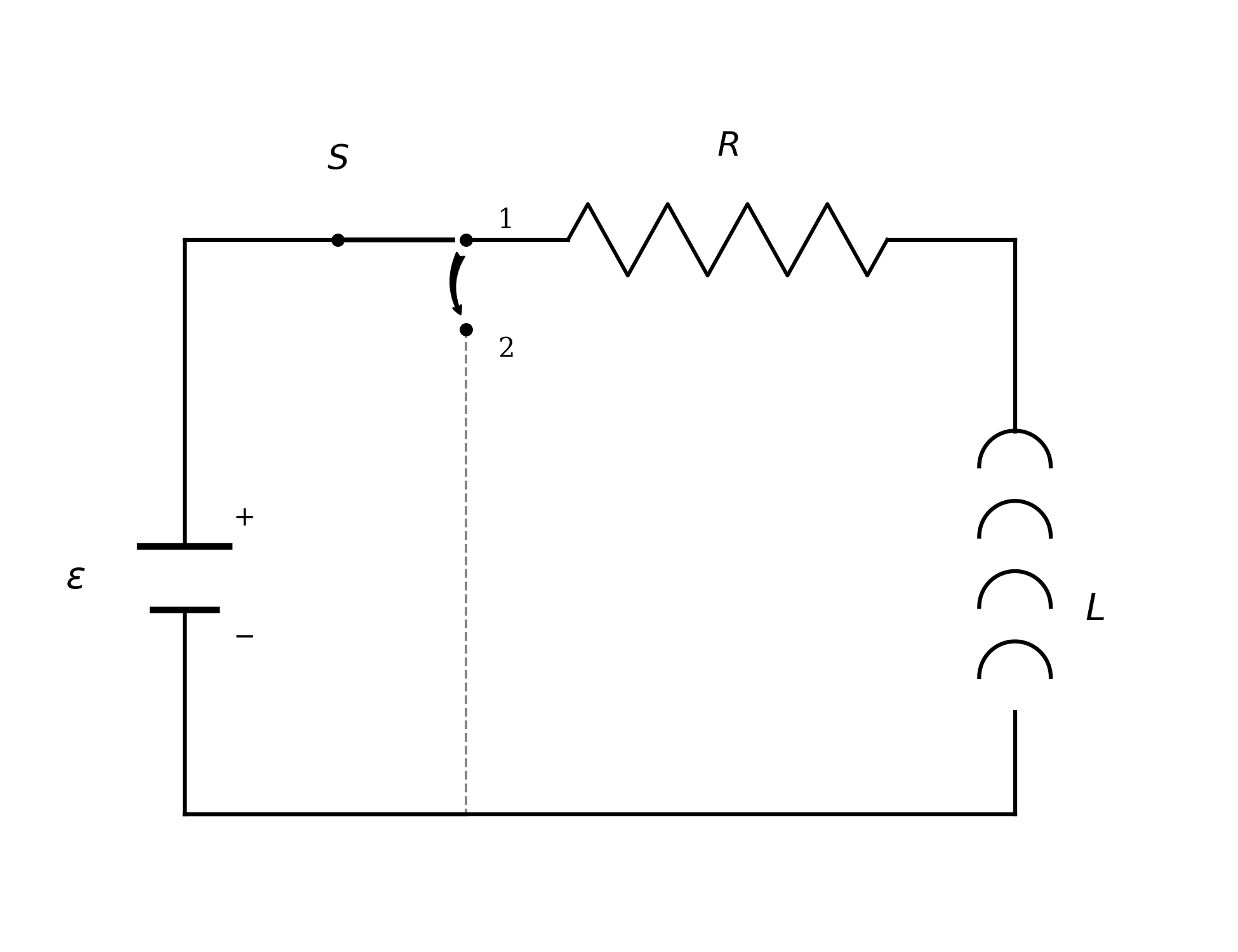
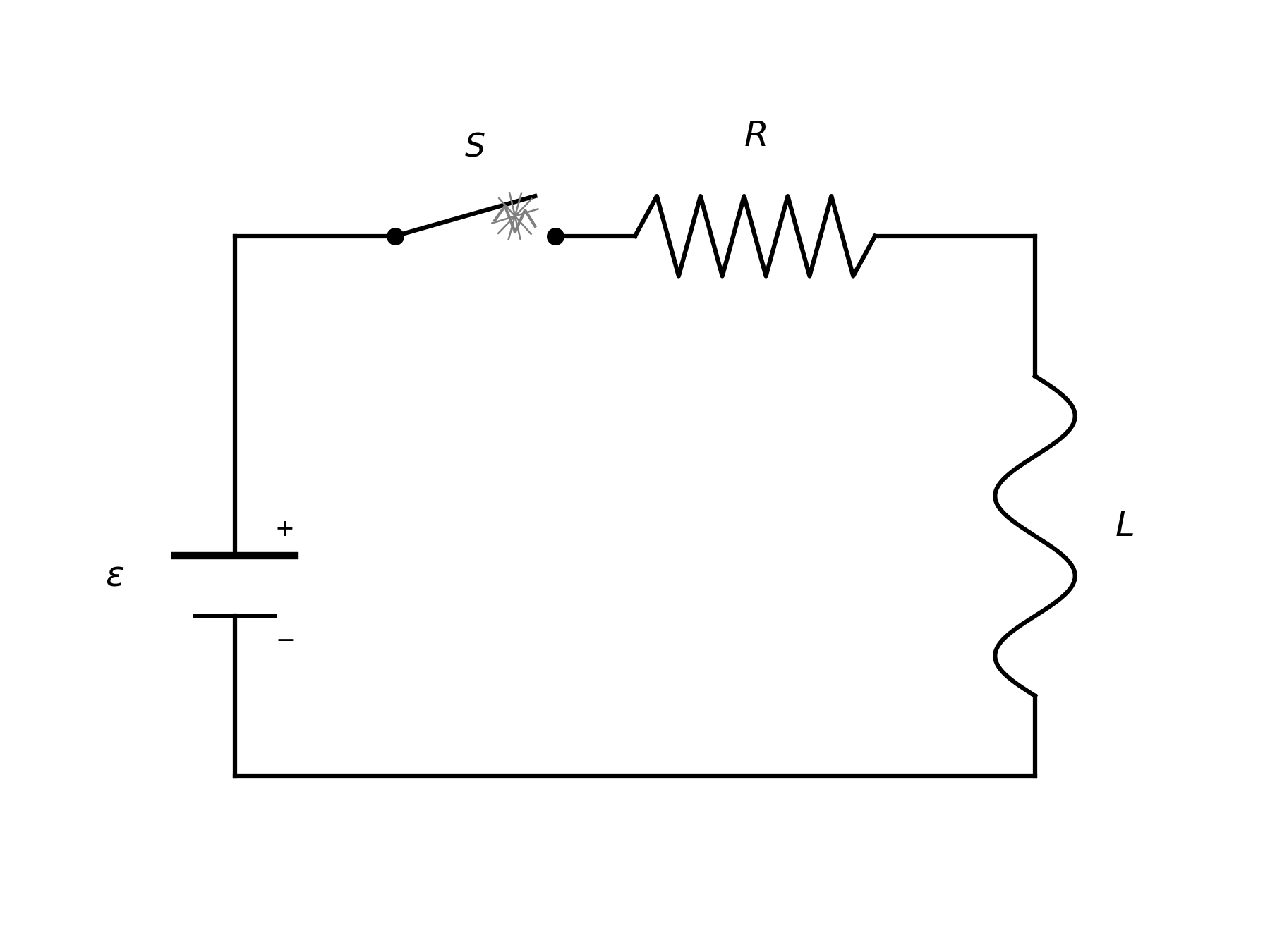
In the LR circuit shown in the figure, the switch has been in position 1 long enough for the circuit to reach steady state. The switch is then moved to position 2 at time t=0. Which of the following expressions correctly represents the current as a function of time for t>0?
ARεe−Rt/L
BRε(1−e−Rt/L)
CRεe−Lt/R
DLεe−Rt/L
Show answer and explanation
Answer: A
In steady state at position 1, I0=ε/R. At position 2 the battery is removed from the loop, and the inductor drives a decaying current through R: I(t)=(ε/R)e−Rt/L, time constant L/R. (B) is the growth curve for closing the switch onto the battery. (C) inverts the time constant. (D) starts at ε/L, which is not a current.
Question 5
Two capacitors, C1=4μF charged to V1=100 V and C2=6μF charged to V2=50 V, are disconnected from their batteries and then connected in parallel with positive plates joined together. What is the final voltage across the combination?
A50 V
B70 V
C75 V
D80 V
Show answer and explanation
Answer: B
Charge is conserved when the positive plates are joined: Q=C1V1+C2V2=(4)(100)+(6)(50)=700μC. In parallel the capacitance is C1+C2=10μF, so Vf=700/10=70 V (B). (A) keeps the lower initial voltage, as if C2 alone set the result. (C) averages 100 V and 50 V without weighting by capacitance. (D) weights each voltage by the other capacitor: (6⋅100+4⋅50)/10=80 V.
Question 6
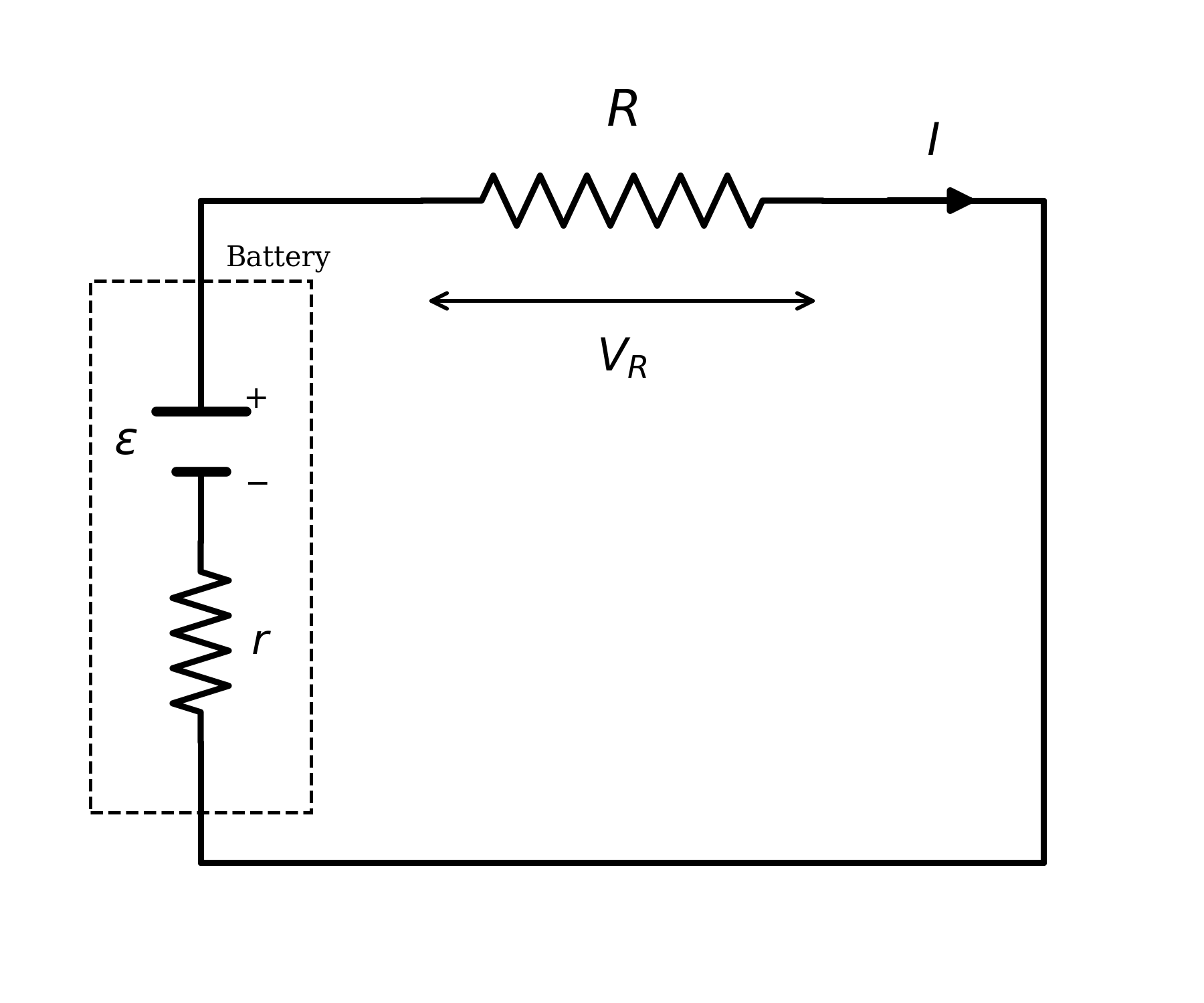
A battery with EMF ϵ and internal resistance r is connected to a single external resistor R, as shown in the figure. Which of the following correctly gives the potential difference VR across the external resistor?
Aϵ
BR+rϵr
CR+rϵR
DRϵ(R+r)
Show answer and explanation
Answer: C
Around the loop, ϵ−Ir−IR=0, so I=ϵ/(R+r) and VR=IR=ϵR/(R+r) (C); the battery's terminal voltage is less than its EMF by the drop Ir inside it. (A) treats the battery as ideal and ignores the internal drop Ir. (B) is the potential drop across the internal resistance r, not across R. (D) inverts the divider ratio, which would make VR larger than the EMF; no element in this loop can raise the potential above ϵ.
Question 7
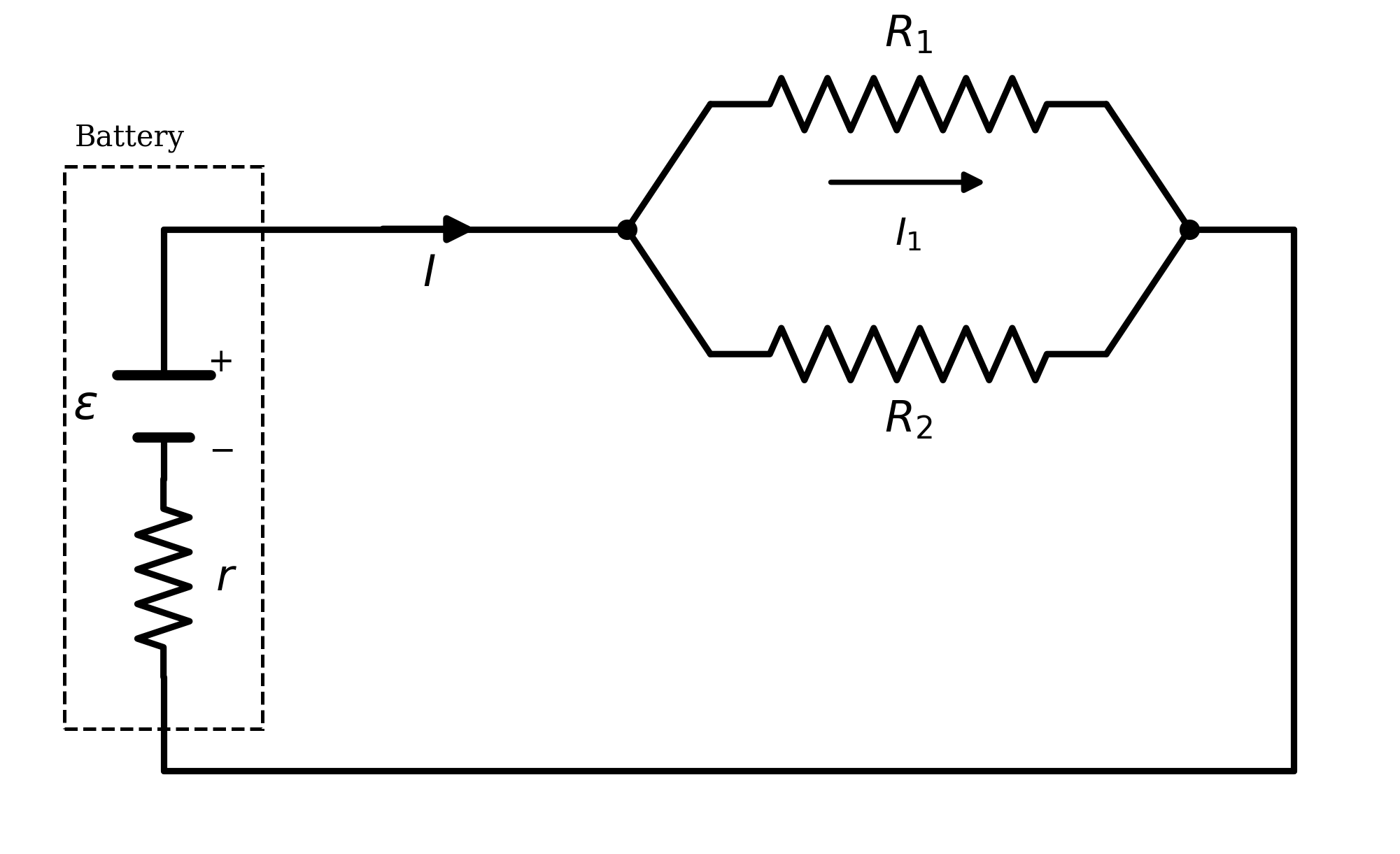
A battery with EMF ϵ and internal resistance r is connected to two resistors R1 and R2 in parallel, as shown in the figure. Which of the following correctly gives the current through R1?
AR1+rϵ
BR1R2+r(R1+R2)ϵR2
CR1+R2+rϵ
DR1R2+rϵ(R1+R2)
Show answer and explanation
Answer: B
The parallel pair is Rp=R1R2/(R1+R2), so the battery current is I=ϵ/(r+Rp), and the current divider gives I1=IR2/(R1+R2)=ϵR2/[R1R2+r(R1+R2)] (B). (A) ignores R2, treating R1 as the only external resistor. (C) puts R1, R2 and r in series. (D) is not dimensionally consistent: its denominator adds a resistance squared to a resistance.
Question 8
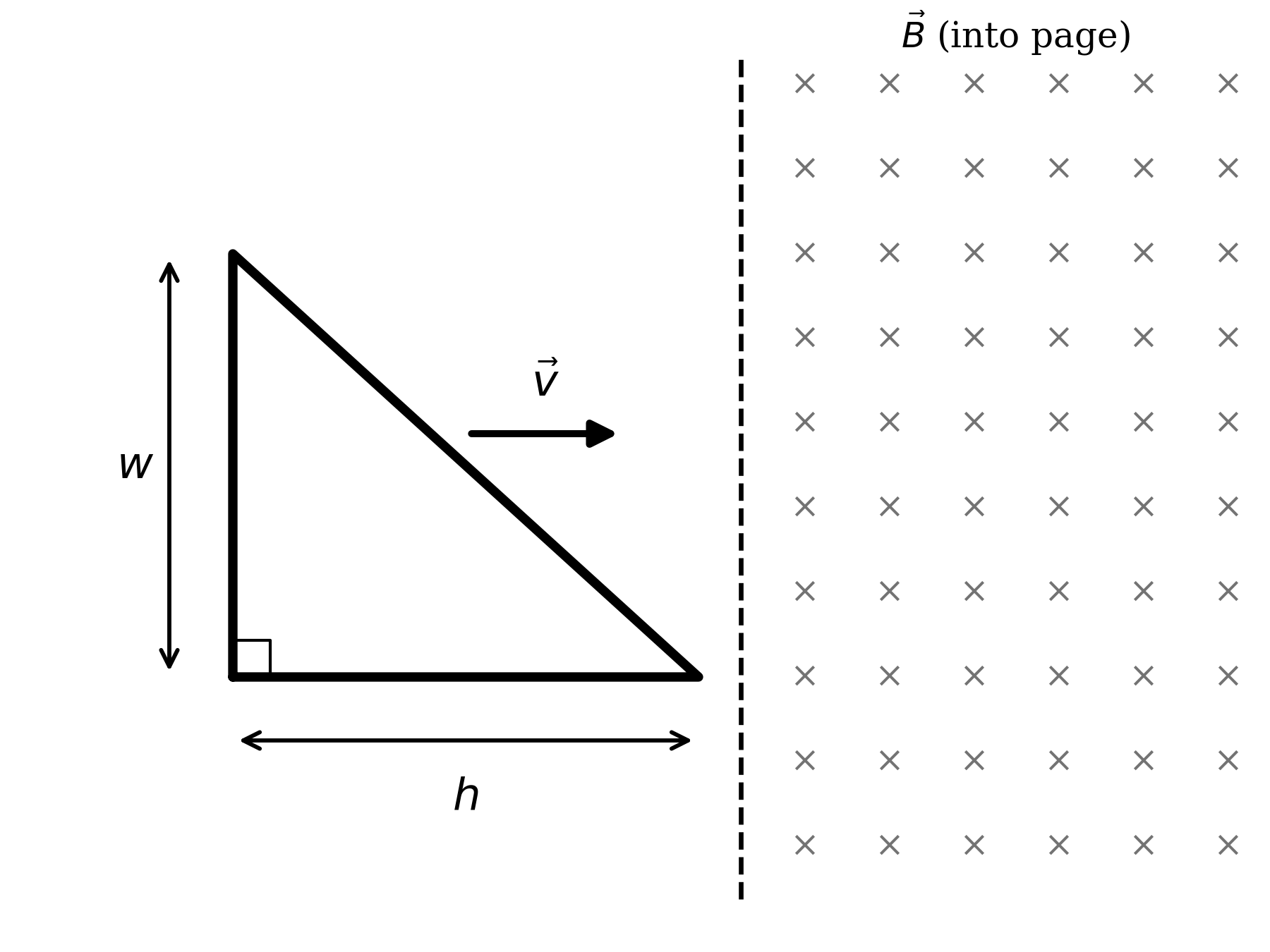
A right-triangular conducting loop moves at constant velocity v into a region of uniform magnetic field B directed into the page, as shown in the figure. The loop enters the field with its apex (pointed vertex) leading, and the apex reaches the field boundary at time t=0. The leg of the triangle parallel to the velocity has length h, and the leg perpendicular to the velocity has length w. Which of the following correctly gives the induced EMF as a function of time t during the entry phase?
ABwv (constant)
BhBwv2t
CwBhv2t
D2Bwv
Show answer and explanation
Answer: B
Let x=vt be how far the apex has moved into the field. The loop's width at that depth is ℓ=(w/h)x, so the flux is Φ=21Bℓx=Bwv2t2/(2h) and ∣E∣=dΦ/dt=Bwv2t/h (B), which grows linearly during entry. Equivalently, the cutting length ℓ moves at v: E=Bℓv. (A) is the result for a rectangular loop of height w, whose cutting length is constant. (C) swaps w and h in the width-to-depth ratio. (D) is a constant, which ignores the growing width.
Question 9
A point charge +Q is located at the origin. A second point charge +4Q is located at x=3d. At what position on the x-axis between the two charges is the net electric field equal to zero?
Ax=23d
Bx=43d
Cx=53d
Dx=d
Show answer and explanation
Answer: D
Between two positive charges the two fields point in opposite directions, so the net field is zero where the magnitudes match: kQ/x2=k(4Q)/(3d−x)2. Taking square roots, (3d−x)/x=2, so x=d: the +4Q charge is twice as far away (2d), which offsets its four-times-larger charge. Choice (A), the midpoint 3d/2, ignores the unequal charges. Choice (C), 3d/5, sets the distance ratio equal to the charge ratio, (3d−x)/x=4, without taking the square root. Choice (B), 3d/4, does not balance the fields: there the +Q field, 16kQ/(9d2), is more than twice the +4Q field, 64kQ/(81d2).
Question 10
A parallel-plate capacitor with plate area A and separation d is charged to voltage V0 and then disconnected from the battery. The plates are then pushed together to separation d/2. Which of the following correctly gives the new voltage and the new energy stored?
ANew voltage =V0; New energy =2dϵ0AV02
BNew voltage =V0/2; New energy =4dϵ0AV02
CNew voltage =2V0; New energy =dϵ0AV02
DNew voltage =V0/2; New energy =2dϵ0AV02
Show answer and explanation
Answer: B
With the battery disconnected the charge Q=CV0 stays fixed. Halving the separation doubles the capacitance, so V′=Q/(2C)=V0/2 and U′=2(2C)Q2=41CV02=4dϵ0AV02, half the original energy (the attracting plates do positive work as they close). Choice (A) keeps the voltage fixed, as if the battery were still connected. Choice (C) halves the capacitance instead of doubling it. Choice (D) has the right voltage but leaves the energy unchanged, although U=21QV halves when V halves at fixed Q.
Question 11
A resistor obeys Ohm's law. When the voltage across it is doubled from V to 2V, which of the following correctly describes the changes in current and power dissipated?
ACurrent doubles; power doubles
BCurrent doubles; power quadruples
CCurrent quadruples; power doubles
DCurrent stays the same; power doubles
Show answer and explanation
Answer: B
For an ohmic resistor I=V/R, so doubling V doubles I, and P=V2/R quadruples. Choice (A) treats the power as proportional to V. Choice (C) swaps the two changes. Choice (D) treats the current as fixed, which contradicts Ohm's law.
Question 12
An LR circuit has been in steady state with the switch closed for a long time. The switch is then opened. Which of the following correctly justifies why a spark may occur at the switch contacts?
AThe resistor stores energy that is released as a spark when the circuit is broken
BThe battery provides a surge of current through the switch as it opens
CThe magnetic field of the inductor collapses instantaneously, releasing radiation as a spark
DThe inductor's EMF, LdI/dt, becomes very large as the current drops, ionizing the air in the gap
Show answer and explanation
Answer: D
Opening the switch forces the current toward zero in a very short time, so ∣dI/dt∣ is huge. The inductor's EMF, LdI/dt, opposes that change and becomes very large, and it appears across the gap opening in the switch, where it can ionize the air. Choice (A) is false: a resistor dissipates energy and stores none; the stored energy is in the inductor's magnetic field. Choice (B) is false: the battery's EMF does not change, and it cannot push more current through an opening gap. Choice (C) is false on both counts: the field cannot collapse instantaneously (that would need an infinite EMF), and a spark is a discharge through ionized air, not radiation from the coil.
Question 13
A point charge +Q is placed at the center of a hollow conducting spherical shell with inner radius a and outer radius b. What is the magnitude of the electric field at a point within the conducting material at distance r from the center, where a<r<b?
A0
Ba2kQ
Cr2kQ
Db2kQ
Show answer and explanation
Answer: A
Inside the material of a conductor in electrostatic equilibrium the electric field is zero. The free charges rearrange (−Q on the inner surface, +Q on the outer surface) so that their field cancels the field of the central charge everywhere within the metal.
(B) kQ/a2 is the field in the cavity just inside the inner surface, not in the metal. (C) kQ/r2 is the field of the point charge alone, ignoring the induced surface charges. (D) kQ/b2 is the field just outside the outer surface.
Question 14
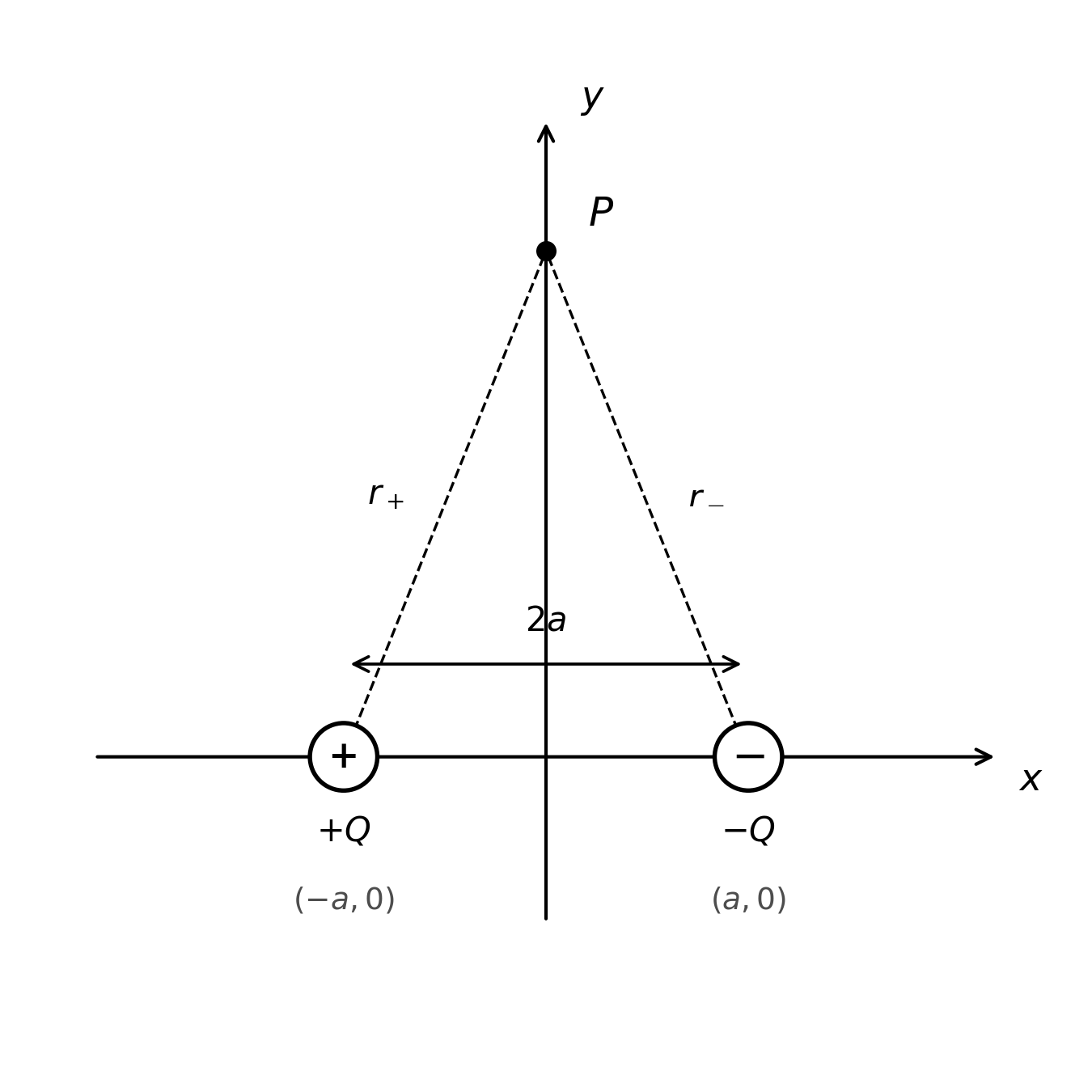
Two point charges +Q and −Q are located on the x-axis at x=−a and x=+a, respectively, as shown in the figure. What is the electric potential at point P on the y-axis at distance y from the midpoint?
A0
By2+a2kQa
Cy2+a2kQ
Dy2+a22kQ
Show answer and explanation
Answer: A
Point P is the same distance y2+a2 from both charges, so V=kQ/y2+a2+k(−Q)/y2+a2=0. Potential is a scalar, so the two contributions simply add to zero.
(B) multiplies by a geometric factor a/y2+a2 as if taking a vector component, which is never needed for potential. (C) is the potential of one charge alone. (D) adds the two potentials as if both charges were positive.
Question 15
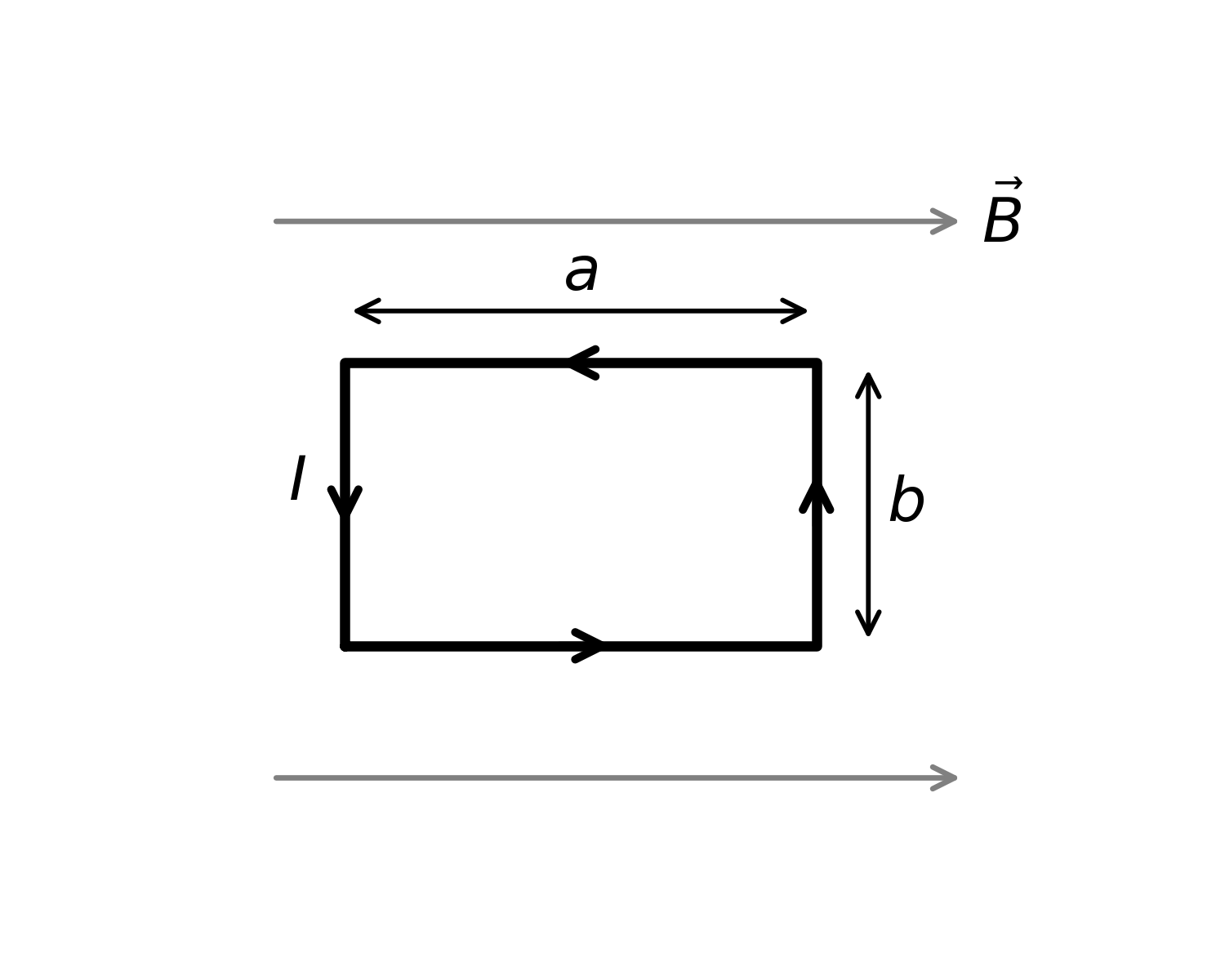
A rectangular current loop with sides a and b carries current I in a uniform magnetic field B of magnitude B, as shown in the figure. The field is parallel to side a and lies in the plane of the loop. What is the magnitude of the torque on the loop?
A0
BIaB
CIabB
D2IabB
Show answer and explanation
Answer: C
The torque on a current loop is τ=IABsinθ, where θ is the angle between the loop's magnetic moment (perpendicular to the loop) and B. With B in the plane of the loop, θ=90∘, so τ=IabB. Directly: the sides of length b are perpendicular to B and each feels a force IbB; these opposite forces act with lever arm a/2 each, giving 2(IbB)(a/2)=IabB. The sides of length a are parallel to B and feel no force.
(A) Zero torque occurs when B is perpendicular to the plane of the loop; here the torque is at its maximum. (B) IaB has units of force, not torque, and uses the side parallel to B, which feels no force. (D) 2IabB uses the full width a as the lever arm for each of the two forces instead of a/2.
Question 16
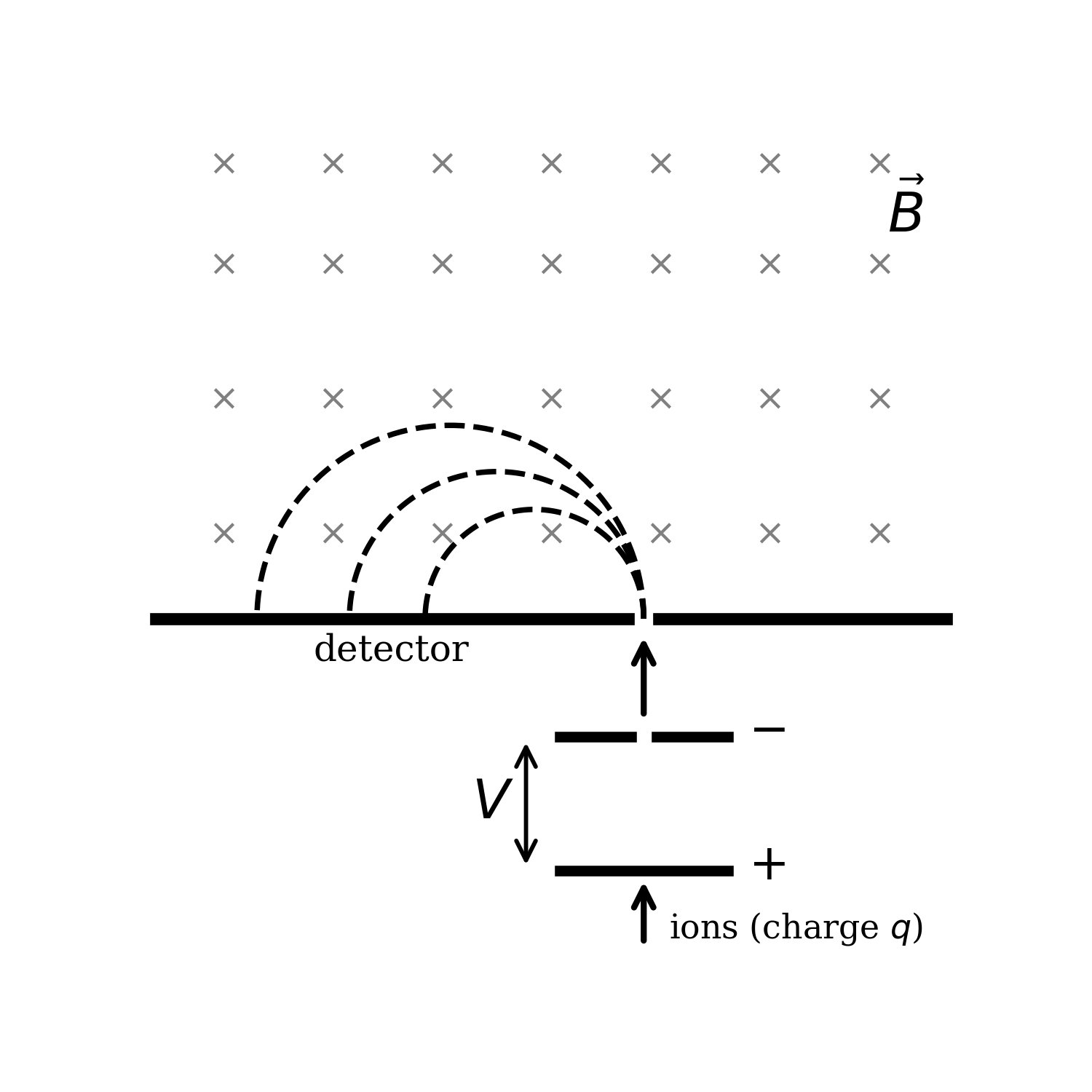
In a mass spectrometer, ions of charge q are accelerated from rest through a potential difference V and enter a uniform magnetic field B, as shown in the figure. Which of the following correctly explains how ions of different masses are separated?
ASince r=B1q2mV, heavier ions follow larger semicircles and land farther from the entrance.
BHeavier ions move slower and therefore spend more time in the field, drifting farther before hitting the detector.
CHeavier ions experience a larger magnetic force, causing them to curve more sharply and hit the detector closer to the entrance.
DLighter ions are accelerated to higher speeds and gain more energy, so they curve less and strike the detector farther from the entrance.
Show answer and explanation
Answer: A
Acceleration gives qV=21mv2, so v=2qV/m. In the field, qvB=mv2/r gives r=mv/(qB)=B1q2mV. Since r∝m, heavier ions follow larger semicircles and land a distance 2r from the entrance, farther away than lighter ions.
(B) The landing point is set by the radius of the semicircle, not by drifting over time. (C) Heavier ions move more slowly, so the magnetic force on them is smaller, and their larger inertia gives a larger radius, not a sharper curve. (D) Every ion gains the same kinetic energy qV; lighter ions are faster, but their radius is smaller, so they land closer to the entrance.
Ready for the full-length tests?
Five full-length AP Physics C: E&M practice tests, every unit of notes and step-by-step solutions. 7 days free.