Instructions: This free practice test has 16 multiple-choice questions from our full-length AP Physics C: Mechanics practice tests. You will have 33 minutes, the same pace as the real exam.
It runs in the same test engine as our full-length tests: you can mark questions for review, cross out choices, open the calculator and move back and forth until time expires. When you finish, you will see every answer with a full explanation. No account needed.
Every question in this AP Physics C: Mechanics practice test is below. The answer and its explanation stay closed until you open them, so you can work each one first.
Question 1
An object moves along the x-axis with its position given by x(t)=4t3−6t+2 (in SI units). What is the acceleration of the object at t=2 s?
A12 m/s2
B24 m/s2
C48 m/s2
D96 m/s2
Show answer and explanation
Answer: C
v=dx/dt=12t2−6 and a=dv/dt=24t, so a(2)=48m/s2 (C). A is too small by a factor of 4; B uses t=1 instead of t=2; D adds an extra factor of 2 to the derivative.
Question 2
An object moves along the x-axis with acceleration a(t)=6t−4 (in SI units) and initial velocity v(0)=1 m/s. At what time does the object momentarily come to rest for the second time?
A31s
B32s
C1s
D23s
Show answer and explanation
Answer: C
Integrating gives v=3t2−4t+1=(3t−1)(t−1). The object stops at t=1/3s and t=1s, so the second stop is C. A is the first stop. B is where acceleration is zero, but velocity is −1/3m/s. At D, velocity is 7/4m/s, not zero.
Question 3
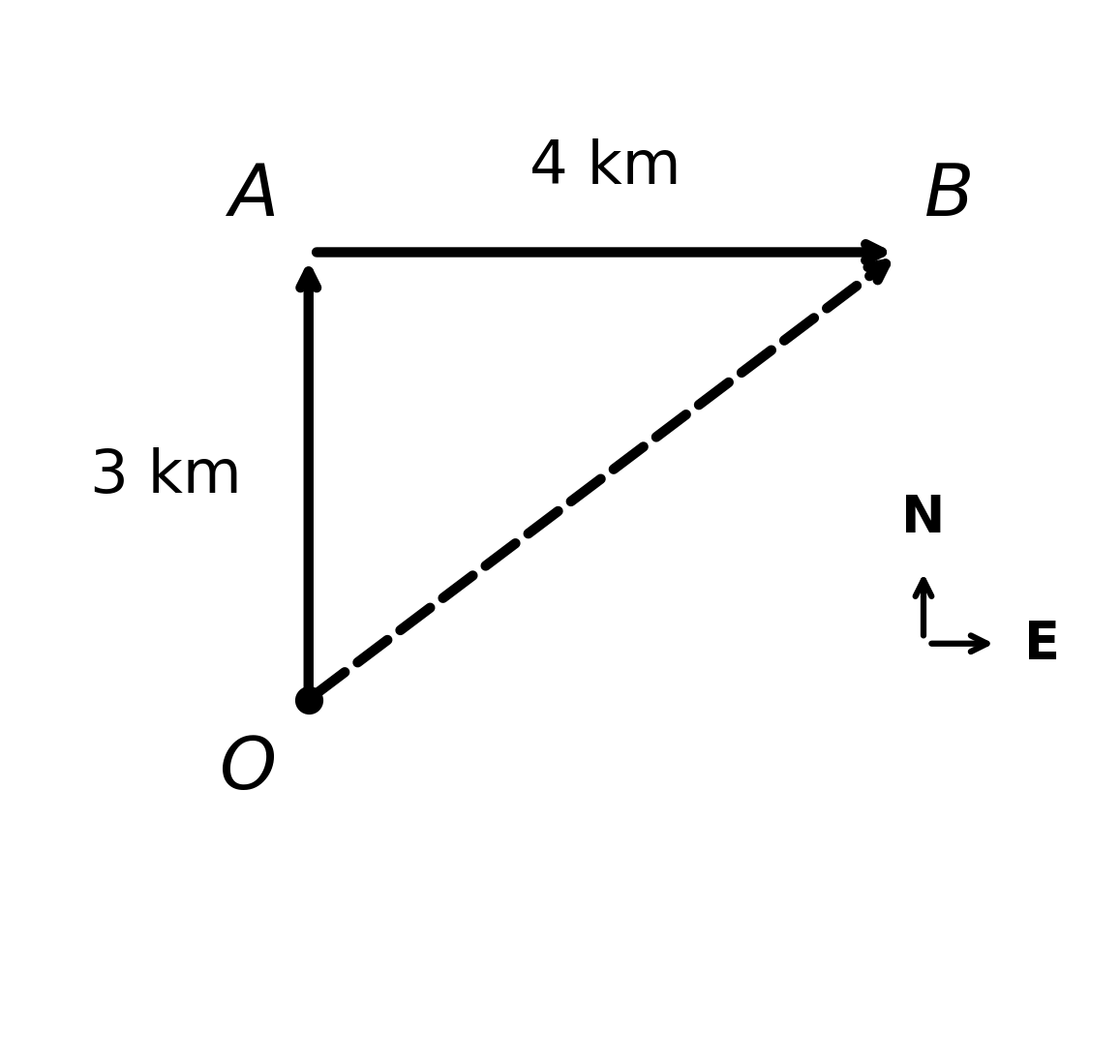
A hiker walks 3 km north and then 4 km east, as shown in the figure. What is the magnitude of the hiker's displacement?
A1 km
B5 km
C7 km
D12 km
Show answer and explanation
Answer: B
The perpendicular displacement components are 3km and 4km, giving 32+42=5km (B). A subtracts perpendicular components. C gives path length. D multiplies lengths instead of combining vector components.
Question 4
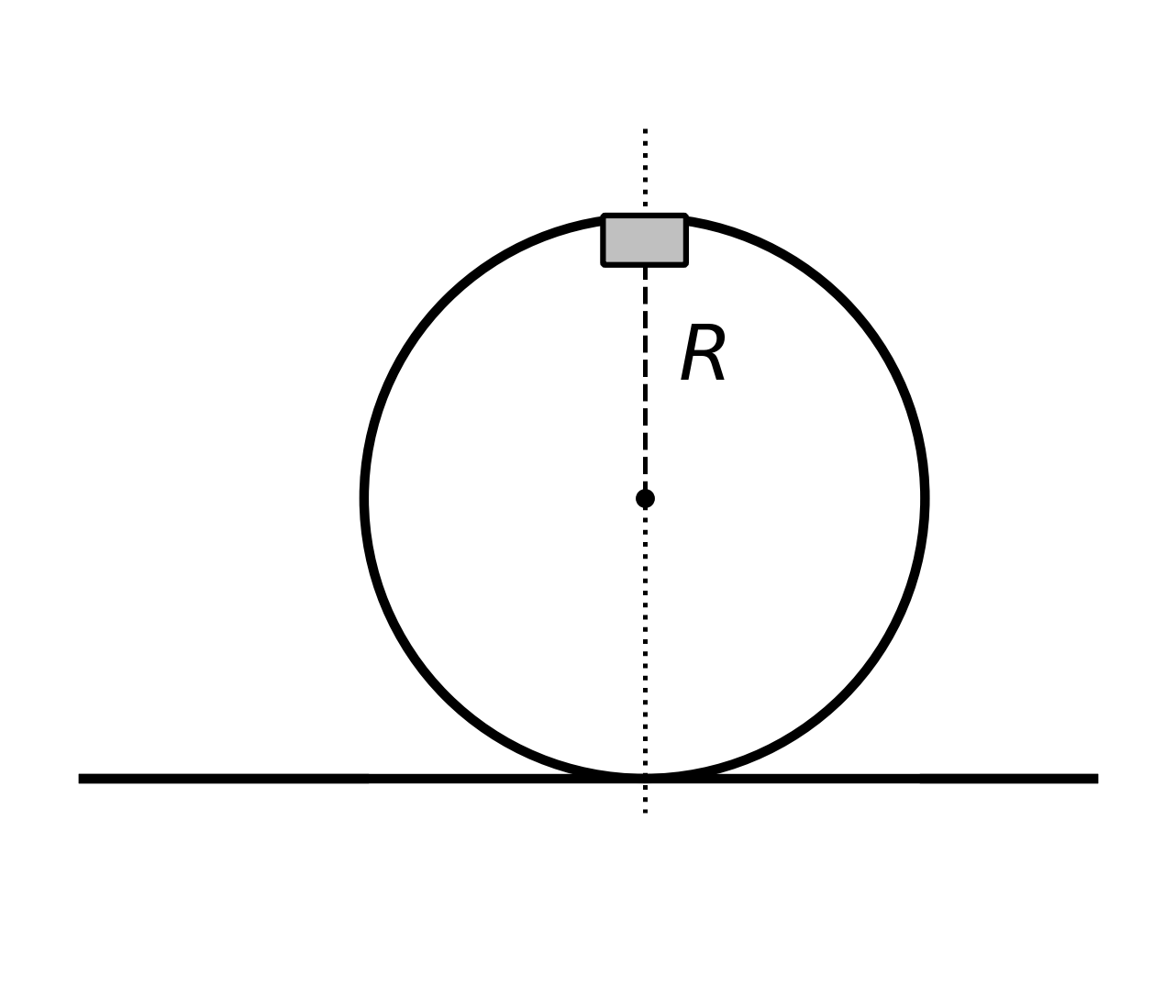
A roller-coaster car moves on the inside of a vertical circular track of radius R. The track can exert only an inward normal force on the car. At the top of the loop, what is the minimum speed for maintaining contact, and what force condition applies at this threshold?
A2gR; the normal force equals the weight.
BgR; the normal force is zero.
C0; the normal force balances the weight.
DgR/2; the normal force is half the weight.
Show answer and explanation
Answer: B
At the top, mg+N=mv2/R. The least speed with N≥0 occurs at N=0, yielding v=gR (B). A gives N=mg and a larger, nonminimum speed. C would require an outward normal force. D also requires an outward normal force, since N=−mg/2.
Question 5
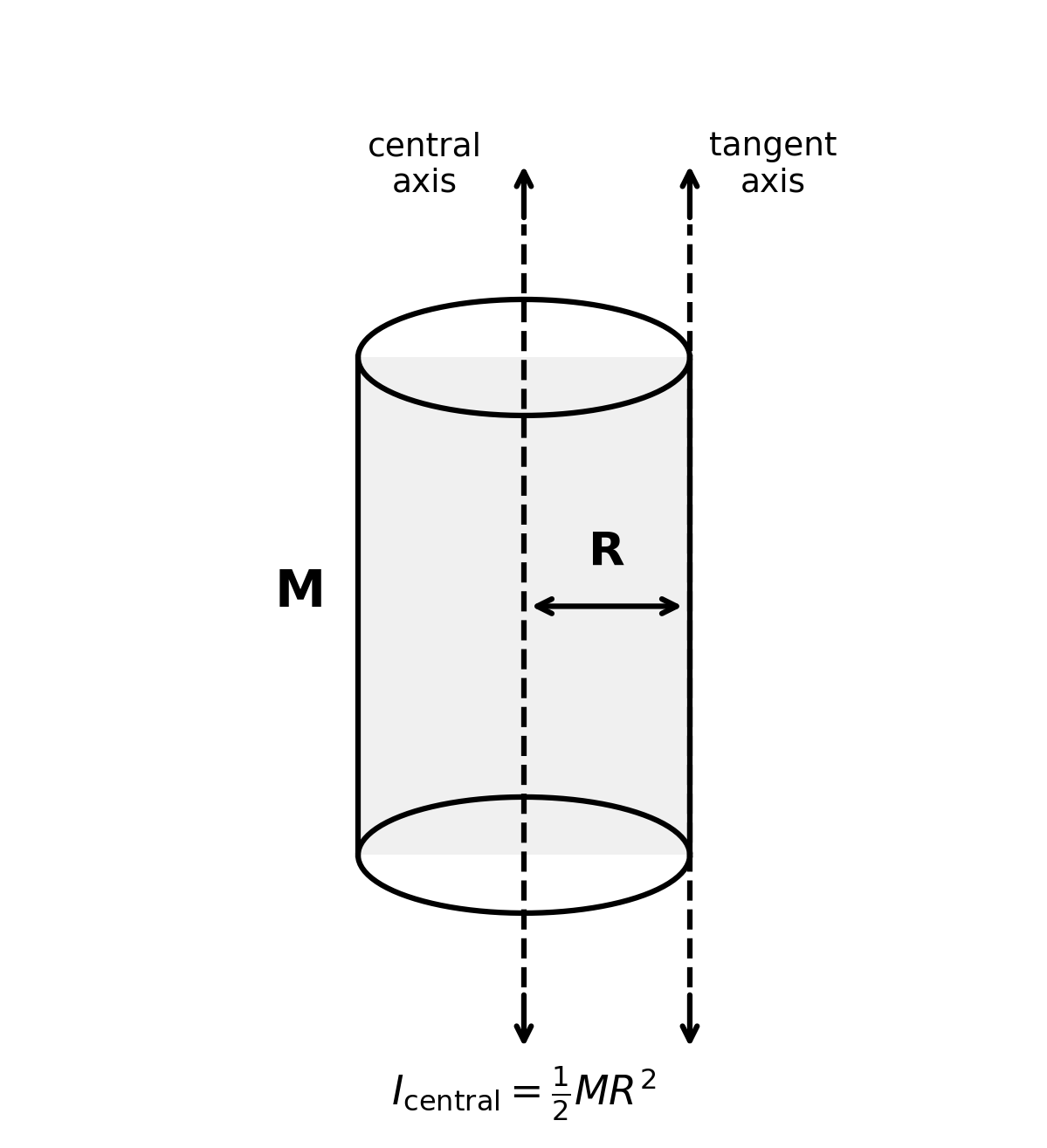
A uniform solid cylinder of mass M and radius R has rotational inertia 21MR2 about its central axis. Using the parallel axis theorem, what is the rotational inertia of the cylinder about an axis tangent to its curved surface and parallel to the central axis, as shown above?
A21MR2
BMR2
C45MR2
D23MR2
Show answer and explanation
Answer: D
The parallel axis theorem states I=Icm+Md2, where d is the distance between the parallel axes. The central axis passes through the center and the tangent axis is at distance d=R from it. Thus I=21MR2+MR2=23MR2. A omits the shift of axis. B includes only MR2 and omits the central inertia. C uses an incorrect additional inertia of 3MR2/4 instead of MR2.
Question 6
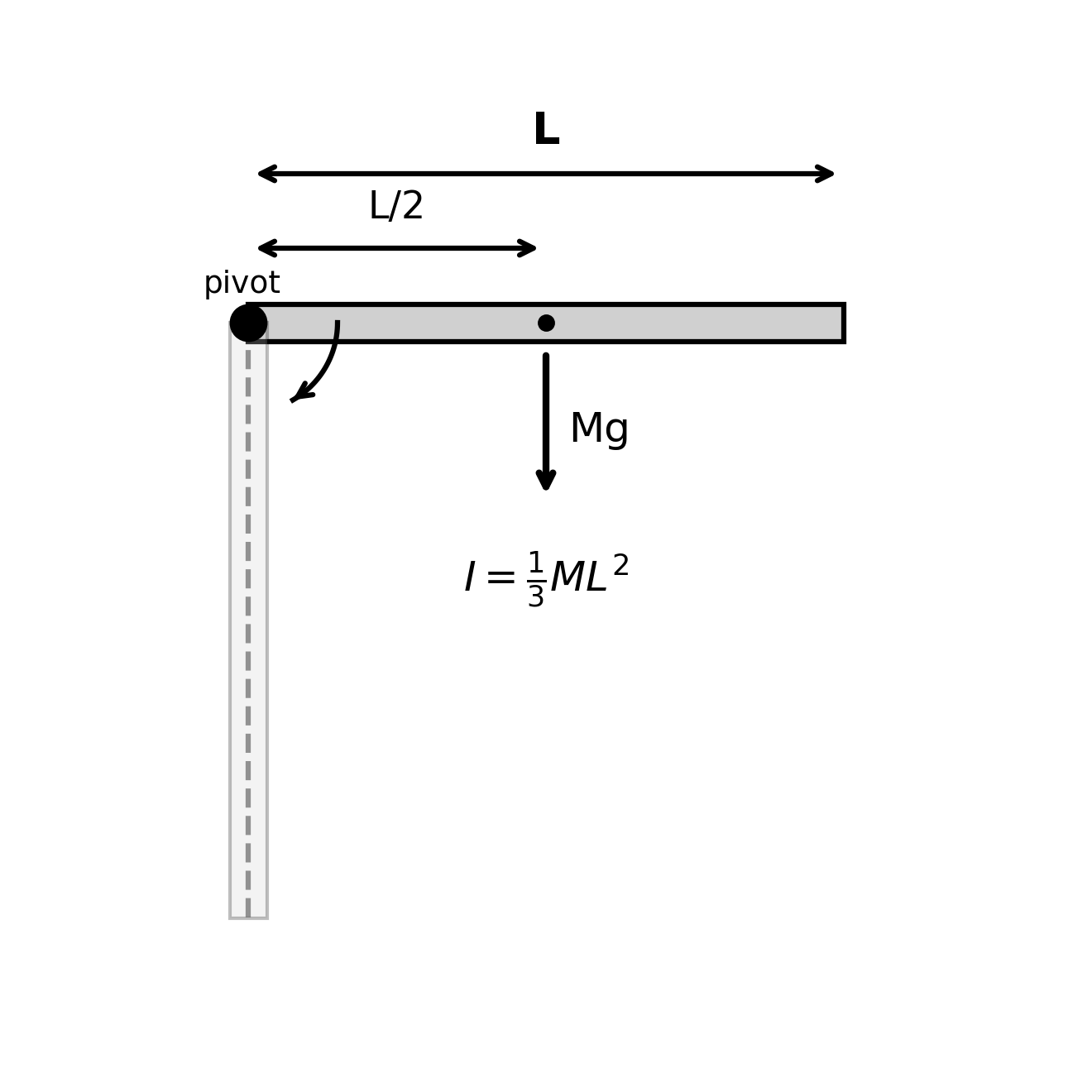
A uniform rod of mass M and length L is pivoted at one end and released from a horizontal position, as shown above. The rotational inertia of the rod about the pivot is 31ML2. What is the angular velocity of the rod as it passes through the vertical position?
ALg
BL3g
CL6g
DL12g
Show answer and explanation
Answer: B
Using energy conservation, the gravitational potential energy lost by the rod's center of mass falling a distance L/2 converts to rotational kinetic energy: Mg(L/2)=21Iω2=21(31ML2)ω2. Solving: ω2=3g/L, so ω=3g/L. A would follow from the too-large inertia ML2. C uses a center-of-mass drop of L instead of L/2. D adds another erroneous factor of two to the squared speed.
Question 7
A mass-spring system oscillates with period T0. If the mass is increased by a factor of 4, what is the new period of oscillation?
AT0
B2T0
C4T0
D16T0
Show answer and explanation
Answer: B
The period of a mass-spring system is T=2πm/k. If the mass is multiplied by 4, the new period is Tnew=2π4m/k=2⋅2πm/k=2T0. The period depends on the square root of the mass, so quadrupling the mass doubles the period. A ignores the mass dependence. C assumes a linear dependence on mass. D assumes a quadratic dependence instead of a square root.
Question 8
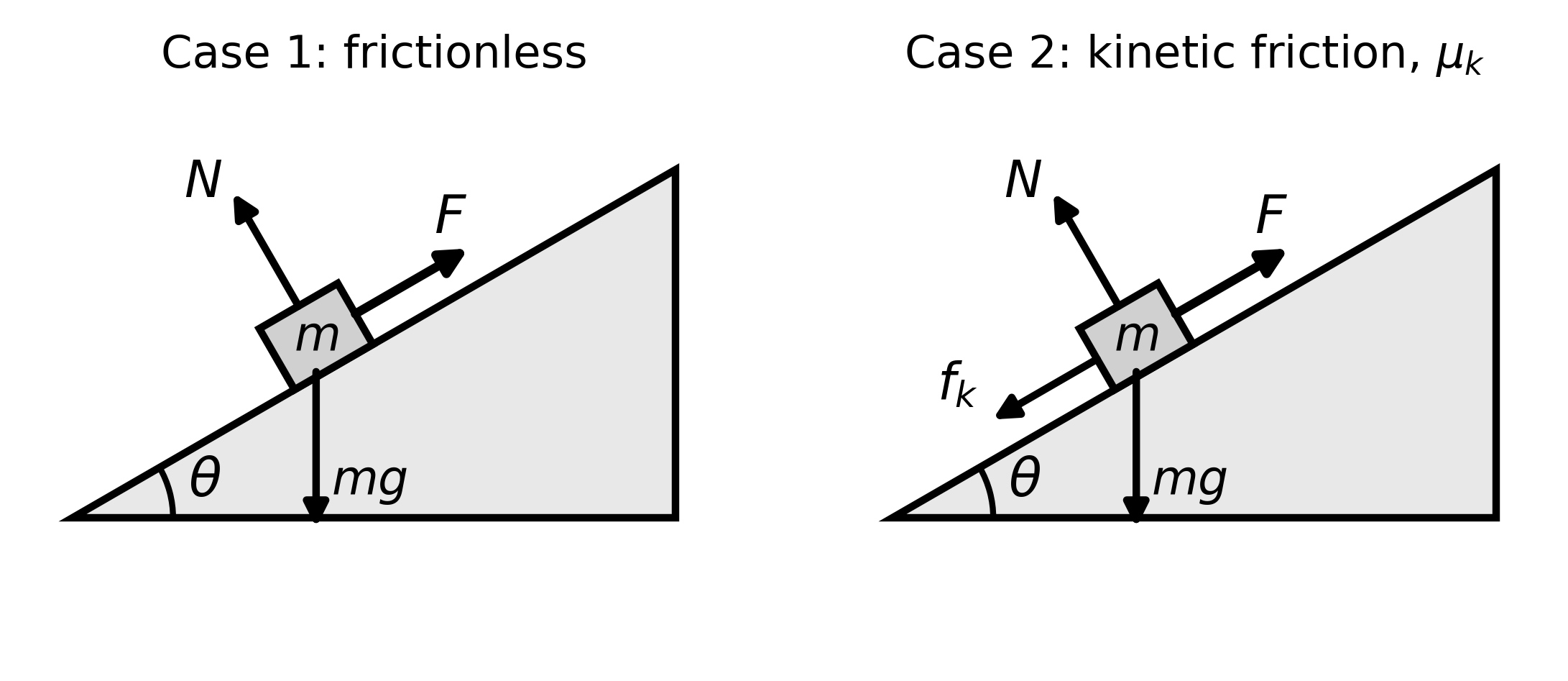
A block of mass m slides up an incline at angle θ while a constant force F pulls parallel to the incline, as shown above. Case 1 is frictionless; Case 2 has coefficient of kinetic friction μk. Take up the incline as positive. What is a1−a2, the difference between the accelerations in the two cases?
A−μkgcosθ
B0
Cμkg
Dμkgcosθ
Show answer and explanation
Answer: D
In Case 1, a1=F/m−gsinθ. In Case 2, a2=F/m−gsinθ−μkgcosθ. The difference is a1−a2=μkgcosθ. Friction reduces the acceleration by μkgcosθ, where the cosθ factor arises because the normal force on an incline is mgcosθ. A reverses the subtraction and gives the wrong sign. B ignores friction. C uses N=mg instead of the incline normal force N=mgcosθ.
Question 9
A spacecraft is located on the line connecting the centers of two planets separated by distance d. Planet 1 has mass M1 and Planet 2 has mass M2, where M1=4M2. At what distance from Planet 1 is the net gravitational force on the spacecraft equal to zero?
A3d
B2d
C32d
D43d
Show answer and explanation
Answer: C
Between the planets, equal gravitational accelerations require 4/r2=1/(d−r)2. Thus 2(d−r)=r, giving r=2d/3. Choice A is incorrect because it is the distance from Planet 2, not Planet 1. Choice B is incorrect because it would balance equal planet masses. Choice D is incorrect because it does not satisfy the inverse-square balance.
Question 10
In a one-dimensional elastic collision, a ball of mass m moving at speed v0 strikes a stationary ball of mass M. Which of the following mass ratios m/M results in the maximum fraction of kinetic energy transferred to ball M?
Am/M=1
Bm/M=2
Cm/M=1/2
DThe fraction transferred is independent of m/M.
Show answer and explanation
Answer: A
The fraction of kinetic energy transferred in a 1D elastic collision is (m+M)24mM, which can be rewritten as (1+m/M)24(m/M). This function is maximized when m/M=1 (equal masses), giving 100% transfer. For unequal masses, the transfer fraction is always less than 1. This result follows from simultaneous conservation of momentum and kinetic energy. Choice B is incorrect because it transfers only eight ninths of the initial kinetic energy. Choice C is incorrect because it also transfers only eight ninths. Choice D is incorrect because the transferred fraction depends on the mass ratio.
Question 11
A block of mass m on a frictionless surface is attached to a spring of constant k, displaced to x=A, and released from rest. Which of the following is the correct differential equation governing the motion of the block?
Amdtdx+kx=0
Bmdt2d2x+kx2=0
Cmdt2d2x−kx=0
Dmdt2d2x+kx=0
Show answer and explanation
Answer: D
Newton's second law gives F=ma=−kx, which becomes mdt2d2x=−kx, or equivalently mdt2d2x+kx=0. Using the first derivative instead of the second confuses velocity with acceleration. A negative sign on the kx term (repulsive rather than restoring force) gives exponential growth rather than oscillation. Choice A is incorrect because it substitutes velocity for acceleration. Choice B is incorrect because it makes the spring force quadratic rather than linear. Choice C is incorrect because it makes the spring force point away from equilibrium.
Question 12
Three blocks of masses m, 2m, and 3m are connected in that left-to-right order by two light strings on a frictionless horizontal surface. A horizontal force F is applied to the 3m block, pulling all three blocks to the right. What is the tension in the string between the m block and the 2m block?
A6F
B3F
C2F
D32F
Show answer and explanation
Answer: A
The six-mass-unit system accelerates at a=F/(6m). The left string accelerates only the leftmost mass m, so its tension is ma=F/6. Choice B is incorrect because it uses 2m as the mass pulled by the left string. Choice C is incorrect because it is the tension in the right string, which pulls mass 3m. Choice D is incorrect because it would correspond to pulling mass 4m.
Question 13
An object moves in a straight line at constant velocity. A student claims the net force on the object must be zero. Which of the following best justifies this claim?
ANewton’s third law pairs cancel on the same object.
BZero net work requires zero net force on the object.
CConstant momentum requires no forces on the object.
DNewton’s second law relates net force to acceleration.
Show answer and explanation
Answer: D
Choice D is correct. Constant velocity gives a=0, and Newton’s second law gives Fnet=ma=0. Choice A is wrong because third-law partners act on different objects. Choice B is not a sufficient argument: a nonzero force perpendicular to motion can do no work. Choice C is wrong because individual forces can act and cancel; only their vector sum must vanish.
Question 14
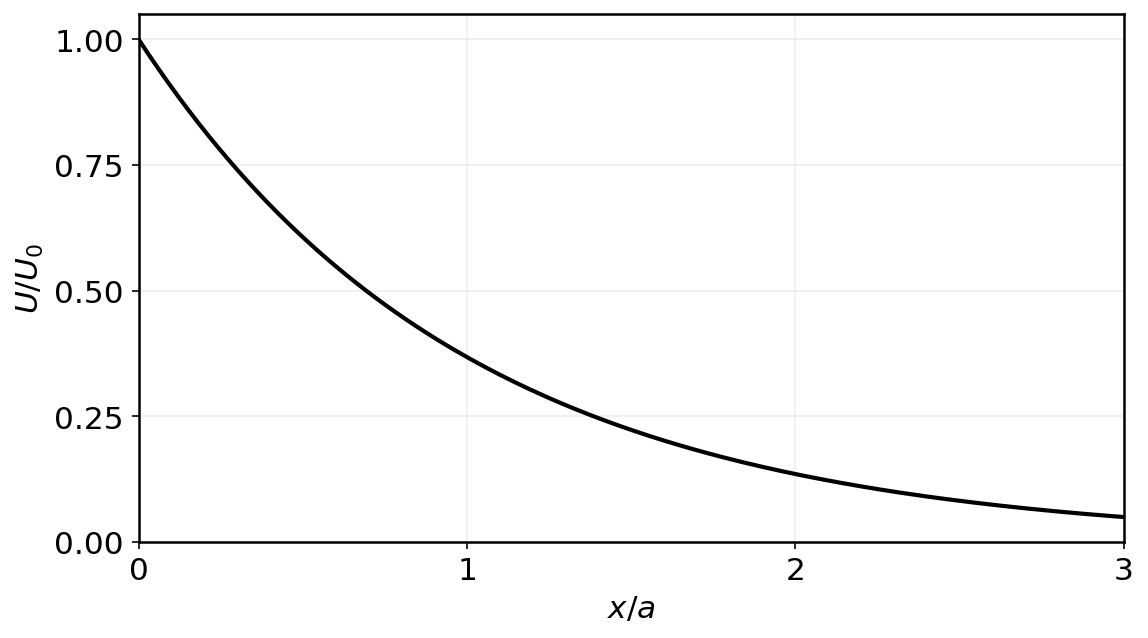
A one-dimensional potential energy function is given by U(x)=U0e−x/a, where U0 and a are positive constants. The graph of U(x) is shown above. Which of the following is a correct expression for the force on the object as a function of x?
A−aU0e−x/a
B−aU0ex/a
CaU0e−x/a
DaU0ex/a
Show answer and explanation
Answer: C
Choice C is correct. Fx=−dU/dx=(U0/a)e−x/a is positive and decreases with x. Choice A misses the negative sign in Fx=−dU/dx. Choice B has both the wrong direction and an increasing magnitude. Choice D has the correct direction but incorrectly changes the decaying exponential into a growing one.
Question 15
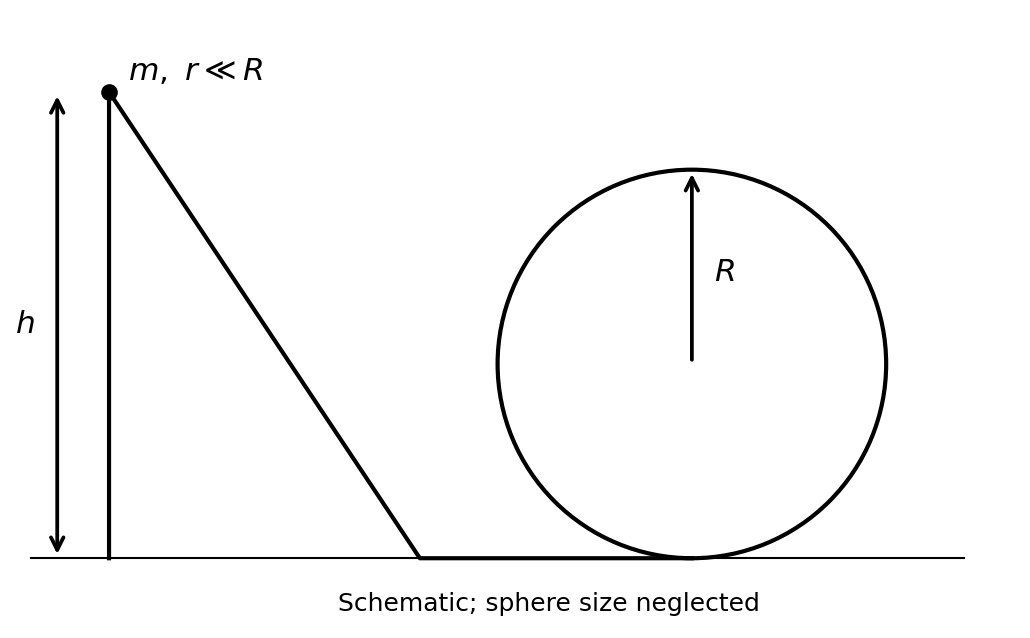
A small solid sphere rolls without slipping from rest down a track and around a vertical loop of radius R. Its rotational inertia is 2mr2/5, and r≪R so its size can be neglected in the loop geometry. Mechanical energy is conserved. Why is the minimum release height greater than 5R/2, the minimum for a sliding particle?
AThe sphere needs rotational as well as translational kinetic energy.
BThe track’s static friction dissipates mechanical energy during rolling.
CThe sphere’s mass increases because it rotates while translating.
DThe sphere needs a larger centripetal acceleration at the loop top.
Show answer and explanation
Answer: A
Choice A is correct. Contact at the top requires v2≥gR in the stated small-sphere approximation. For rolling, K=mv2/2+(2mr2/5)(v/r)2/2=7mv2/10, so the threshold energy gives hmin=2R+7R/10=2.7R>2.5R. Choice B contradicts ideal energy-conserving rolling. Choice C incorrectly changes the sphere’s mass. Choice D is wrong because the same contact condition applies to the sliding particle and the small rolling sphere.
Question 16
A uniform rod of mass M and length L is hinged at one end to a wall and held horizontal by a string attached to the free end. The string makes an angle θ above the horizontal. What is the tension T in the string?
A2cosθMg
B2sinθMg
CsinθMg
DcosθMg
Show answer and explanation
Answer: B
Choice B is correct. Taking torques about the hinge gives TLsinθ=Mg(L/2), so T=Mg/(2sinθ). Choice A uses the horizontal tension component instead of the perpendicular component. Choice C places the rod’s weight at its free end. Choice D makes both errors.
Ready for the full-length tests?
Five full-length AP Physics C: Mechanics practice tests, every unit of notes and step-by-step solutions. 7 days free.