Instructions: This free practice test has 16 multiple-choice questions from our full-length AP Precalculus practice tests. You will have 40 minutes, the same pace as the real exam.
It runs in the same test engine as our full-length tests: you can mark questions for review, cross out choices, open the calculator and move back and forth until time expires. When you finish, you will see every answer with a full explanation. No account needed.
Every question in this AP Precalculus practice test is below. The answer and its explanation stay closed until you open them, so you can work each one first.
Question 1
What is the exact value of sin(65π)−cos(34π)?
A0
B1
C21+3
D3
Show answer and explanation
Answer: B
The angle 65π is in Quadrant II with reference angle 6π, and sine is positive there, so sin(65π)=21. The angle 34π is in Quadrant III with reference angle 3π, and cosine is negative there, so cos(34π)=−21. Then sin(65π)−cos(34π)=21−(−21)=1 (B). (A) gives cos(34π) a positive sign, as if cosine were positive in Quadrant III: 21−21=0 (giving sin(65π) a negative sign leads to the same 0). (C) uses cos(34π)=−23, the sine of the reference angle 3π rather than its cosine: 21+23=21+3. (D) swaps the sine and cosine reference values for both angles, using 23 for the sine and −23 for the cosine: 23+23=3.
Question 2
Let a, b, and c be positive constants. Which of the following is equivalent to ln(c2a3b)?
A3lna+lnb−2lnc
B3lna+lnb+2lnc
Cln(3a)+lnb−ln(2c)
D3lna⋅lnb−2lnc
Show answer and explanation
Answer: A
By the quotient, product, and power rules, ln(c2a3b)=ln(a3)+lnb−ln(c2)=3lna+lnb−2lnc (A). (B) adds ln(c2), but a factor in the denominator is subtracted. (C) puts the exponents inside as factors: ln(a3)=3lna, not ln(3a). (D) multiplies ln(a3) and lnb, but the log of a product is a sum of logs.
Question 3
The functions f and g are given by f(x)=2x+1 and g(x)=x2−3. Which of the following is an expression for (f∘g)(x)?
A2x2−5
B2x2−2
C4x2+4x−2
D4x2+4x+1
Show answer and explanation
Answer: A
(f∘g)(x)=f(g(x))=2(x2−3)+1=2x2−6+1=2x2−5 (A). (B) does not distribute the 2: 2x2−3+1=2x2−2. (C) is g(f(x))=(2x+1)2−3=4x2+4x−2, the composition in the wrong order. (D) is (2x+1)2, which squares f(x) and drops the −3.
Question 4
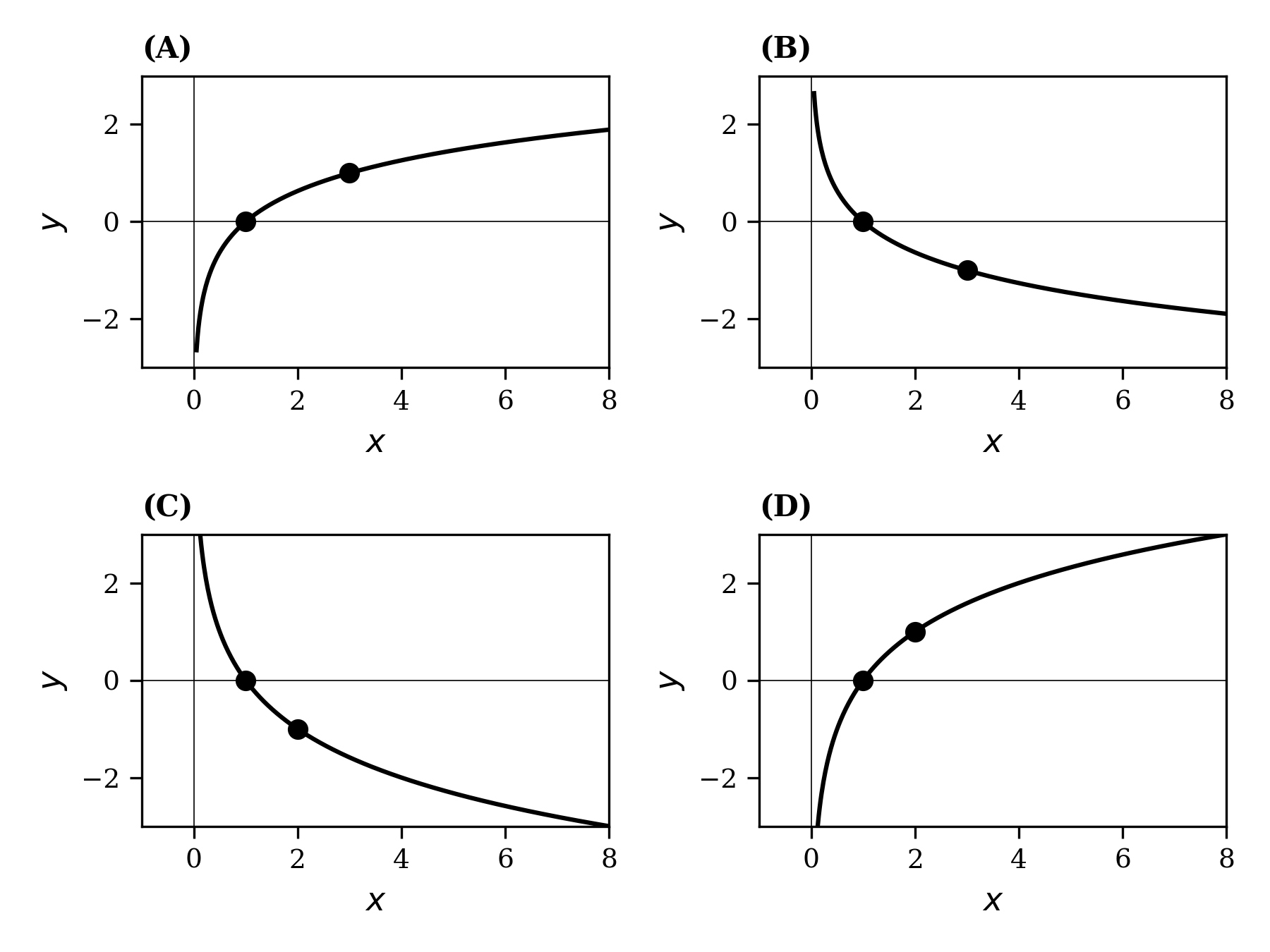
The function g is given by g(x)=log3(x). Which of the following is the graph of y=g(x) in the xy-plane?
AGraph A
BGraph B
CGraph C
DGraph D
Show answer and explanation
Answer: A
Since the base 3 is greater than 1, g(x)=log3(x) is increasing, with g(1)=0 and g(3)=1. Graph A is increasing and passes through (1,0) and (3,1) (A). Graph B passes through (3,−1); it is y=−log3(x), a reflection over the x-axis. Graph C is decreasing and passes through (2,−1), so it is y=log1/2(x). Graph D passes through (2,1), so it is y=log2(x).
Question 5
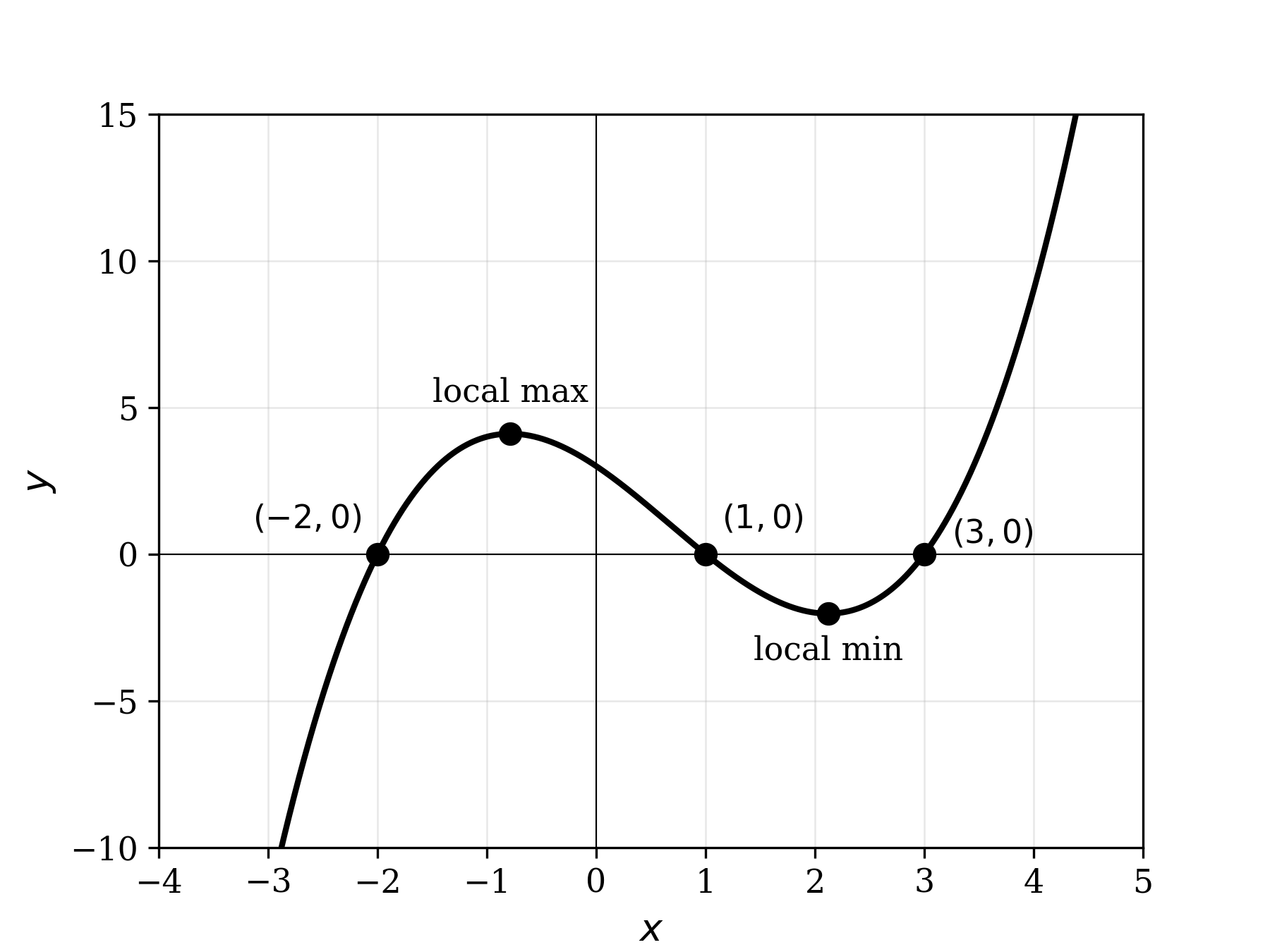
The figure shows the graph of a polynomial function f in the xy-plane. The graph has three real zeros and two turning points, as shown. What is the minimum degree of f?
A2
B3
C4
D5
Show answer and explanation
Answer: B
The graph crosses the x-axis at x=−2, x=1, and x=3, so f has at least three real zeros and its degree is at least 3. That rules out 2 (A): a quadratic has at most two real zeros and one turning point. The graph falls to the left and rises to the right, so the two ends go in opposite directions and the degree is odd; that rules out 4 (C). A polynomial of degree n has at most n−1 turning points, and two turning points fit degree 3. Degree 5 (D) is also possible, but it is not the minimum. The minimum degree is 3.
Question 6
The function h is given by h(x)=2x2+34x2−1. Which of the following describes the end behavior of h?
Ax→−∞limh(x)=−∞ and x→∞limh(x)=∞
Bx→−∞limh(x)=−2 and x→∞limh(x)=2
Cx→−∞limh(x)=2 and x→∞limh(x)=2
Dx→−∞limh(x)=−31 and x→∞limh(x)=−31
Show answer and explanation
Answer: C
The numerator and denominator both have degree 2, so h(x) approaches the ratio of the leading coefficients, 24=2, as x→−∞ and as x→∞. Choice A describes a numerator of higher degree than the denominator. Choice B gives opposite limits, but h(−x)=h(x), so both ends approach the same value. Choice D uses the ratio of the constant terms, −31, which is h(0), not the end behavior.
Question 7
The function f is given by f(θ)=sec(θ)tan(θ). Which of the following is equivalent to f(θ)?
Asin(θ)
Bcos(θ)
Ccsc(θ)
Dsec(θ)tan(θ)
Show answer and explanation
Answer: A
sec(θ)tan(θ)=cos(θ)sin(θ)⋅cos(θ)=sin(θ). Choice B is sec(θ)1; it drops the tan(θ). Choice C is the reciprocal of the correct result. Choice D multiplies tan(θ) by sec(θ) instead of dividing.
Question 8
A Ferris wheel has a radius of 30 feet and its center is 35 feet above the ground. The wheel completes one full revolution every 2 minutes. The height h, in feet, of a seat on the Ferris wheel above the ground at time t minutes is modeled by h(t)=−30cos(πt)+35. What is the height of the seat above the ground at t=1 minute?
A5 feet
B30 feet
C35 feet
D65 feet
Show answer and explanation
Answer: D
h(1)=−30cos(π)+35=−30(−1)+35=65 feet. Half a revolution after starting at the lowest point, the seat is at the top: the center height plus the radius. Choice A uses cos(π)=1. Choice B drops the +35 and gives only −30cos(π)=30. Choice C uses cos(π)=0, which gives the center height.
Question 9
A polynomial function p has an even degree and a positive leading coefficient. Which of the following statements about the end behavior of p is true?
Alimx→−∞p(x)=∞ and limx→∞p(x)=∞
Blimx→−∞p(x)=−∞ and limx→∞p(x)=−∞
Climx→−∞p(x)=−∞ and limx→∞p(x)=∞
Dlimx→−∞p(x)=∞ and limx→∞p(x)=−∞
Show answer and explanation
Answer: A
For large ∣x∣, p(x) behaves like its leading term axn with n even and a>0. Because n is even, xn>0 for both large positive and large negative x, so p(x)→∞ at both ends: limx→−∞p(x)=∞ and limx→∞p(x)=∞. (B) is the end behavior for an even degree with a negative leading coefficient. (C) is the end behavior for an odd degree with a positive leading coefficient. (D) is the end behavior for an odd degree with a negative leading coefficient.
Question 10
Let a and b be positive constants. Which of the following is equivalent to log3(a)+2log3(b)−log3(a2)?
Alog3(a3b2)
Blog3(b2)
Clog3(ab2)
Dlog3(b2a)
Show answer and explanation
Answer: C
Use the power rule, then combine: log3(a)+2log3(b)−log3(a2)=log3(a)+log3(b2)−log3(a2)=log3(a2ab2)=log3(ab2). (A) adds log3(a2) instead of subtracting it, giving log3(a⋅b2⋅a2). (B) cancels a against a2 completely, as if a2a=1. (D) inverts the result by subtracting in the wrong order.
Question 11
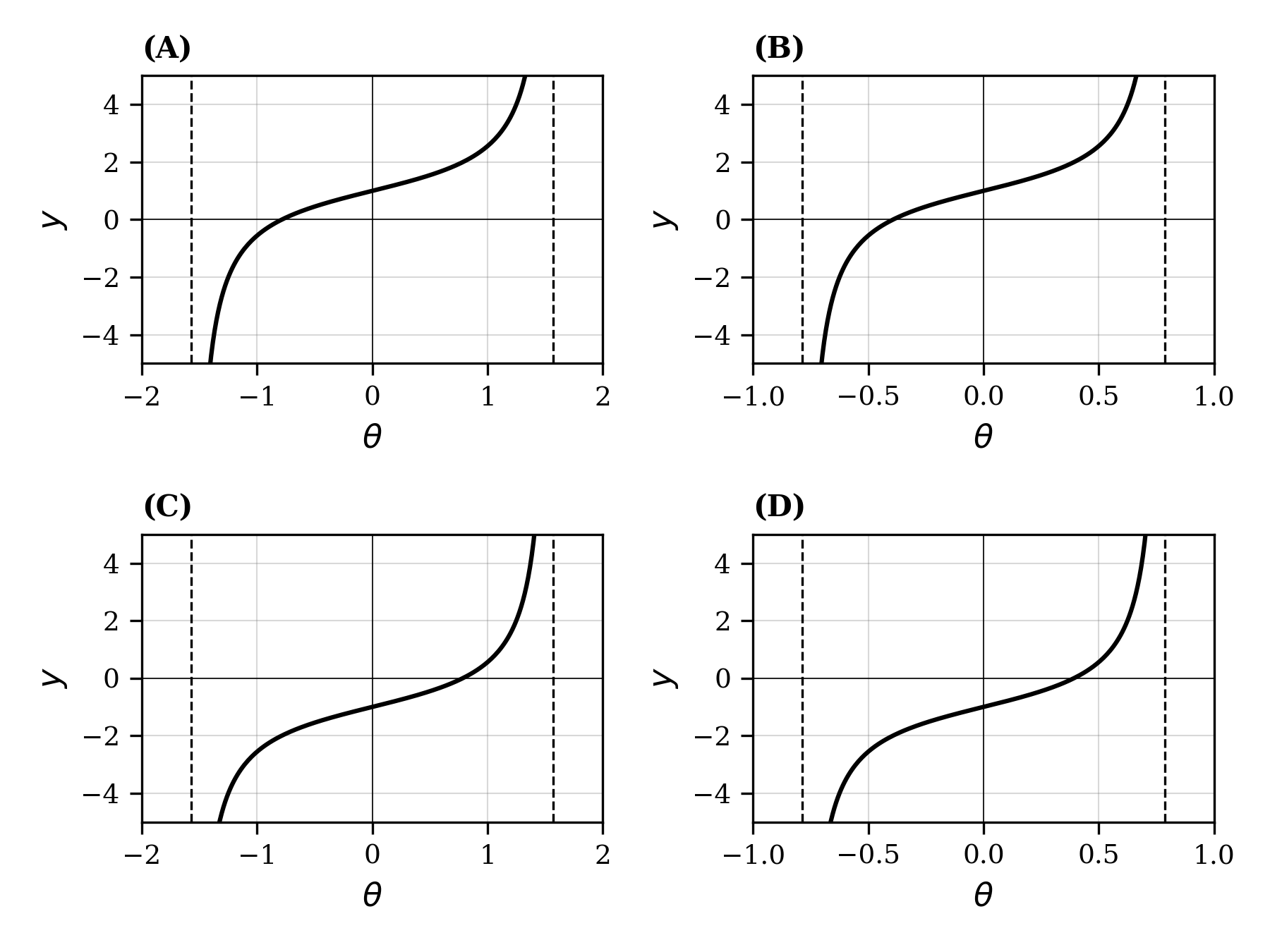
The function f is given by f(θ)=tan(2θ)+1. Which of the following could be the graph of y=f(θ) in the θy-plane?
AGraph A
BGraph B
CGraph C
DGraph D
Show answer and explanation
Answer: B
The period of tan(2θ) is 2π, so the vertical asymptotes nearest the origin are at θ=±4π≈±0.785. The shift +1 makes f(0)=tan(0)+1=1. Graph B has asymptotes at about ±0.785 and passes through (0,1). (A) passes through (0,1) but has asymptotes at ±2π, the period-π graph of tan(θ)+1, which ignores the coefficient 2. (C) has period π and passes through (0,−1), ignoring the coefficient 2 and reversing the shift. (D) has the correct period but passes through (0,−1), the graph of tan(2θ)−1.
Question 12
Which of the following rational functions has a zero at x=4, a vertical asymptote at x=−1, a hole at x=2, and a horizontal asymptote of y=1?
Af(x)=(x+1)(x−3)(x−2)(x−4)(x−2)
Bf(x)=(x+1)(x−2)(x+4)(x−2)
Cf(x)=(x+1)(x+2)(x−4)(x+2)
Df(x)=(x+1)(x−2)(x−4)(x−2)
Show answer and explanation
Answer: D
A zero at x=4 needs the factor x−4 in the numerator only. A hole at x=2 needs x−2 in both numerator and denominator. A vertical asymptote at x=−1 needs x+1 in the denominator only. Choice (D) has all three, and after canceling it is x+1x−4, whose numerator and denominator have equal degree and leading coefficients 1 and 1, so the horizontal asymptote is y=1. (A) has a denominator of degree 3 and a numerator of degree 2, so its horizontal asymptote is y=0, and it has an extra vertical asymptote at x=3. (B) has a zero at x=−4, not x=4. (C) has its hole at x=−2, not x=2.
Question 13
A certain city experiences the same weather pattern every 12 months. The average monthly rainfall increases from a minimum in the winter to a maximum in the summer and then decreases back to the minimum. Which of the following best describes the 12-month interval?
AThe amplitude of the rainfall pattern
BThe midline of the rainfall pattern
CThe period of the rainfall pattern
DThe phase shift of the rainfall pattern
Show answer and explanation
Answer: C
A periodic pattern repeats at regular intervals, and the length of one complete cycle is the period. The rainfall pattern repeats every 12 months, so 12 months is the period (C). The amplitude (A) is half the difference between the maximum and minimum rainfall, which is measured in rainfall units, not months. The midline (B) is the rainfall value halfway between the maximum and minimum, also not a time. The phase shift (D) is a horizontal translation that sets where a cycle starts, not how long a cycle lasts.
Question 14
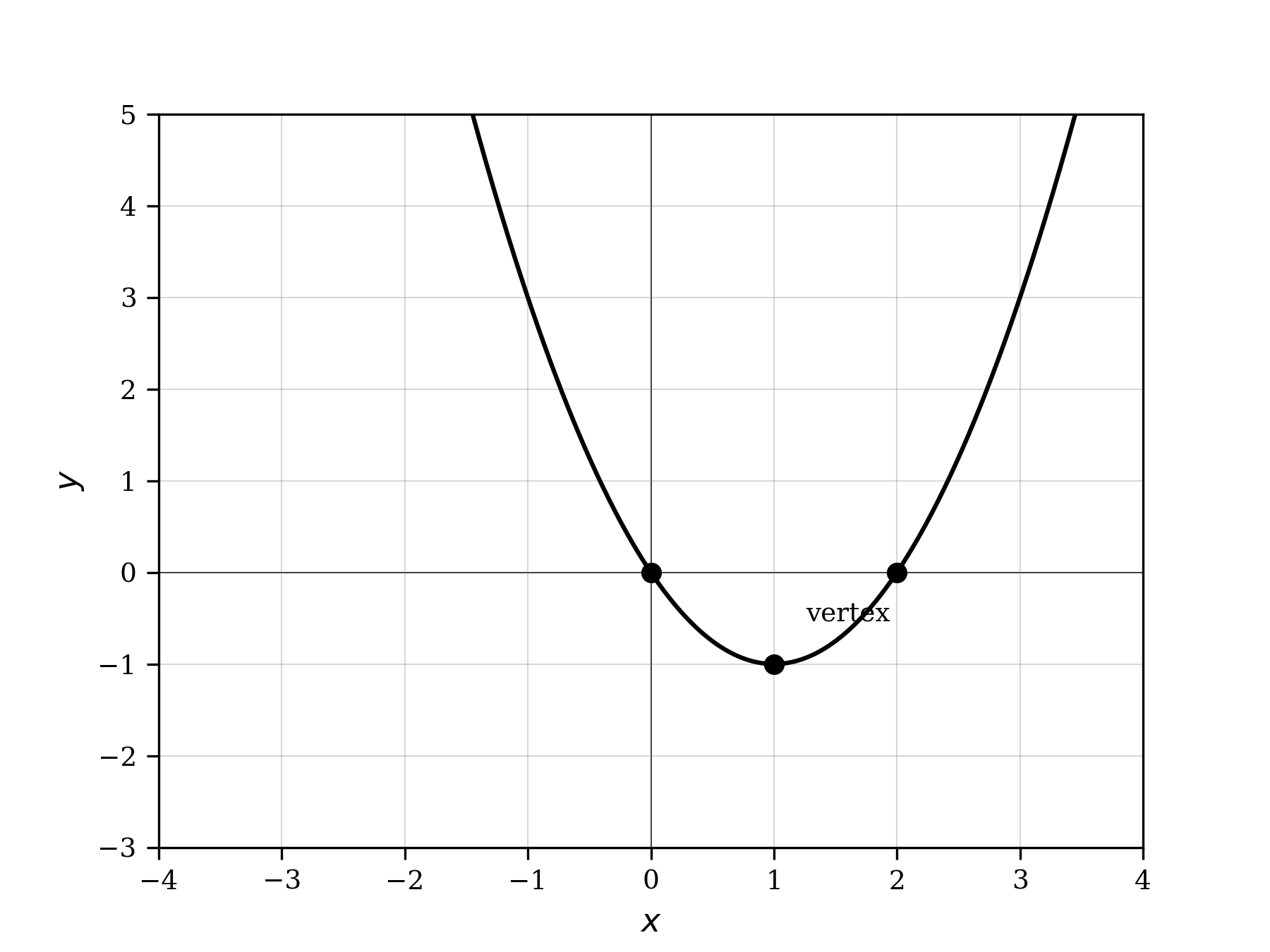
The graph of the quadratic function f is shown in the figure. The function g is defined by g(x)=f(−x). Which of the following describes the graph of g?
AA parabola opening upward with vertex (−1,−1) and x-intercepts at x=−2 and x=0
BA parabola opening downward with vertex (1,1) and x-intercepts at x=0 and x=2
CA parabola opening downward with vertex (−1,1) and x-intercepts at x=−2 and x=0
DA parabola opening upward with vertex (1,−1) and x-intercepts at x=0 and x=2
Show answer and explanation
Answer: A
The transformation g(x)=f(−x) reflects the graph of f across the y-axis, sending each point (a,b) to (−a,b). The vertex (1,−1) goes to (−1,−1) and the x-intercepts 0 and 2 go to 0 and −2; the parabola still opens upward (A). Choice B is −f(x), a reflection across the x-axis. Choice C is −f(−x), a reflection across both axes. Choice D is f itself, which would require f to be symmetric about the y-axis, but the graph of f is symmetric about x=1.
Question 15
A rational function h must satisfy the following conditions: a horizontal asymptote at y=2, a vertical asymptote at x=−1, a zero at x=4, and h(0)=−8. Which of the following could be an expression for h(x)?
Ax−12(x+4)
Bx−12(x−4)
Cx+12(x+4)
Dx+12(x−4)
Show answer and explanation
Answer: D
A zero at x=4 needs the factor (x−4) in the numerator, a vertical asymptote at x=−1 needs (x+1) in the denominator, and a horizontal asymptote y=2 with equal degrees needs leading-coefficient ratio 2. So h(x)=x+12(x−4), and h(0)=1−8=−8 checks (D). Choice A has its zero at x=−4 and its asymptote at x=1 (h(0)=−8 also, which is why the other conditions must be checked). Choice B has the right zero but its vertical asymptote at x=1. Choice C has the right asymptote but its zero at x=−4, and h(0)=8.
Question 16
The polar function r is given by r(θ)=3+cos(θ). At θ=2π, is the distance between the origin and the point on the curve increasing, decreasing, or neither?
AIncreasing, because the rate of change of r with respect to θ is positive at θ=2π
BDecreasing, because the rate of change of r with respect to θ is negative at θ=2π
CNeither increasing nor decreasing, because the rate of change of r with respect to θ is zero at θ=2π
DDecreasing, because r(2π)<r(0)
Show answer and explanation
Answer: B
The distance from the origin to the point on the curve is ∣r(θ)∣, and r(θ)=3+cos(θ) is always positive. As θ increases through 2π, cos(θ) is decreasing (it goes from positive values to negative values), so r is decreasing there and the rate of change of r with respect to θ is negative: the distance is decreasing (B). Choice A has the wrong sign. Choice C would require r to have a maximum or minimum at θ=2π, but cos(θ) has its extreme values at θ=0 and θ=π. Choice D reaches the right conclusion for the wrong reason: comparing r(2π) with r(0) gives only an average change over [0,2π], not the behavior at θ=2π.
Ready for the full-length tests?
Five full-length AP Precalculus practice tests, every unit of notes and step-by-step solutions. 7 days free.