← AP Prep

AP U.S. History Practice Test

Instructions: This free practice test has 16 multiple-choice questions from our full-length AP U.S. History practice tests. You will have 16 minutes, the same pace as the real exam.

It runs in the same test engine as our full-length tests: you can mark questions for review, cross out choices and move back and forth until time expires. When you finish, you will see every answer with a full explanation. No account needed.

Or

Go Back

All 16 questions, with answers

Every question in this AP U.S. History practice test is below. The answer and its explanation stay closed until you open them, so you can work each one first.

Questions 1 to 3

We find customs among these peoples that conflict with our holy faith, yet we also hear questions that encourage us to continue our instruction. We learn their language so that we may teach Christian doctrine more clearly. Their ceremonies show a concern for spiritual matters, but we believe those practices must give way to Christian worship. Our task is to bring these communities into the Church, even when their understanding of our teachings differs from our own.

Original illustrative account written for this practice test in the voice of a Spanish Franciscan missionary in sixteenth-century New Spain.

Question 1

Which broader development best explains the activity described in the account?
  • AEnglish planters’ growing reliance on enslaved African labor
  • BFrench traders’ alliances in the Great Lakes fur trade
  • CDutch merchants’ expansion of Atlantic commercial networks
  • DSpanish efforts to extend Christian rule in the Americas
Show answer and explanation

Answer: D

D supplies the imperial and religious context for a Spanish missionary seeking conversion in New Spain. A concerns labor in a different colonial setting. B concerns a different empire and commercial activity. C concerns Dutch commerce rather than Spanish religious instruction.

Question 2

Which detail most clearly shows that cultural exchange could accompany efforts to impose European beliefs?
  • AThe speaker learns a local language in order to teach Christianity
  • BThe speaker treats local religious ceremonies as equal to Christian worship
  • CThe speaker asks colonial merchants to finance a mission school
  • DThe speaker proposes replacing Spanish officials with local rulers
Show answer and explanation

Answer: A

A combines the adoption of a local language with a stated goal of conversion. B conflicts with the assertion that local ceremonies must give way to Christianity. C introduces merchants and a school that are absent from the account. D introduces a transfer of political authority that the speaker never proposes.

Question 3

Which perspective is most evident in the account?
  • AA missionary who considers Christian conversion a duty
  • BAn official concerned mainly with collecting royal tribute
  • CAn Indigenous diplomat negotiating an alliance with Spain
  • DA merchant seeking access to Indigenous trading networks
Show answer and explanation

Answer: A

A fits the repeated references to teaching doctrine and bringing communities into the Church. B would emphasize revenue or tribute, neither of which appears. C would present an Indigenous diplomatic position rather than call local worship mistaken. D would emphasize exchange and markets rather than conversion.

Question 4

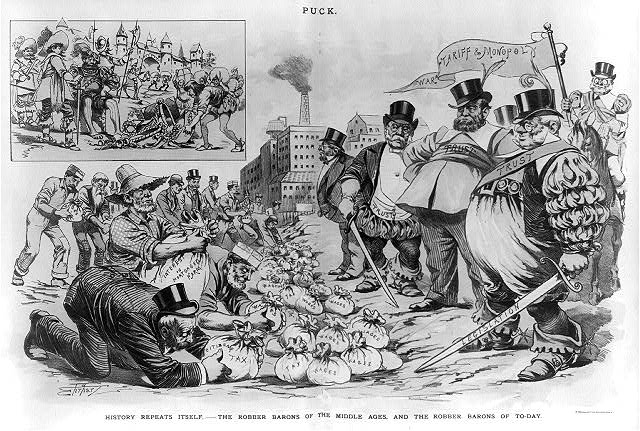
A cartoon with an inset of armed medieval figures receiving goods. In the main scene, oversized men in top hats, including figures labeled Trust, stand above smaller people and bags of money; A citizen in a dark coat kneels beside a bag marked Tax; Uncle Sam holds a banner at upper right reading Tariff & Monopoly. The caption compares robber barons of the Middle Ages and of the present day.
Questions 37-39 refer to the following image. The political cartoon below was published in the late 1880s.

S. D. Ehrhart, History Repeats Itself—The Robber Barons of the Middle Ages, and the Robber Barons of To-Day, Puck, volume 26, issue 661, November 6, 1889, centerfold. Verified against the digitized primary issue, Internet Archive.

Which later action most closely addressed the cartoon’s criticism of concentrated corporate power?
  • AThe enforcement of the Fugitive Slave Act in Northern communities
  • BThe establishment of racial segregation in Southern public facilities
  • CThe adoption of immigration quotas based on national origin
  • DProgressive federal antitrust suits against large business combinations
Show answer and explanation

Answer: D

D directly targeted concentrated corporate power of the kind depicted. A concerns slavery before this cartoon. B concerns racial segregation. C concerns immigration restriction. Those policies did not address the cartoon’s central criticism of trusts and monopoly.

Questions 5 to 7

That it is inseparably essential to the freedom of a people, and the undoubted right of Englishmen, that no taxes be imposed on them, but with their own consent, given personally, or by their representatives. That the people of these colonies are not, and from their local circumstances cannot be, represented in the House of Commons in Great-Britain. That the only representatives of the people of these colonies, are persons chosen therein by themselves, and that no taxes ever have been, or can be constitutionally imposed on them, but by their respective legislatures.

Declarations of the Stamp Act Congress, October 19, 1765, resolutions 3–5.

Question 5

Which of the following most directly describes the historical context for the meeting that produced the excerpt?
  • AThe fighting between colonial militia and British troops in Massachusetts
  • BThe circulation of Common Sense among supporters of republican independence
  • CThe peace negotiations recognizing the independence of the United States
  • DThe expansion of British taxation after the costs of the Seven Years’ War
Show answer and explanation

Answer: D

D is correct: The Stamp Act followed Britain’s expensive Seven Years’ War and efforts to raise colonial revenue. A is incorrect: Lexington and Concord occurred in 1775, a decade after the congress. B is incorrect: Common Sense appeared in 1776. C is incorrect: The peace recognizing American independence was negotiated in 1783.

Question 6

Which of the following best explains the colonists' argument as expressed in the excerpt?
  • ATaxation without colonial consent violates the constitutional rights of subjects
  • BIndependence is necessary because monarchy cannot protect the rights of any people
  • CColonial governments should tax commerce between colonies to finance defense
  • DColonial delegates should take seats in Parliament to approve imperial taxes
Show answer and explanation

Answer: A

A is correct: The delegates connect taxation to consent through representatives chosen in the colonies. B is incorrect: They invoke the rights of Englishmen without declaring independence or rejecting monarchy. C is incorrect: The issue is external taxation without colonial consent, not a proposal for intercolonial tariffs. D is incorrect: They say local circumstances prevent representation in the House of Commons and defend their own legislatures.

Question 7

Which feature of the excerpt best supports the conclusion that the delegates still sought reform within the British Empire?
  • ATheir demand to redistribute land among colonial farmers and laborers
  • BTheir appeal to the rights of Englishmen and existing colonial legislatures
  • CTheir proposal to negotiate an independent alliance with the French monarchy
  • DTheir objection to religious restrictions on membership in colonial assemblies
Show answer and explanation

Answer: B

B is correct: The appeal to English rights and existing assemblies seeks constitutional protection within the imperial relationship. A is incorrect: The excerpt makes no demand for land redistribution. C is incorrect: No independent French alliance is proposed. D is incorrect: Religious membership restrictions are not addressed.
Question 8

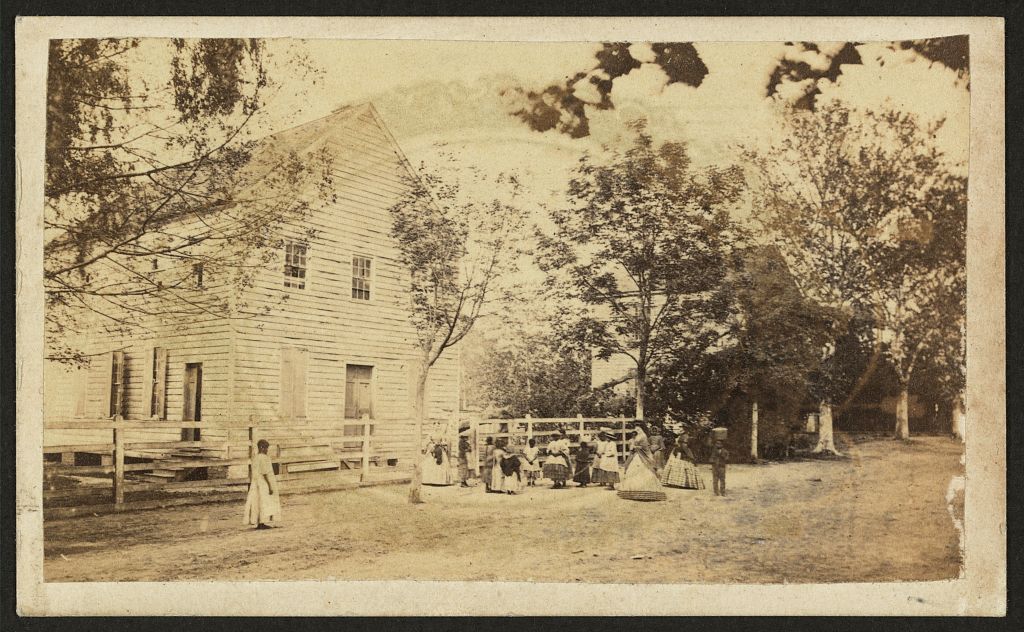
An albumen photograph on a carte de visite mount. A two-story wooden building stands at left, with several windows and a fence in front. A group of Black adults and children stands along the road beside it. Trees surround the building. The Library of Congress catalog identifies the scene, with uncertainty, as a freedmen’s school in South Carolina, between 1865 and 1870; the picture itself contains no visible school sign.
Questions 27–29 refer to the following photograph. The Library of Congress catalog identifies the location as “[Freedmen’s school?, South Carolina]”; the question mark indicates that this identification is uncertain.

Sam A. Cooley, [Freedmen’s school?, South Carolina], between 1865 and 1870. Library of Congress, item 2010647795, LC-DIG-ppmsca-10984.

Which development most directly created conditions for the expansion of schools for freedpeople during the period of the photograph?
  • AThe decision of antebellum southern governments to educate enslaved children
  • BThe Supreme Court’s ruling that racially segregated public schools were unequal
  • CThe adoption of federal vocational-training programs during the New Deal
  • DThe Union victory and abolition of slavery through the Thirteenth Amendment
Show answer and explanation

Answer: D

D is correct: Union victory and the abolition of slavery in 1865 opened opportunities for freedpeople, who pursued schools with community and outside support. Later amendments are not required to have preceded this photograph. A is incorrect: Antebellum governments generally restricted rather than established schooling for enslaved people. B is incorrect: Brown v. Board of Education was decided in 1954. C is incorrect: New Deal training programs date to the 1930s.

Questions 9 to 11

The newcomers crowd into industrial cities and compete with American workmen for employment. Many bring languages, religious practices, and political ideas unfamiliar to those already here. Advocates of restriction argue that immigration should be limited to protect wages and preserve the nation’s character. They offer these assertions as reasons for tighter admission requirements.

Original practice passage presenting nativist arguments in U.S. immigration debates of the 1890s; written for this test.

Question 9

Which of the following types of evidence does the excerpt use to support its anti-immigration argument?
  • AComparisons of measured wage changes across American cities
  • BAssertions about competition, cultural difference, and national identity
  • CAccounts by immigrants of their experiences in industrial workplaces
  • DComparison of admission requirements in different receiving countries
Show answer and explanation

Answer: B

A is incorrect: The passage supplies no measured cross-city wage data. B is correct: Employment competition, unfamiliar cultural practices, and national character are its stated grounds for restriction. C is incorrect: No immigrant narrates a personal experience. D is incorrect: No comparison of different countries’ admission laws is provided.

Question 10

Which of the following developments is most directly described by the concerns expressed in the excerpt?
  • AGrowing immigration from Southern and Eastern Europe to industrial cities
  • BThe forced relocation of Native peoples to western reservations
  • CMovement of Black Americans from rural areas to Southern factory towns
  • DReturn migration from American cities to European communities
Show answer and explanation

Answer: A

A is correct: Urban employment and cultural anxieties were prominent responses to immigration from Southern and Eastern Europe. B is incorrect: Native removal does not describe the foreign newcomers discussed. C is incorrect: Domestic Black migration is not immigration and does not explain the passage’s concern about foreign customs. D is incorrect: Return migration occurred, but the passage addresses arrivals and proposed restrictions.

Question 11

For measuring immigrants’ actual economic contributions, the perspective represented in the passage is limited because it
  • Adescribes migration before the growth of industrial cities
  • Bconcentrates on diplomatic relations with European governments
  • Casserts harmful effects without measuring immigrants’ contributions
  • Dcompares statistical estimates collected in different census years
Show answer and explanation

Answer: C

A is incorrect: The passage explicitly concerns industrial cities, not a period before their growth. B is incorrect: Its subject is employment and culture within the United States, not diplomatic relations. C is correct: It supplies nativist assertions rather than evidence measuring immigrants’ work or contributions. D is incorrect: No statistical comparison appears in the passage.

Question 12

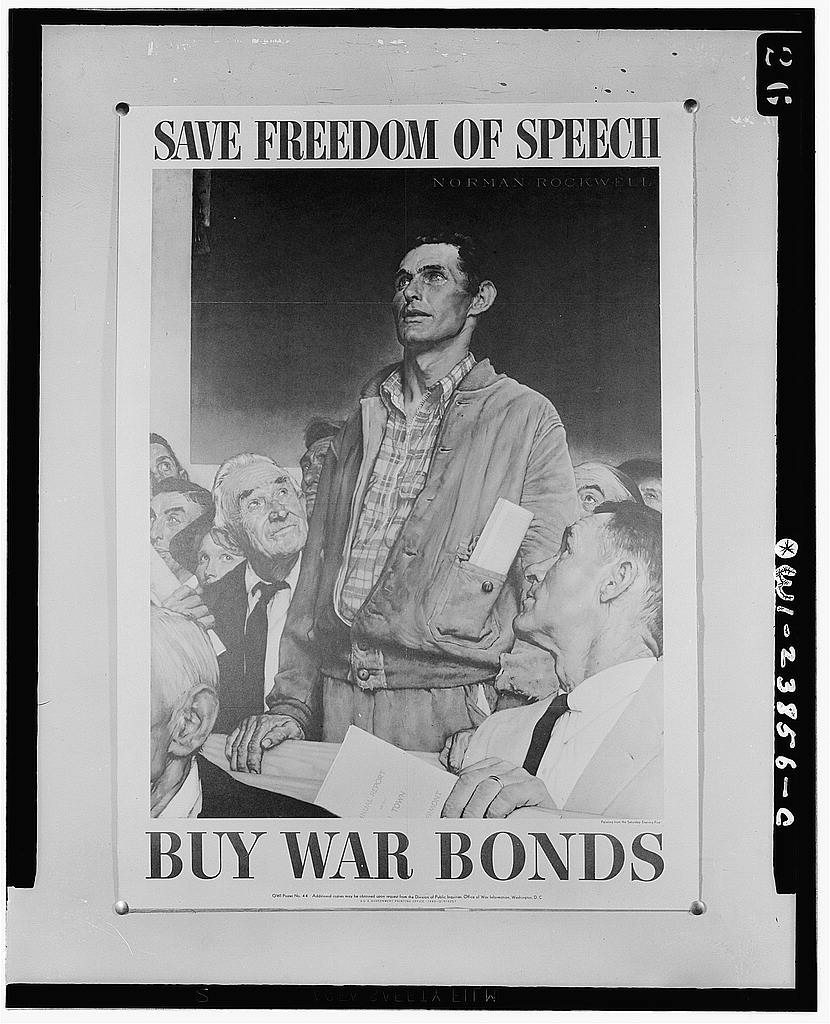
A reproduction of Norman Rockwell's 'Save Freedom of Speech' painting, created in 1943, showing a working-class man standing and speaking at a town meeting while neighbors listen respectfully. The poster includes text urging Americans to 'Buy War Bonds' to support the war effort.
Questions 38-40 refer to the following image from the 1940s.

Norman Rockwell, Save Freedom of Speech, Buy War Bonds, 1943. Courtesy of the Library of Congress

The wartime propaganda depicted in the image most directly reflects a continuity with which of the following earlier developments?
  • ALiberty Loan campaigns financing American participation in World War I
  • BNeutrality legislation limiting involvement in foreign wars during the 1930s
  • CCampaigns for the constitutional recognition of women’s voting rights
  • DPublic enforcement campaigns associated with national Prohibition
Show answer and explanation

Answer: A

A is correct: World War I Liberty Loan drives also mobilized civilian money for war. B is incorrect: Neutrality laws sought to limit foreign-war involvement rather than fund it. C is incorrect: Suffrage campaigns concerned voting rights rather than war finance. D is incorrect: Prohibition enforcement does not supply the continuity in civilian war financing.

Question 13

The war with Mexico enlarged the territory claimed by the United States, but victory did not settle how that land would be governed. During the fighting, the Wilmot Proviso proposed excluding slavery from territory acquired from Mexico. Although the proposal did not become law, the controversy exposed a sectional divide. The Mexican Cession therefore expanded the republic’s land while intensifying an argument over slavery’s future within it. To describe the war simply as an achievement of continental expansion misses that political consequence.

From an original secondary historical interpretation of the Mexican-American War and the sectional crisis, written for this examination.

Which federal measure most directly attempted to settle the territorial dispute described in the excerpt?
  • AThe Northwest Ordinance establishing a framework for territory north of the Ohio River
  • BCompromise of 1850 provisions for California and the Mexican Cession
  • CThe Kansas-Nebraska Act applying popular sovereignty to territory from the Louisiana Purchase
  • DThe Homestead Act granting land to settlers who met residence and cultivation requirements
Show answer and explanation

Answer: B

A is incorrect: The 1787 ordinance predates the Mexican Cession and concerns a different region. B is correct: The 1850 settlement addressed California and the remaining cession as well as related sectional issues. C is incorrect: The 1854 act concerned the Louisiana Purchase region, not the direct organization of the Mexican Cession. D is incorrect: The 1862 land law did not settle the slavery controversy raised during the Mexican War.

Questions 14 to 16

Federal agencies now reach into fields once left to households, businesses, and local governments. Their defenders promise security, but every new rule requires administrators and limits the choices of those who must obey. Recovery should rest on private enterprise and voluntary effort rather than a permanent enlargement of Washington’s authority. Americans can relieve distress without allowing emergency programs to become the ordinary form of economic government.

From an original political argument written in the style of conservative criticism of the New Deal, 1936.

Question 14

Which argument does the speaker make?
  • AFederal relief should be extended into a permanent national employment guarantee
  • BFederal regulation should replace market competition in setting industrial output
  • CFederal control should be expanded to include the ownership of commercial banks
  • DFederal economic intervention risks weakening private initiative and local authority
Show answer and explanation

Answer: D

A is incorrect: The speaker objects to making emergency programs a permanent governing system. B is incorrect: He defends private enterprise rather than administrative replacement of competition. C is incorrect: Bank ownership by the government would enlarge the authority he opposes. D is correct: He presents regulatory expansion as a threat to enterprise, choice, and decentralized authority.

Question 15

Which later proposal most closely reflected the economic approach advocated in the excerpt?
  • AExtending federal insurance to older Americans through the creation of Medicare
  • BIncreasing federal funding for employment through the Works Progress Administration
  • CReducing federal business regulations and lowering personal income tax rates
  • DExpanding federal responsibility for health care through the creation of Medicaid
Show answer and explanation

Answer: C

A is incorrect: Medicare expanded federal social provision rather than limiting it. B is incorrect: The WPA was a New Deal public employment program the argument criticizes. C is correct: Tax reduction and regulatory relief, prominent in Reagan’s 1981 program, continued this preference for private economic activity. D is incorrect: Medicaid expanded public health coverage rather than reducing regulatory authority.

Question 16

Which additional evidence would most help determine whether the speaker’s argument fairly describes the results of New Deal programs?
  • ASpeeches by officials defending the constitutionality of federal relief policies
  • BRecords of relief benefits compared with the programs’ administrative costs
  • CElection returns showing the Republican vote in the 1928 presidential election
  • DEditorial cartoons about presidential power during the national bank controversy
Show answer and explanation

Answer: B

A is incorrect: Officials’ speeches supply another argument about legal authority, rather than direct evidence of relief programs’ results. B is correct: Evidence of employment, income, and administrative costs permits a test of benefits and burdens rather than assuming the speaker’s claims. C is incorrect: The 1928 election preceded the New Deal and cannot establish its effects. D is incorrect: Bank War cartoons concern an earlier controversy and do not measure the effects of 1930s relief.

Ready for the full-length tests?

Five full-length AP U.S. History practice tests, every unit of notes and step-by-step solutions. 7 days free.

Start my free 7 days →