SAT Math Formulas and Reference Sheet
Yes, the digital SAT gives you a math reference sheet. In every Math module you can open it from the Reference button in the Bluebook app. It lists 12 formulas and 3 facts, and all of them are geometry: area and circumference of a circle, area of a rectangle and triangle, the Pythagorean theorem, the two special right triangles, five volume formulas, and the facts that a circle has 360° (2π radians) and a triangle's angles sum to 180°. Algebra, statistics and trigonometry formulas are not on it, so you need to memorize those.
Last verified against College Board's official practice test and Bluebook pages: November 1, 2026.
On this page
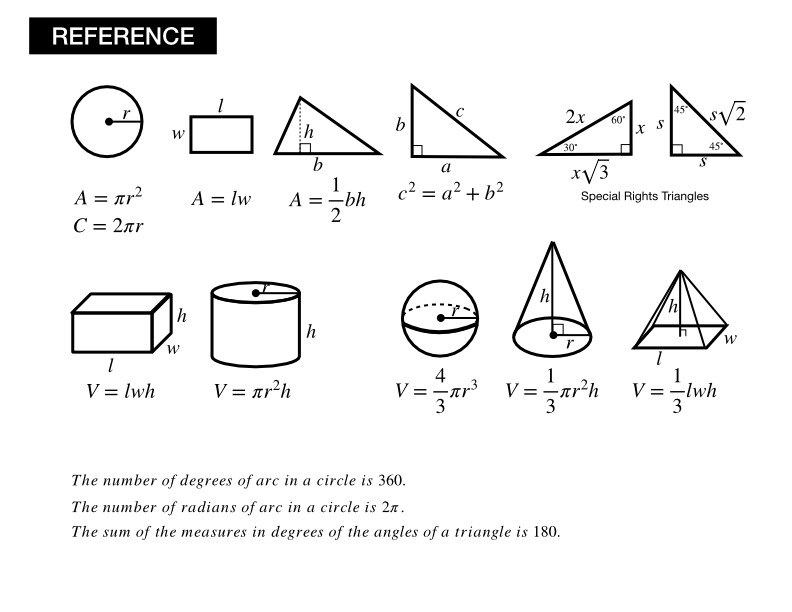
Every formula on the SAT reference sheet
All the formulas on the sheet are geometry related, so it only helps on geometry and trigonometry questions. Geometry and Trigonometry is about 15% of the Math section, around 5 to 7 of its 44 questions. There are formulas for areas, volumes and triangle properties.
The formulas for the other topics on the Math section, such as algebra, are not provided. Algebra and Advanced Math together make up about 70% of the section, so study the formulas you have to memorize too, not just these geometry ones.
Circle
The area of a circle is given by the formula where is the radius of the circle. This formula calculates the space enclosed within the circle.
The circumference of a circle is calculated using , which gives the distance around the circle. This is crucial for problems involving the perimeter of circular shapes. For circle equations, arcs and sectors, see SAT circles.
Rectangle
The area of a rectangle is found using , where is the length and is the width. This formula helps determine the amount of space within the rectangle.
Understanding this formula is essential for solving problems related to rectangular plots, rooms, or any scenarios involving rectangular dimensions.
Triangle
The area of a triangle is given by , where is the base and is the height. This formula calculates the space within the triangle.
The sum of the measures in degrees of the angles of a triangle is 180, a fundamental property for solving problems involving triangles.
The Pythagorean Theorem, , is used to find the length of the sides in a right triangle. This is crucial for solving problems involving distances and lengths in geometry.
Special Right Triangles
The 30-60-90 triangle has sides in the ratio , which simplifies many trigonometry problems by providing consistent side ratios.
The 45-45-90 triangle has sides in the ratio , which is useful for problems involving isosceles right triangles.
Rectangular Prism
The volume of a rectangular prism is found using , where is the length, is the width, and is the height. This formula calculates the space within the prism.
This is important for solving problems related to the capacity of boxes, rooms, and other rectangular objects.
Cylinder
The volume of a cylinder is given by , where is the radius of the base and is the height. This formula calculates the space within the cylinder.
This is essential for problems involving cylindrical containers, pipes, and similar objects.
Sphere
The volume of a sphere is calculated using , where is the radius. This formula determines the space within the sphere.
Understanding this formula is crucial for solving problems involving balls, planets, and other spherical objects.
Cone
The volume of a cone is found using , where is the radius of the base and is the height. This formula calculates the space within the cone.
This is important for problems related to conical containers, ice cream cones, and similar shapes.
Pyramid
The volume of a pyramid is given by , where is the length, is the width, and is the height. This formula calculates the space within the pyramid.
Understanding this formula helps in solving problems related to pyramidal structures and objects.
Arcs and Radians
The number of degrees of arc in a circle is 360, which is essential for problems involving angles and circles.
The number of radians of arc in a circle is , providing an alternative way to measure angles in trigonometry problems.
Quiz: is it on the reference sheet?
For each formula, decide whether Bluebook gives it to you or you have to memorize it.
- Volume of a cone:
- Quadratic formula:
- 30-60-90 triangle sides:
- Slope:
- Equation of a circle:
- Pythagorean theorem:
- Sine (SOH-CAH-TOA):
- Volume of a sphere:
- Arc length:
- Vertex form of a parabola:
Formulas to memorize for the SAT (not on the reference sheet)
These come up on the SAT and are not on the sheet. Most are algebra and advanced math, which is where most of the section's points are.
| Topic | Formula |
|---|---|
| Slope | |
| Slope-intercept form | |
| Point-slope form | |
| Parallel and perpendicular lines | |
| Quadratic formula | |
| Discriminant (number of solutions) | |
| Vertex form | |
| Exponent rules | |
| Exponential growth or decay | |
| Percent change | |
| Mean | |
| Distance and midpoint | |
| Equation of a circle | |
| SOH-CAH-TOA | |
| Complementary angles | |
| Arc length and sector area | |
| Degrees to radians |
For practice with the trig and circle formulas, see SAT trigonometry. For the algebra side, see SAT Advanced Math practice.
How to use the reference sheet on test day
- Open it from Bluebook. The Reference button sits in the toolbar of both Math modules, next to the built-in Desmos calculator. You can open it as often as you like.
- Don't rely on it for speed. You have 35 minutes for each 22-question module, about 1.6 minutes per question. Knowing the formulas by heart saves the time it takes to open and scan the sheet.
- Let Desmos do the algebra. Graphing an equation often replaces the quadratic formula or a system of equations. See our Desmos guide for the SAT.
- Practice in Bluebook format. Use the sheet during full-length SAT practice tests so test day feels familiar.
FAQ
Do you get a formula sheet on the SAT?
Yes. Every digital SAT Math module has a reference sheet you can open from the Reference button in the Bluebook app at any time. It lists 12 geometry formulas (area, volume, the Pythagorean theorem and the two special right triangles) and 3 facts about angles and arcs.
What formulas are on the SAT reference sheet?
Area of a circle, circumference, area of a rectangle, area of a triangle, the Pythagorean theorem, the 30-60-90 and 45-45-90 triangles, and the volumes of a rectangular prism, cylinder, sphere, cone and pyramid. It also states that a circle has 360 degrees and 2π radians of arc and that a triangle's angles add up to 180 degrees.
What formulas do I need to memorize for the SAT?
Everything outside geometry: slope, slope-intercept and point-slope form, the quadratic formula and discriminant, vertex form, exponent rules, percent change, mean and median, the circle equation, SOH-CAH-TOA, and arc length and sector area. None of these are on the reference sheet.
Is the SAT reference sheet the same as the PSAT one?
Yes. The PSAT/NMSQT, PSAT 10 and PSAT 8/9 use the same Bluebook reference sheet as the SAT, with the same formulas and facts.
Can I use a calculator on the whole SAT Math section?
Yes. A calculator is allowed on every question in both Math modules. Bluebook has a built-in Desmos graphing calculator, and you can also bring an approved calculator of your own.
Official sources
- College Board: SAT Practice Test 4 (linear version), Math reference page
- College Board: SAT Suite calculator policy
- College Board: SAT structure (44 Math questions in two 35-minute modules)
Related SAT guides
Ready to put your math skills to the test?
Take a Free Digital SAT Math Practice Module