Upper Level SSAT prep for grades 8 through 11
The SSAT for students applying to grades 9 through 12 at boarding and day schools. Upper Level prep is usually the student’s own project, so ours runs without a tutor: a study plan, 20 full-length tests and a 1,256-word vocabulary trainer.
$0.00 due today · 7-day free trial · cancel anytime
- 20
- full-length practice tests
- 120
- lessons in the course
- 1,256
- vocabulary words
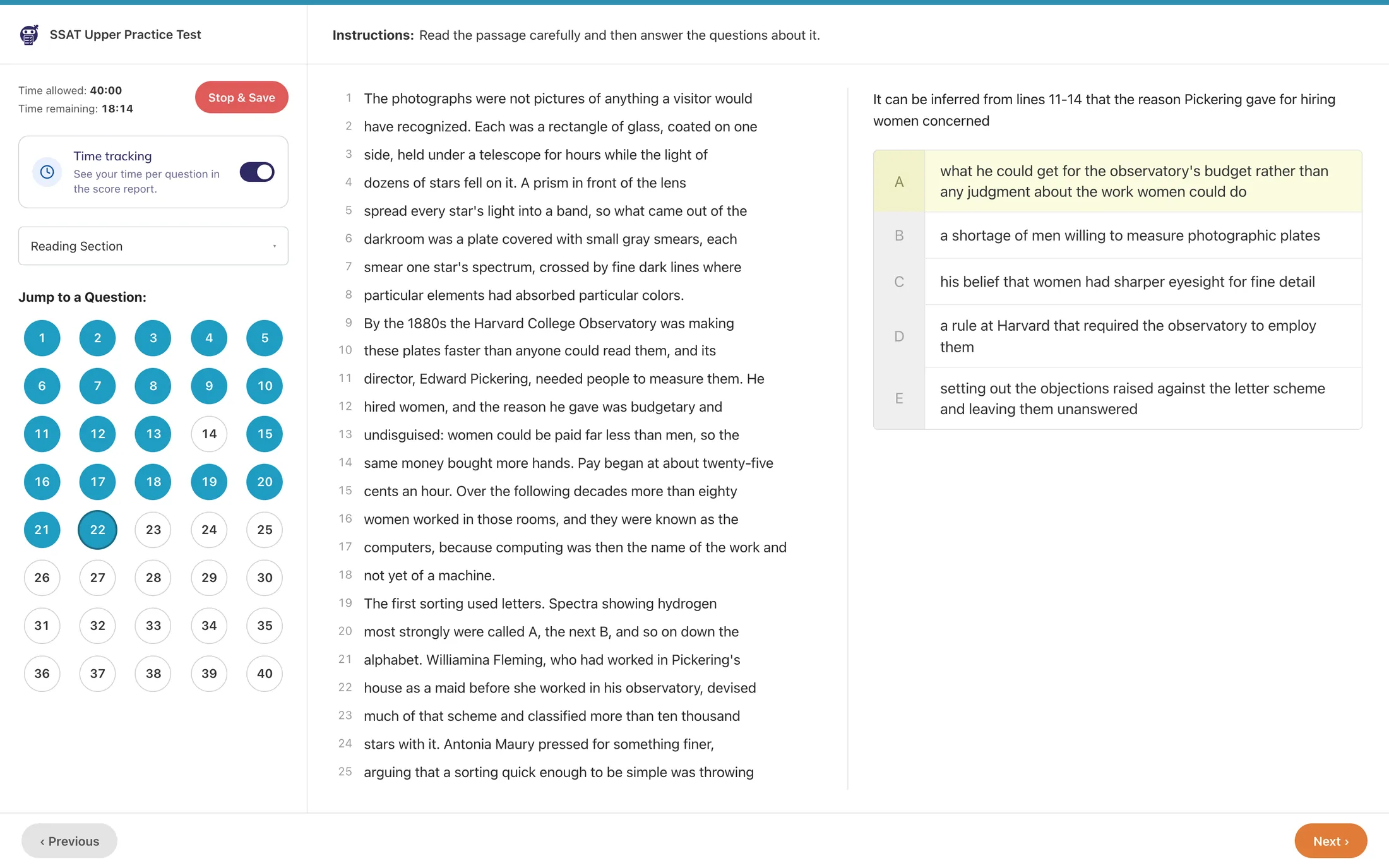
Each score comes with a percentile against students in your grade.
Five sections, three scores
The writing sample comes first, then four multiple-choice sections and a short experimental section. Only Quantitative, Reading and Verbal are scored, and each wrong answer on them costs ¼ point.
Verbal
Scored30 synonyms and 30 analogies, with the hardest vocabulary of the three levels.
Quantitative
ScoredArithmetic, algebra and geometry, all by hand. No calculators.
Reading
ScoredFiction, poetry and essays, plus science and history passages: main idea, inference, tone and words in context.
Writing sample
Not scoredA personal or a general essay prompt. Not scored, but sent to every school that gets your scores.
Experimental
Not scoredTrial questions for future tests. Not scored.
How schools read an Upper Level score
- 01Three section scores
Verbal, Quantitative and Reading are each scored 500–800, for a total of 1500–2400.
- 02A percentile against your own grade
Each score comes with a percentile from 1 to 99 that compares you with first-time test takers in your grade over the past three years. An eighth grader is never ranked against eleventh graders.
- 03Read with everything else
Admissions officers weigh the percentiles alongside grades, recommendations, the interview and the writing sample. There is no official cutoff.
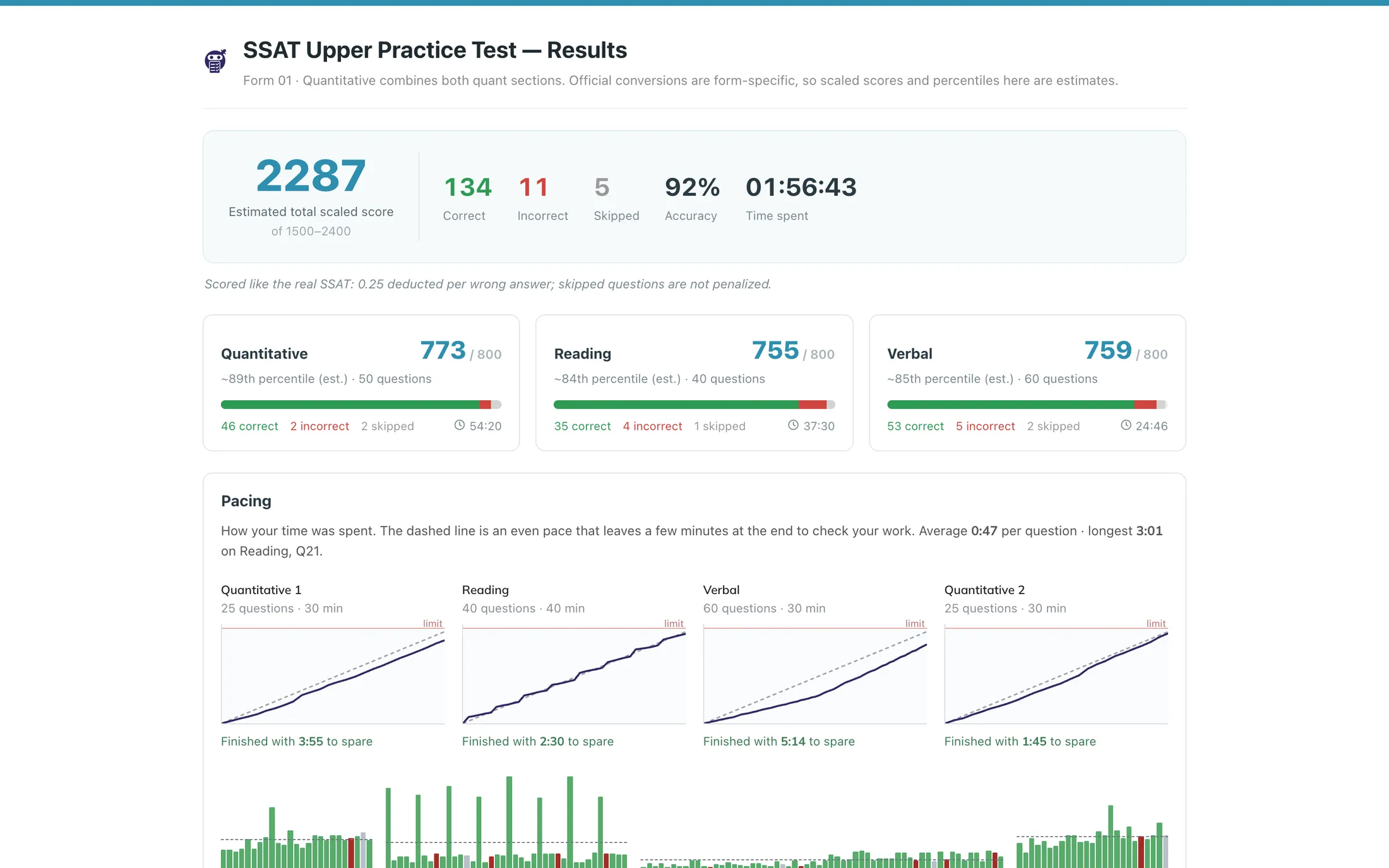
Analogies are a pattern game. Learn the patterns.
Half the verbal section is analogies, and most of them use a small set of relationships. Name the relationship in the first pair, then find the answer pair that has the same one. It is faster than testing each choice.
The other half is synonyms
Synonyms come down to vocabulary. The 1,256-word trainer drills Upper Level words with a word of the day, and practice tests time the section like the real one.
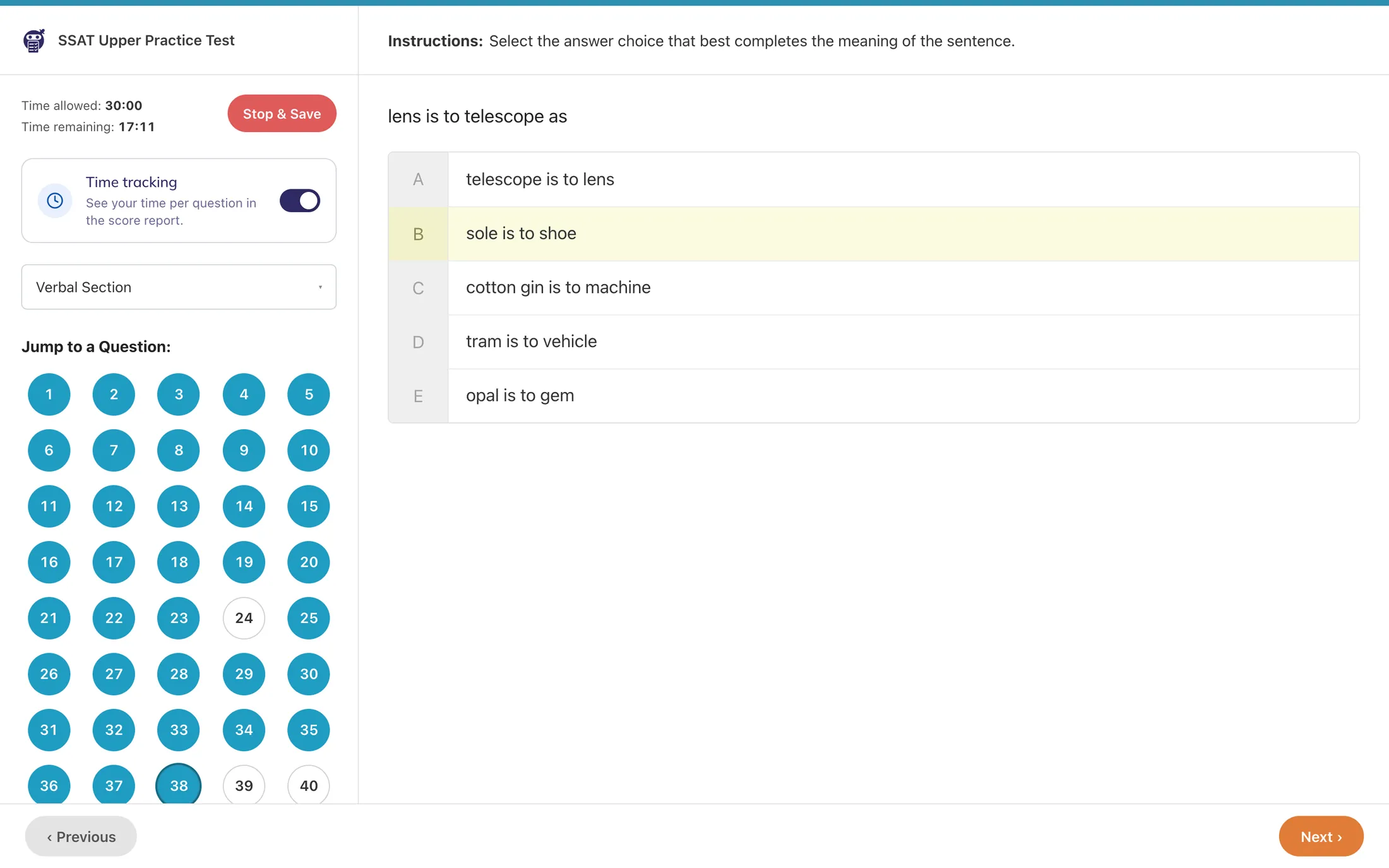
The essay schools actually read
You write it first, in 25 minutes. It isn’t scored, but the unedited copy goes to every school that receives your scores, and readers see it next to your application essays.
“If you could live anywhere else in the world, where would it be and why?”
Answer the question in your first paragraph, then build the essay around one specific story or example.
A position on a broader question, such as whether social media has done more good than harm.
Take one side, give two or three reasons with examples, and answer the strongest objection.
Ten weeks from first practice test to test day
Most students prepare for two to three months. Here is a sample ten-week schedule and the part of Test Ninjas you would use at each step.
- Week 1Take a full practice test
Get estimated scores and percentiles, and see where your time went. Your study plan picks out your weakest skills from it.
- Weeks 2–4Work on your weakest skills
Lessons from the 120-lesson course and problem sets by skill, starting with what the study plan flags. Vocabulary every day.
- Weeks 5–8Practice under time
A full practice test every other week, timed sections in between, and the 3,000-question bank set to your missed and flagged questions.
- Weeks 9–10Sharpen, then rest
One or two last full tests, one timed essay on paper, and a light final week before the test.
Every answer explained, every minute accounted for
See what went wrong, question by question
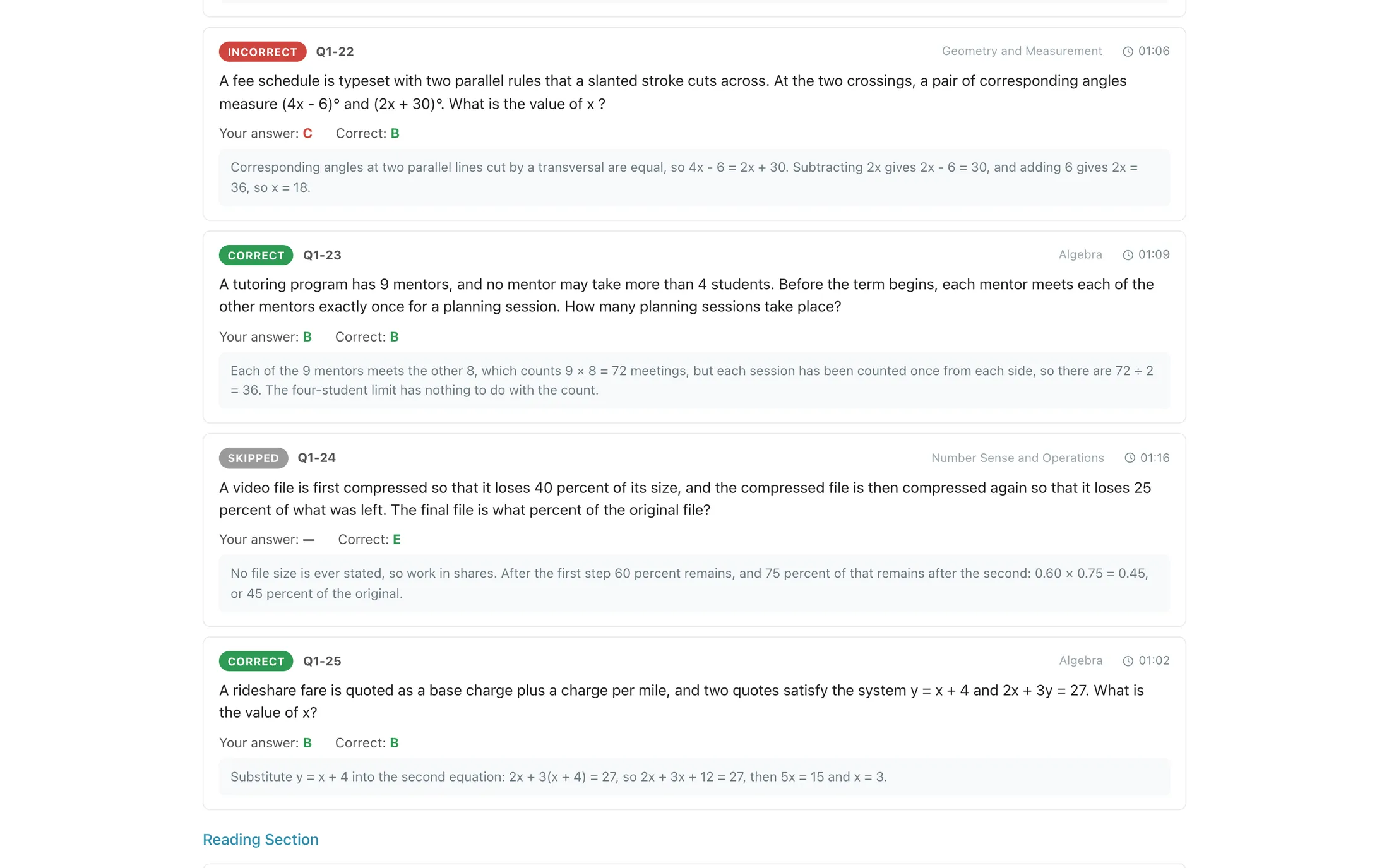
After each test, every question shows your answer, the right one and an explanation, with the time you spent on it. Example results shown.
Find the section that runs you out of time
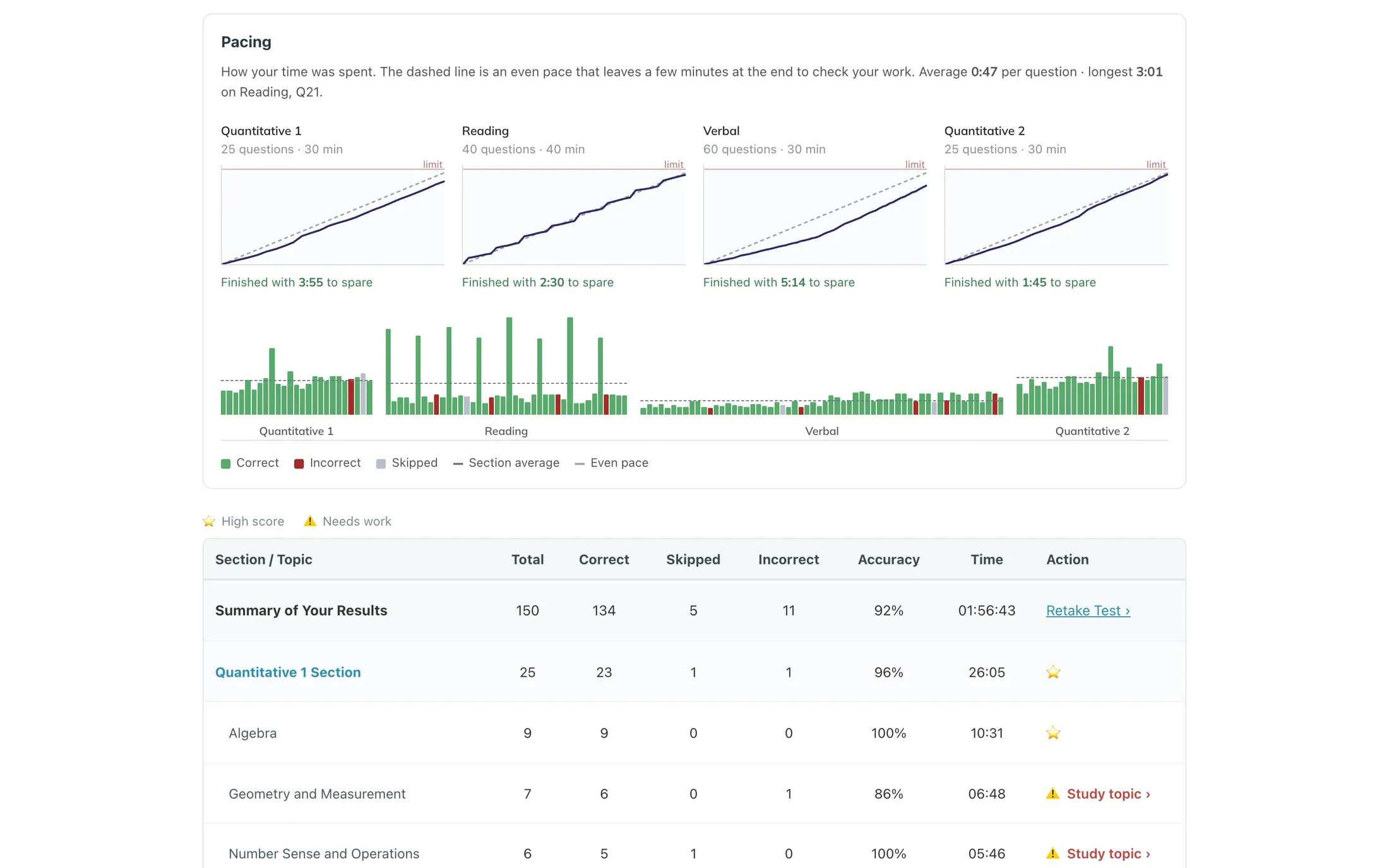
Time curves for each section and the time on every question show where your pacing breaks down. Example results shown.
Everything for the Upper Level in one plan
Practice tests, course, question bank and vocabulary trainer for grades 8 through 11. Start with 7 days free.
$0.00 due today · full access for 7 days · cancel anytime
- Personalized study plan: your child’s estimated scores and weakest skills, with practice for each
- 20 full-length practice tests scored on the 1500–2400 scale, timed like the real test, with save and resume
- Score report with estimated scaled scores and percentiles, pacing, and a question-by-question review
- 68-hour on-demand course with 120 lessons across Quantitative, Reading, Verbal, and the writing sample
- 73 problem sets by section and skill
- 3,000-question bank: practice new, missed, or flagged questions, untimed or timed
- 1,256-word vocabulary trainer with a word of the day
Preparing more than one child, or not sure of the level? The All-Levels plan covers Elementary, Middle and Upper. See all plans
Frequently asked questions
Who takes the Upper Level SSAT?
Students in grades 8 through 11 who are applying for grades 9 through 12.
What is a good Upper Level SSAT score?
There is no official cutoff. The 50th percentile is the middle of first-time test takers in your grade, and many schools publish the middle range of their admitted students’ percentiles, so set a target from your own list of schools.
Should I guess on the Upper Level SSAT?
Only when you can rule out at least one choice. With five choices and a quarter-point penalty, a blind guess breaks even on average; each choice you eliminate makes guessing worth more.
Are calculators allowed?
No. All 50 math questions are done by hand, so practice without one.
Is the writing sample scored?
No, but the unedited copy is sent to every school that receives your scores, and admissions officers read it.
Can I take the Upper Level at home?
Yes. It is offered on paper, at Prometric test centers and at home, and it runs 3 hours 10 minutes in every format.
More on the Upper Level
Start with one full practice test.
Start with 7 days free and $0.00 due today. Cancel anytime.
Start my free 7 days