GRE Multiple Choice (Select One): Geometry Questions
Geometry questions on the GRE Quantitative Reasoning section test your ability to work with shapes, angles, areas, volumes, and spatial reasoning. In the Multiple Choice (Select One) format, you are given five answer choices displayed as circles and must select exactly one correct answer. These problems range from straightforward angle-sum calculations to multi-step challenges involving coordinate geometry, inscribed figures, and shaded regions. Below you will learn the five patterns these questions follow, work through two interactive examples step by step, and then practice with six questions drawn from our question bank.
What Are MC Select One Geometry Questions?
Geometry MC Select One questions present you with a problem involving geometric figures and relationships — triangles, circles, quadrilaterals, polygons, three-dimensional figures, or coordinate geometry — along with five answer choices labeled A through E. You must select exactly one correct answer. Many problems reference a figure (which may or may not be drawn to scale), while others describe geometric scenarios purely through text. The correct answer always requires applying one or more geometric formulas, theorems, or properties, often in multiple steps.
These questions cover a wide range of topics: the angle sum property of triangles and polygons, the Pythagorean theorem and special right triangles (30-60-90 and 45-45-90), circle formulas for area and circumference, coordinate geometry with parallelograms and midpoints, shaded-region computations, and volume calculations for cylinders and rectangular solids. The difficulty comes not from any single formula being complex, but from needing to chain two or three relationships together and avoid the carefully designed distractors.
Key fact: Geometry accounts for roughly 15 to 20 percent of GRE Quantitative Reasoning questions. Most geometry questions on the GRE are rated Medium difficulty, but the ones that combine multiple concepts (such as inscribed triangles in circles or shaded regions in overlapping figures) frequently reach Hard difficulty.
5 Patterns You'll See
Nearly every MC Select One Geometry question on the GRE follows one of five patterns. Recognizing the pattern quickly tells you which formulas and theorems to reach for.
1
Angle and Length Computation
Use geometric properties like the angle sum of a triangle (180°), supplementary angles with parallel lines, or the Pythagorean theorem to find a combined value. Example: 'What is (x+y+z)/45 for interior angles x,y,z of a triangle?'
2
Coordinate Geometry
Use coordinate properties such as parallelogram vector reasoning, midpoint formulas, or slope calculations to find missing points or distances. Example: 'What are the coordinates of point R in parallelogram OPQR?'
3
Formula Derivation
Derive a relationship between geometric quantities using standard formulas. You are asked to express one quantity in terms of another and identify a constant. Example: 'A=kC2, find k for a circle.'
4
Area, Perimeter, and Volume
Direct geometric computation from given dimensions: shaded regions (total minus unshaded), triangle and circle areas, perimeters of inscribed figures, and volumes of cylinders or rectangular solids.
5
Angle Measurement with Parallel Lines or Circles
Angle computation using parallel-line transversals, inscribed angle theorems, or polygon angle-sum properties. These questions test whether you know the relationship between central angles, inscribed angles, and intercepted arcs.
How to Solve Geometry Questions Step by Step
These six strategies apply across all five patterns. Follow them in order to avoid the most common errors on GRE geometry questions.
Even if a figure is provided, redraw it with all given measurements labeled. If no figure is given, sketch one immediately. Label all known side lengths, angles, and relationships. Mark right angles with a small square. This single habit prevents more errors than any formula.
Before computing, determine which geometric principle applies. Angle sum of a triangle: x+y+z=180. Pythagorean theorem: a2+b2=c2. Circle formulas: C=2πr, A=πr2. Parallelogram: opposite sides are equal and parallel, area = base times height. Equilateral triangle area: 43s2.
Many GRE geometry problems are designed around Pythagorean triples: 3-4-5, 5-12-13, 8-15-17, and their multiples (such as 6-8-10 or 9-12-15). Recognizing these triples saves significant computation time. Also remember that the Pythagorean theorem applies to 3D diagonal calculations: first find the diagonal of a face, then use that as a leg to find the space diagonal.
For parallelogram problems in the coordinate plane, use vector addition. If O is the origin and P = (a, b), then the vector OP = (a, b). In parallelogram OPQR, the vector OR = vector OQ minus vector OP. This approach is faster and less error-prone than trying to reason about slopes and distances separately.
When given circumference, find the radius first, then use it for everything else. C=2πr, so r=C/(2π). Then A=πr2, diameter = 2r, and so on. Never try to compute area directly from circumference without first isolating the radius.
Shaded regions, walkways, and composite figures can always be decomposed. Shaded area = total area minus unshaded area. Area of a figure with a hole = outer area minus inner area. For overlapping regions, find the area of each component and subtract or add as needed.
Pro tip: If a geometry problem feels overwhelming, ask yourself: "What shape am I really dealing with?" Many hard-looking problems reduce to a simple right triangle or a basic circle calculation once you strip away the narrative.
Worked Example: Shaded Region
Work through each step below. You must answer each mini-challenge correctly to unlock the next step.
Interactive Walkthrough0/5 steps
Area of a Shaded Region
A circle is inscribed in a square with side length 10. The shaded region is the area inside the square but outside the circle.
What is the area of the shaded region?
1
Step 1: Find the area of the square
The square has side length 10. What is its area?
2
Step 2: Find the radius of the inscribed circle
3
Step 3: Find the area of the circle
4
Step 4: Subtract to find the shaded area
5
Step 5: Identify the radius-diameter trap
Worked Example: Exterior Angle Theorem
This example teaches the Exterior Angle Theorem — a frequently tested shortcut on the GRE. Work through each step below.
Interactive Walkthrough0/5 steps
Exterior Angle Theorem
In triangle PQR, angle P measures 35° and angle Q measures 75°. Side QR is extended beyond R to point S, forming exterior angle PRS.
What is the measure, in degrees, of exterior angle PRS?
1
Step 1: Recall the Exterior Angle Theorem
An exterior angle of a triangle equals:
2
Step 2: Identify the remote interior angles
3
Step 3: Compute the exterior angle
4
Step 4: Verify using the interior angle method
5
Step 5: Identify the common trap
Practice Questions
Now apply what you learned. Each question has a step-by-step solution walkthrough — after you submit your answer, click through the solution one step at a time to compare against your own work.
Question 1 — Sector Area and Arc Length
A sector of a circle has radius 9 and a central angle of 160°. What is the area of the sector?
Question 2 — Tangent Lines from an External Point
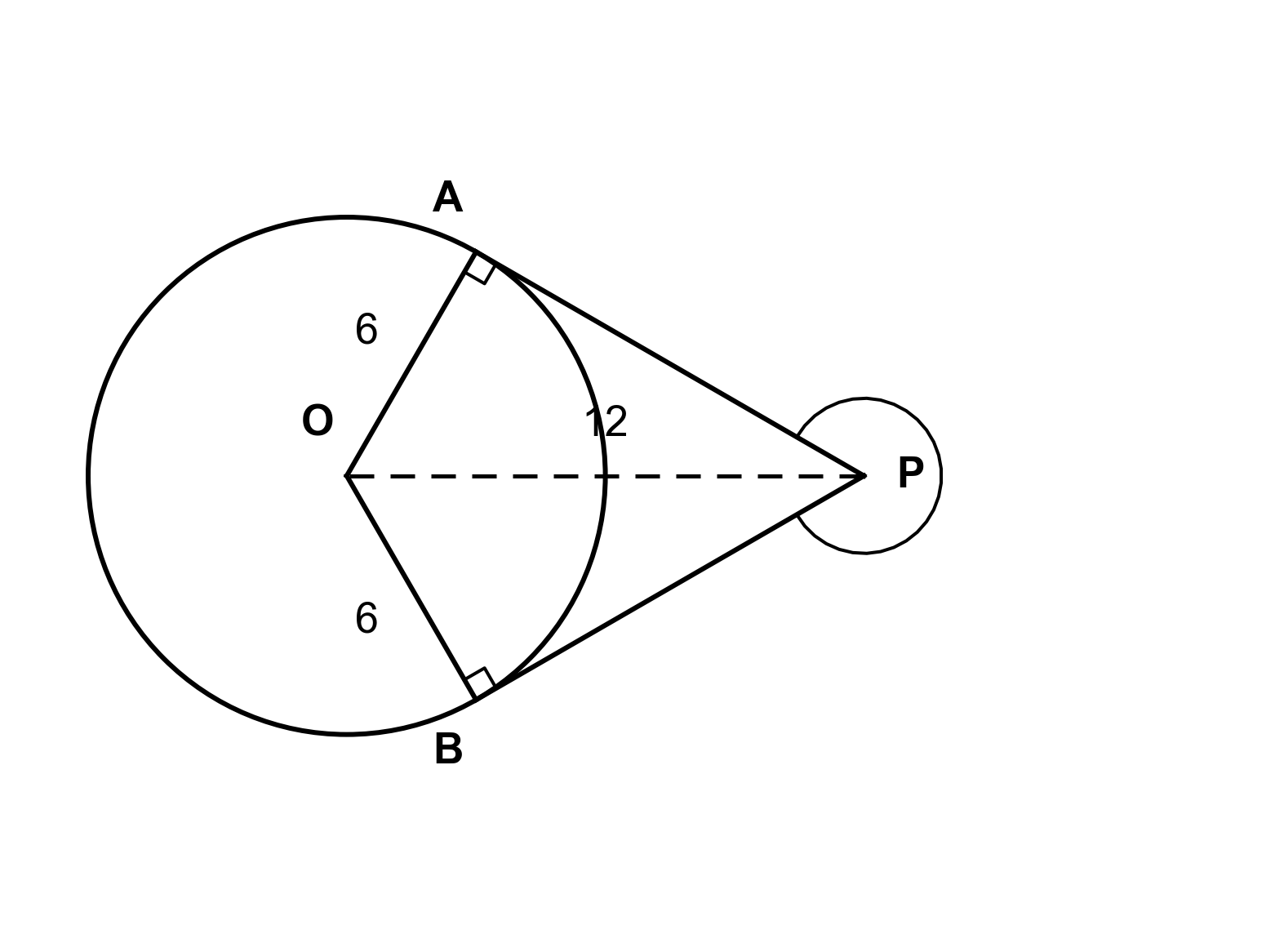
Point P is located outside a circle with center O and radius 6. Two line segments from P are tangent to the circle at points A and B, and the distance from P to the center O is 12. What is the measure, in degrees, of ∠APB?
Question 3 — Circular Segment Area
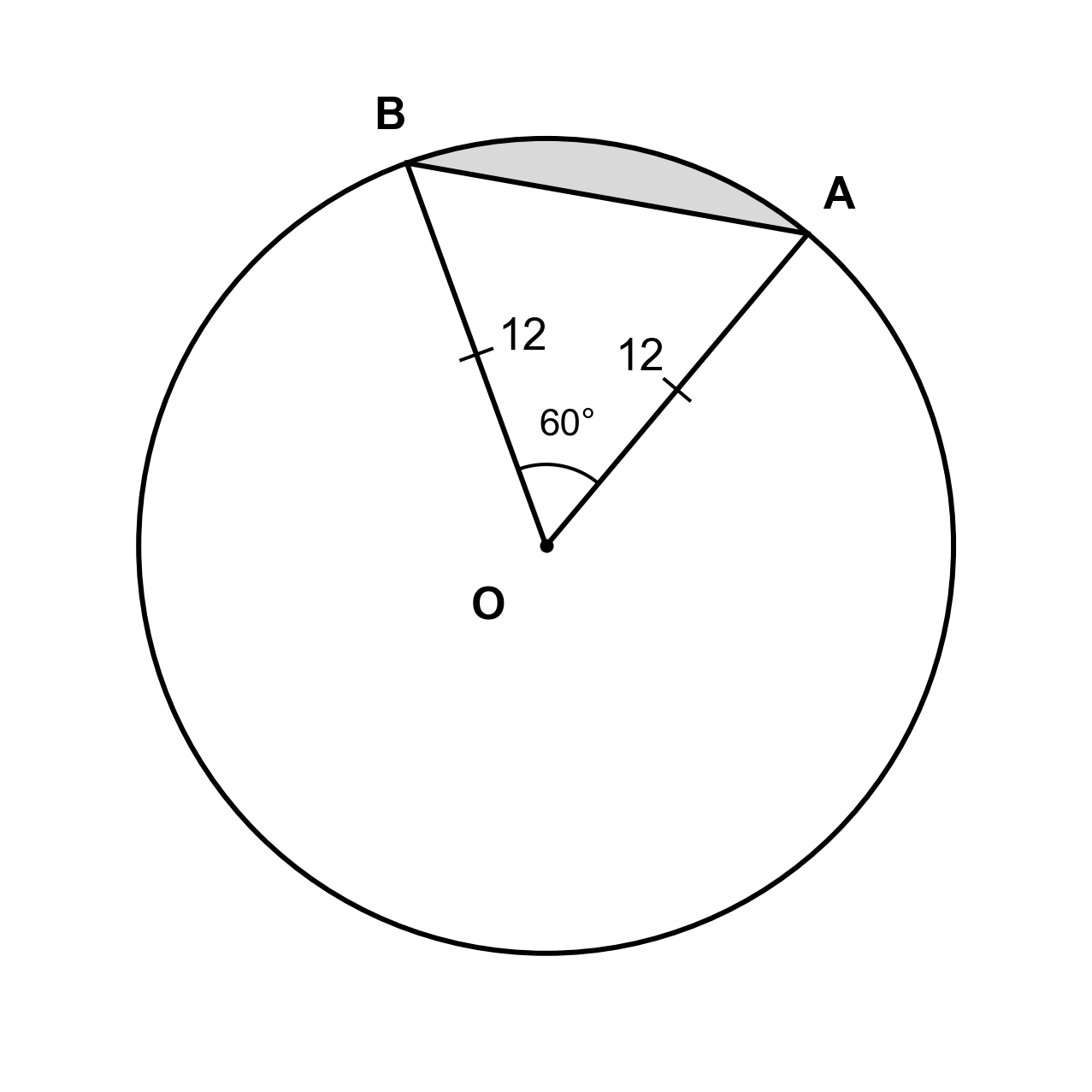
A circle has center O and radius 12. Points A and B lie on the circle such that the central angle AOB=60°. What is the area of the circular segment bounded by chord AB and minor arc AB?
Question 4 — Concentric Circles and a Tangent Chord
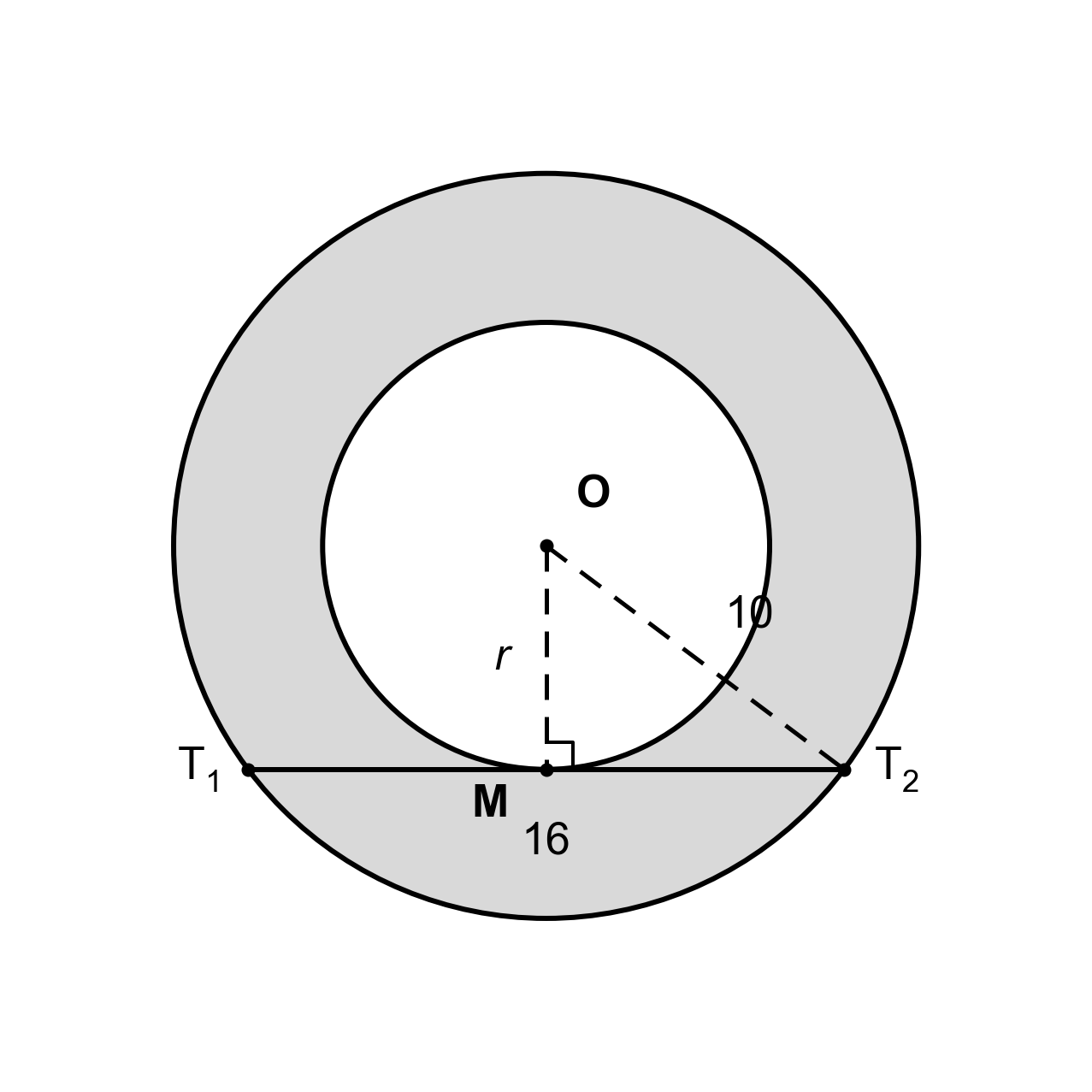
Two concentric circles have center O. The outer circle has radius 10. A chord of the outer circle is tangent to the inner circle and has length 16. What is the area of the shaded region between the two circles?
Question 5 — Inscribed Angle Theorem
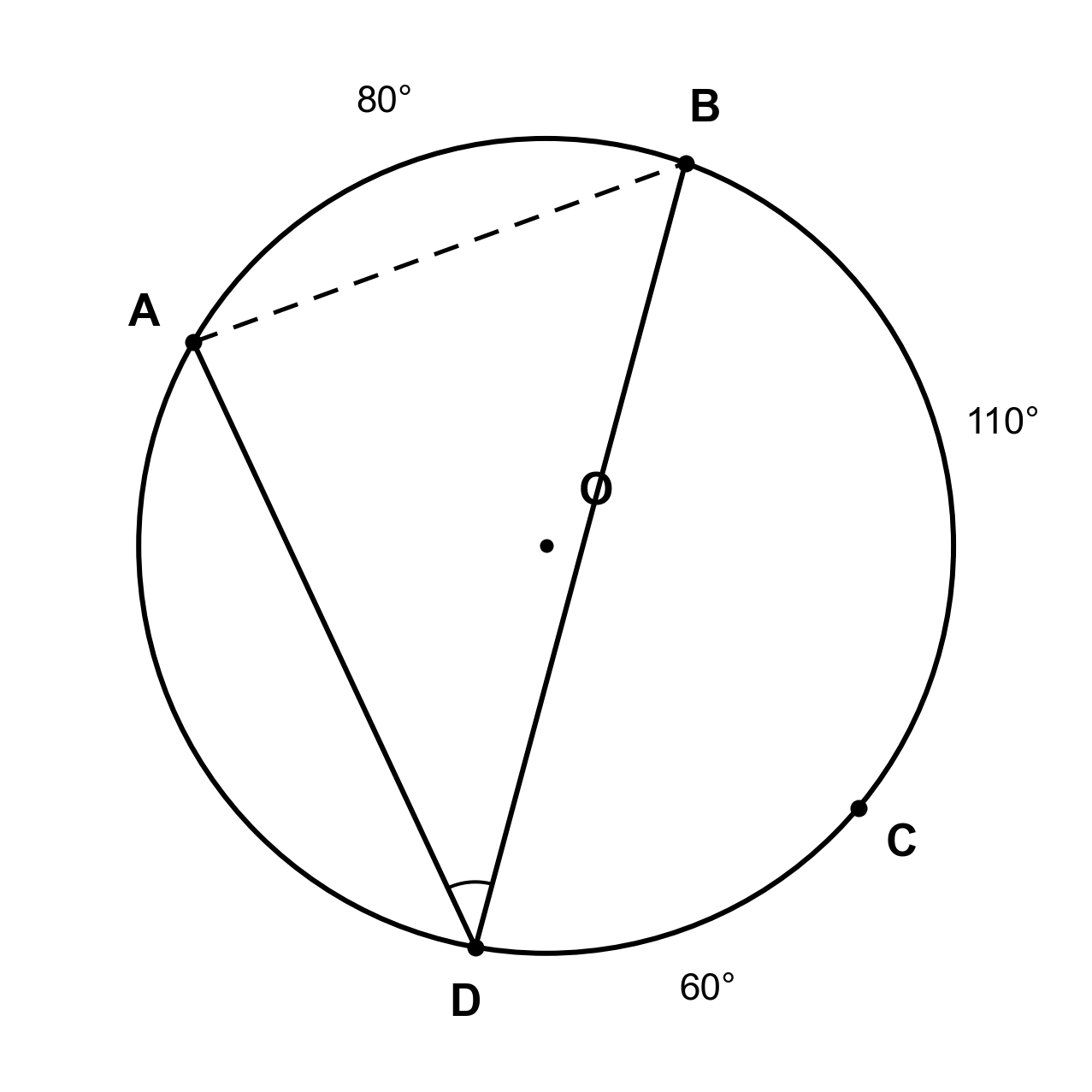
Points A, B, C, and D lie on a circle with center O, in that order around the circle. Arc AB = 80°, arc BC = 110°, and arc CD = 60°. What is the measure, in degrees, of inscribed angle ADB?
Question 6 — Intersecting Chords
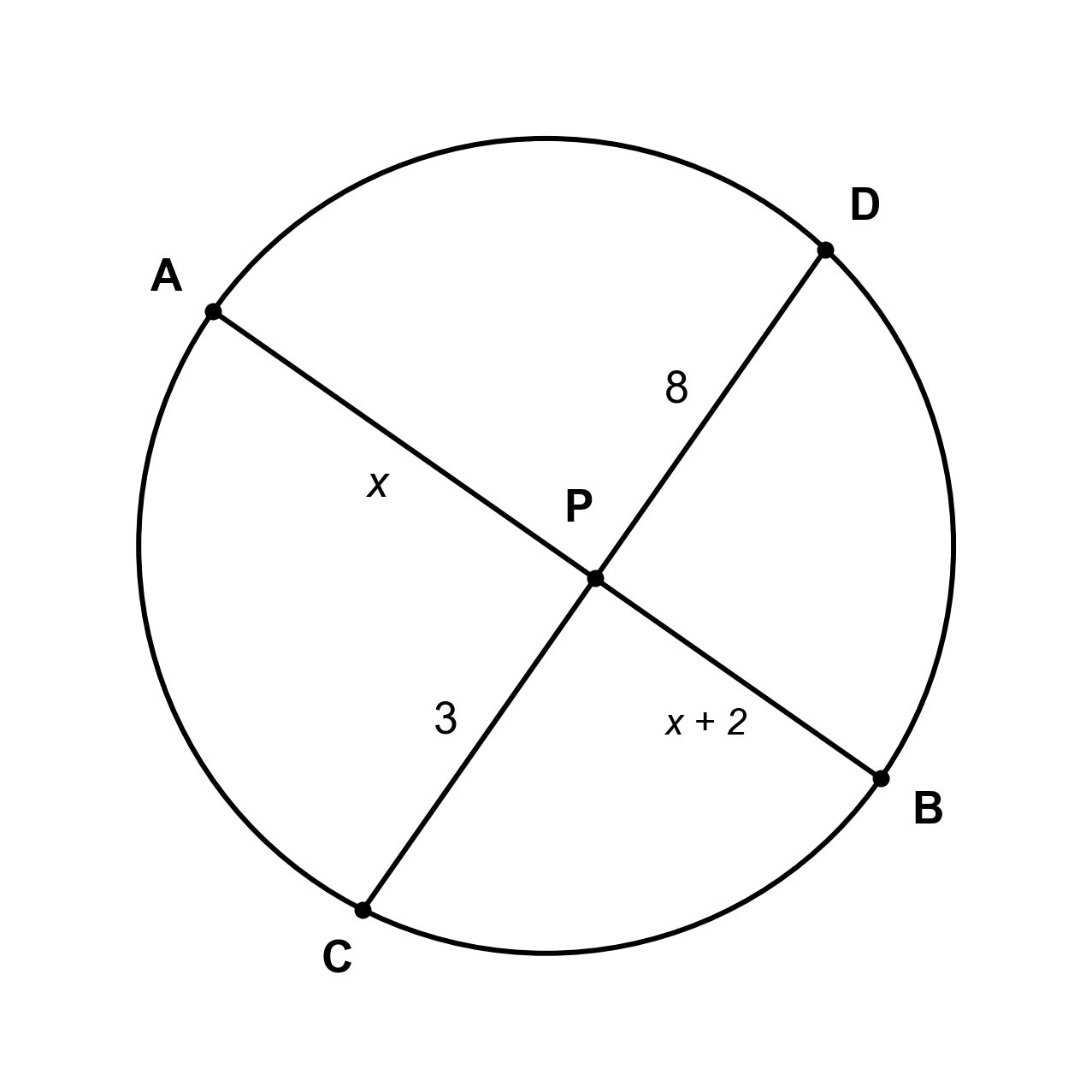
Two chords AB and CD intersect at point P inside a circle. Chord CD is divided by P into segments CP = 3 and PD = 8. Chord AB is divided by P into two segments whose lengths differ by 2, with AP < PB. What is the length of chord AB?
Common Traps
Trap 1 — Radius vs. diameter confusion. A circle with diameter 10 has radius 5. Using 10 as the radius quadruples the area (π×102=100π instead of π×52=25π). The GRE regularly provides the diameter and expects you to halve it before computing. Similarly, when given the circumference, divide by 2π to get the radius — not by π.
Trap 2 — Forgetting the 1/2 factor in triangle area. The area of a triangle is (1/2) times base times height, not base times height. This factor of 1/2 is the single most frequently forgotten detail in GRE geometry. It appears in the area formula, in the relationship between a sector and a triangle when computing segment area, and in the inscribed angle theorem (half the intercepted arc). When in doubt, check whether you need to halve your result.
Trap 3 — Misidentifying the special triangle type. A 30-60-90 triangle has side ratios 1:3:2, while a 45-45-90 triangle has side ratios 1:1:2. Confusing these ratios is a frequent source of wrong answers. If the problem mentions an equilateral triangle or a 60-degree angle, you are in 30-60-90 territory. If it mentions a square diagonal or an isosceles right triangle, you are in 45-45-90 territory. Always confirm the angle measures before applying special triangle ratios.
Recognizing Geometry Patterns at a Glance
Use this table to quickly identify which geometric approach a question requires based on the language in the question stem.
Question Stem Clue
Pattern
Key Formula or Theorem
"What is (x + y + z) / n?" with angles
Angle Computation
Angle sum = 180° (triangle), 360° (quadrilateral), (n−2)×180° (polygon)
"What are the coordinates of point..."
Coordinate Geometry
Vector addition for parallelograms; midpoint and distance formulas
"What is k in A=kC2?"
Formula Derivation
Express one variable in terms of another; substitute and simplify
"What is the area/perimeter/volume of..."
Direct Computation
Break into simple shapes; apply standard area/volume formulas
"What is the measure of angle..." with parallel lines or circles
Shaded = total - unshaded; decompose into triangles and sectors
The fastest path to recognizing these patterns is repeated practice. After working through 20 to 30 geometry questions, you will start identifying the pattern within seconds of reading the question stem, leaving you more time for the actual computation.
Study Checklist
MC Geometry Mastery Checklist0/10 complete
Frequently Asked Questions
How many geometry questions appear on the GRE Quantitative section?
Geometry typically accounts for roughly 15 to 20 percent of the Quantitative Reasoning section. Across both scored math sections you can expect around 5 to 8 questions that involve geometric reasoning, covering triangles, circles, coordinate geometry, and three-dimensional figures. Some of these will be in the Multiple Choice Select One format, others may appear as Quantitative Comparison or Numeric Entry.
Do I need to memorize all geometry formulas for the GRE?
The GRE does not provide a formula sheet, so you must know the core formulas: area of a triangle (21×base×height), the Pythagorean theorem (a2+b2=c2), circle area (πr2) and circumference (2πr), and special triangle ratios (30-60-90 and 45-45-90). Beyond these, most problems can be solved by combining two or three fundamental relationships. You do not need to memorize obscure formulas.
Are GRE geometry figures drawn to scale?
Not always. The GRE states that figures are "not necessarily drawn to scale" unless explicitly noted otherwise. You should never estimate angle measures or side lengths by visual inspection. Always rely on the given numerical information and geometric properties. A figure that looks like a right angle might not be one unless the problem says so or marks it with a small square.
What are the most common geometry traps on the GRE?
The three most common traps are: (1) confusing radius with diameter in circle problems, which quadruples or quarters the area; (2) forgetting the 1/2 factor in the triangle area formula; and (3) applying the wrong special triangle ratios, such as using 45-45-90 ratios when the triangle is actually 30-60-90. A close fourth is computing area when the question asks for perimeter, or vice versa. Reading the question stem carefully and underlining what is being asked for prevents most of these errors.
How should I approach coordinate geometry problems on the GRE?
For coordinate geometry problems, always plot the points and label them. Use vector reasoning for parallelogram problems: if OPQR is a parallelogram with O at the origin, then the vector OR equals the vector OQ minus the vector OP. For distance questions, apply the distance formula: d=(x2−x1)2+(y2−y1)2. For midpoint questions, average the x-coordinates and y-coordinates separately. These formulas are straightforward, and the main source of error is mixing up which coordinates belong to which point.