The GRE "Select One or More" format pairs naturally with geometry because geometric constraints, especially the triangle inequality, define ranges of valid values. Multiple answer choices can fall inside that range while others fall outside it. These questions use square checkboxes, and you must select every correct answer and only correct answers to receive credit. Below you will learn the key geometric patterns that appear, work through two interactive examples step by step, and then practice with six guided questions drawn from the question bank.
What Are Select One or More Geometry Questions?
These are GRE Quantitative Reasoning questions that combine the Select One or More format (square checkboxes, variable number of choices, no partial credit) with geometry content. You must select every correct answer and only correct answers. Selecting all but one correct choice, or including one incorrect choice, both result in zero credit for the question.
On the actual GRE, the instructions read "Indicate all such lengths" or "Indicate all that apply." The number of correct answers is not disclosed. Some questions have a single correct answer; others have two, three, four, or more. You must evaluate each choice independently.
Format note: Select One or More questions display square checkboxes rather than round radio buttons. This visual cue tells you that multiple answers may be correct. There is no partial credit — you must get every selection right.
Four Geometry Patterns You'll See
Nearly every Select One or More geometry question falls into one of four patterns. Recognizing the pattern quickly tells you what constraint to apply and how to check each choice.
1
Triangle Inequality Range
Given two sides of a triangle, determine which values from a list could be the third side. The third side must be strictly between ∣a−b∣ and a+b. This is the dominant pattern for this question type.
2
Circle and Angle Theorems
Inscribed angles, central angles, arc measures, and tangent-secant relationships. You must identify which geometric statements follow from the given configuration. Each choice tests a different theorem or its common misapplication.
3
Polygon and Solid Properties
Properties of parallelograms, trapezoids, regular polygons, and three-dimensional solids. Questions ask which measurements or relationships are consistent with the given figure. Scaling laws (linear, area, volume) are frequently tested.
4
Coordinate Geometry
Points, distances, areas, and transformations in the coordinate plane. Questions ask which points satisfy given conditions (e.g., lying inside a circle) or which statements about a plotted figure are true.
How to Solve These Questions Step by Step
These five strategies apply across all four geometry patterns. Work through them in order and you will avoid the most common errors.
Before checking any answer choice, determine the mathematical constraint. For triangle inequality questions, compute ∣a−b∣ and a+b to find the valid range. For angle problems, compute the relevant arc measures or angle sums. Having the constraint in hand before looking at choices prevents piecemeal errors.
Do not let one choice influence your evaluation of another. Each answer choice must be tested against the constraint on its own. In Select One or More format, the number of correct answers is not fixed, so you cannot use elimination logic the way you would with a single-answer question.
The triangle inequality uses strict inequalities: the third side must be strictly greater than ∣a−b∣ and strictly less than a+b. Boundary values create degenerate triangles (straight lines), which are not valid. This is the single most common source of errors on these questions.
For similar figures with scale factor k, linear dimensions scale by k, areas by k2, and volumes by k3. Confusing these is a frequent trap. If two similar triangles have a side ratio of 3/2, their area ratio is 9/4, not 3/2.
If time permits, confirm your answer using an alternative approach. For coordinate geometry, you can use the distance formula and then cross-check with the Shoelace formula for area. For circle problems, the inscribed angle theorem and the central angle theorem should give consistent results.
Pro tip: For triangle inequality questions, compute the range once and write it down. Then mechanically check each choice against that range. This is faster and less error-prone than evaluating each choice from scratch.
Worked Example: Triangle Inequality
Work through each step below. You must answer each mini-challenge correctly to unlock the next step. If you get stuck, a second wrong attempt will reveal the answer so you can keep going.
Interactive Walkthrough0/5 steps
Triangle Inequality with Obtuse Constraint
Triangle ABC has AB=5 and BC=9. The triangle is obtuse. You need to determine which values of AC produce a valid obtuse triangle. This requires satisfying both the triangle inequality and the obtuse angle condition.
Which of the following could be the length of side AC? Select all that apply.
5
8
10
11
13
1
Step 1: Apply the triangle inequality
What is the valid range for AC? (Compute ∣9−5∣<AC<9+5)
2
Step 2: Find the obtuse condition when BC = 9 is the longest side
3
Step 3: Find the obtuse condition when AC is the longest side
4
Step 4: Identify the acute (non-obtuse) zone
5
Step 5: Check each choice
Worked Example: Circle Theorems
This example tests inscribed angle relationships. Work through each step to see how arc measures determine inscribed angles.
Interactive Walkthrough0/4 steps
Inscribed Angles and Arc Measures
In circle O, chord AB has an inscribed angle ∠ACB=35°, where C is on the major arc AB. Point D lies on the minor arc AB. You must determine which geometric statements must be true.
Which of the following statements must be true? Select all that apply.
Minor arc AB = 70°
Central angle ∠AOB=35°
∠ADB=145°
Major arc AB = 250°
Any inscribed angle from the major arc intercepting minor arc AB = 145°
1
Step 1: Find the minor arc measure
By the inscribed angle theorem, an inscribed angle equals half its intercepted arc. Since C is on the major arc and ∠ACB=35°, what is the minor arc AB?
2
Step 2: Find the central angle
3
Step 3: Find angle ADB
4
Step 4: Check the remaining statements
Practice Questions
Now apply what you learned. Each question uses the "select all that apply" format. After you submit your answer, click through the solution one step at a time to compare against your own work.
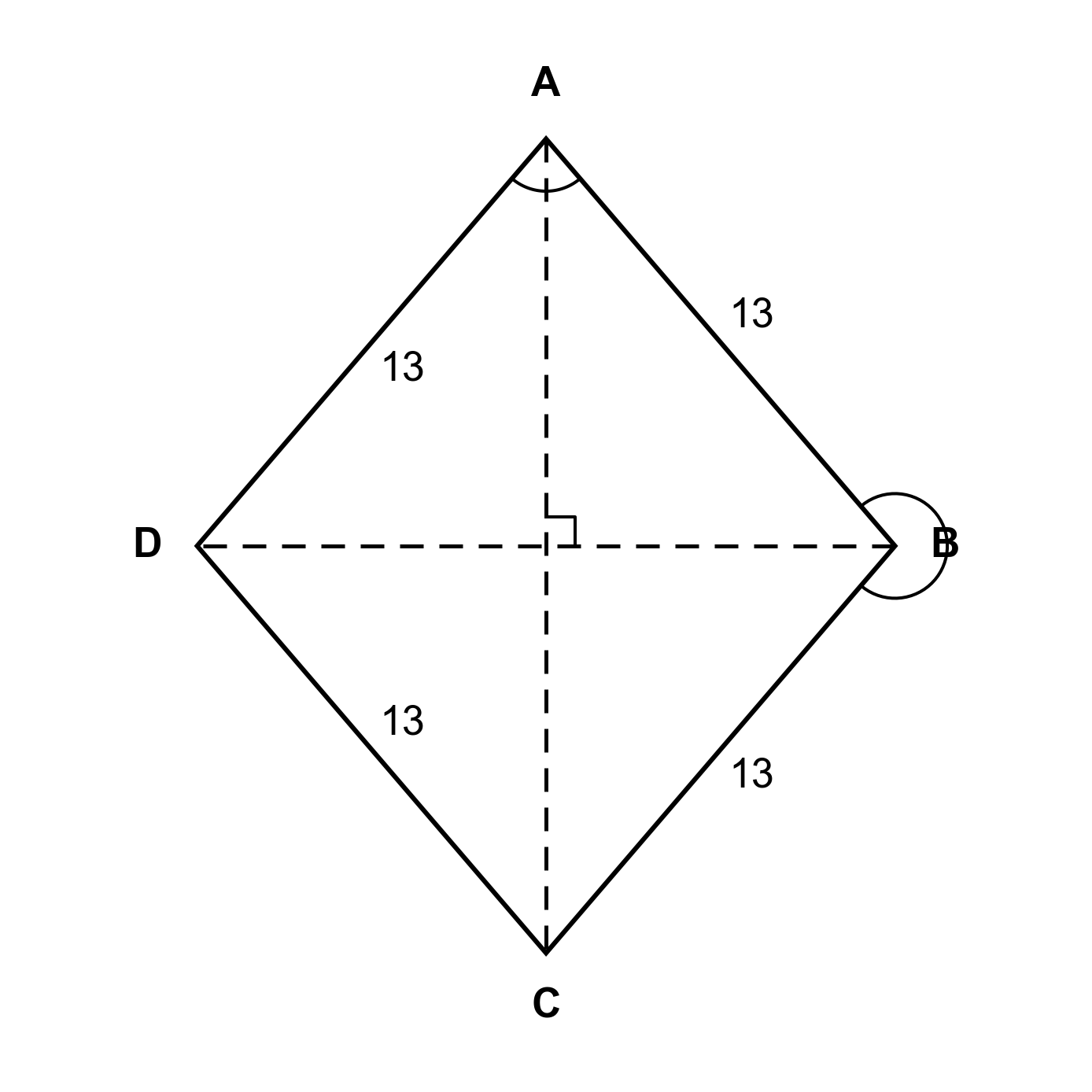
Question 1 — Rhombus Diagonal Length
Rhombus ABCD has a side length of 13, and its larger interior angle is greater than 120 degrees. Which of the following could be the length of the shorter diagonal of the rhombus?
Question 2 — Similar Triangle Scaling
Two triangles are similar, with the ratio of corresponding sides of the larger triangle to the smaller triangle being r, where 1<r<3. The smaller triangle has a perimeter of 12 and an area of 10. Which of the following must be true about the larger triangle?
Question 3 — Points Inside a Circle
A circle in the coordinate plane has center (3,−2) and passes through the point (7,1). Which of the following points lie strictly inside the circle?
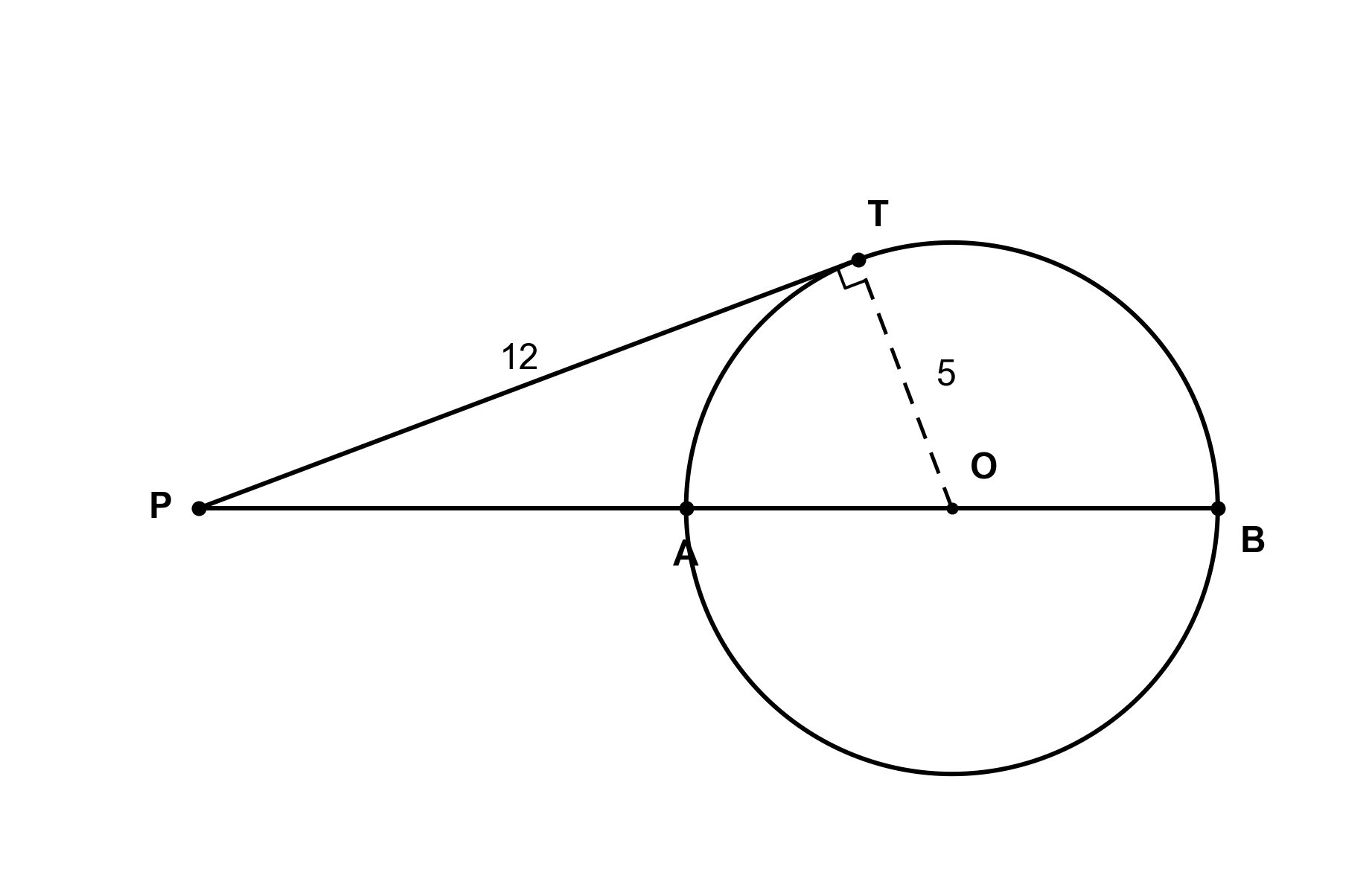
Question 4 — Tangent and Secant from External Point
From an external point P, a tangent segment PT touches a circle of radius 5 at point T, and a secant from P passes through the center of the circle, intersecting the circle at points A and B (with A closer to P). If PT=12, which of the following could be the distance from P to a point where the secant intersects the circle?
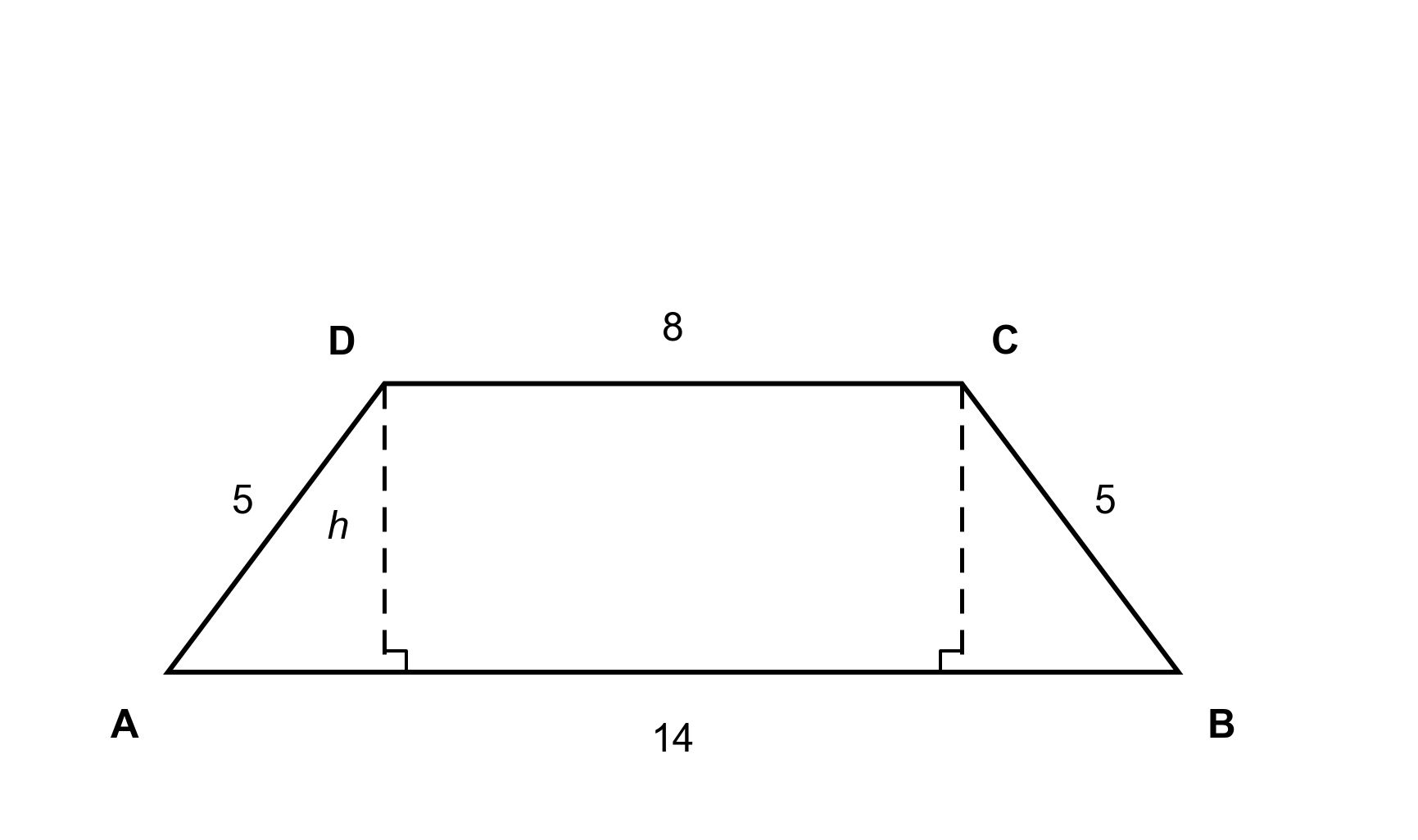
Question 5 — Isosceles Trapezoid Measurements
Trapezoid ABCD has parallel sides AB=14 and CD=8. The non-parallel sides have lengths AD=5 and BC=5. Which of the following measurements are consistent with this trapezoid?
Question 6 — Parallelogram Properties
In the coordinate plane, parallelogram ABCD has vertices A=(0,0), B=(8,2), C=(10,7), and D=(2,5). Which of the following statements about ABCD are true?
Four Common Traps
Trap 1 — Including boundary values in triangle inequality. If two sides are 5 and 9, the valid range for the third side is 4<x<14. Choices of x=4 or x=14 are wrong because they create degenerate triangles (straight lines). Both inequalities are strict.
Trap 2 — Confusing inscribed and central angles. An inscribed angle is half the intercepted arc, while a central angle equals the intercepted arc. If an inscribed angle is 35 degrees, the central angle subtending the same arc is 70 degrees, not 35. Confusing these doubles or halves the correct value.
Trap 3 — Mixing up linear and area scaling. For similar figures with scale factor k, perimeter scales by k but area scales by k2. If the perimeter doubles, the area quadruples, not doubles. This error appears in nearly every similarity question.
Trap 4 — Confusing "on" with "strictly inside." When a question asks for points strictly inside a circle, a point whose distance from the center exactly equals the radius is on the boundary, not inside. The word "strictly" excludes boundary points. Always compute exact distances before making this distinction.
Quick Reference: Key Geometry Facts
Keep these formulas and relationships at your fingertips when tackling Select One or More geometry questions.
Concept
Formula / Rule
Common Trap
Triangle Inequality
∣a−b∣<x<a+b (strict)
Boundary values create degenerate triangles
Inscribed Angle Theorem
Inscribed angle =21 intercepted arc
Confusing with central angle (which equals the arc)
Thales' Theorem
Angle in semicircle =90°
Forgetting to apply when diameter is given
Similar Figures — Linear
Perimeter scales by k
Using k2 instead of k
Similar Figures — Area
Area scales by k2
Using k instead of k2
Similar Figures — Volume
Volume scales by k3
Using k2 instead of k3
Obtuse Triangle Test
c2>a2+b2 (c is longest side)
Checking only one angle instead of all possibilities
Point Inside Circle
Distance from center <r
Including points on the boundary (distance =r)
Shoelace Area Formula
21∣∑cross products∣
Using base times height for non-rectangular parallelograms
Trapezoid Midsegment
(b1+b2)/2
Using the difference instead of the average
Study Checklist
Select One or More Geometry Mastery Checklist0/8 complete
Frequently Asked Questions
What is the Select One or More format on the GRE?
Select One or More questions present square checkboxes instead of radio buttons. You must select every correct answer and only correct answers. There is no partial credit: missing even one correct choice or including one wrong choice results in zero credit for the question.
What geometry topics appear most often in GRE Select One or More questions?
The triangle inequality theorem dominates this question type because it naturally produces a range of valid values, which maps perfectly to the select-all-that-apply format. Other topics include circle theorems (inscribed angles, central angles, tangent-secant relationships), properties of polygons (parallelograms, trapezoids, rhombuses), similar figures with scaling, and coordinate geometry.
How does the triangle inequality work for Select One or More questions?
Given two sides of a triangle with lengths a and b, the third side x must satisfy ∣a−b∣<x<a+b. Both inequalities are strict (no equals sign). You compute this range once, then check each answer choice against it. Any value strictly inside the range is correct; boundary values are always wrong because they create degenerate triangles.
Why are boundary values a trap in triangle inequality problems?
The triangle inequality uses strict inequalities. If the valid range is 4<x<14, then x=4 and x=14 are both wrong because they would create degenerate triangles collapsed into straight lines rather than valid triangles. This is the single most common error on these questions. Always verify that your selected values are strictly inside the range.
How many correct answers should I expect in a Select One or More geometry question?
The number of correct answers varies. Some questions have a single correct answer, while others may have two, three, four, or even more. There is no fixed count, and the GRE does not tell you how many to select. You must evaluate every choice independently against the given constraints. Do not assume that exactly two or three answers are correct.