GRE Numeric Entry Algebra: Strategies and Practice
Numeric Entry Algebra is one of the toughest corners of GRE Quantitative Reasoning. Unlike multiple-choice questions, there are no answer choices to guide your work or enable back-solving. You must set up the equation, solve it cleanly, and type the exact number into the box — an integer, a decimal, or a fraction. A single sign error, a flipped reciprocal, or a miscounted exponent produces a wrong number with no safety net. This guide covers the four question stem patterns, five strategies to avoid common errors, two interactive worked examples, and thirteen practice questions drawn from the official question bank.
What Is Numeric Entry Algebra?
Numeric Entry questions require you to solve for an exact numerical value and type it directly into a blank box. There are no answer choices. You either see a single empty box for integers or decimals, or two stacked boxes with a fraction bar when the answer is a fraction. Equivalent forms are accepted — 0.75 and 0.750 are both correct, and fractions do not need to be reduced (86 is accepted for 43).
The Algebra domain within Numeric Entry tests topics including slopes and equations of lines, coordinate geometry (midpoints, intercepts, distances), solving equations and systems of equations, functions and function evaluation, word problems translated into algebraic expressions, and quadratic equations. Because there are no choices to back-solve with, you must work forward through the algebra with precision.
Why NE Algebra is harder than MC Algebra: On a multiple-choice question, you can plug each answer choice into the equation and see which one works. On Numeric Entry, that shortcut does not exist. A sign error or a misapplied formula produces a wrong number with no way to detect the mistake from a list of options. Verification by substitution becomes your only safety net.
Four Question Stem Patterns
Nearly every NE Algebra question falls into one of four stem patterns. Recognizing the pattern tells you what type of setup to build before you start computing.
1
What is the slope of line k?
Find slope from given points, midpoints, or intercepts. These questions test the slope formula and often require computing a midpoint first. Watch for sign errors in the subtraction order.
2
How many minutes does it take...
Work rate and combined rate problems. Add individual rates (not times), then invert to find total time. The variable representing the shared quantity often cancels completely.
3
Give your answer as a fraction
Problems requiring algebraic setup before fraction entry — perpendicular line intercepts, Pythagorean distances, or algebraic manipulation yielding a non-integer answer.
4
What is the value of [expression]?
Compute a specific algebraic expression value — often from a system of equations, a recursive sequence, or function composition. The trap is answering the wrong sub-expression.
Five Strategies for Numeric Entry Algebra
These five strategies apply across all four stem patterns. They are ordered from setup to verification — follow them sequentially for each problem.
Before solving, write out the equation or system of equations that the problem requires. For coordinate geometry, label the points and write the relevant formula (slope = rise/run, midpoint formula, etc.). A clear setup prevents errors downstream. On the GRE, scratch paper is provided — use it.
After solving an equation, substitute your answer back into the original equation to verify it works. This is especially important when there are no answer choices to serve as a reasonableness check. A 15-second verification can save you from a costly error.
Slope problems are the most common NE Algebra type. Remember: slope =x2−x1y2−y1 — do not reverse the subtraction order. Perpendicular slopes are negative reciprocals: if one slope is m, the other is −m1. The y-intercept is the value of y when x=0.
When the answer is a fraction, simplify before performing large multiplications or divisions. The answer does not need to be reduced on the GRE, but working with smaller numbers reduces arithmetic errors during intermediate steps.
Many coordinate geometry NE problems involve computing distances, which requires the Pythagorean theorem or the distance formula. Recognize right triangle setups early — if two points share an x-coordinate or y-coordinate, you have a horizontal or vertical leg.
Pro tip: For work-rate problems, always add rates — never average times. If Machine A does a job in 10 minutes and Machine B does it in 15 minutes, the combined rate is 101+151, not 210+15. This is the single most common error on combined-rate NE questions.
Worked Example: Constant from Intersecting Lines
This walkthrough teaches a common NE Algebra pattern: finding an unknown constant by first solving a system of equations, then substituting the result into a third equation. Work through each step — you must answer each mini-challenge correctly to unlock the next.
Interactive Walkthrough0/5 steps
Finding a Constant from Intersecting Lines
The line y=ax−5 passes through the point where the lines x+3y=14 and 2x−y=0 intersect.
What is the value of a? Give your answer as a fraction.
1
Step 1: Solve one equation for y
Start with the simpler equation 2x−y=0. What is y in terms of x?
2
Step 2: Substitute to find x
3
Step 3: Find y at the intersection
4
Step 4: Substitute the point into y = ax - 5
5
Step 5: Solve for a
Worked Example: Mixture Concentration
This walkthrough covers a classic NE Algebra pattern: mixture problems solved with a system of equations. The key technique is writing two equations — one for total volume and one for the dissolved substance — then solving by substitution.
Interactive Walkthrough0/4 steps
Mixing Two Solutions
A chemist has two salt solutions. Solution X is 15% salt by volume and Solution Y is 40% salt by volume. She combines some amount of each to produce exactly 20 liters of a 25% salt solution.
How many liters of Solution Y did the chemist use?
1
Step 1: Set up the volume equation
Let x = liters of Solution X and y = liters of Solution Y. What equation represents the total volume?
2
Step 2: Set up the salt equation
3
Step 3: Simplify the salt equation
4
Step 4: Substitute and solve for y
Practice Questions
Apply what you have learned. Each question has a step-by-step solution walkthrough. After submitting your answer, click through the solution one step at a time. These questions are drawn from the official question bank — all have been converted to multiple-choice format with one correct answer and four plausible distractors based on common errors.
Function Composition and Expressions
Question 1 — Function Composition (Hard)
If f(x)=2x2−3x+1 and g(x)=x+5, what is the value of f(g(2))−g(f(2))?
Your Answer:
Question 2 — Reciprocal Expressions (Hard)
If x1+y1=41 and x1−y1=121, what is the value of x−yx+y?
Your Answer:
Question 3 — Exponent Chains (Hard)
If 32x+1=5 and 32y−1=7, what is the value of 9x+y?
Your Answer:
Coordinate Geometry and Lines
Question 4 — Perpendicular Line Intercept (Hard)
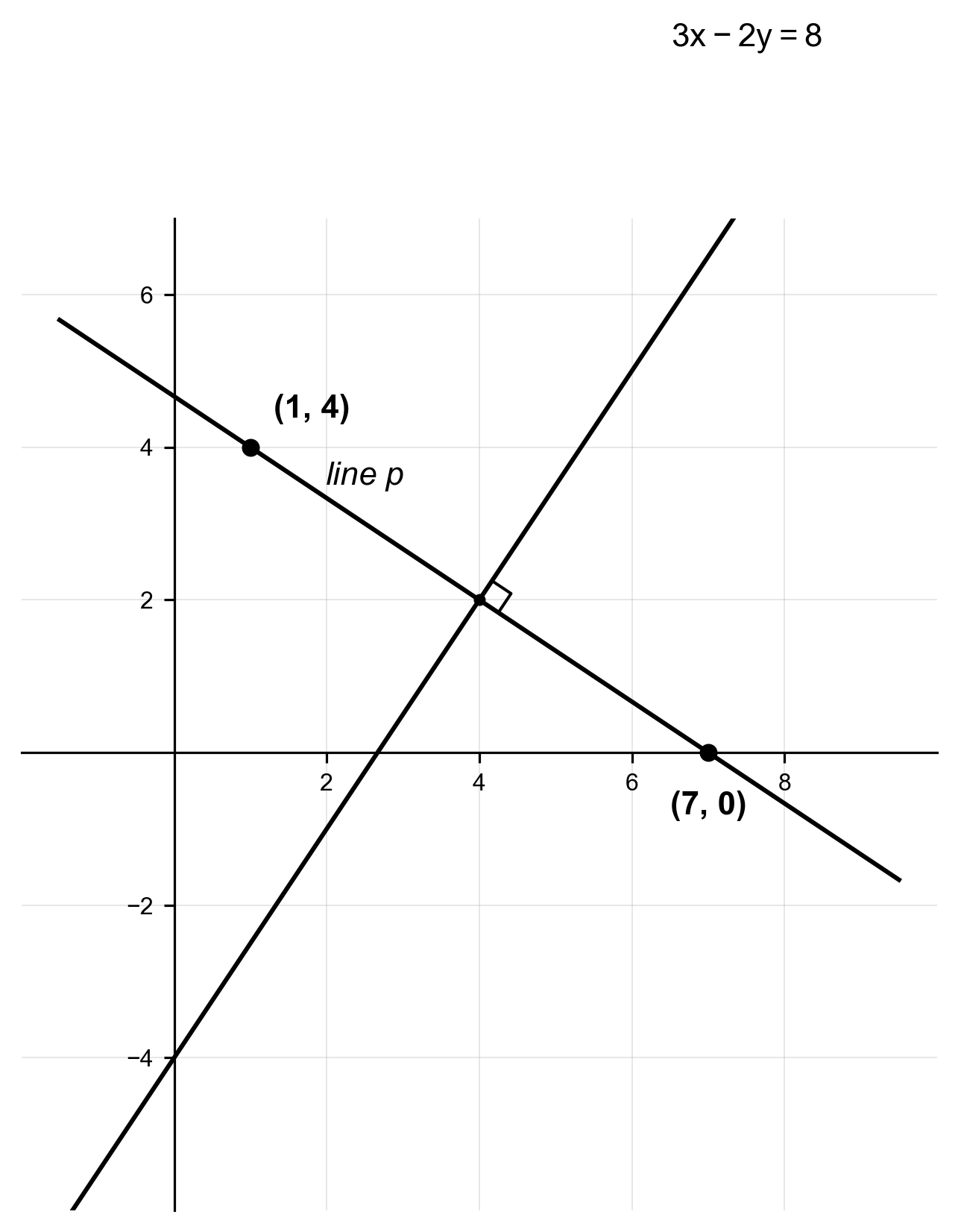
In the xy-plane, line p passes through the point (1,4) and is perpendicular to the line 3x−2y=8. What is the x-coordinate of the point where line p intersects the x-axis?
Your Answer:
Question 5 — Difference of Squares System (Hard)
If x and y are positive integers such that x2−y2=91 and x−y=7, what is the value of xy?
Your Answer:
Mixture and Rate Problems
Question 6 — Two-Stage Mixture (Hard)
A chemist has Solution A (40% acid) and Solution B (70% acid). She mixes them to create 60 liters of a 52% acid solution. She then adds x liters of pure water to dilute it to exactly 40% acid. What is the value of x?
Your Answer:
Question 7 — Round-Trip Rate (Hard)
A train travels from City A to City B at an average speed of 60 miles per hour and returns along the same route at an average speed of 40 miles per hour. If the total round-trip travel time is 5 hours, what is the distance, in miles, from City A to City B?
Your Answer:
Sequences and Quadratics
Question 8 — Recursive Sequence (Hard)
For all positive integers n, a sequence is defined by a1=3 and an+1=2⋅an−1. What is the value of a6?
Your Answer:
Question 9 — Vieta's Formulas (Hard)
The quadratic equation x2−2kx+(k+5)=0 has two real roots. If the sum of the squares of the roots is 20, what is the positive value of k?
Your Answer:
Systems of Equations and Functions
Question 10 — Three-Point Quadratic (Hard)
A function f(x)=ax2+bx+c satisfies f(1)=5, f(−1)=1, and f(2)=16. What is the value of f(3)?
Your Answer:
Question 11 — Multi-Phase Work Rate (Hard)
Pipe A can fill a tank in 12 hours, and Pipe B can fill it in 18 hours. Both pipes are opened simultaneously. After 3 hours, Pipe A is shut off and Pipe C (which drains the tank at 361 of the tank per hour) is opened alongside Pipe B. How many additional hours after the switch does it take to completely fill the tank?
Your Answer:
Question 12 — Exponent Chain Product (Hard)
If 2a=3, 3b=5, and 5c=8, what is the value of the product abc?
Your Answer:
Question 13 — Worker Rate with Unknown (Hard)
Worker A can complete a job in 10 days, and Worker B can complete the same job in 15 days. They start working together. After 3 days, Worker A leaves and Worker C joins Worker B. Together, Workers B and C finish the remaining work in 6 days. How many days would it take Worker C alone to complete the entire job?
Your Answer:
Common Traps and How to Avoid Them
Trap
What Goes Wrong
How to Avoid It
Slope sign error
Computing x1−x2y2−y1 instead of x2−x1y2−y1, which flips the sign
Always subtract in the same order: second point minus first point, in both numerator and denominator
Perpendicular slope mistake
Using the same slope or just the reciprocal (without the negative) for perpendicular lines
Perpendicular = negative reciprocal. Check: the product of the two slopes should be −1
Midpoint vs. endpoint confusion
The midpoint formula gives (2x1+x2,2y1+y2); confusing this with the full coordinates
Label your points clearly. The midpoint is always between the endpoints
Fraction entry errors
Entering numerator and denominator in the wrong boxes
Double-check which box is numerator (top) and denominator (bottom)
Answering the wrong variable
Computing the slope when asked for the y-intercept, or finding x when asked for y
Re-read the question after solving. Circle what is being asked before you begin
Averaging times instead of rates
Computing 210+15=12.5 instead of adding rates 101+151
Always add rates (work per unit time), then invert for total time
The verification rule: On every NE Algebra question, spend 15-20 seconds substituting your answer back into the original conditions. This single habit eliminates the majority of errors. If the question says the line passes through (2,3), plug x=2 into your equation and confirm you get y=3.
Numeric Entry vs. Multiple Choice: Key Differences
Understanding how Numeric Entry differs from Multiple Choice helps you allocate your time and adjust your strategy.
Feature
Multiple Choice
Numeric Entry
Answer choices
Five choices provided
No choices — you type the answer
Back-solving
You can plug choices into the equation
Not possible — you must work forward
Estimation
Often sufficient to eliminate wrong choices
Exact answer required
Random guess probability
20% (1-in-5 choices)
0% — you must know the answer
Common format
Select exactly one choice
Single box (integer/decimal) or two boxes (fraction)
Error detection
Wrong answer may not match any choice, signaling an error
No feedback — any number can be entered
The lack of answer choices makes verification by substitution especially critical on NE questions. On MC questions, a calculation error often produces a number that does not match any choice, alerting you to re-check. On NE questions, there is no such safeguard.
Time allocation: Budget 2.0-2.5 minutes for NE Algebra questions, compared to 1.5-2.0 for MC Algebra. The extra time goes to verification, which you cannot skip when there are no answer choices to validate against.
Study Checklist
NE Algebra Mastery Checklist0/8 complete
Frequently Asked Questions
How are GRE Numeric Entry Algebra questions different from multiple-choice algebra?
Numeric Entry Algebra questions require you to compute an exact value and type it into a box — there are no answer choices to guide you or back-solve from. You must work forward through the algebra, and any sign error, flipped fraction, or misapplied formula produces a wrong number with no way to catch the mistake from a list of options. This makes verification by substitution essential.
What algebra topics appear most often in GRE Numeric Entry?
The most common topics are slopes and equations of lines, coordinate geometry (midpoints, intercepts, distances), solving equations and systems of equations, function evaluation and composition, work-rate problems, and word problems translated into algebraic expressions. Quadratic equations and sequences also appear occasionally.
Can I enter fractions on GRE Numeric Entry questions?
Yes. When a question says "Give your answer as a fraction," two boxes appear — one for the numerator and one for the denominator. Fractions do not need to be reduced: 86 is accepted for 43. When a single answer box appears, equivalent decimal forms like 0.75 and 0.750 are both accepted.
What is the most common mistake on Numeric Entry Algebra questions?
The most common mistake is a slope sign error — computing x1−x2y2−y1 instead of x2−x1y2−y1, which flips the sign. Other frequent errors include using the same slope instead of the negative reciprocal for perpendicular lines, averaging times instead of adding rates in work-rate problems, and answering the wrong variable (finding x when the question asks for y).
How should I check my answer on a Numeric Entry question?
Substitute your answer back into the original equation or conditions. For coordinate geometry, verify the line passes through all given points. For work-rate problems, confirm the total work sums to 1. For systems of equations, check both equations. This takes 15-20 seconds but can prevent costly errors — and since there are no answer choices to validate against, it is your only safety net.