GRE Numeric Entry Geometry: Strategies and Practice
Numeric Entry Geometry questions are among the most demanding on the GRE Quantitative section. There are no answer choices to guide you, no options to eliminate, and no way to estimate your way to a correct response. You must compute an exact value — an area, a length, a distance, or another geometric measurement — and type it directly into a blank box. Below you will learn the four question patterns that appear, master six strategies for computing accurate answers, work through two fully interactive examples step by step, and then practice with six questions drawn from a calibrated question bank.
What Are Numeric Entry Geometry Questions?
Numeric Entry questions in the Geometry domain require you to compute an exact numerical answer and type it directly into a blank box. You see either a single empty box (for integers or decimals) or two stacked boxes with a fraction bar (for fractions). There are no answer choices. Equivalent forms are accepted: 10 and 10.0 are both correct, and fractions do not need to be reduced. If the question specifies a particular format or rounding instruction, you must follow it exactly.
These questions test a focused set of geometry topics: area and perimeter of rectangles, triangles, and composite figures; the Pythagorean theorem and special right triangles; properties of circles including circumference, area, and arcs; three-dimensional figures including rectangular solids and surface areas; and relationships between angles, sides, and diagonals in polygons.
Why NE Geometry is harder than MC Geometry: Without answer choices, you cannot estimate and select the closest option. You cannot use back-substitution. You cannot eliminate obviously wrong answers. Every computation must be carried through to an exact value, and a single arithmetic slip means a wrong answer with no safety net.
Four Question Stem Patterns
Nearly every Numeric Entry Geometry question falls into one of four recognizable patterns. Identifying the pattern early tells you which formula to reach for and what intermediate values you will need.
1
Shaded or Composite Region Area
Compute area by subtraction (large shape minus smaller shape) or by combining areas of sub-regions. Common in problems involving walkways, borders, or shaded portions of 3D figures.
2
Perimeter or Length Ratio as a Fraction
Fraction entry for perimeter ratios. You compute two perimeters separately and form the requested ratio. Enter numerator and denominator in the two-box format.
3
Direct Geometric Measurement
Compute a single measurement such as an area, a diagonal length, or a side length. Often involves the Pythagorean theorem or coordinate distance formula.
4
3D Figure Computation
Surface area, volume, or diagonal of a three-dimensional figure. Typically requires identifying a right triangle embedded in the solid and applying the Pythagorean theorem to find a missing dimension.
How to Solve NE Geometry Step by Step
These six strategies apply across all four patterns. Working through them in order will prevent the most common errors on Numeric Entry Geometry questions.
Even if a figure is described verbally, sketch it and label all given measurements. Mark right angles, equal sides, and any values you compute along the way. A labeled diagram prevents you from confusing which measurement goes where — a critical concern when there are no answer choices to catch your mistakes.
Many Geometry Numeric Entry problems involve a right triangle that is not immediately obvious. A diagonal across a rectangle, a height dropped from a vertex, or a radius to a tangent point all create right triangles. Identify them early and apply the Pythagorean theorem. This single skill unlocks the majority of NE Geometry questions.
Problems often require you to find a side length, diagonal, or height before you can compute the requested area or perimeter. Organize your work in steps: find the missing measurement first, then apply it in the final formula. Writing intermediate results down prevents you from holding too many numbers in working memory.
Read the question carefully. "What is the area" and "What is the perimeter" require entirely different computations. On Numeric Entry, entering the perimeter when the area was asked produces a wrong number with no answer choices to alert you. After computing, re-read the question stem to confirm you answered what was actually asked.
If the problem involves area, your answer should be in square units. If it involves a walkway "around" something, you likely need to subtract the inner area from the outer area. Make sure your final computation matches the dimensional analysis the question demands.
Recognizing triples saves time and reduces error: 3-4-5 (and multiples like 6-8-10, 9-12-15), 5-12-13, 8-15-17, and 7-24-25. When you see legs of 3 and 4, the hypotenuse is instantly 5. This avoids square root computations and the rounding errors that come with them.
Pro tip: If your computed answer involves an ugly decimal (like 7.2111...), step back and check whether the problem was designed around a Pythagorean triple. GRE Numeric Entry Geometry answers are almost always clean integers, simple decimals, or reducible fractions. An ugly decimal usually signals a computational error.
Worked Example: Space Diagonal of a Rectangular Box
Work through each step below. You must answer each mini-challenge correctly to unlock the next step. If you get stuck, a second wrong attempt will reveal the answer so you can keep going.
Interactive Walkthrough0/4 steps
Finding a Space Diagonal Using Nested Right Triangles
A rectangular storage crate has a base with length AB = 8 and width BC = 6. The crate is 24 units tall (edge CG). A stiff rod is placed inside the crate so that it runs from corner A at the base to the diagonally opposite corner G at the top.
What is the length of the rod AG?
1
Step 1: Identify the first right triangle
To find AG, you first need an intermediate length. The base diagonal AC lies flat on the bottom face. What are the two legs of the right triangle that has AC as its hypotenuse?
2
Step 2: Compute the base diagonal AC
3
Step 3: Identify the second right triangle
4
Step 4: Compute the space diagonal AG
Worked Example: Border Area by Subtraction
This example teaches the subtraction method for computing the area of a uniform border region. Work through each step to see why you must compute both the outer and inner areas separately.
Interactive Walkthrough0/5 steps
Computing a Deck Area Around a Swimming Pool
A rectangular swimming pool is 20 meters long and 10 meters wide. A tiled deck of uniform width 2 meters surrounds the pool on all four sides.
What is the area of the tiled deck, in square meters?
1
Step 1: Find the outer length
The deck extends 2 meters beyond each end of the pool. Outer length = 20+2+2 = ?
2
Step 2: Find the outer width
3
Step 3: Compute the outer area (pool + deck)
4
Step 4: Compute the pool area
5
Step 5: Subtract to find the deck area
Practice Questions
Now apply what you learned. Each question has a step-by-step solution walkthrough — after you submit your answer, click through the solution one step at a time to compare against your own work. All questions are drawn from the Numeric Entry Geometry question bank.
Question 1 — Intersecting Chords
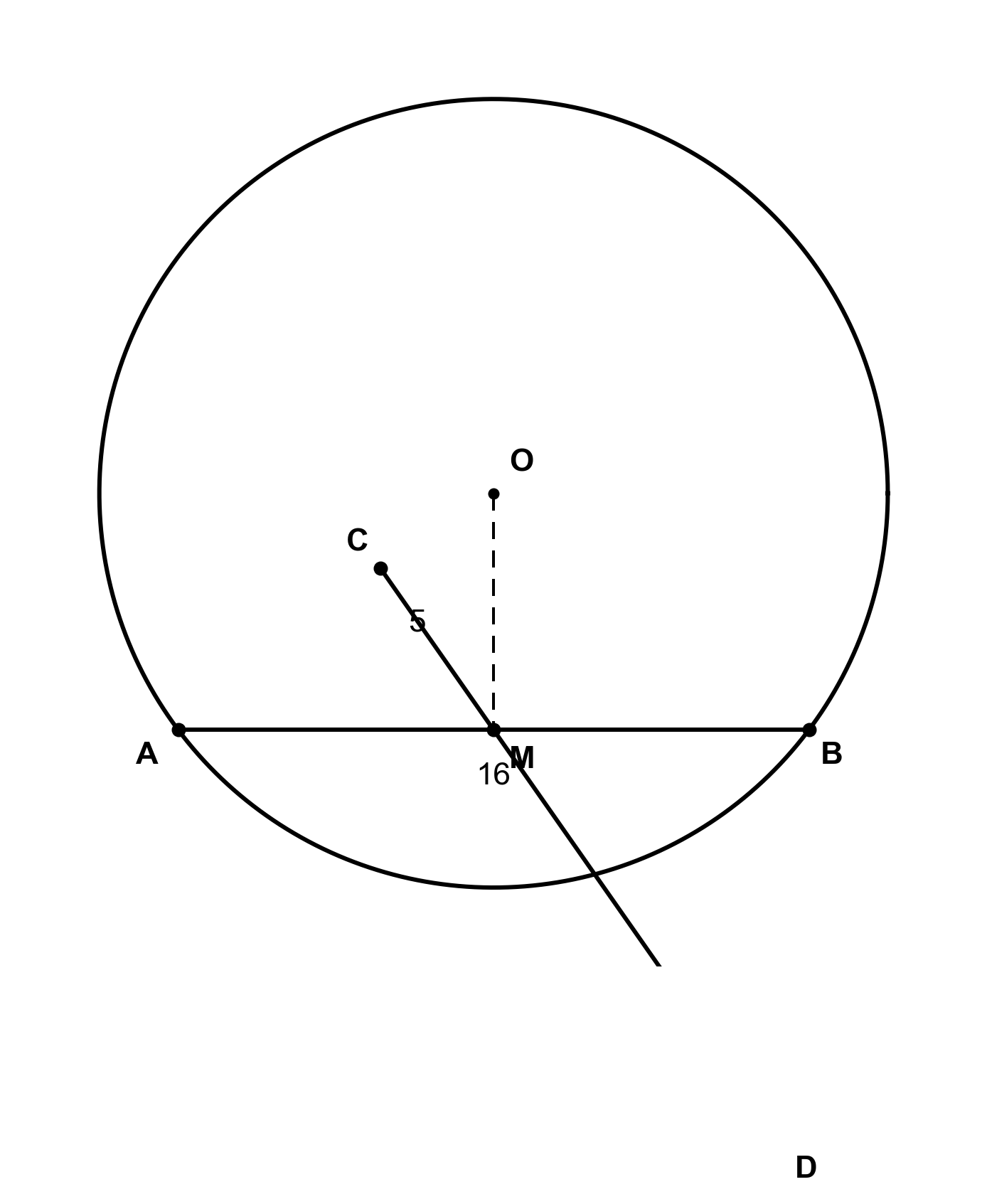
In a circle with radius 10, chord AB has length 16. Point M is the midpoint of AB. A second chord CD passes through M with CM = 5. What is the length of MD?
Your Answer:
Question 2 — Rhombus Perimeter
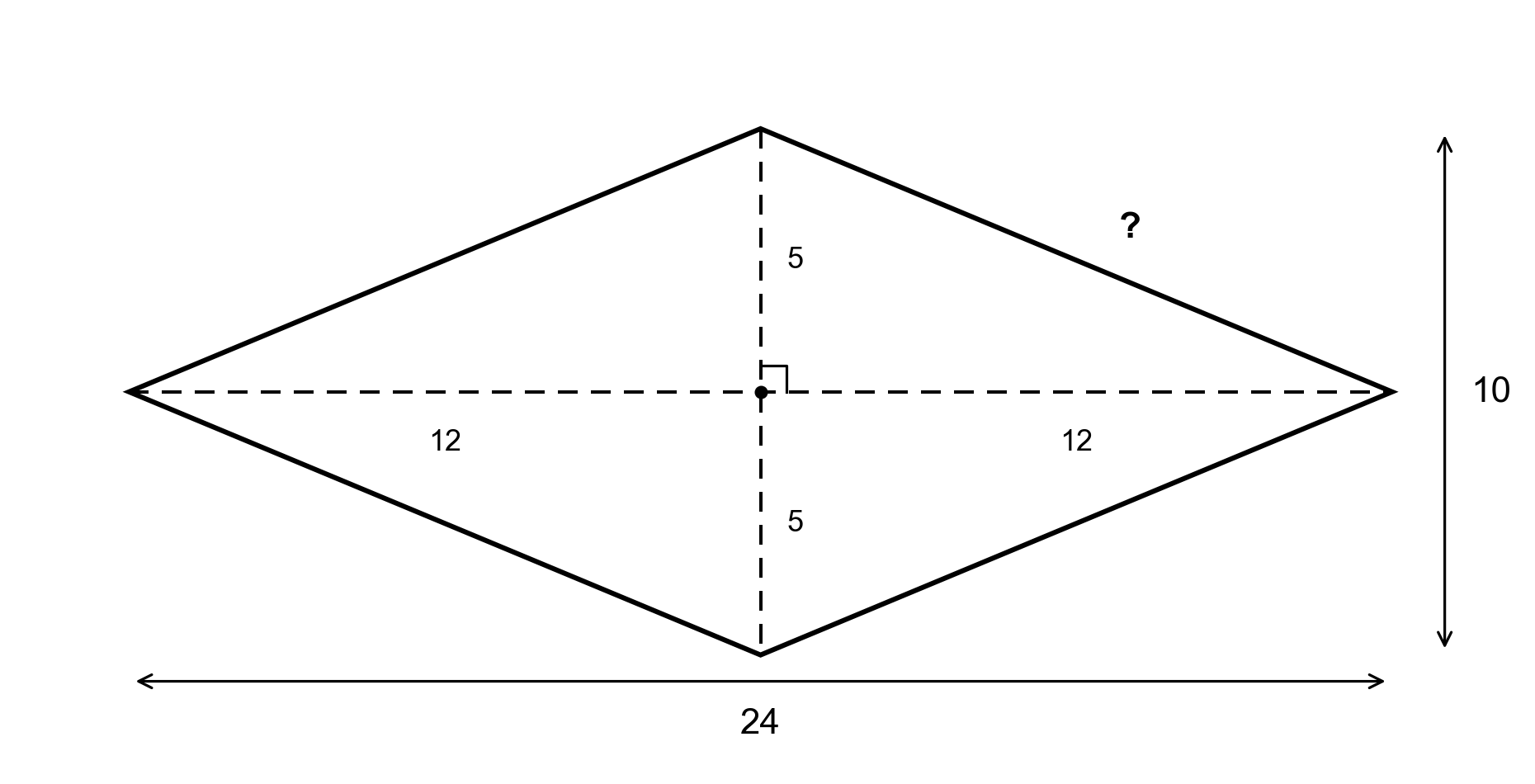
A rhombus has diagonals of length 10 and 24. What is the perimeter of the rhombus?
Your Answer:
Question 3 — Trapezoid and Diagonal Intersection
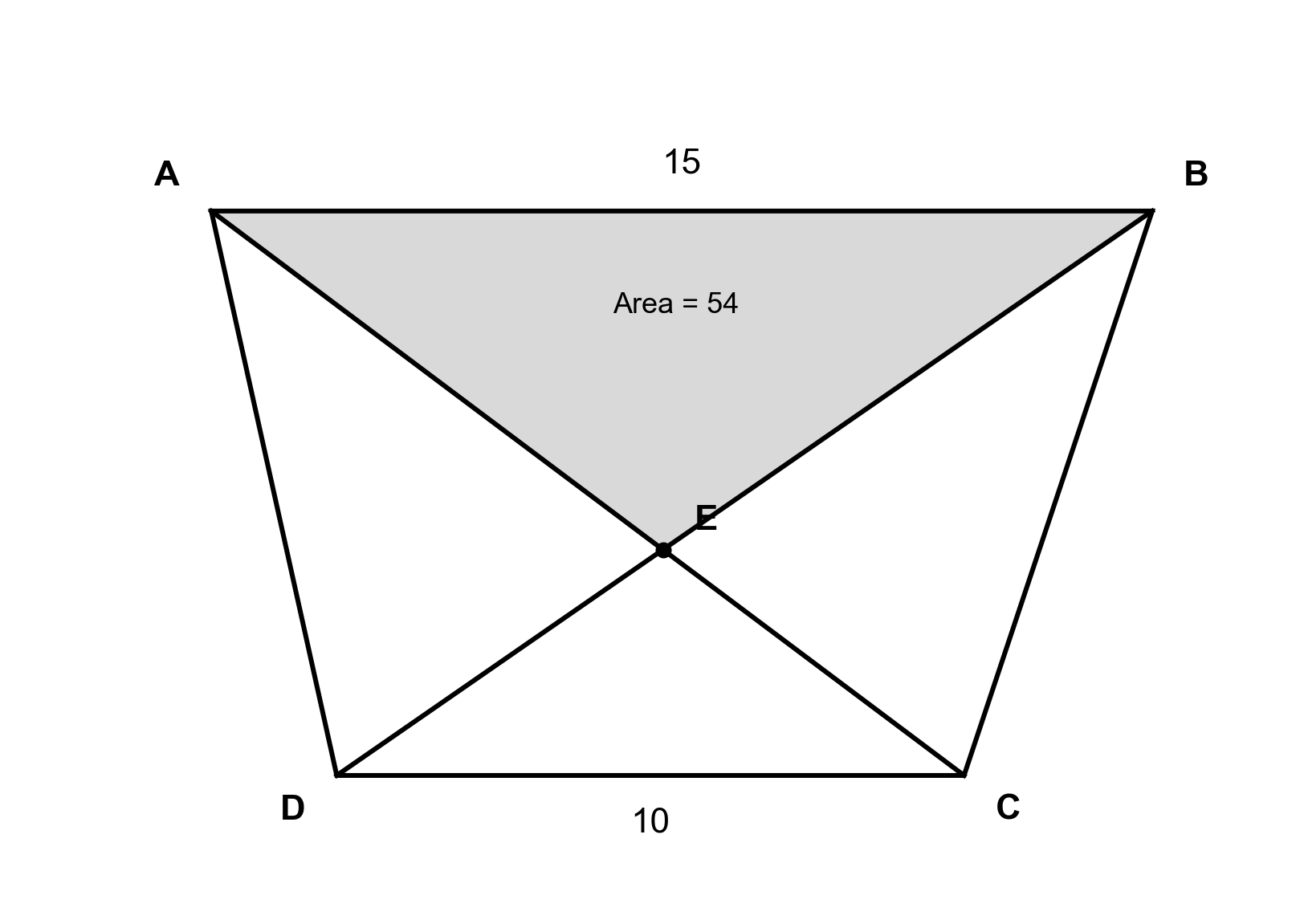
In trapezoid ABCD, AB is parallel to CD, AB = 15, and CD = 10. The diagonals AC and BD intersect at point E. If the area of triangle AEB is 54, what is the area of trapezoid ABCD?
Your Answer:
Question 4 — Semicircle and Right Triangle
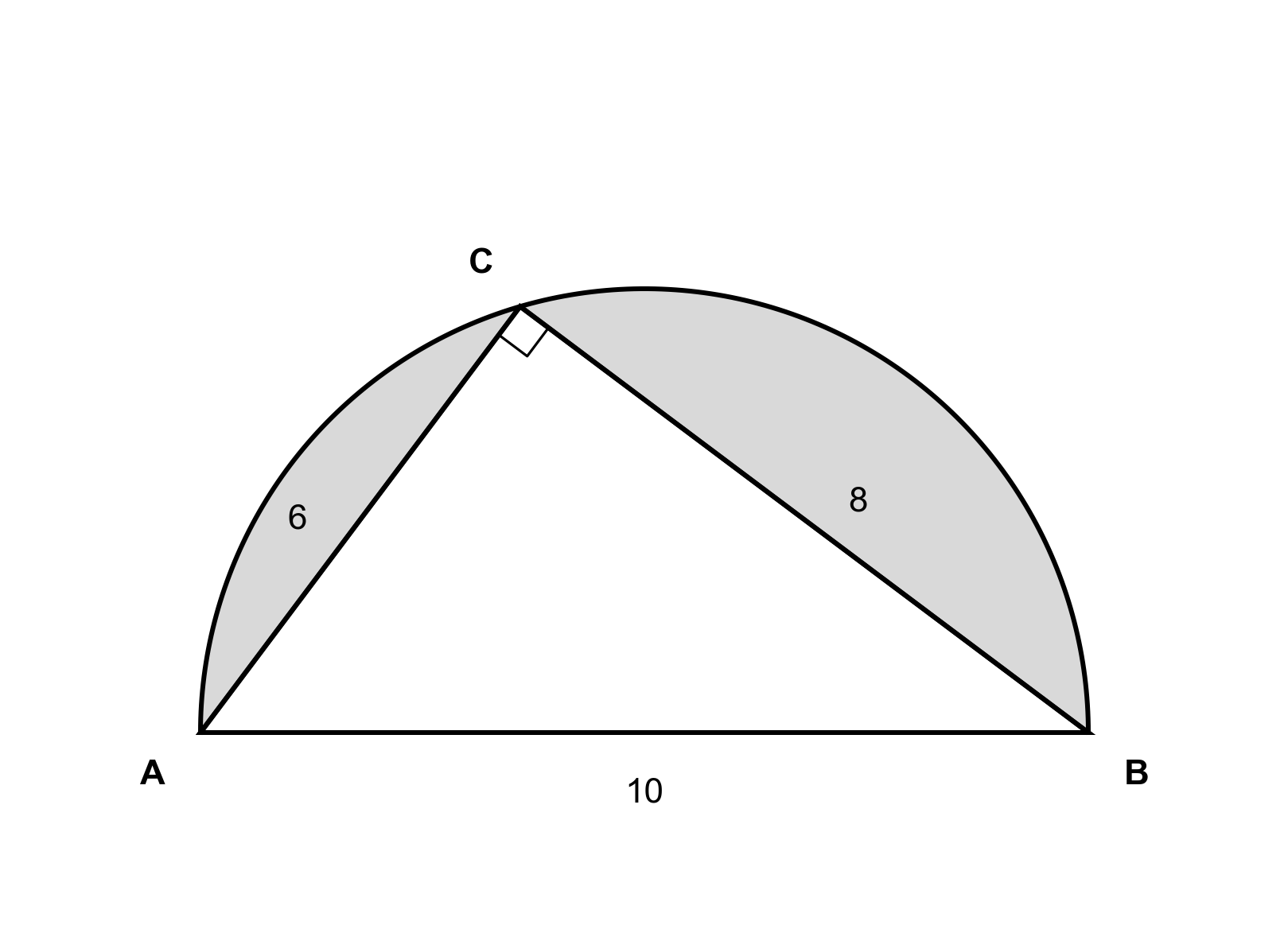
A semicircle is drawn on the hypotenuse of a right triangle as its diameter. The legs of the right triangle have lengths 6 and 8. What is the area of the region inside the semicircle but outside the triangle? Give your answer to the nearest 0.01.
Your Answer:
Question 5 — Distance Between Parallel Chords
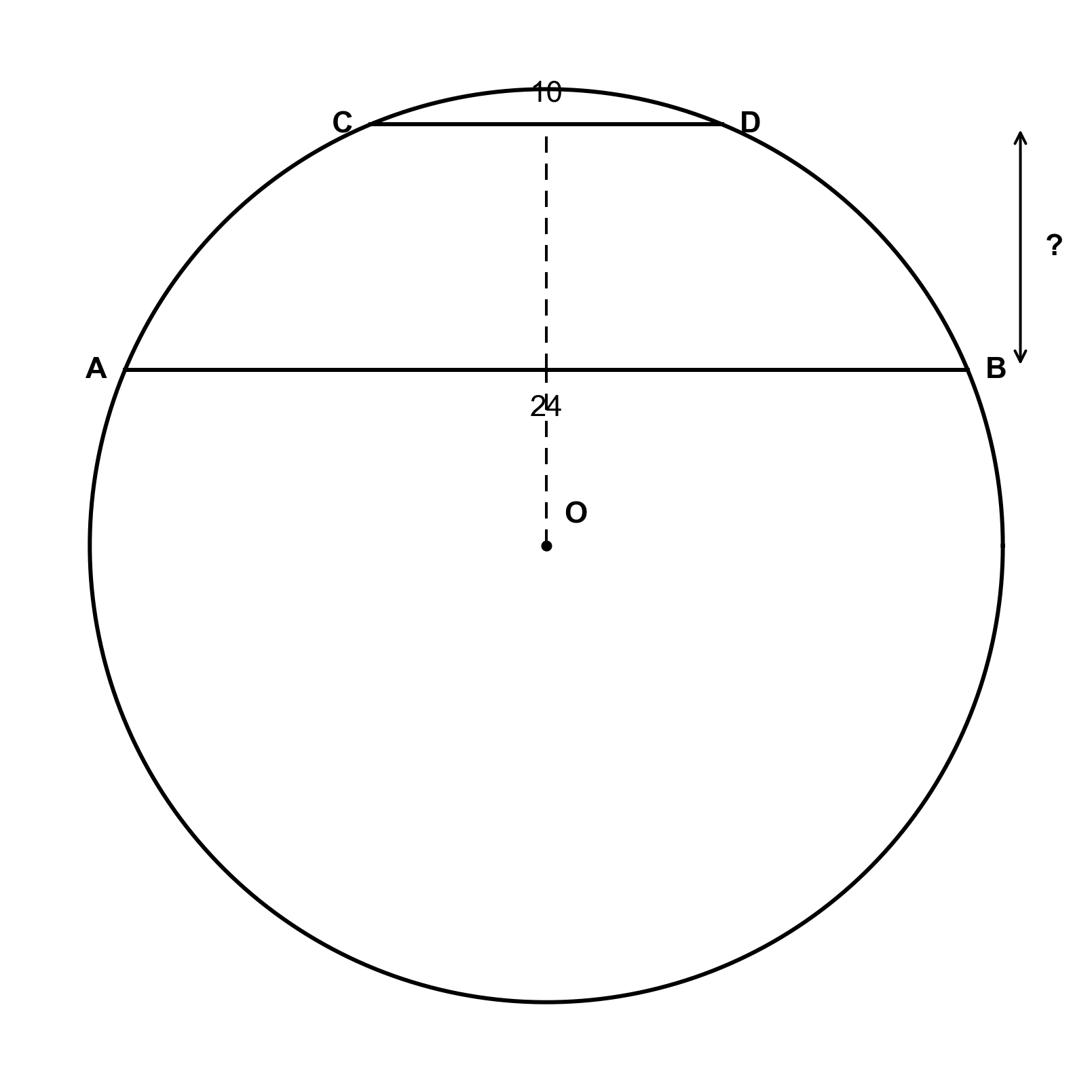
In a circle with radius 13, chord AB has length 24 and chord CD has length 10. The two chords are parallel and lie on the same side of the center. What is the distance between the two chords?
Your Answer:
Question 6 — Triangle Inside a Square
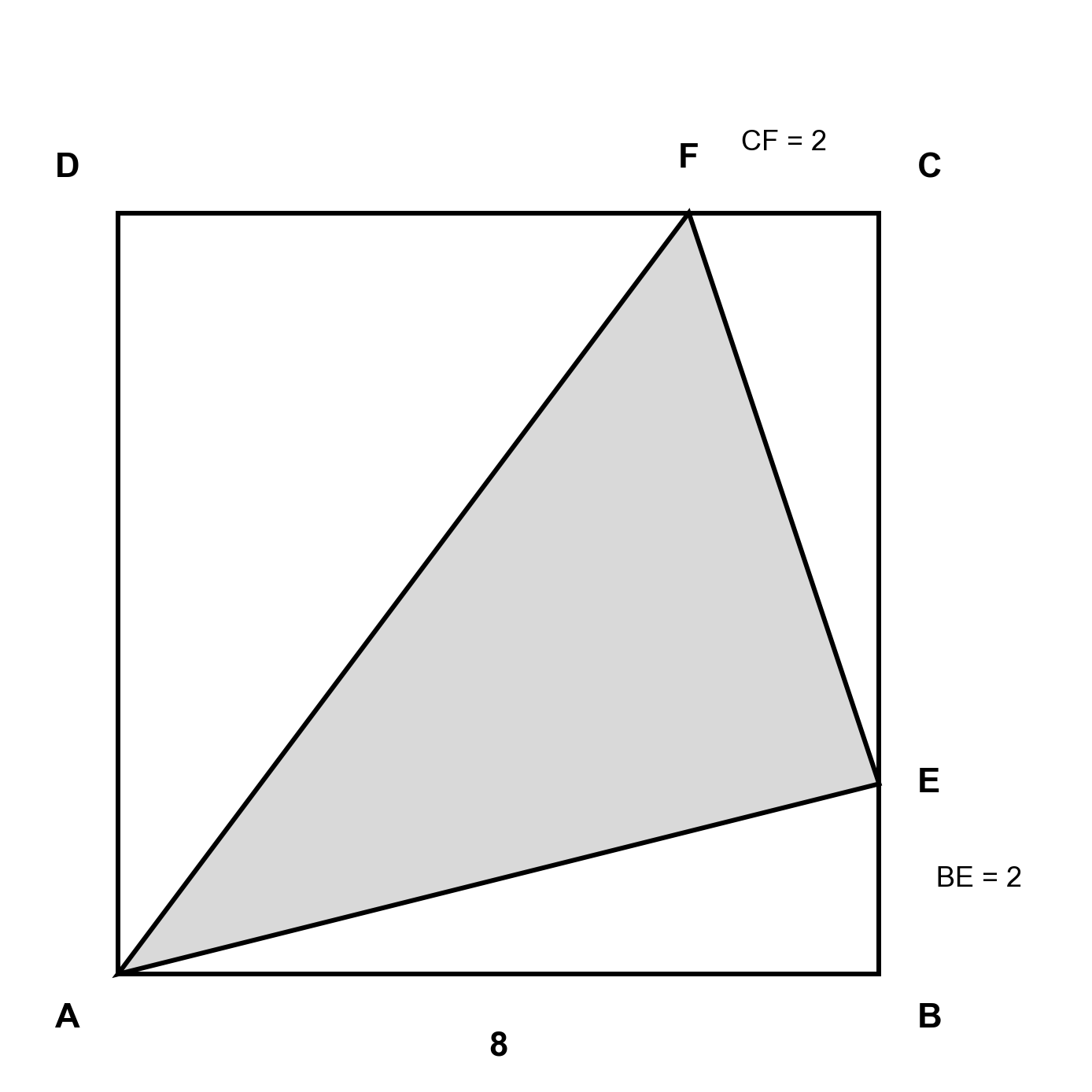
Square ABCD has side length 8. Point E lies on side BC such that BE = 2. Point F lies on side CD such that CF = 2. What is the area of triangle AEF?
Your Answer:
Three Common Traps
Trap 1 — Confusing area with perimeter. Computing 2l+2w when the question asks for l×w, or vice versa. Without answer choices to serve as a sanity check, this error goes undetected. Always re-read the question stem after computing to confirm you answered what was actually asked.
Trap 2 — Forgetting to subtract inner from outer. For walkways, borders, and shaded regions, the answer is the outer area minus the inner area. Computing only the outer area (or only the inner area) gives an answer that looks plausible but is wrong. The walkway area is never the same as the total area unless the inner region has zero area.
Trap 3 — Using the wrong side as the hypotenuse. In the Pythagorean theorem, c (the hypotenuse) is always the longest side, opposite the right angle. Computing c2=a2−b2 (subtracting instead of adding) or treating a leg as the hypotenuse inverts the relationship and produces the wrong answer. Draw the triangle, label the right angle, and confirm which side is opposite it.
Recognizing Hidden Right Triangles
The single most important skill in NE Geometry is recognizing right triangles that are not explicitly drawn. The table below lists the most common situations where a hidden right triangle appears and how to use it.
Situation
Where the Right Triangle Is
What You Find
Diagonal of a rectangle
The diagonal is the hypotenuse; the two sides are legs
Length of the diagonal
Altitude of a triangle
The altitude creates two right triangles inside the original triangle
Height for computing area
Radius to a tangent point
The radius meets the tangent line at 90 degrees
Distance from center to external point
Diagonal of a rectangular solid
Apply the theorem twice: first on a face, then using that diagonal as one leg
Space diagonal or face diagonal
Chord distance from center
The perpendicular from center to chord bisects the chord at 90 degrees
Distance from center to chord
Inscribed angle in a semicircle
Any angle inscribed in a semicircle is 90 degrees (Thales' theorem)
The hypotenuse is the diameter
When you encounter a Numeric Entry Geometry problem and do not immediately see how to compute the answer, ask yourself: "Is there a right triangle hiding in this figure?" In the vast majority of cases, the answer is yes.
Common Pythagorean Triples to Memorize: 3-4-5 (and multiples: 6-8-10, 9-12-15, 15-20-25), 5-12-13, 8-15-17, and 7-24-25. The GRE frequently designs problems around these triples so that the answer comes out to a clean number.
Study Checklist
NE Geometry Mastery Checklist0/9 complete
Frequently Asked Questions
What topics appear in GRE Numeric Entry Geometry questions?
GRE Numeric Entry Geometry covers area and perimeter of polygons, the Pythagorean theorem and special right triangles (3-4-5, 5-12-13), properties of circles including circumference, area, and arcs, three-dimensional figures including rectangular solids and surface areas, coordinate geometry involving distance computations, and relationships between angles, sides, and diagonals in polygons.
How is a Numeric Entry Geometry question different from a multiple-choice geometry question?
In a Numeric Entry question there are no answer choices to select from. You must compute the exact numerical answer and type it into a blank box (or enter a numerator and denominator for fractions). This means you cannot estimate or eliminate choices — you must perform the full calculation correctly. The absence of answer choices also means you cannot back-substitute to verify your work.
Which Pythagorean triples should I memorize for the GRE?
The most important triples are 3-4-5 (and multiples like 6-8-10 and 9-12-15), 5-12-13, 8-15-17, and 7-24-25. Recognizing these instantly saves computation time and reduces errors, especially in multi-step problems where a hidden right triangle must be identified before the final area or perimeter can be computed.
What is the most common mistake on GRE Numeric Entry Geometry questions?
The most common mistake is confusing area with perimeter. Because there are no answer choices to serve as a sanity check, computing 2l+2w when the question asks for l×w (or vice versa) produces a wrong number with no warning. A close second is forgetting to subtract the inner area from the outer area in walkway and border problems. Always re-read the question stem before entering your answer.
Can I enter equivalent forms for Numeric Entry answers?
Yes. Equivalent forms are accepted: 10 and 10.0 are both correct for an integer answer. For fraction entry, you do not need to reduce — entering 20/80 is accepted when 1/4 is the answer. However, if the question specifies a particular format or rounding instruction (such as "to the nearest 0.01"), you must follow it exactly. Always check whether the question requests a specific format before entering your answer.