GRE Quantitative Comparison Questions: Complete Strategy Guide
Quantitative Comparison (QC) is the signature question format of the GRE Quantitative Reasoning section. Every QC question presents two mathematical quantities — Quantity A and Quantity B — and asks you to determine their relationship using four fixed answer choices. No other standardized test uses this format, so understanding how it works is essential for a strong GRE score. This guide covers the QC format itself, the four math domains it draws from, the most effective solving strategies, and provides six interactive practice questions drawn from official-style question banks across all domains.
What Are Quantitative Comparison Questions?
Quantitative Comparison is one of the four question types in the GRE Quantitative Reasoning section. Each QC question presents two mathematical quantities — Quantity A and Quantity B — and asks you to determine their relationship. Some questions include additional information (constraints, equations, or context) displayed above the two quantities that applies to both. Unlike other question types, you never need to calculate an exact numerical answer. You only need to determine which quantity is greater, whether they are equal, or whether the relationship is indeterminate.
Every QC question uses the same four answer choices in the same order, on every single question. There is no fifth choice, no partial credit, and only one answer is ever correct. Learning to work within this fixed format — and using its constraints to your advantage — is the key to consistent performance on QC questions.
The 4 answer choices (memorize these):
(A) Quantity A is greater. (B) Quantity B is greater. (C) The two quantities are equal. (D) The relationship cannot be determined from the information given.
Structural shortcut: If there is no variable or unknown in the problem, the answer is never D. Both quantities are fixed, so the comparison must be A, B, or C. Eliminate D immediately and save time.
QC Format at a Glance
Feature
Detail
What you compare
Quantity A vs. Quantity B
Number of answer choices
Always exactly 4
Choice A
Quantity A is greater
Choice B
Quantity B is greater
Choice C
The two quantities are equal
Choice D
The relationship cannot be determined
Additional info
Constraints, equations, or figure descriptions may appear above the quantities
Partial credit
None — you must select the single correct answer
Approximate count per section
7-8 questions out of 27 total
4 Math Domains You'll See
QC questions draw from all four GRE math content domains. Recognizing the domain immediately tells you which strategies and traps are most likely to apply.
1
Arithmetic
Percents, ratios, rates, exponents, roots, integer properties (divisibility, primes), and sequences. Arithmetic QC questions often have fixed values, making the answer A, B, or C. When a variable appears in an exponent comparison, expect answer D.
2
Algebra
Equations with variables, inequalities, functions, and coordinate geometry. Algebra QC questions frequently produce answer D because variables with loose constraints can take many values, changing the comparison. One equation with two unknowns is a classic D scenario.
3
Geometry
Triangles, circles, quadrilaterals, coordinate geometry, and area/perimeter comparisons. Geometry QC questions produce answer D when a figure is not fully determined (e.g., a point can be anywhere on a segment). When dimensions are fixed, the answer is definite.
4
Data Analysis
Mean, median, standard deviation, normal distributions, frequency tables, and probability. Data Analysis QC questions test conceptual understanding — for example, how multiplying data by a constant affects standard deviation, or how skewness shifts the mean relative to the median.
Typical Answer Patterns by Domain
Domain
Typical Answer Pattern
Why
Arithmetic
Often A, B, or C
Values are usually fixed or fully determined
Algebra
Often D
Variables with loose constraints change the comparison
Geometry
Often A, B, or C
Fixed dimensions produce definite comparisons; D appears when figures are unfixed
Data Analysis
Varies
Depends on whether data is fully or partially specified
How to Solve Step by Step
The following strategies cover every QC question across all four domains. Apply them in order for maximum efficiency.
When variables are present and no single algebraic simplification is obvious, test specific values. Start with simple values like x = 1 or x = 2. Then test edge cases: x = 0 (if allowed), x = -1, x = 1/2, very large numbers, and negative numbers. If two trials give different results, the answer is D and you are done. If all trials agree, the answer is likely A, B, or C — but verify with algebra if possible.
What values to try: Zero (if allowed), positive and negative integers (1, -1, 2, -2), fractions between 0 and 1 (1/2, 1/3), very large numbers (100, 1000), and the boundary of any constraint (if x > 1, try values just above 1).
Before plugging in, see if you can simplify. Subtract the same expression from both sides. Divide both sides by the same positive quantity. Factor or expand expressions. Combine fractions with a common denominator. If after simplification both sides are identical, the answer is C.
Critical rule: You may add or subtract the same value from both sides (always safe). You may multiply or divide both sides by a positive quantity (preserves direction). Never multiply or divide by a quantity that could be negative or zero. Never square both sides unless both sides are known to be non-negative.
Answer D is correct when the relationship changes depending on which values you choose. Common signals: a single equation with two unknowns (e.g., x + y = -1, comparing x vs. y), variables constrained loosely by an inequality, or a geometric figure that is not fully determined. To prove D, you need exactly two cases — one where Quantity A wins and one where Quantity B wins (or one where they are equal and one where they are not).
You do not need exact values. If you can establish that one side is definitely above 100 and the other is definitely below 100, that is sufficient. For example, 54% of 360 is greater than 50% of 360 = 180, which is greater than 150. No exact computation needed. Estimation is especially powerful for percent and rate problems.
Squaring a number between 0 and 1 makes it smaller. Squaring a negative number makes it positive. Multiplying two negatives gives a positive. Adding a constant to every data value does not change the standard deviation. Multiplying every data value by a constant k scales the standard deviation by |k|. These properties let you resolve comparisons without computation.
For geometry QC problems, sketch the figure and label known lengths and angles. This often reveals the comparison immediately. Critical reminder: geometric figures in QC are not necessarily drawn to scale. Lengths and angles may not appear as shown. You must redraw the figure with different configurations to test whether the comparison changes.
Pro tip: Before doing any math, check whether the problem contains a variable. If it does not, eliminate answer D immediately — the comparison is fully determined. If it does, your first instinct should be to test two different values. If both values give the same winner, consider whether algebra can prove it always holds. If the values give different winners, the answer is D and you are done in under 30 seconds.
Worked Example 1: Weighted Average vs. Simple Midpoint
This example shows why a simple midpoint of two averages can mislead you when the groups have different sizes. Work through each step below.
Interactive Walkthrough0/5 steps
Weighted Average vs. Simple Midpoint
A teacher gives two tests. The first test has 15 students with an average score of 72. The second test has 25 students with an average score of 88.
Quantity A
Quantity B
The overall average score for all 40 students
80
Quantity A is greater
Quantity B is greater
The two quantities are equal
Cannot be determined
1
Step 1: Compute total points from Test 1
The first test has 15 students with an average of 72. What is the total number of points from Test 1? Compute 15×72.
2
Step 2: Compute total points from Test 2
3
Step 3: Compute overall average
4
Step 4: Compare with Quantity B
5
Step 5: Understand the trap
Worked Example 2: Remainder from Division
This example demonstrates how to use the division algorithm to determine remainders when a divisor evenly divides into the original divisor. Work through each step.
Interactive Walkthrough0/5 steps
Remainder from Division
When the positive integer n is divided by 12, the remainder is 7.
Quantity A
Quantity B
The remainder when n is divided by 4
3
Quantity A is greater
Quantity B is greater
The two quantities are equal
Cannot be determined
1
Step 1: Express n using the division algorithm
Since n divided by 12 leaves remainder 7, we can write n in terms of a non-negative integer k. What form does this give n?
2
Step 2: Divide n by 4
3
Step 3: Verify with a specific value
4
Step 4: Test another value
5
Step 5: Compare the quantities
Practice Questions
Now apply what you have learned across all four domains. Each question presents Quantity A and Quantity B for you to compare. After you submit your answer, click through the solution walkthrough one step at a time.
Practice 1 — Algebra
x and y are positive integers with x+y=12 and xy=35, and x>y.
Quantity A
Quantity B
x2−y2
24
Select one answer:
Practice 2 — Algebra
3x+5y=30, where x and y are positive numbers.
Quantity A
Quantity B
2x+y
10
Select one answer:
Practice 3 — Arithmetic
Machine X produces 100 widgets in 20 minutes. Machine Y produces 100 widgets in 30 minutes. Machine Z produces 100 widgets in 60 minutes. All machines work alone at constant rates.
Quantity A
Quantity B
The number of widgets produced when machines X and Z work together for 30 minutes
The number of widgets produced when machine Y works alone for 60 minutes
Select one answer:
Practice 4 — Data Analysis
Data set S consists of n values with n > 2. Data set T is formed by multiplying each value in S by -3 and then adding 7 to each result.
Quantity A
Quantity B
The standard deviation of data set T
3 times the standard deviation of data set S
Select one answer:
Practice 5 — Geometry
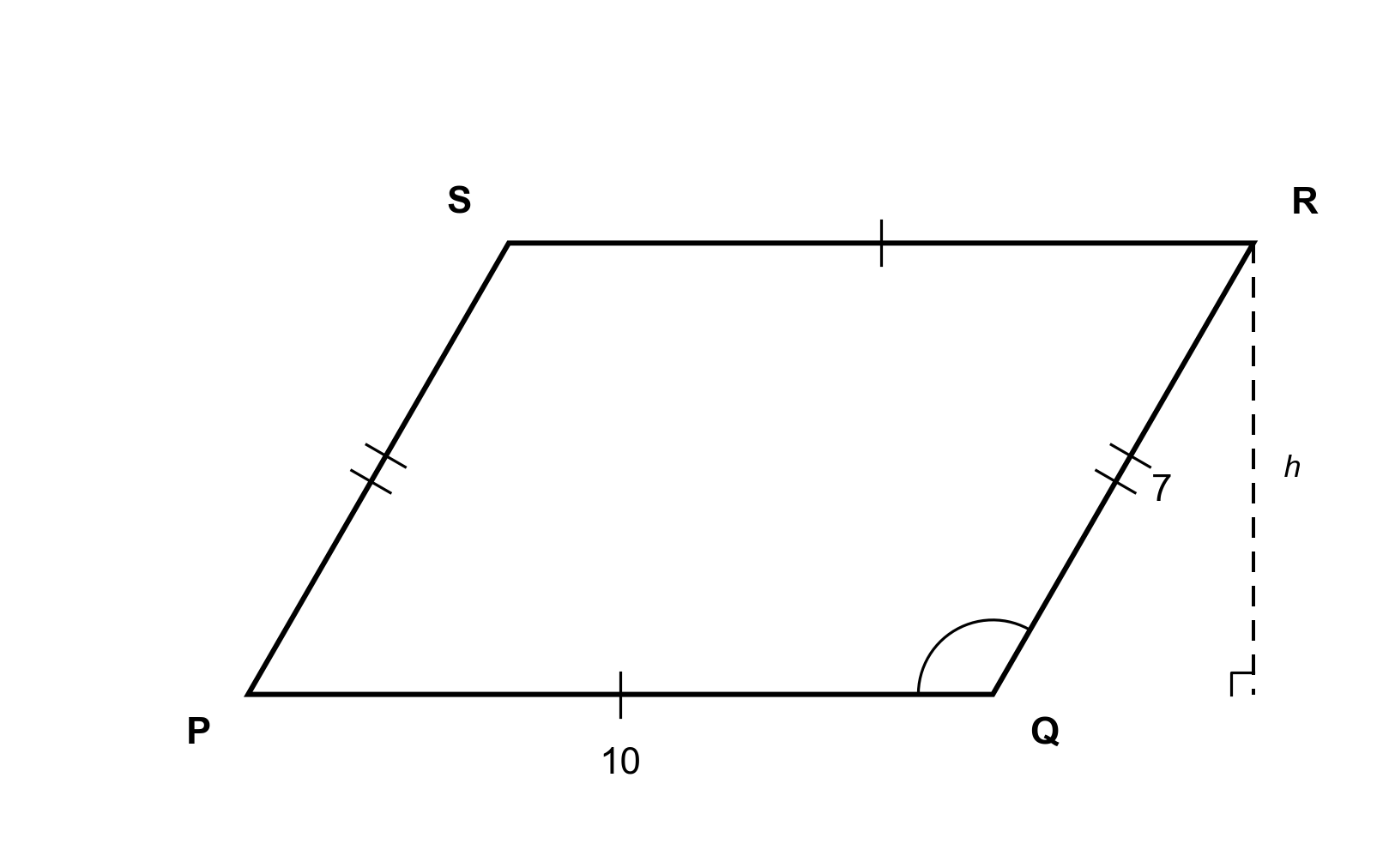
Parallelogram PQRS has PQ = 10 and QR = 7. Angle PQR is obtuse.
Quantity A
Quantity B
The area of parallelogram PQRS
70
Select one answer:
Practice 6 — Arithmetic
Of the integers from 1 to 360, inclusive, let S be the number of integers that are divisible by 4 but not by 6, and let T be the number of integers that are divisible by 6 but not by 4.
Quantity A
Quantity B
S
T
Select one answer:
Common Traps
GRE question writers exploit the same cognitive shortcuts on every test. Here are three traps that catch the most test-takers on QC questions.
Trap 1: Forgetting to test negative numbers and fractions for "Cannot Be Determined." Unless stated otherwise, variables can be zero, negative, fractions, or decimals. If the problem says "x is a real number," you must test x = -1 and x = 1/2 in addition to positive integers. Many students test only x = 2 and x = 3, get the same result, and choose A or B — when testing x = -1 would have flipped the comparison and revealed the answer is D. Always ask: "What edge cases am I missing?"
Trap 2: Assuming that equal-looking expressions must be equal. Students see Quantity A = "base x side" and Quantity B = "70" for a parallelogram with base 10 and side 7, and immediately conclude C. But the area formula requires the sine of the included angle: Area=base×side×sin(θ). Unless the angle is 90 degrees, the area is less than base x side. Similarly, +30% then +20% looks like +50%, but successive percent changes are multiplicative: 1.30 x 1.20 = 1.56, a 56% increase, not 50%.
Trap 3: Choosing D when algebra would resolve the comparison definitively. Complex-looking expressions with variables can trick students into assuming the answer is indeterminate. But many such problems simplify to a definite comparison. For example,x2+1 versus 2x−1: the difference is (x−1)2+1, which is always at least 1 for any real x. The answer is A, not D. Before choosing D, always attempt algebraic simplification — factor, expand, or complete the square to see if the comparison collapses to a constant.
Study Checklist
QC Mastery Checklist0/8 complete
Frequently Asked Questions
How many Quantitative Comparison questions appear on the GRE?
Each Quantitative Reasoning section contains roughly 7-8 Quantitative Comparison questions. Since the GRE has two scored Quantitative Reasoning sections, you will see approximately 14-16 QC questions total on the test. The questions span all four math domains: Arithmetic, Algebra, Geometry, and Data Analysis. The exact count varies by adaptive section.
What are the four answer choices for every QC question?
Every QC question uses the same four fixed choices: (A) Quantity A is greater, (B) Quantity B is greater, (C) The two quantities are equal, (D) The relationship cannot be determined from the information given. There is no option E, and the wording never changes. Memorize them so you can focus entirely on the math.
When should I choose answer D on a QC question?
Choose D when different valid values of the variable or variables produce different comparison outcomes. For example, if plugging in x = 2 makes Quantity A greater but x = 5 makes Quantity B greater, the answer is D. You need at least two test cases that give opposite results. Importantly, D is only possible when the problem contains a variable — if both quantities are fixed numbers, eliminate D immediately.
Do I need to calculate exact values for Quantitative Comparison questions?
No. You only need to determine the relationship between the two quantities, not compute their exact values. Estimation, simplification, and strategic number-plugging are often faster than full computation. For example, if you can show Quantity A exceeds 100 and Quantity B is below 100, you do not need either exact value. The GRE rewards strategic laziness — compute only what is necessary to determine the comparison.
What is the best overall strategy for QC questions?
Start by checking whether the problem contains variables. If no variables are present, the answer cannot be D, so compute or estimate to determine A, B, or C. If variables are present, plug in at least two strategically chosen values (e.g., positive and negative, small and large, integer and fraction). If two values give different outcomes, the answer is D. If they consistently agree, use algebra to verify the result holds universally. This two-step approach — variable check first, then test or simplify — handles every QC question efficiently.