115 minutes
Mathematical Reasoning
Algebra, geometry, graphs and everyday number problems. An on-screen calculator is built in for the second part, and a formula sheet is provided.
In GED Prep: 27 lessons, 135 practice questions
Lessons, practice questions and study plans for all four GED tests: Math, Language Arts, Science and Social Studies. Study on your phone or laptop, whenever your day allows.
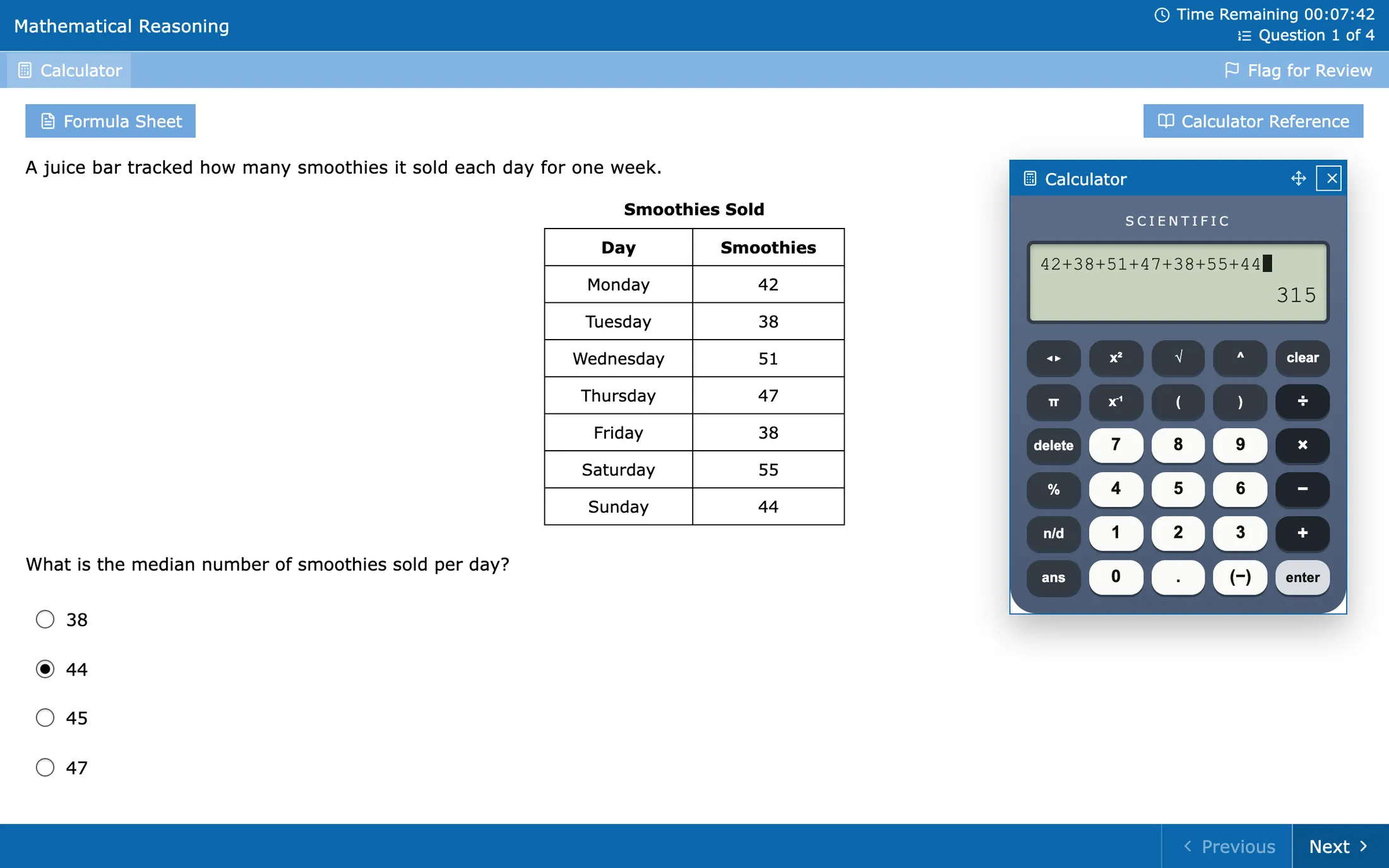
A test window that works like the GED.
Flag for Review, Previous and Next, a calculator you can drag anywhere, the formula sheet and the calculator reference.
Each GED subject is its own test, with its own score and its own day if you like. Many people take one, pass it, and move on to the next.
115 minutes
Algebra, geometry, graphs and everyday number problems. An on-screen calculator is built in for the second part, and a formula sheet is provided.
In GED Prep: 27 lessons, 135 practice questions
150 minutes
Reading passages, grammar and editing, and a written response in which you weigh the arguments of two passages.
In GED Prep: 31 lessons, 111 practice questions
90 minutes
Life science, physical science, and Earth and space science, often through charts, data and experiments you read and reason about.
In GED Prep: 18 lessons, 98 practice questions
70 minutes
Civics and government, U.S. history, economics and geography, often through documents, maps and graphs.
In GED Prep: 21 lessons, 83 practice questions
Each subject is scored from 100 to 200 on its own. Scores are not added up or averaged: you need 145 or higher on all four tests to earn your GED.
Age limits, prices and online testing differ by state. A free account at GED.com shows the rules where you live.
Pick a subject to start with. Lessons teach each skill, and practice questions check it before you move on.
When your practice is steady, take GED Ready, the official practice test, to see whether you are likely to pass.
Test at a nearby test center, or online from home if your state allows it and your GED Ready score qualifies you.
Score 145 or higher on every subject and your state issues your high school equivalency credential.
Many people studying for the GED are also working, raising kids, or both. GED Prep is built for short, regular sessions.
Lessons and question sets follow the four GED tests, so you can finish one subject, pass it, and start the next.
Follow a study plan for 2 weeks, 1 month or 2 months, so you always know what to do next.
All 427 practice questions come with an explanation, so a wrong answer still teaches you something.
It runs in your browser. Study on a lunch break, late at night or on the weekend, and pick it back up anywhere.
One plan covers all four subjects. Until it opens, 16 free practice questions are ready to try in the same test window.
Try the practice questionsHow the test works, what it costs in your state, and what each subject covers.
The GED is a set of four tests: Mathematical Reasoning, Reasoning Through Language Arts, Science and Social Studies. Pass all four and your state issues a high school equivalency credential, which nearly all U.S. colleges and employers accept in place of a high school diploma.
Adults who did not finish high school and are not enrolled in one. Most states set the minimum age at 18 and let 16- and 17-year-olds test only with extra requirements, such as proof they have left school; a few set it at 19. Rules differ by state, so check yours on GED.com.
About 7 hours in all, split across four tests you can take on different days: Mathematical Reasoning 115 minutes, Reasoning Through Language Arts 150 minutes, Science 90 minutes, Social Studies 70 minutes.
145 on each test. Every subject is scored from 100 to 200, and scores are not averaged, so a high score on one test cannot make up for a low score on another. Scores of 165–174 are labeled GED College Ready, and 175–200 GED College Ready + Credit, which could qualify you for up to 10 college credit hours.
Yes, in most states. The online test is taken from home on a computer with a webcam, watched by a live proctor. To book it you first need a “green” (likely to pass) score on GED Ready, the official practice test, for that subject within the last 60 days. You can also test in person at a test center.
You pay per subject, so you can spread the cost out. Most states charge $36 per subject, a few charge nothing, and the most any state charges is $50; some states also cover part of the price. GED.com shows the price where you live when you schedule.
Yes. Each subject is booked separately, in any order. Many people start with the subject they feel most confident about and build momentum from there.
You retake only that subject; your passing scores on the others still count. At a test center you can retake a subject twice, and after three attempts you wait 60 days before the next one (online, the wait starts after your second attempt). Your score report lists the skills to work on before you try again.
Yes, but the services treat a GED differently from a diploma, and some ask GED holders for a higher ASVAB score. Read how enlisting with a GED works →
In December 2026. It will have 97 lessons and 427 practice questions across all four subjects, every question explained, study plans for 2 weeks, 1 month or 2 months, and a new practice question every day.
Pick the one you feel best about and start there.
Try free practice questionsGED® and GED Testing Service® are registered trademarks of the American Council on Education (ACE), administered by GED Testing Service LLC under license. Test Ninjas is not affiliated with, and is not endorsed by, ACE or GED Testing Service.