Identify the requested quantity. Write a label such as “sale price,” “hours,” or “square feet.” That label determines which calculation you need.
Translate the relationship. Write an equation, ratio, diagram, or rate with units before doing the arithmetic.
Estimate, then calculate. Decide whether the answer should be larger or smaller than the starting value. Simplify fractions and cancel common factors when possible.
Check the original situation. Substitute an algebra answer, rebuild a total from its parts, or compare the result with a useful bound.
A quick guide to choosing a method
Question asks for…
Start with…
Check…
A percentage of a whole
part = decimal rate × whole
Which amount represents 100%?
Shares of a combined total
one share = total ÷ sum of ratio terms
Do the shares add to the total?
Distance, production, or elapsed time
amount = rate × time
Do the time units match?
An unknown value
An equation with a defined variable
Does substitution work?
A boundary, surface, or capacity
Perimeter, area, or volume
Are the units linear, square, or cubic?
Try 12 mixed math questions
Know the methods already? Use this mixed set to find what needs attention. Start with four questions, review your setups, and continue when you are ready. It samples the lesson sets and does not estimate an official ASVAB score.
Mixed math practice
Work through one question at a time. Explain your approach, check the worked answer, then move on. Use scratch paper for calculations.
0 of 12 checked · 0 correct.
Progress is saved in this browser. These original study questions do not produce an official AFQT score.
Question 1: Reverse a percentage complement
Question 1 · Reverse a percentage complement · easy
A display holds only blue-capped and red-capped bottles. Blue-capped bottles make up 40% of the display, and there are 18 red-capped bottles. How many bottles are in the display altogether?
Worked answer and explanation
Answer: C. 30
Red-capped bottles make up the remaining 60%. If 60% of the total is 18, the total is 18 ÷ 0.60 = 30. Dividing by 40% gives 45, but 18 counts the red group, not the blue group. Twelve is the number with blue caps.
Question 2: Undoing two price changes
Question 2 · Undoing two price changes · medium
A service’s original price is increased by 25%. A separate $6 fee is then added, making the final charge $56. What was the original price?
Worked answer and explanation
Answer: A. $40
Undo the last change first: $56 − $6 = $50. That $50 is 125% of the original price, so the original is $50 ÷ 1.25 = $40. Subtracting 25% from $56 uses the wrong base and fails to remove the separate fee correctly.
Question 3: Percentage within a subgroup
Question 3 · Percentage within a subgroup · medium
Of 80 forms, 60% are checked manually and the rest are checked automatically. One quarter of the manually checked forms contain errors. None of the automatically checked forms contain errors. How many forms contain errors?
Worked answer and explanation
Answer: A. 12
There are 80 × 0.60 = 48 manually checked forms. One quarter of that group is 48 ÷ 4 = 12. The 20 choice applies one quarter to all 80 forms, but the error fraction applies only to the manual subgroup.
Question 4: Completing a three-part mixture
Question 4 · Completing a three-part mixture · easy
A soil mixture calls for peat, compost, and grit in the volume ratio 2:3:1. A gardener has already combined 12 liters of peat with 18 liters of compost. How many liters of grit should be added to complete this mixture?
Worked answer and explanation
Answer: B. 6 liters
Two ratio parts of peat equal 12 liters, so one part equals 6 liters. The compost confirms the scale because 3 × 6 = 18 liters. Grit accounts for one part, so add 6 liters. Taking one sixth of the compost alone would give 3 liters, but the six total ratio parts describe the entire mixture.
Question 5: Ratio after removing one color
Question 5 · Ratio after removing one color · medium
A box contains only red and white tokens in a ratio of 5 red to 3 white. After 12 red tokens are removed, the box contains equal numbers of the two colors. How many tokens remain in the box?
Worked answer and explanation
Answer: C. 36
The original red excess is two ratio parts, and removing 12 eliminates that excess. One part is therefore 12 ÷ 2 = 6 tokens. The 3 white parts contain 18 tokens; 18 red tokens remain as well. The remaining total is 36. Forty-eight is the original total before removal.
Question 6: Inverse mixture concentration
Question 6 · Inverse mixture concentration · medium
A technician mixes a 10% salt solution and a 30% salt solution to make 12 liters of 15% salt solution. Percentages mean salt amount per unit volume, and the solution volumes add with no loss. How many liters of the 30% solution are needed?
Worked answer and explanation
Answer: A. 3 liters
Using all 10% solution would supply 0.10 × 12 = 1.2 units of salt, but the target needs 0.15 × 12 = 1.8. Each liter replaced by 30% solution adds 0.30 − 0.10 = 0.20 unit of salt. The required amount is (1.8 − 1.2) ÷ 0.20 = 3 liters. Nine liters is the amount of the 10% solution.
Question 7: Repeated distance and speed
Question 7 · Repeated distance and speed · easy
An electric cart completes three laps of a 240-meter route. It travels at a constant 4 meters per second and does not stop. How many seconds does the three-lap trip take?
Worked answer and explanation
Answer: B. 180 seconds
Three laps cover 3 × 240 = 720 meters. Time equals distance divided by speed, so 720 ÷ 4 = 180 seconds. The 720-second choice uses the distance as a time without dividing by speed; 120 seconds accounts for only two laps.
Question 8: Clearing a bridge
Question 8 · Clearing a bridge · medium
A train is 180 meters long and travels at a constant 20 meters per second. A bridge is 420 meters long. How many seconds pass from the moment the front of the train enters the bridge until the rear leaves it?
Worked answer and explanation
Answer: D. 30 seconds
The front must travel the bridge length plus the train length before the rear clears the far end: 420 + 180 = 600 meters. At 20 meters per second, that takes 600 ÷ 20 = 30 seconds. The 21-second choice covers only the front’s trip across the bridge.
Question 9: Reading closed and open interval endpoints
Question 9 · Reading closed and open interval endpoints · easy
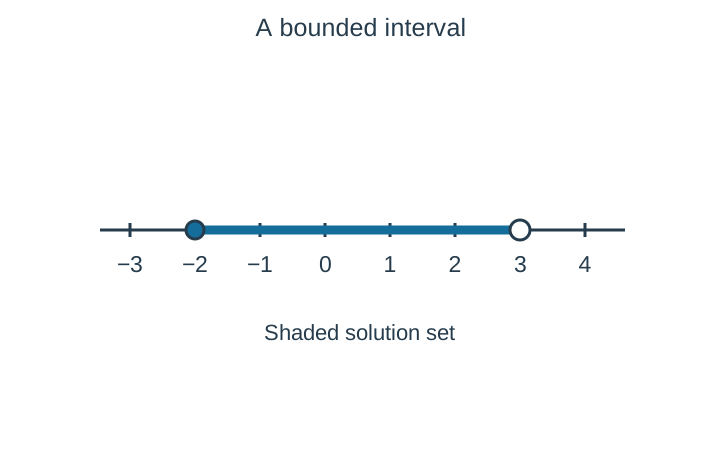
The number line shades all values from −2 to 3, with a filled circle at −2 and an open circle at 3. Which listed value belongs to the shaded solution set?
Worked answer and explanation
Answer: B. −2
The filled endpoint includes −2, whereas the open endpoint excludes 3. The shaded set is −2≤x<3. Of the four choices, only −2 is in that set; −3 and 4 lie outside it.
Question 10: Least integer in an inequality
Question 10 · Least integer in an inequality · medium
What is the least integer x that satisfies −2(3x − 4) ≤ 20?
Worked answer and explanation
Answer: C. −2
Distribute to get −6x + 8 ≤ 20, then subtract 8: −6x ≤ 12. Dividing by −6 reverses the inequality, giving x ≥ −2. Therefore −2 is the least permitted integer. Two also satisfies the inequality but is not the least, while −3 and −4 do not satisfy it.
Question 11: Rectangle with a triangular cutout
Question 11 · Rectangle with a triangular cutout · easy
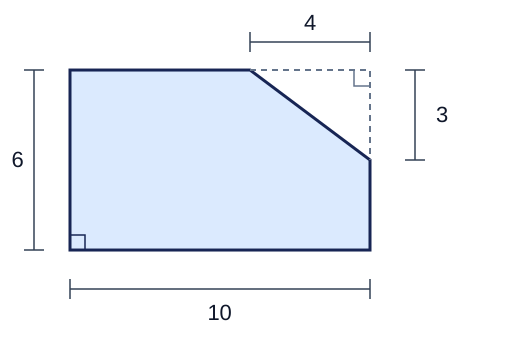
The shaded region is formed by removing the right-triangular corner from a 10-unit-by-6-unit rectangle. The removed triangle has perpendicular legs of 4 units and 3 units, as labeled. What is the area of the shaded region?
Worked answer and explanation
Answer: C. 54 square units
The full rectangle has area 10 × 6 = 60 square units. The removed right triangle has area (1/2) × 4 × 3 = 6. The remaining area is 60 − 6 = 54. Subtracting 4 × 3 without halving treats the cutout as a rectangle and gives the incorrect 48.
Question 12: Area determined by side midpoints
Question 12 · Area determined by side midpoints · medium
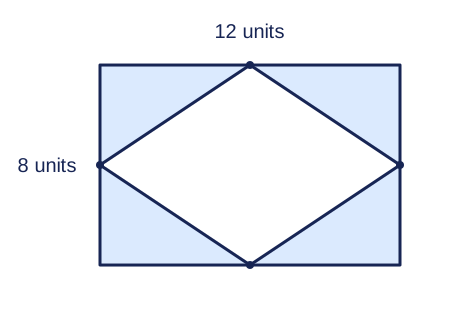
The rectangle is 12 units long and 8 units wide. The midpoint of each side is joined to the midpoints of the two adjacent sides, as shown. What is the total area of the four shaded corner regions?
Worked answer and explanation
Answer: B. 48 square units
Each corner is a right triangle whose legs are half the rectangle’s side lengths: 6 units and 4 units. Each has area (1/2) × 6 × 4 = 12 square units. The four corners total 4 × 12 = 48 square units. The full rectangle has area 96; 24 counts only two of the four congruent corner triangles.
For each missed question, record one error type: interpreting the prompt, setting up the relationship, arithmetic, or checking the answer. Then write one correction you can use next time. “I divided by the ending value” is more useful than “I need to study percentages.” Rework that question tomorrow without looking at the explanation.