Learn as you go
Start with a few questions from a 20-question sampler. Check an answer immediately, study the explanation, and pause whenever you need to.
Best for: your first visit or a short study break.
Start guided practice →Get familiar with the questions, learn a method you can reuse, and leave knowing what to study next. Choose the practice that fits today.
Start with a few questions from a 20-question sampler. Check an answer immediately, study the explanation, and pause whenever you need to.
Best for: your first visit or a short study break.
Start guided practice →Answer 135 questions in timed subtests, then use the report to plan your review. Two fixed forms let you try a different test later.
Best for: practicing pacing after you have studied.
Choose a full practice test →Both options are free, with no account required. These are original Test Ninjas exercises. The sampler introduces each subject; two questions per subject cannot diagnose your readiness or predict an official AFQT score.
Work through one question at a time. Explain your approach, check the worked answer, then move on. Use scratch paper for calculations.
0 of 20 checked · 0 correct.
Progress is saved in this browser. These original study questions do not produce an official AFQT score.
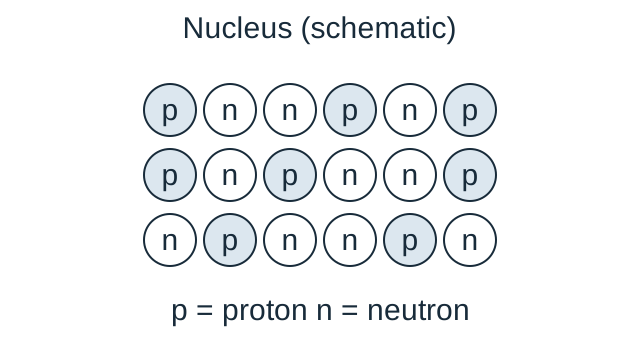
Answer: D. 18
Mass number is the total number of protons and neutrons. Counting eight protons and ten neutrons gives 18. Eight is the atomic number, ten is the neutron count, and subtracting the counts does not give mass number.
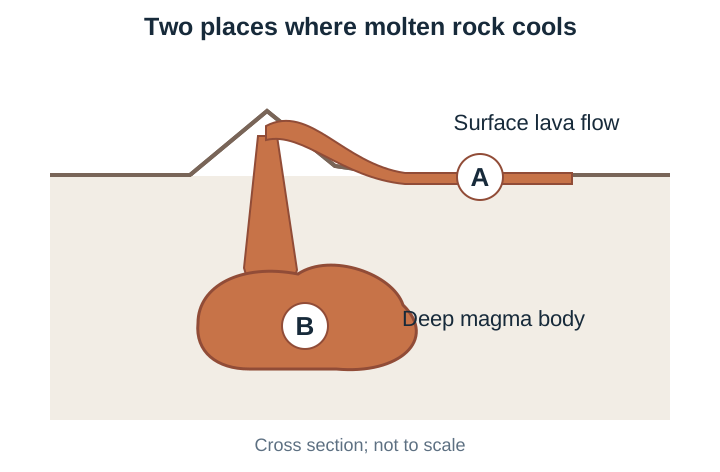
Answer: C. B, because slower cooling allows crystals more time to grow.
Site B is underground, where a large magma body generally cools more slowly. Slower cooling gives mineral crystals more time to grow, so intrusive rock commonly has larger visible crystals. Rapid cooling at the surface generally limits crystal growth; composition was held the same.
Answer: C. 3
There are 1 + 4 + 7 = 12 counters, so each of the 3 trays must finish with 4. Move 3 counters from the tray holding 7 to the tray holding 1; the middle tray already has 4. Fewer than 3 moves cannot remove all 3 excess counters from the largest pile. The answer 4 is the final count per tray, not the number moved.
Answer: D. $540
The six installments total 6 × $72 = $432. They cover 80% of the full price, since the deposit covered 20%. Thus the full price is $432 ÷ 0.80 = $540. The $432 choice omits the deposit, and multiplying by 0.80 would reduce a part that is already the remainder.
Answer: D. Select
Choose means select from possibilities. Describe means give an account of something, borrow means receive it temporarily, and arrange means put things in order. Those actions do not themselves mean making a selection.
Answer: D. Reject
Dismiss here means reject from consideration. The historian will not set the note aside solely because its author is unknown. Revise means change the wording, publish means make it publicly available, and deliver means bring it to a destination.
Our party waited beneath the station clock while Leena collected the tickets. There were six of us, with two large cases and enough smaller bags to make counting them worthwhile. When Leena returned, she asked everyone to check a name against the list before we crossed to the platform. We were taking the same train to the coast and hoped to find seats together.
Answer: C. A group of people traveling together.
The six people share tickets, luggage, a destination, and a train, so party refers to their traveling group. The group is preparing to travel, not holding a celebration. No political activity is described. No lawsuit or dispute is involved in the journey.
Each sample packet from the design studio contains three fabric textures in one color family. On the request form, choose the color family first; then choose either the small or large sample size. A larger sample shows more of the same texture, not an additional texture. The samples are intended to help you compare surfaces and make a general color choice. Because samples may come from earlier dye batches, the packet does not promise an exact color match to a future order. For that purpose, request a cutting from the fabric currently available.
Answer: A. A cutting from the current fabric.
The passage separates general comparison samples from a current-fabric cutting intended for an exact match. Larger samples show more surface, not a guaranteed match to the current dye batch. Additional packets still may contain samples from earlier batches. Each packet contains one color family, and multiple families would not establish an exact match.
Answer: B. −3x + 7
Inside the bracket, 2x − (3 − x) = 2x − 3 + x = 3x − 3. Then 4 − (3x − 3) = 7 − 3x. The other choices miss the outer sign change, the inner sign change, or the added 3.
Answer: D. 25
First evaluate the inside function: f(−2) = 3(−2) + 1 = −5. Then apply g to that result: g(−5) = (−5)² = 25. The 13 choice evaluates f(g(−2)) instead, reversing the order. The −5 choice stops after the first function.
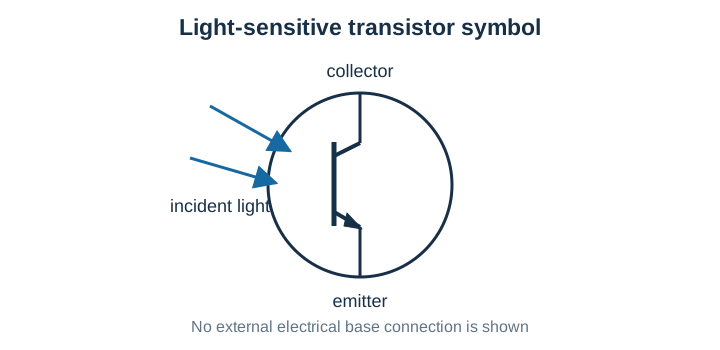
Answer: D. Phototransistor
The collector/emitter transistor outline plus incoming light arrows identifies a phototransistor. A photoresistor is drawn as a light-sensitive resistor, a photodiode as a diode with light arrows, and an optocoupler encloses both an emitter and detector; none matches this single illuminated transistor symbol.
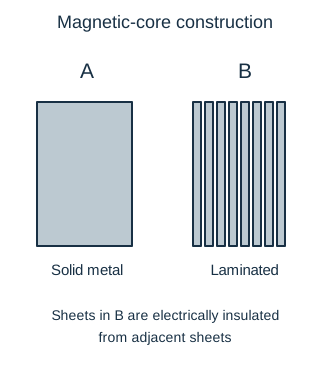
Answer: D. It interrupts large conducting loops and reduces eddy currents
Changing magnetic flux can induce circulating currents in a conducting core. Electrically insulated laminations restrict the available loop paths and reduce eddy-current losses. They do not connect the windings electrically or prevent the needed changing magnetic field.
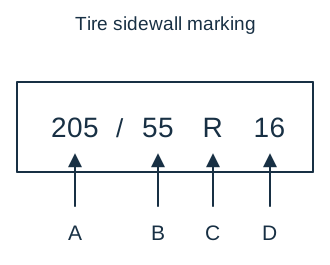
Answer: B. B
B marks 55, the aspect ratio: nominal sidewall height is 55% of the tire’s width. A gives width in millimeters, C indicates radial construction, and D gives the wheel-rim diameter in inches.
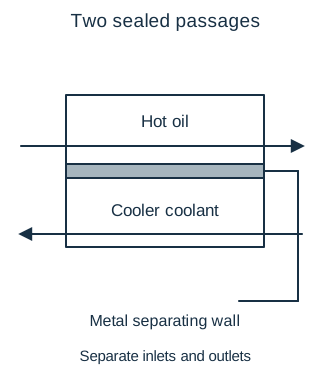
Answer: D. Transfer heat through the wall while keeping the fluids separate
Heat passes from the hotter oil through the metal wall into the cooler coolant. The sealed passages prevent normal mixing. A leak across that wall would be a fault, not the intended way to cool the oil, and a solid heat-transfer wall is not a particle filter.
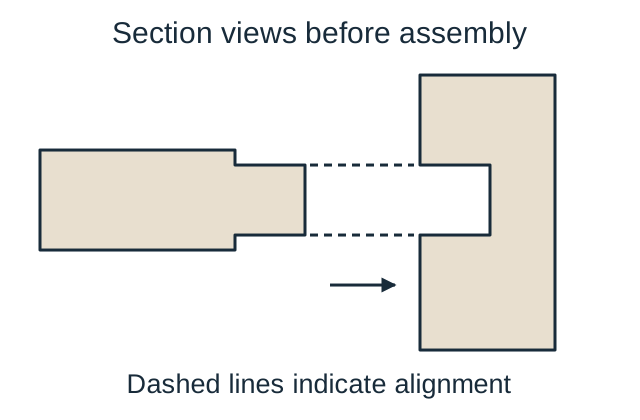
Answer: C. Mortise-and-tenon joint
The rectangular projection, or tenon, fits into a matching cavity, or mortise, in the other member. A dovetail has flared sides, a dowel is a separate round pin, and a plain butt joint has neither this projection nor the matching cavity.
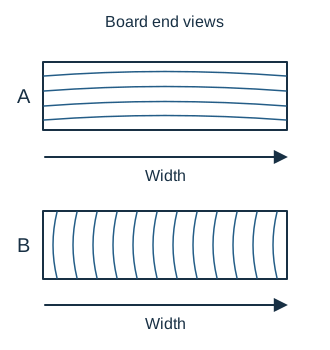
Answer: C. Board B
In B the rings run mainly through the board’s thickness, so its width runs more nearly perpendicular to them. In A the rings lie more nearly along the width, the higher-shrinkage tangential direction described in the stem.
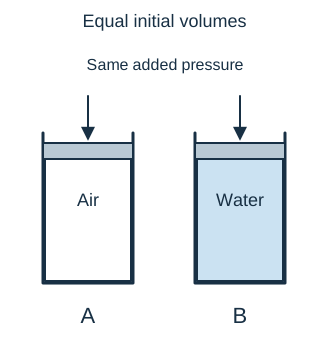
Answer: A. The air in A
Air is much more compressible than liquid water under these conditions. Both can change volume, but a modest pressure increase produces a much larger fractional change in the gas. Trapped air therefore makes a liquid-filled mechanism respond less rigidly.
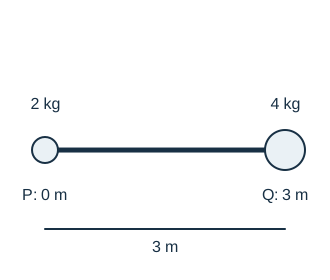
Answer: D. 2.00 m
The center of mass is the mass-weighted mean position: (2 × 0 + 4 × 3)/(2 + 4) = 2 m from P. It lies nearer the heavier mass, not at the unweighted midpoint.
![Two distinct objects above a separate 1-segment connector. A marks the left object’s arc and connector start; B marks the right object’s arc and connector end. Boundary coordinates use common relative units, x rightward and y downward, from each object’s bounding-box upper-left corner. Left object: Start (52.6, 22.8). line to (37.0, 52.0); line to (13.1, 52.2); line to (0.0, 21.8); line to (15.6, 1.4); clockwise circular arc, radius 22.4, minor arc, to (35.9, 3.8); line to (52.6, 22.8). Contact (26.8, 0.2). Right object: Start (47.9, 21.4). clockwise circular arc, radius 44.1, minor arc, to (21.4, 51.5); line to (0.7, 43.3); line to (0.0, 7.6); line to (27.3, 0.0); line to (47.9, 21.4). Contact (37.3, 40.7). Connector follows relative points [(0, 0), (64, 0)].](/asvab-study/figures/ao-059-source.svg)
Answer: B. Diagram B
Diagram B joins each object at its original marked location. Follow the unequal neighboring edges around A and B and the curved boundary to identify those locations after rotation; preserve the connector’s segment lengths and turns. The other candidates attach at a different location on the A object, the B object, or both. A connector touching two boundaries is not enough: it must touch the specified points.
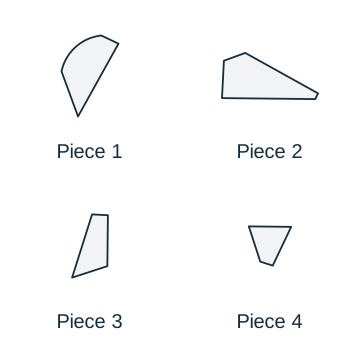
Answer: D. Diagram D
Diagram D preserves the boundary of every source piece under movement and rotation. Match the unequal edge lengths and the order of corners and curved edges around each piece, then trace the shared seams. All 4 pieces fit without overlap. The other alternatives reverse handedness, change edge proportions or curvature, or distort individual pieces; matching only the outside outline is insufficient.
Each fixed practice form contains 135 questions in ten timed subtests. The section limits total 197 minutes; you can finish sections early. These forms use the current scored-question counts and time limits without tryout questions. They do not reproduce adaptive item selection or official scoring.
Work one question at a time, with forward-only navigation. Progress is saved in this browser. The two forms use different questions from the daily-practice bank.
Start practice test 1 →Work one question at a time, with forward-only navigation. Progress is saved in this browser. The two forms use different questions from the daily-practice bank.
Start practice test 2 →The official computer test averages about two hours, and includes additional unscored tryout questions in selected subtests. Read the current ASVAB format guide for the distinction between time limits and typical completion time. Any score estimate in a practice report is unofficial.
If you knew the idea but lost track of the steps, work through an example slowly. If the explanation introduced a new concept, start with its subject guide. Try a fresh question before repeating one whose answer you remember.
Work through a math lesson · Build vocabulary · Find evidence in passages
Short on time? The three daily questions give you a small session to return to tomorrow.