Free PERT practice for math, reading and writing
Free practice for the PERT, Florida’s customized college placement test in math, reading and writing.
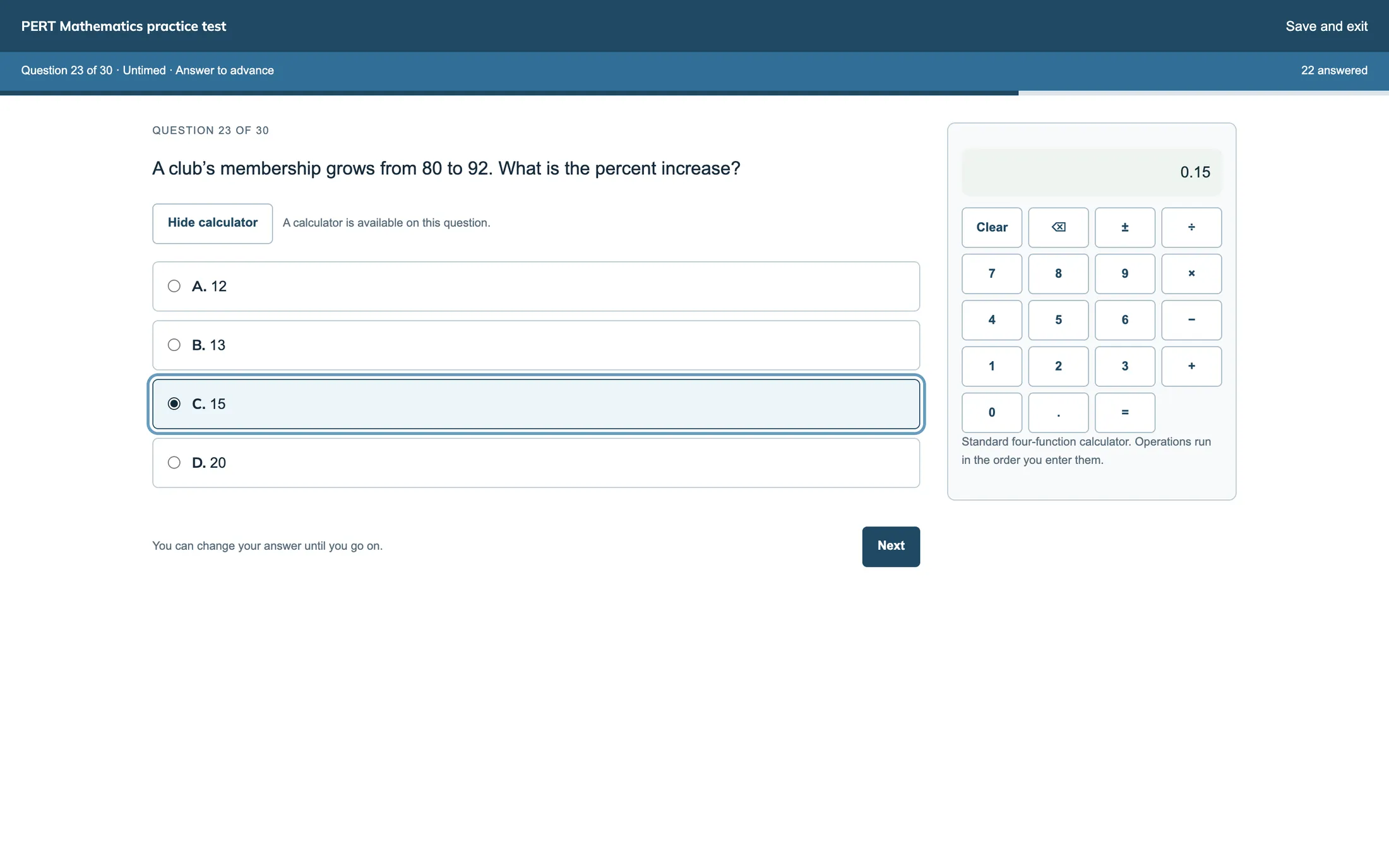
Free, untimed PERT practice tests.
Answer each question to move on, as on the real PERT. The onscreen four-function calculator appears only on designated math questions.
Daily practice
Answer today’s question, then read the explanation.
365 daily questions, mixed across topics and difficulty. None repeats until you have seen them all.
What’s on the PERT
How PERT scoring works
Reading, Writing and Mathematics are each scored from 50 to 150. Florida’s college-ready scores are 106, 103 and 114 respectively.
Open the score calculator- PERT Score Calculator
- Compare your official PERT Reading, Writing and Math scores with Florida’s college-ready scores and an optional college target.
What the PERT is and who takes it
The Postsecondary Education Readiness Test (PERT) is Florida’s customized common placement test. Florida College System institutions and public high schools give it to decide whether a student is ready for entry-level college courses in three subjects: Mathematics, Reading and Writing. It is not pass/fail. Each subject is scored from 50 to 150, and the score places you either in a college-credit course or in developmental education for that subject.
Each subject has 30 multiple-choice questions, of which 25 count toward your score. There is no time limit. The test is computer-adaptive, so the next question depends on your earlier answers, and you must answer each question before moving on, with no going back. You can’t bring your own calculator unless an approved disability accommodation allows one; an on-screen calculator appears only on some math questions. The PERT exam guide covers all of this in detail.
Common reasons to take it: you are starting or returning to a Florida state college without scores that already place you, you are a high school student applying for college-credit dual enrollment, or you want to retest after placing into a developmental course. Dual enrollment requires an unweighted high school GPA of 3.0 and proof of college-level reading, writing and math skills, which a PERT score can provide.
When you may not need the PERT
Not every student has to take it. Florida exempts students who entered 9th grade in a Florida public school in 2003–04 or later and earned a Florida standard diploma, and active-duty service members; what a good PERT score is explains the exemptions in full.
Students who are not exempt can often use other evidence. Rule 6A-10.0315 approves other common placement tests (Next-Generation ACCUPLACER, the SAT, the ACT and the Classic Learning Test), each with its own college-ready scores, and since 2022 colleges may also accept alternative methods such as high school coursework: an unweighted GPA of 3.0 plus a B or better in a listed math or English course.
| Test | Reading | Writing | Math |
|---|---|---|---|
| PERT | 106 | 103 | 114 |
| Next-Generation ACCUPLACER | 256 | 253 | 261 (QAS) |
| Digital SAT | 490 Evidence-Based Reading and Writing (one score for both) | Same as Reading | 480 |
| ACT | 19 | 17 (English) | 19 |
These are separate standards, not equivalent scores; no official conversion between the tests exists. The table leaves out the paper SAT and the Classic Learning Test, which the rule also covers. Colleges set local policies on which measures they accept, so ask your college’s advising or admissions office before you book a PERT. The PERT vs ACCUPLACER guide explains the most common alternative.
The PERT for high school students
For dual enrollment, the PERT is one of several ways to show you are ready. You cannot take a college-credit math or English course through dual enrollment until you have shown readiness in that area, so a Math score below 114 can hold back a math course even when your Reading and Writing scores qualify you for English. Home-education students who demonstrate readiness do not need a GPA, and school districts and colleges may add their own requirements.
Testing steps are local. FSCJ, for example, requires a current referral from your school or dual-enrollment coordinator before you test, while Broward College does not offer the PERT to prospective dual-enrollment applicants. Start with your school counselor.
PERT scores can also count toward the Florida Gold Seal Vocational Scholars award. For 2026–27 the minimums match the college-ready scores (Reading 106, Writing 103, Math 114) and must be met by August 31 of your graduation year. The PERT does not count toward other Bright Futures awards.
What each PERT subject asks you to do
Mathematics
Arithmetic with negatives, fractions, percents and exponents; linear equations, inequalities and systems; slope and equations of lines; polynomials and factoring; quadratic equations and rational expressions. Most questions are algebra, and the calculator appears only on some. Start with the PERT Math guide, then the guides to algebra and word problems and expressions, polynomials and factoring.
Reading
Passages followed by questions on the main idea, summaries, inferences, vocabulary in context, tone, purpose and structure, and on judging arguments or comparing two texts. See the PERT Reading guide and the guides to inference and evidence and purpose and vocabulary questions.
Writing
Revising short numbered drafts for focus, support, order, transitions and tone, and editing sentences for agreement, pronouns, tense, punctuation, modifiers and parallel structure. There is no essay. See the PERT Writing guide and the guides to revision and grammar and editing questions.
PERT cut scores
| Subject | College-ready score | Below the college-ready score |
|---|---|---|
| Reading | 106 | Developmental education in reading |
| Writing | 103 | Developmental education in writing |
| Mathematics | 114 | Developmental education in math |
State Board of Education Rule 6A-10.0315 sets these scores, and each subject counts on its own. Meeting 114 in Math does not open every math course: colleges set their own rules for College Algebra and above, and Santa Fe College, for example, requires more placement testing for PERT Math scores of 123 or higher. Below the cut, your score still matters, because colleges use it to choose which developmental course you take. Scores are generally valid for two years (PERT scores explained has the details). You don’t have to send PERT scores between Florida College System institutions, because every college testing center can look them up; ask the center if you need a copy. Read what a good PERT score is, or compare your official scores in the PERT score calculator.
How the free practice works
All PERT practice here is free and needs no account. Your answers and progress are saved in your browser on this device. The practice questions are written by Test Ninjas to match the skills in the public PERT study guide. They are not official PERT questions, and practice results do not convert to a PERT score.
| Tool | What you get | Use it to |
|---|---|---|
| Practice tests | One 30-question test per subject. Untimed, answer to advance, no going back | Get a baseline and rehearse the real navigation |
| Question of the day | One question a day with a full explanation; 365 days in the library | Keep a short daily habit |
| Question bank | Sets of 5 to 100 questions by subject and difficulty from 365 questions | Drill a weak subject or level |
| Free course | 49 lessons with worked examples | Learn a skill before you practice it |
| Question-type guides | Six guides with methods, mistakes and worked examples | Learn how each kind of question works |
| Reference sheets | Algebra rules, reading terms, grammar rules | Review rules quickly |
A good first session is one practice test in the subject you are most worried about. The results screen sorts your answers by question type and by skill, weakest first, and links each skill to its lesson. Every question includes a worked explanation, and the review lists each question with your answer and the correct one.
The practice tests copy the parts of the real PERT you can rehearse: no clock, one question at a time, an answer required to advance and no going back. They differ in two ways. Each form is a fixed set of 30 questions, where the real test adapts to your answers, and all 30 are scored, where the real test scores 25.
The six PERT question types
We sort every question in our bank into two types per subject. Each guide explains what the questions test, a method for answering them, common mistakes and worked examples.
- Math: algebra and mathematical models (equations, inequalities, systems, lines and word problems) and expressions, polynomials and factoring (arithmetic, exponents, polynomials, factoring and rational expressions).
- Reading: passage evidence and inference (main ideas, summaries, inferences and supporting details) and purpose, vocabulary and relationships (word meaning, tone, structure and paired texts).
- Writing: revision and organization (focus, support, order and sources in a draft) and grammar and sentence editing (agreement, tense, punctuation, modifiers and parallelism).
Plan your prep
- Ask your college whether you need the PERT, which subjects and by when. Check whether an exemption or other score already places you.
- Take a free practice test in each subject you need, and note the skills you missed most.
- Pick a 14-, 30- or 60-day study plan and work through the matching lessons.
- Book your test with the college testing center. The test dates and registration guide compares how colleges schedule it.
- Read the test day checklist: ID, arrival time and what you can bring.
- If a score comes in under the cut, check the college’s retake policy before you retest.
Free lessons
Signed numbers and order of operations
An expression records a sequence of operations.
Start the lessonFractions and rational arithmetic
Fractions describe division, so equivalent fractions preserve value when numerator and denominator are multiplied by the same nonzero quantity.
Start the lessonPercents and proportional models
A percent is a ratio out of 100.
Start the lessonPowers and exponent structure
Repeated multiplication explains exponent rules: multiplying equal bases concatenates their factors, whereas a power of a power repeats the full group.
Start the lessonGuides and resources
Algebra and arithmetic quick reference
Use these reminders after a connected lesson. Reconstruct the reasoning and check conditions rather than memorizing an isolated answer.
Open referenceReading evidence quick reference
Use a passage to practice every check; the surrounding evidence determines the answer.
Open referenceSentence and revision reference
These checks support selected-response editing and passage revision. Read each choice in the complete sentence or draft.
Open referenceStudy plans
Pick a 2-week, 1-month or 2-month schedule and check off each day as you go.
Frequently asked questions
Is the PERT timed?
No. No subject has an official time limit. Colleges’ own estimates range from about two hours to more than three for all three subjects; there is no official time limit. Plan around the testing center’s hours.
How many questions are on the PERT?
Each subject has 30 multiple-choice questions, 90 in total if you take all three. In each subject 25 questions are scored and 5 are unscored field-test questions. You won’t be told which 5 are unscored, so treat every question as if it counts.
Can you go back to a question on the PERT?
No. You must answer each question before moving on, and you cannot change an answer once you submit it.
Is there an essay on the PERT?
No. PERT Writing is multiple choice: revising short drafts and editing sentences.
What PERT score do you need to be college-ready?
The PERT is not pass/fail. Florida’s college-ready scores are 106 in Reading, 103 in Writing and 114 in Mathematics, and a lower score places you in a developmental course in that subject.
Can you use a calculator on the PERT?
You can’t bring your own calculator unless an approved disability accommodation allows one; an on-screen four-function calculator appears only on some math questions.
Can you retake the PERT?
Yes. Each college sets its own waiting period, fee and attempt limit; at the colleges we checked, waits run from no same-day retest (FSCJ, Palm Beach State) to 30 days (Polk State), and fees for a college’s own students from $4 (Tallahassee State) to $33.50 (Broward, $30 plus a $3.50 online fee). See the retake policy guide for examples.
How long are PERT scores valid?
Two years. FDOE says scores used for placement must be no older than two years, and colleges such as Miami Dade and Broward follow that.
Is this practice official?
No. Test Ninjas writes these questions to match the skills in the public PERT study guide. They are not real PERT questions, and practice results do not convert to a PERT score.
How is the PERT different from ACCUPLACER?
Both are adaptive placement tests that Florida accepts, and ACCUPLACER is untimed in most administrations, but they use different score scales (PERT 50–150, ACCUPLACER 200–300) and ACCUPLACER splits math into several tests. Your college decides which one you take.