Upper Level ISEE prep for grades 8 through 11
For students applying to grades 9 through 12: 160 questions in 2 hours 40 minutes, with a stanine for every section on the report schools see. Practice on 20 full-length Upper Level tests with the tools of the online ISEE, and see your estimated stanines after each one.
$0.00 due today · 7-day free trial · cancel anytime
- 760–940
- scaled score in each section
- 1–99
- percentile against your grade
- 1–9
- stanine, set by the percentile
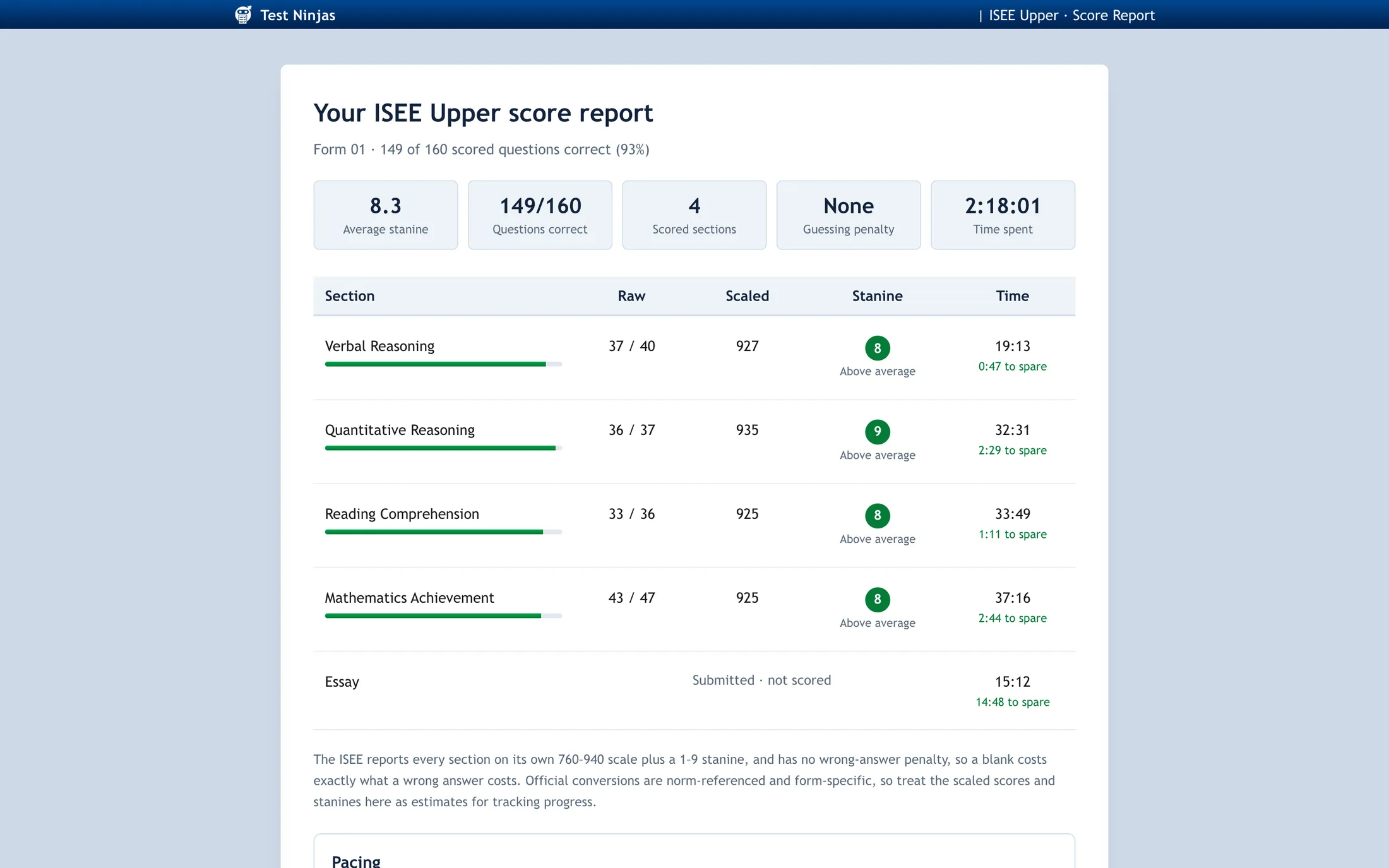
An Upper Level practice score report. Example results shown.
The Upper Level test, in order
Four multiple-choice sections and an essay, always in this order, with two 10-minute breaks. The essay is the only unscored section, and no section takes off points for a wrong answer.
- 01Verbal20 minutes40 questions: synonyms and sentence completions
- 02Quantitative35 minutes37 questions: word problems and comparisons
- 03Break10 minutesA short rest
- 04Reading35 minutes36 questions on six passages
- 05Math40 minutes47 questions, no calculator
- 06Break10 minutesA short rest
- 07Essay30 minutesOne prompt, typed online or handwrittenNot scored
2 hours 40 minutes of testing plus two 10-minute breaks, so plan on about three hours.
How a percentile becomes a stanine
Each section’s raw score becomes a scaled score and a percentile against recent applicants to your grade. ISEE then sorts the percentile into one of nine stanines with a fixed table. Move the slider to see where any percentile lands.
Stanine 7, above average: higher than about 80 of every 100 recent applicants to your grade.
| Stanine | Percentile ranks | Share of test takers |
|---|---|---|
| 1 | 1–3 | about 4% |
| 2 | 4–10 | about 7% |
| 3 | 11–22 | about 12% |
| 4 | 23–39 | about 17% |
| 5 | 40–59 | about 20% |
| 6 | 60–76 | about 17% |
| 7 | 77–88 | about 12% |
| 8 | 89–95 | about 7% |
| 9 | 96–99 | about 4% |
- 01Compared with your grade only
An 8th grader applying to 9th grade is ranked against other 9th-grade applicants from the past three years, never against 11th graders.
- 02Wide in the middle, narrow at the ends
Stanine 5 covers 20 percentile points (40–59), while stanine 9 covers only 96–99, because most test takers score near the middle.
- 03No cutoff, and no penalty
Schools read stanines next to grades, recommendations, the interview and the essay, and each sets its own expectations. Wrong answers cost nothing, so answer every question.
Two-blank sentence completions: one blank at a time
Only the Upper Level has sentence completions with two blanks, and both words have to fit. Test the blank you are surest of first, cross out every choice that fails it, then check the other blank. Try it on a question from our Upper Level tests.
The apology that opened the meeting was blank 1, delivered in a flat voice to a spot on the wall; the argument that followed it was, by contrast, blank 2.
Pick an answer, or work through the two steps.
Algebra is the biggest part of the math
ISEE’s Upper Level guide gives the number of Mathematics Achievement questions from each strand. Algebraic concepts, up to second-year algebra, outnumber every other strand.
Functions as equations, graphs and tables; modeling with equations; equivalent expressions, equations and inequalities
Reading data; mean, median, mode, range, standard deviation and quartiles; probability and expected value
Integers through real numbers, matrices and vectors, combinations and permutations
2- and 3-dimensional figures, the coordinate grid and transformations, congruence, symmetry and similarity
Area, surface area and volume, including cones, spheres and cylinders; choosing units and scales
Out of 47 Mathematics Achievement questions, from ISEE’s What to Expect on the ISEE guide for the Upper Level. Quantitative Reasoning adds 37 more math questions, also without a calculator.
The essay schools read without your edits
Upper Level prompts ask you to take a position or work through a problem, in 30 minutes. The essay isn’t scored and you won’t get a copy, but every school on your score list does, and it shows how you write with no time to revise. Both examples come from our Upper Level practice tests.
“Should students have a real say in how their school is run, or is that a responsibility better left to adults? Support your answer with reasons.”
Take one side in your first paragraph, give two reasons with specific examples, and answer the strongest objection.
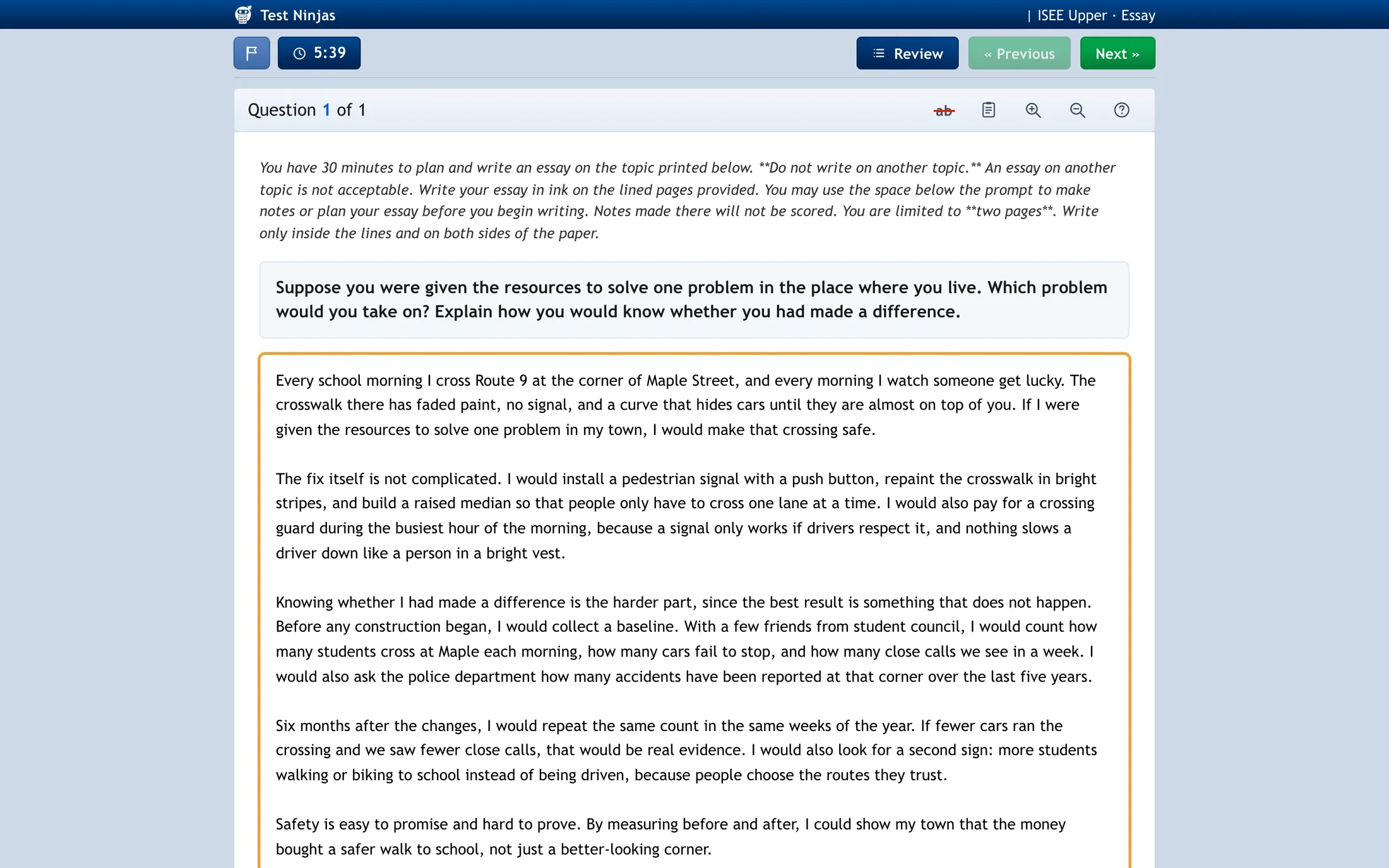
“Suppose you were given the resources to solve one problem in the place where you live. Which problem would you take on? Explain how you would know whether you had made a difference.”
Name one concrete problem, lay out your plan in steps, and say how you would measure success. The second question is the one people forget.
- Plan for four or five minutes before writing
- Answer every part of the prompt
- Save two minutes to proofread
Plan around the testing seasons
You can take the ISEE once in each of three testing seasons: fall (August–November), winter (December–March) and spring/summer (April–July). Check each school’s deadline, then count back.
- 10–12 weeks outTake a full practice test
Get estimated stanines for all four sections and see where your time went. Your study plan picks out your weakest skills from it.
- Weeks 2–5Fix the weakest skills
Lessons from the 120-lesson course and problem sets by skill, starting with what the study plan flags, plus the 1,256-word vocabulary trainer every day: two-blank completions reward a big vocabulary.
- Weeks 6–9Practice under time
A full practice test every other week, timed sections in between, and the 3,200-question bank set to missed and flagged questions.
- Last 2 weeksSharpen, then rest
One last full test, one timed essay, and a light final week.
- After test dayRetake next season if you need to
Online scores arrive in 3–5 days and paper scores in 5–10. If one section falls short, you can test again in the next season.
The online ISEE’s tools, in every practice test
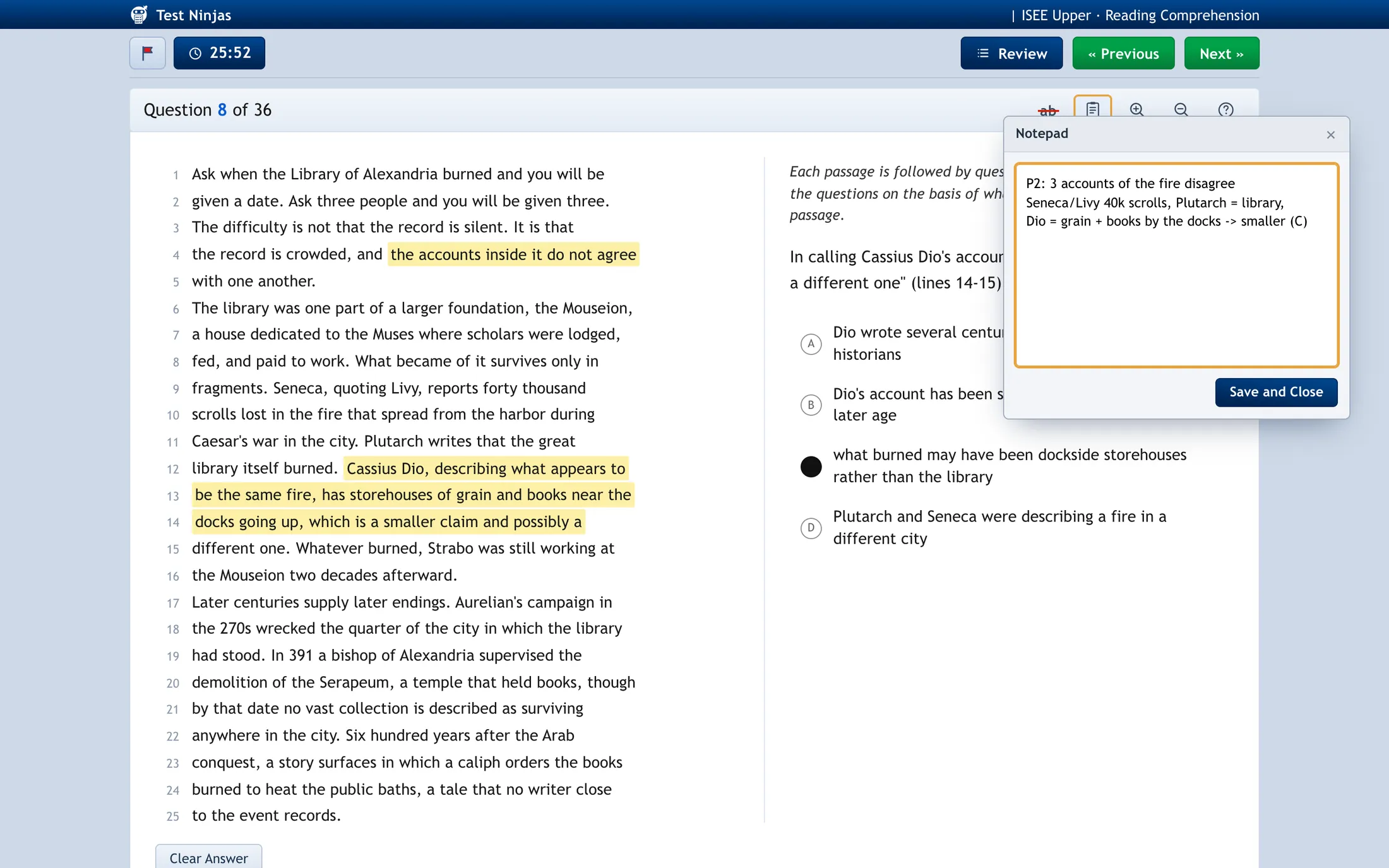
Highlight, flag and take notes
Mark up passages, flag questions and jot notes in the notepad, with the same kind of timer and review screen the online test uses.
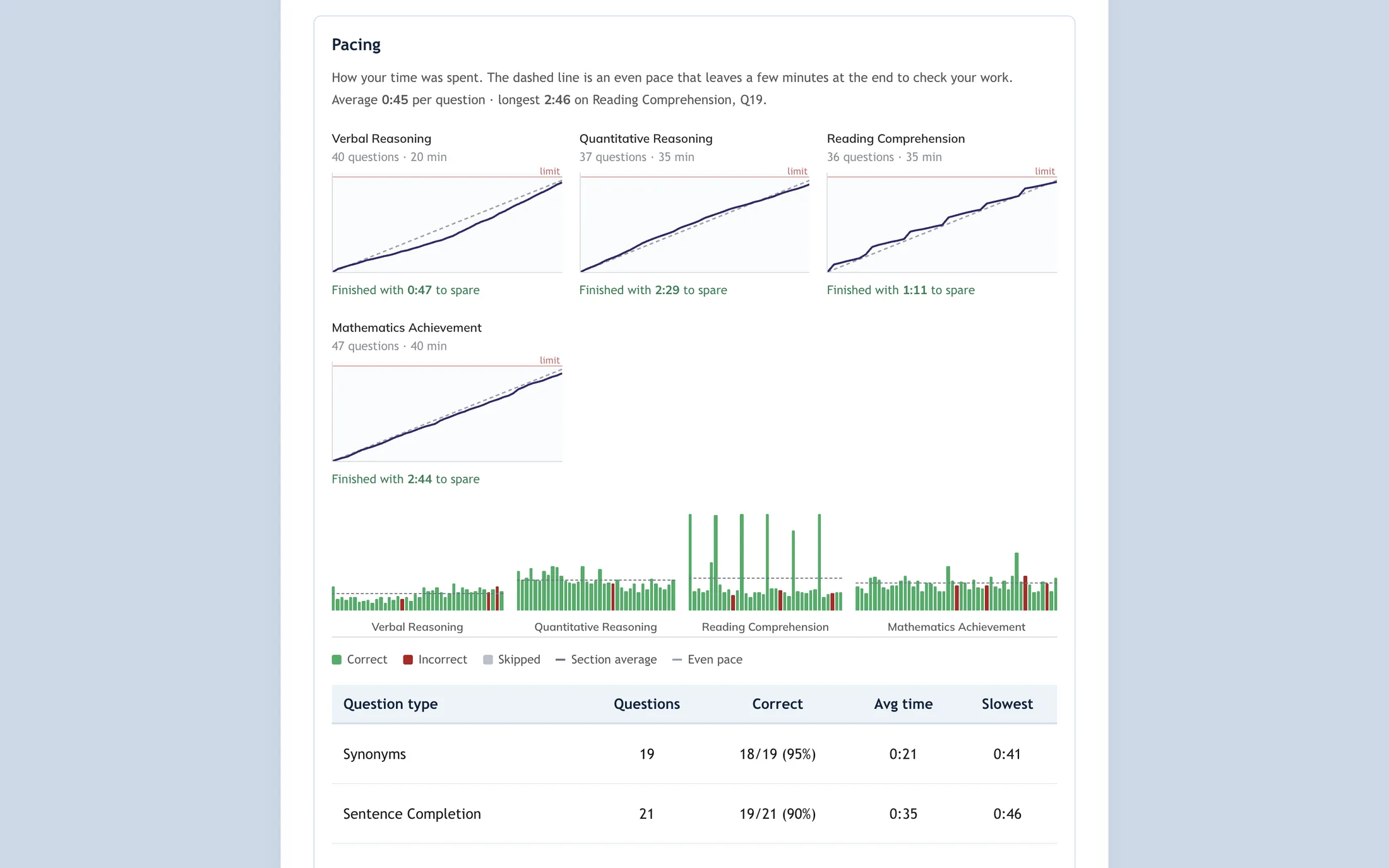
Find the section that runs you out of time
Pacing charts for each section and the time on every question show where your timing breaks down. Example results shown.
A timed essay at the end of every test
Write to an Upper Level prompt with the clock running, the way you will on test day.
Print a free Upper Level practice test
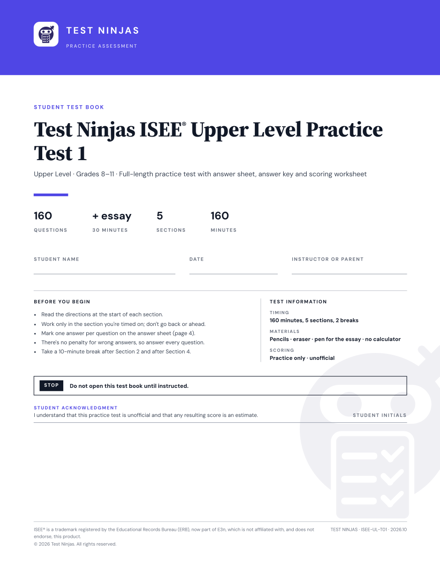
Practice Test 1 is a free PDF: 160 questions and an essay prompt in the real order and timing. Take it in one sitting to see where you stand.
- An answer sheet, an answer key and a scoring worksheet
- Nine two-blank sentence completions to practice on
- The Detailed Answer Key, with why each wrong answer is wrong, free with an account
Everything for the Upper Level in one plan
Practice tests, course, question bank and vocabulary trainer for grades 8 through 11. Start with 7 days free.
$0.00 due today · full access for 7 days · cancel anytime
- Personalized study plan: your child’s estimated scores and weakest skills, with practice for each
- 20 full-length practice tests, timed like the real test, with save and resume
- Score report with scaled scores and stanines for every section, pacing, and a question-by-question review
- 70-hour on-demand course with 120 lessons across Verbal, Quantitative, Reading, and Math
- Timed essay practice in every test
- 73 problem sets by section and skill
- 3,200-question bank: practice new, missed, or flagged questions, untimed or timed
- 1,256-word vocabulary trainer with a word of the day
Preparing more than one child, or not sure of the level? The All-Levels plan covers Lower, Middle and Upper. See all plans
Frequently asked questions
Who takes the Upper Level ISEE?
Students applying to grades 9 through 12, so 8th through 11th graders.
What is a good Upper Level ISEE score?
There is no passing score. Stanines 4–6 are average and 7–9 above average for your grade, and each school sets its own expectations, so check the ranges your schools publish or ask their admissions offices.
How many times can I take the ISEE?
Once per testing season, and there are three seasons a year: fall (August–November), winter (December–March) and spring/summer (April–July).
Does the Upper Level ISEE have two-blank sentence completions?
Yes. It is the only ISEE level that does, and both words in an answer must fit the sentence.
Is there a guessing penalty on the ISEE?
No. ISEE scores count only correct answers, so answer every question.
Can I use a calculator on the Upper Level?
No. Calculators are not allowed on any section unless you have an approved accommodation, so practice all 84 math questions by hand.
More on the Upper Level
See your stanines before schools do.
Start with 7 days free and $0.00 due today. Cancel anytime.
Start my free 7 days