Free HSPT Practice Test (Printable PDF)
A full-length HSPT practice test to print and take at home: all 298 questions in the real test’s five sections, order and question numbers, timed to the HSPT’s standard section times. The PDF includes a bubble answer sheet, the answer key and an explanation for every question.
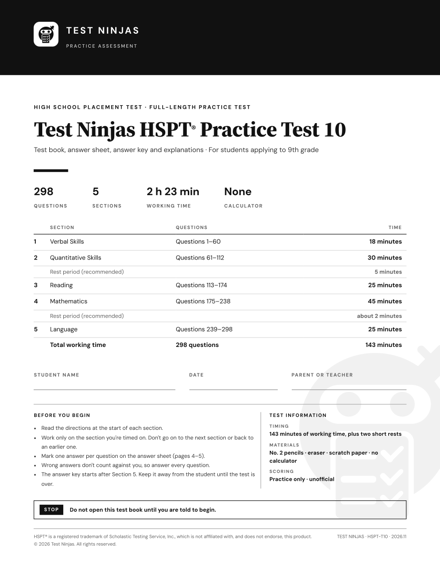
- 298 questions · 2 hours 23 minutes of timed testing, plus two short rests
- All five sections in test order, each with its standard time and directions
- Bubble answer sheet, answer key, scoring worksheet and an explanation for every question
- 63 pages · letter size · prints in black and white
No account needed (3.4 MB). Pages 1–40 are the test book and answer sheet; the answer key starts on page 41, so you can print the two parts separately.
What’s on the HSPT practice test
Practice Test 10 has the same five sections as the real HSPT, with the same number of questions in each, in the same order and with the same question numbers, from 1 to 298. Each section is timed separately, and calculators aren’t allowed.
Times are the standard times in STS’s HSPT administration directions (E-Score User Manual v4.1), which also recommend the two rest periods.
How to use the PDF
The PDF is one 63-page document in two parts: the test for the student, then the answers for the parent or teacher.
- Print pages 1–40 for the student and keep pages 41–63 until the test is over. Every page prints well in black and white.
- Pull out the answer sheet (pages 4–5) so the student can mark answers beside the test book, as on test day.
- Have a timer, two No. 2 pencils, an eraser and scratch paper ready. No calculator.
- Score with the answer key, then go through the explanations together, starting with the questions the student missed or guessed.
Download the free HSPT practice test PDF
Sample questions from the test
Five real questions from Practice Test 10, one from each section, with their question numbers in the test: a logic question with three choices, a figure comparison, an underlined vocabulary word, a graph and a “No mistakes” usage question.
The red kite flew higher than the blue kite. The blue kite flew higher than the green kite. The green kite flew higher than the red kite. If the first two statements are true, the third is
- (A)true
- (B)false
- (C)uncertain
Show the answer and explanation
Answer: (B) false. The first two statements put the kites in order from highest to lowest: red, blue, green. The green kite flew lower than the red kite, so the third statement is false.
Examine figures A, B, and C and find the best answer.
- (A)A is more shaded than B
- (B)C is more shaded than A
- (C)B and C are equally shaded
- (D)C is more shaded than B
Show the answer and explanation
Answer: (A) A is more shaded than B. A has 2 of 4 equal parts shaded, which is 1/2, and B has 3 of 9 equal parts shaded, which is 1/3, so A is more shaded than B. B has more shaded pieces, but each piece is much smaller. C's one strip is 1/4 of the square, a little less than B's 1/3, so B and C are not equal.
Choose the word that means the same or about the same as the underlined word: a frigid wind
- (A)icy
- (B)powerful
- (C)whistling
- (D)gentle
Show the answer and explanation
Answer: (A) icy. A frigid wind is extremely cold, or icy. Winds are often powerful or whistling, but those words describe force and sound, not temperature.
The bar graph shows how many items Groups A and B collected. By what percent is B's count greater than A's?
- (A)20%
- (B)25%
- (C)80%
- (D)125%
Show the answer and explanation
Answer: (B) 25%. The graph shows that A collected 80 items and B collected 100, so B collected 20 more. Compared with A's count, that is 20/80 = 25%. Dividing by B's count instead gives 20%, and 125% is B's count as a percent of A's, not the increase.
Look for errors in capitalization, punctuation, or usage. If there are no errors, choose D.
- (A)Dad, can you help me carry these chairs?
- (B)I think the bus is running late again, Marcus.
- (C)Please pass me the scissors Kayla.
- (D)No mistakes
Show the answer and explanation
Answer: (C) Please pass me the scissors Kayla. Kayla is the person being spoken to, so a comma must set off her name: Please pass me the scissors, Kayla. The other two sentences correctly use a comma to set off Dad and Marcus.
The full test has all 298 questions, including six reading passages. Download the PDF to take it.
How to take it like test day
A practice test is only as useful as it is realistic. These rules follow the directions HSPT proctors read to students:
- Time each section separately: 18 minutes for Verbal Skills, 30 minutes for Quantitative Skills, 25 minutes for Reading, 45 minutes for Mathematics and 25 minutes for Language. Announce when about half the time is left.
- Work only on the section being timed. No going on to the next section or back to an earlier one. Stop at the word STOP or when time is called; anyone who finishes early may check that section only.
- Check the numbers. Question numbers run from 1 to 298 through the whole test, so make sure each mark on the answer sheet matches the question being answered.
- Answer every question. Wrong answers don’t count against you. If a question seems very hard, make a careful guess and move on at a fairly rapid pace.
- Write in the test book or on scratch paper. Calculators aren’t allowed.
- Rest as on test day: about five minutes after Quantitative Skills and about two minutes after Mathematics.
How to score the practice test
Count the correct answers in each section with the answer key on page 42, then fill in the scoring worksheet on page 43. It adds the sections into the HSPT’s composites: Cognitive Skills (Verbal Skills and Quantitative Skills), Basic Skills (Reading, Mathematics and Language) and the total battery.
The real HSPT reports each section and composite as a standard score from 200 to 800, a national percentile from 1 to 99 and a stanine from 1 to 9. STS doesn’t publish how raw scores convert, so a practice test can’t give you an exact HSPT score. Use your number correct to compare sections and to track progress from one test to the next. To read real score reports, see how HSPT scoring works, what a good HSPT score is and the percentile to stanine calculator.
What to study after the practice test
Read the explanation for every question you missed or guessed first. Each one names its question type, so patterns show up quickly. Then work on the sections where you lost the most points:
- Verbal Skills: analogies, logic, classification and synonyms questions, with worked examples.
- Quantitative Skills: number series, comparisons and number manipulation questions, with worked examples.
- Reading: comprehension and vocabulary questions, with worked examples.
- Mathematics: word problems and computation questions, with worked examples.
- Language: capitalization, punctuation and usage and composition questions, with worked examples.
More free HSPT practice
- Timed practice on screen. The free HSPT practice test page has guided practice sets and a timed practice engine.
- Every question type. HSPT practice questions explain each question type with examples.
- A question a day. HSPT questions of the day keep skills sharp between practice tests.
- A plan to the test date. The HSPT study plan and the test-day checklist.
Frequently Asked Questions
Sources
- Scholastic Testing Service, HSPT E-Score User Manual v4.1, “Administration of the Test”: standard section times, rest periods and the directions read to students.
Practice Test 10 is an independent Test Ninjas practice test, not an official HSPT form. HSPT® is a registered trademark of Scholastic Testing Service, Inc., which is not affiliated with, and does not endorse, Test Ninjas.