Free SSAT Upper Level practice test
Download a free, full-length SSAT Upper Level practice test below. Practice Test 1 has all 150 scored questions plus the writing sample and experimental section, in the official order and timing (3 hours 10 minutes with breaks). It comes with an answer sheet and answer key, and this page scores it the way the SSAT does.
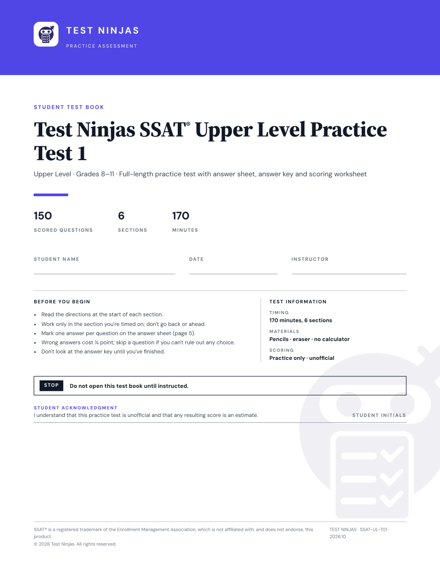
- 150 scored questions, two writing prompts and the 16-question experimental section
- All six sections in test-day order, with answer sheet, answer key and scoring worksheet
- 50-page test book · 115-page answer key
The test book's own answer key is enough to score it. The Detailed Answer Key adds why each answer is right and each wrong choice is wrong. To practice on screen, try the Upper Level sample questions below or the timed SSAT math practice test.
SSAT Upper Level sample questions with answers
These eight questions come straight from Practice Test 1: two from each Quantitative section, two synonyms, two analogies and two reading questions on the test’s poem. Pick an answer to see whether it’s right and why.
A video file is first compressed so that it loses 40 percent of its size, and the compressed file is then compressed again so that it loses 25 percent of what was left. The final file is what percent of the original file?
On a hiking map, the function f(x) = 2x2 + 3x converts a horizontal distance x, measured in hundreds of meters east of the trailhead, into an elevation change in meters. Distances west of the trailhead are negative. What is the value of f(-6)?
Choose the word whose meaning is closest to the word in capital letters.
ACRIMONY
Choose the word whose meaning is closest to the word in capital letters.
PERSPICACIOUS
Choose the answer that best completes the meaning of the sentence.
fatigue is to error as …
Choose the answer that best completes the meaning of the sentence.
sprint is to jog as …
- Before the light there is the heat, which is older,
- and before the heat the dark, which is oldest,
- and in the dark the proving drawer is working
- at the one thing it does, which is to wait.
- Flour to the forearm. A wrist that knows
- how long is long enough without a clock.
- The hands go in and the dough gives, and gives
- in the particular way that means it is ready,
- and the hands know this before the man does.
- Trays go up. The oven takes them without comment.
- Somewhere a van is already on its way
- for bread that is not bread yet.
- By the time the first light gets to the window
- the work is two hours old and does not mention it.
The poem is primarily concerned with
In line 3, the word "proving" most nearly means
Score your Upper Level practice test
Your raw score is right answers minus a quarter point for each wrong answer, with omitted questions worth 0. The SSAT counts it separately for Quantitative (both sections together), Verbal and Reading. Finished Practice Test 1? Enter your counts and the worksheet does the arithmetic and checks that they add up.
Mark your answer sheet with the answer key, then enter counts for each scored area. Enter right and wrong; omitted fills itself in. Leave out the writing sample and the experimental section.
Fill in all three areas to see your total raw score.
Why raw scores only: the SSAT converts each raw score to a 500 to 800 scaled score with conversion tables that are adjusted for each test edition (equating) and are not published. We don't have them, so this worksheet doesn't guess at a scaled score. Scoring rule from admission.org, checked November 13, 2026.
What's on the SSAT Upper Level?
The Upper Level SSAT has 150 scored questions in four sections, plus an unscored writing sample and experimental section, and takes 3 hours 10 minutes with two 10-minute breaks. Practice Test 1 follows the same order, counts and time limits. It's for students currently in grades 8 to 11.
| Section | Questions | Time | What's in it |
|---|---|---|---|
| 1. Writing Sample (unscored) | 1 prompt | 25 min | Choose a general (opinion) prompt or a personal one |
| Break | 10 min | ||
| 2. Quantitative 1 | 25 | 30 min | Arithmetic, algebra, geometry, data; no calculator |
| 3. Reading | 40 | 40 min | Passages with several questions each (8 passages of 5 in Practice Test 1) |
| Break | 10 min | ||
| 4. Verbal | 60 | 30 min | 30 synonyms, then 30 analogies |
| 5. Quantitative 2 | 25 | 30 min | Same content as Quantitative 1 |
| 6. Experimental (unscored) | 16 | 15 min | 6 verbal, 5 reading and 5 math tryout questions |
The SSAT is given on paper, at home and at Prometric test centers (the computer formats are for the Middle and Upper Levels only), with the same sections in each. On a paper test taken in a room with other students, everyone uses the full time for each section. See About the SSAT for formats, and our SSAT Upper Level test breakdown for what each section covers.
How the Upper Level differs from the other SSAT level
A practice test from the wrong level gives a misleading score. These are the differences that matter for the Upper Level:
- Same format as the Middle Level, harder content. Sections, question counts and timing match the Middle Level exactly. The difference is the level of the words, the math and the passages.
- Algebra is the biggest math topic. In Practice Test 1, 19 of the 50 Quantitative questions are algebra (linear equations, systems of two equations, inequalities, functions such as f(x) = 2x² + 3x), 14 are geometry and measurement (similar figures, area, angles of polygons), 11 are number sense and 6 are data and probability.
- Harder vocabulary. Synonyms reach words like ACRIMONY, PERSPICACIOUS, VACILLATE and EPHEMERAL, and analogy answer choices use words like saturnine and tenacious. A steady word habit matters more here than anywhere else on the test.
- Denser reading. Most passages run 300 to 350 words: science (gravitational waves, volcanoes), history, an argument and a poem. Half of the 40 questions ask about inference, tone, organization or a word in context rather than a stated detail or the main idea.
- Four grades, one test. An 8th grader and an 11th grader take the same test, but percentiles compare each student only with first-time test takers in the same grade, so an 8th grader isn't expected to know every 11th-grade topic.
How to take the practice test like the real SSAT
Take Practice Test 1 in the official order, timed section by section, in one sitting if you can. A realistic run tells you about pacing and stamina as well as content:
- Print single-sided and keep the answer sheet separate. Fill in bubbles and do scratch work in the test book, as on the paper SSAT. No calculator, so exponents, percents and fractions are by hand.
- Start with the writing sample. On the real test it comes first: 25 minutes, one of two prompts, two lined pages. Then take a 10-minute break.
- Time every section separately: Quantitative 1 (30 minutes), Reading (40), a second 10-minute break, then Verbal (30), Quantitative 2 (30) and the experimental section (15). Stop when time is called, even mid-section.
- Pace Verbal at 30 seconds a question. Synonyms go fast when you know the word, which buys time for analogies. Build the relationship sentence first ("fatigue causes error"), then test each choice against it.
- Skip blind guesses. A wrong answer costs a quarter point. Guess when you can rule out at least one choice; leave it blank when you can't.
Mark questions you guessed on with a small dot in the test book. When you score the test, compare how those guesses went with the guessing table below.
How is the SSAT Upper Level scored?
Each right answer earns 1 point, each wrong answer loses 1/4 point and an omitted question scores 0. Each area's raw score then becomes a scaled score from 500 to 800. The SSAT also reports a percentile for each area, which compares a student with first-time test takers in the same grade over the last three years in the US and Canada (admission.org). The writing sample isn't scored, but a copy goes to the schools that receive your scores.
Because the conversion from raw to scaled score is set for each test edition and isn't published (how SSAT scores are calculated), the most useful number from a practice test is your raw score in each area and how it changes between tests. If you want a rough scaled estimate anyway, the SSAT score calculator gives one; treat it as an estimate, not a prediction.
When to guess. With five choices and a quarter-point penalty, a blind guess is worth nothing on average. Each choice you rule out tips the odds your way, which matches E3n's own advice on guessing on the SSAT:
| Choices ruled out | Chance a guess is right | Average points per guess |
|---|---|---|
| 0 | 1 in 5 | 0 (break-even) |
| 1 | 1 in 4 | +0.06 |
| 2 | 1 in 3 | +0.17 |
| 3 | 1 in 2 | +0.38 |
If the worksheet shows wrong answers costing you several points in one area, look at which of those were blind guesses. Leaving those blank next time raises your raw score without learning anything new.
What to study after the practice test
Start with the area where your raw score is furthest below its maximum, then go through every missed question in the Detailed Answer Key, including lucky guesses. Then use these to work on each area:
Take a second full test after two to four weeks of targeted work, and compare raw scores area by area. See how often to take SSAT practice tests for spacing.
More free SSAT Upper Level practice
- Official practice from E3n. The free 30-question online Mini-Practice Test gives an instant score report. E3n's official guide books and Online Practice add four full-length Middle and Upper Level tests (SSAT practice at admission.org). Save an official test for a dress rehearsal close to test day.
- Timed math on screen. The free SSAT math practice test is a full 25-question, 30-minute Quantitative section at the Upper Level, scored with the same penalty.
- Explained practice by section. SSAT practice questions, SSAT verbal practice and SSAT reading practice.
- Wrong level? The level depends on the grade a student is in now. Students in grades 5–7 use the SSAT Middle Level practice test. Students in grades 3–4 take the Elementary Level; its printable test is on free SSAT practice tests.
Planning test dates? See SSAT test dates for 2026–2027.
Frequently asked questions
Yes. Test Ninjas SSAT Upper Level Practice Test 1 is a free full-length PDF: all six sections in test-day order with 150 scored questions, the writing sample prompts and the experimental section, plus an answer sheet, answer key and scoring worksheet. A Detailed Answer Key that explains every question and why each wrong choice is wrong is free with a Test Ninjas account. E3n, which makes the SSAT, also offers a free 30-question online Mini-Practice Test.
The Upper Level SSAT takes 3 hours 10 minutes including two 10-minute breaks: Writing Sample (25 minutes), Quantitative 1 (25 questions, 30 minutes), Reading (40 questions, 40 minutes), Verbal (60 questions, 30 minutes), Quantitative 2 (25 questions, 30 minutes) and an unscored 16-question experimental section (15 minutes).
Students currently in grades 8 to 11 take the Upper Level SSAT. Percentiles compare each student only with first-time test takers in the same grade over the last three years in the US and Canada.
Each right answer earns 1 point, each wrong answer loses 1/4 point and an omitted question scores 0. The raw scores for Verbal, Quantitative (both sections together) and Reading are converted to scaled scores from 500 to 800 each. The writing sample and experimental section are not scored.
Not exactly. The SSAT converts raw scores to scaled scores with tables that are adjusted for each test edition through equating, and those tables are not published. The worksheet on this page reports your raw score per section the way the SSAT counts it, which is the reliable number to compare from one practice test to the next.
Only when you can rule out at least one of the five choices. A blind guess has an expected value of zero, because a wrong answer costs 1/4 point. Ruling out one choice makes a guess slightly positive on average, and ruling out three makes it clearly worth taking.
Official sources
Checked November 13, 2026:
- admission.org: What's on the Upper Level SSAT (sections, order, counts, timing, breaks, experimental section, writing sample)
- admission.org: About the SSAT (grades for each level, test formats)
- admission.org: SSAT score reports (+1 right, −1/4 wrong, 0 omitted)
- enrollment.org: How are SSAT scores calculated? (440–710 Middle, 500–800 Upper; equating)
- admission.org: How should I interpret the SSAT score report? (percentile comparison group)
- admission.org: Guessing on the SSAT
- admission.org: SSAT practice (official Mini-Practice Test and guides)
Practice Test 1 is an independent Test Ninjas practice test, not an official SSAT form. SSAT® is a registered trademark of the Enrollment Management Association, which is not affiliated with, and does not endorse, Test Ninjas.
Related SSAT guides
- SSAT Upper Level test breakdown
- Free SSAT practice tests for every level
- SSAT math practice test
- SSAT score calculator
- SSAT Middle vs Upper Level