Parents Guide to the PSAT
The PSAT is the test you probably remember as the "practice SAT" — but for parents of 8th through 11th graders, the real picture is a bit more interesting. Colleges never see your student's PSAT score. There's no admissions risk. But junior year, the same test becomes the gateway to the National Merit Scholarship Program, and every year before that it's the cleanest possible diagnostic for the SAT that does count. This guide explains what's actually on the line, what good scores look like, and how to support your student without becoming the homework police.
What the PSAT actually is
The PSAT is a family of three tests built by the College Board: PSAT 8/9, PSAT 10, and the PSAT/NMSQT. All three follow the same digital, adaptive format as the SAT, use the same Reading & Writing and Math sections, and are scored on the same scale. The differences are the score range, the difficulty calibration, and what each test is used for.
Two things are worth being clear about up front. First, PSAT scores are never sent to colleges. They do not appear on transcripts or applications. There is no scenario in which a low PSAT hurts your student's admissions chances. Second, only the junior-year PSAT/NMSQT can qualify a student for the National Merit Scholarship Program. Earlier PSATs are practice and feedback only.
PSAT vs. SAT: the relationship
Think of the PSAT as the on-ramp to the SAT. Same test maker, same digital platform, same question types, same skills. The PSAT is slightly shorter and tops out at a lower maximum score, but every hour your student spends preparing for the PSAT is also SAT prep — which is the part that matters for college admissions.
| Feature | PSAT 10 / PSAT/NMSQT | SAT |
|---|---|---|
| Format | Digital, adaptive | Digital, adaptive |
| Length | About 2 hours 14 minutes | About 2 hours 14 minutes |
| Sections | Reading & Writing, Math | Reading & Writing, Math |
| Score range | 320–1520 | 400–1600 |
| Used by colleges? | No | Yes |
| National Merit? | Junior-year PSAT/NMSQT only | No |
For most students, this means the PSAT is the perfect target for sophomore- and junior-year prep. A solid effort produces a meaningful PSAT score, generates a real diagnostic, and leaves your student in a strong position for the SAT a few months later. You can ballpark a student's SAT readiness using the digital PSAT score calculator.
Which PSAT your student takes
The version of the test your student takes depends almost entirely on their grade. Schools choose when (and whether) to administer each version, so policies vary, but the general pattern is below.
| Grade | PSAT version | Score range | What's at stake |
|---|---|---|---|
| 8th | PSAT 8/9 | 240–1440 | Early baseline. Pure practice. |
| 9th | PSAT 8/9 | 240–1440 | Baseline + first real diagnostic of strengths and gaps. |
| 10th | PSAT 10 (spring) and/or PSAT/NMSQT (fall, optional) | 320–1520 | Calibration year. Junior-year score targets become concrete. |
| 11th | PSAT/NMSQT | 320–1520 | The only one that counts for National Merit. |
If your student is preparing for a specific test, Test Ninjas has dedicated tracks for each: PSAT 8/9, PSAT 10, and PSAT/NMSQT.
What a good PSAT score looks like
"Good" is relative — it depends on grade, on your student's goals, and on which version of the PSAT they took. The percentile bands below give a reasonable mental model for the PSAT/NMSQT and PSAT 10 (both scored 320–1520). Exact cutoffs shift slightly each year.
| PSAT score | Approx. percentile | What it means |
|---|---|---|
| ~1010 | ~50th | Right around the national average for juniors. |
| ~1130 | ~75th | Top quarter of test takers. On track for a competitive SAT. |
| ~1210 | ~90th | Top 10%. Strong indicator for selective colleges. |
| ~1280 | ~95th | Top 5%. Approaching Commended Student territory. |
| ~1410+ | ~99th | Roughly the range where National Merit recognition becomes realistic, depending on section mix and state. |
To convert your student's actual score to a percentile and an estimated SAT range, use the calculator that matches their test: PSAT/NMSQT, PSAT 10, or PSAT 8/9.
National Merit in plain English
The National Merit Scholarship Program is run by an independent organization, not the College Board, but it uses the junior-year PSAT/NMSQT as its qualifying test. Roughly the top 1% of scorers in each state become Semifinalists and can compete for scholarships; a broader group of high scorers nationally is named Commended Students. Both designations look good on a college application even if no scholarship money follows.
How qualification is calculated
National Merit does not use the overall PSAT score directly. It uses a "Selection Index" that weights Reading and Writing more heavily than Math. The formula:
The maximum possible Selection Index is 228. The Commended Student cutoff in recent years has hovered around 207–210 nationally. State Semifinalist cutoffs are higher and vary by state.
Because Reading and Writing is doubled, students who are stronger on the verbal side often qualify more easily than the raw total score would suggest. A student with a 750 R&W and a 660 Math has the same total (1410) as a student with 660 R&W and 750 Math, but a much higher Selection Index (216 vs. 202).
What recognition is actually worth
Direct National Merit Scholarship payouts are modest — a few thousand dollars in most cases. The larger value comes from college-sponsored National Merit scholarships, which can be substantial (sometimes full or near-full tuition at participating universities). The recognition itself is also a small but real boost on applications.
When is the test given?
The PSAT/NMSQT is administered each fall, typically during an October window. Within that window, schools pick a primary test day, a Saturday option, and an alternate make-up date. Your student's school counselor will know the specific date — and in most cases, the school registers students automatically and proctors the test during the school day.
The PSAT 10 is administered in the spring, and the PSAT 8/9 can be offered in either fall or spring depending on the district. Because schools choose the schedule, two students in the same town can sit for the test on different days.
What if my school doesn't offer it?
Not every school participates, especially for PSAT 8/9. If your student's school doesn't offer the version they want, contact the school counselor first — they can sometimes arrange testing at a nearby school. You can also call other local public and private schools directly; many will allow outside students to sit for the test if there's space. For National Merit specifically, your junior must take the PSAT/NMSQT during the official October window — there's no make-up window in November.
How to support without nagging
The research on adolescent test prep is fairly consistent: students perform best when parents create structure but don't hover. That looks like this in practice.
Set a schedule together, then back off
Sit down with your student and pick two or three weekly practice blocks — 30 to 60 minutes each. Put them on the family calendar. After that, your job is to protect those blocks from getting overrun by other activities, not to police what happens during them.
Watch the data, not the desk
A weekly summary of what your student practiced, where they improved, and where they're stuck is far more useful than asking "how's PSAT prep going?" every other day. If you can see the trend in a single email, you don't need to ask.
Insist on at least one full-length practice test
The single most useful piece of prep is a full-length test taken in one sitting, in test-day conditions. It builds stamina, surfaces real weaknesses, and removes test-day surprises. One practice test is non-negotiable; two or three is better.
Do not sit next to them while they practice
It's tempting, but it backfires. Students who feel watched practice defensively — they pick safer answers, take longer, and learn less. Let them get things wrong in private; that's how they actually improve.
How Test Ninjas helps
Test Ninjas is built for exactly the situation most families are in: a smart kid, a busy schedule, and no appetite for full-time tutoring. The platform handles three things parents otherwise end up doing manually.
The PSAT hub at /psat walks through the format in more detail, and the grade-specific courses (8/9, 10, NMSQT) drop your student directly into the right curriculum.
Cost vs. a private tutor
Most families compare PSAT prep options on two dimensions: results and cost. Tutoring rates have crept upward in the last few years, and a typical private SAT/PSAT tutor in 2026 charges somewhere in the range of $70–$150 per hour for an experienced individual. Brand-name tutoring companies often start near $200/hour and go up sharply from there.
| Option | Typical cost | What you actually get |
|---|---|---|
| Private tutor (independent) | $70–$150/hr | 1:1 instruction. Usually 1–2 hours per week. |
| Brand-name tutoring company | $200–$500+/hr | 1:1 with a vetted tutor. Often a package commitment. |
| Group classes | $500–$1,500 per course | Fixed schedule, fixed pacing, less individualized. |
| Test Ninjas | Far less than one hour of tutoring per month | Unlimited practice, adaptive tests, weekly parent digest, personalized curriculum. |
That doesn't mean tutoring is wrong — some students genuinely need 1:1 help with specific concepts. But for the majority of students preparing for the PSAT, the binding constraint isn't access to a tutor; it's whether they put in consistent reps with quality material. That's exactly what a well-designed platform plus a Sunday morning email can deliver. See high school pricing for specifics.
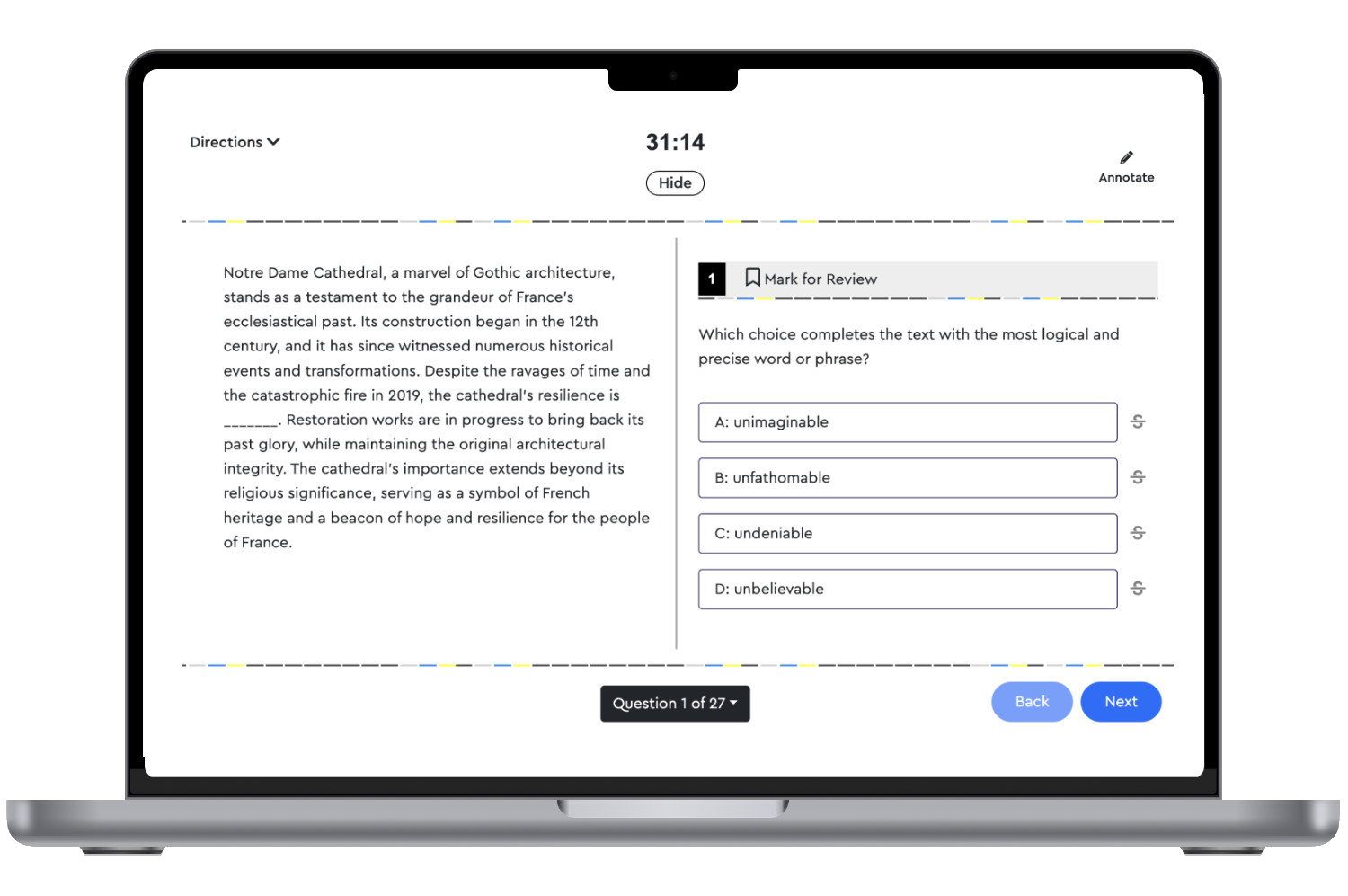
Inside the digital testing experience.
The PSAT uses the same adaptive, Bluebook-style digital interface as the SAT, so the screens below show that shared testing environment. Because the format is identical, every practice test your student takes on Test Ninjas transfers straight to test day.


Trusted by students and the teachers who guide them.
Real results from students, and the tutors and teachers who use Test Ninjas with their classes every day.
The practice tests felt just like Bluebook, so nothing on test day surprised me. I scored almost exactly what I was getting at home.
The plan told me what to study each day instead of me guessing. Most of what I kept missing was algebra and comma rules.
The science lessons gave me a way to attack the long passages instead of just reading and hoping. It went from my worst section to my best.
The practice tests actually made me feel the time pressure in reading. After a few weeks I stopped running out of time on the last passage.
The English questions actually explain the grammar rules the test keeps using. English ended up being my biggest jump.
Test Ninjas has made a real difference for my students. The platform is outstanding, and the adaptive tests really help them get used to what they'll see on test day.

Since adopting the platform, our students have improved by 150+ points on average. The targeted modules and realistic tests made a huge difference.