The Harvard alumni interview
Harvard interviews are conversations with an alum who lives near you, offered at the admissions committee's discretion. Not everyone gets one, you can't ask for one, and Harvard says your application is complete without it. If an interviewer does contact you, here is how it works and how to prepare.
Practice your Harvard interview
Pick a question, take 15 seconds to think, then answer out loud or in writing against the clock. Harvard doesn't publish its questions; these line up with what its 2026–27 interviewer training reportedly looks for: curiosity, openness to other views, and reflection.
Tell me about yourself.
Your interviewer hasn't seen your application, so this is where they meet you. Have a one-minute answer that goes beyond your activities list.
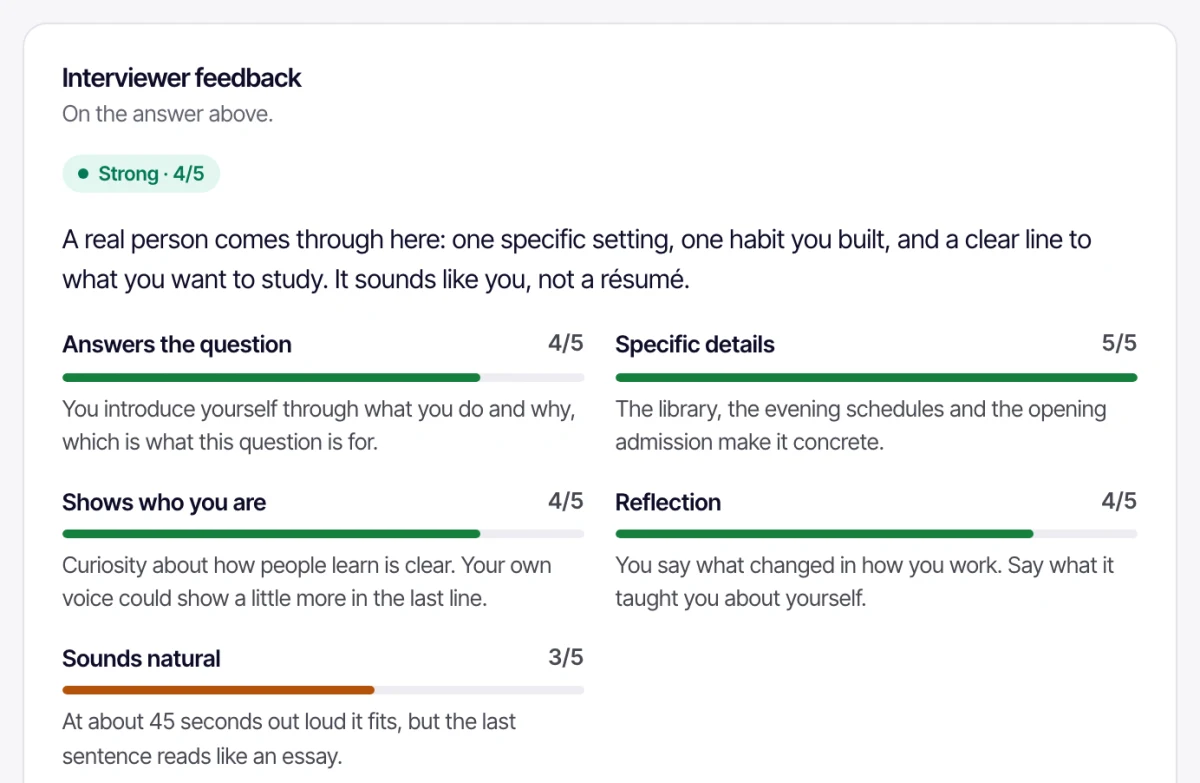
Switch to Write to get an AI interviewer's critique of your answer.
Your answers and practice history stay in this browser. An answer you send for feedback goes to our AI interviewer and isn't stored. Recordings are never uploaded and disappear when you leave the page.
Practice for Harvard with an AI interviewer
College Admissions has interview practice built in. Pick a school on your list, practice the questions its applicants report being asked, and get feedback on every answer.
- Questions past applicants report from each school's interviews, with sources, plus common questions worded for that school
- Feedback on every typed answer: a rating, five scored criteria, what to fix, and the follow-up an interviewer would ask
- Spoken mock interviews of 10, 15 or 20 minutes with an AI interviewer, with a report at the end
- Your essays, deadlines and chances in the same place
7-day free trial · From $29/mo after · Cancel anytime
How the Harvard interview works
From application to interview report.
- You submit your Common App
Harvard says your application is what opens your file and is used to "set up a possible alumni interview", so an interview can't happen before you apply.Harvard
- An alum may get in touch
Interviewers usually write from their own email address, sometimes they call. To check that someone really is a Harvard interviewer, call 617-495-1551 or email college@fas.harvard.edu.Harvard
- Timing depends on your round
Harvard publishes no interview dates. In the 2025–26 cycle interviews began in October for Restrictive Early Action applicants and in January for Regular Decision, The Crimson reported.Crimson
- The conversation
By video, phone or in person, for about 30–45 minutes and no more than an hour, per Harvard's interviewer guidance. Your interviewer knows only your name, contact details and high school, not your application. Recording is strictly prohibited, and in-person meetings now take place in public places, a regional alumni chair told The Crimson.Harvard
- The interviewer's report
Afterward, your interviewer writes up the conversation for the admissions committee, which reads it alongside the rest of your file.Harvard
Does everyone get a Harvard interview?
No, and not getting one doesn't count against you.
Harvard has nearly 10,000 alumni volunteers, but says most areas "do not have the capacity to interview all applicants." Interviews are assigned at the committee's discretion, based partly on how many alumni live near you. You can't request one, and Harvard doesn't hold interviews in Cambridge.
Harvard also says someone may reach out "if the Committee would like more information about a student or has questions about any application materials." So is an interview a good sign? Not by itself. Whether you get one depends partly on where you live, so treat it as a chance to add to your file, not a signal about your odds.
Your application is considered complete without an interview and will receive a full and thorough evaluation. In most cases, the Admissions Committee has sufficient information in the student's application materials to reach an admissions decision.
What the interview is for
A conversation about you, not a test.
Harvard's Common Data Set rates the interview "Considered", the same as essays and recommendations; Harvard rates no factor higher. Harvard says it relies on "teachers, counselors, and alumni to share information with us about an applicant's strength of character, their ability to overcome adversity, and other personal qualities."
Interviewer training for 2026–27, reported by The Crimson in September 2026, suggests questions that show whether a student "seems broadly curious across academic disciplines or particularly focused on one field", and whether applicants "display intellectual curiosity, openness to new perspectives, and the ability to reflect." Interviewers may not ask about your GPA or test scores, though they can ask about your academic interests and activities.
It may count for more than it used to. Asked about applicants' use of AI, Harvard's admissions dean, William Fitzsimmons, said the alumni interview has become more important than it used to be, according to an attendee's account reported by The Crimson in October 2026.
Questions to prepare for
Why each question comes up, and what a good answer does. Interviewers may not ask about grades or scores, so none of these are about numbers.
- Tell me about yourself.
Your interviewer hasn't seen your application, so this is where they meet you. Have a one-minute answer that goes beyond your activities list.
- What's something you learned recently, in or out of class, that you keep thinking about?
Intellectual curiosity is the first quality the training names. One specific idea and why it grabbed you beats a list of hard classes.
- What do you read, watch or listen to when nobody assigns it?
It shows what you're curious about on your own time. Be ready to say what you took from it.
- What might you study at Harvard, and what draws you to it?
Academic interests are fair game. It's fine to be undecided if you can say what you're drawn to.
- Which of your activities matters most to you, and why?
The why is the answer. Pick the one with the best story, not the biggest title.
- Tell me about a time you changed your mind about something.
Openness to new perspectives is named in the training, and it echoes Harvard's "strongly disagreed" essay question.
- Describe a conversation with someone who sees the world very differently from you.
Shows whether you listen as well as argue. Say what you learned, not who won.
- What's a setback that taught you something?
The ability to reflect is the third quality in the training. Spend most of the answer on what changed afterward.
- What's your school or community like, and what's your place in it?
Gives the interviewer context they don't have from your file. Be concrete about what you do there.
- Why Harvard?
Name something specific you'd do there and why it fits you. Rankings and reputation don't count as reasons.
- What do you hope to be doing ten years from now?
Direction matters more than a precise plan. It pairs with Harvard's question about how you'd use your education.
- What questions do you have for me?
Harvard frames the interview as a chance to learn about Harvard from someone who studied there. Bring two or three real questions.
How to prepare for a Harvard interview
Harvard's own tips plus what follows from how the interview works.
Before
- Reread your application. Your interviewer hasn't, so you choose which stories they hear.
- Pick three or four stories that show different sides of you, and practice telling each in about a minute.
- For a video interview, Harvard suggests a computer rather than a phone, and a quiet room with no one else in it.
- Dress as you would for school. Harvard says there's no need for formal clothes.
During
- Treat it as a conversation. Short answers that invite a follow-up beat speeches.
- Be specific: name the book, the problem, the person, the moment.
- Don't recite grades or scores. Interviewers aren't allowed to ask for them.
- Pause and think when you need to. Reflection is one of the things they're listening for.
Questions to ask your interviewer
- What surprised you most when you got to Harvard?
- What would you do differently if you were a student there again?
- Where did you find your people on campus?
- What do you think a student like me would find hardest there?
After
- A short thank-you email within a day or two is a courtesy. Harvard doesn't ask for one, so keep it to a few sentences.
- Don't send your interviewer extra materials. Harvard asks that updates go through the Applicant Portal and be limited to significant developments.
- Don't read anything into how the conversation felt. Interviewers write a report; they don't make the decision.
Frequently asked questions
Does everyone get a Harvard interview?
No. Harvard assigns interviews at the admissions committee's discretion, based partly on how many alumni live near you, and says most areas can't interview every applicant. Your application is complete without one.
Is a Harvard interview a good sign?
Not on its own. Getting an interview depends partly on alumni availability where you live. Harvard says it may reach out when the committee wants more information, so treat it as a chance to add to your file.
Can I request a Harvard interview?
No. Harvard says it isn't possible to request an interview, and it doesn't conduct interviews in Cambridge.
How long is the Harvard interview?
About 30–45 minutes and no more than an hour, according to Harvard's guidance for alumni interviewers.
Are Harvard interviews virtual?
They can be. Interviews happen by video, phone or in person, depending on local conditions and what you and your interviewer prefer. In-person interviews now take place in public places.
Does my Harvard interviewer see my application?
No. Alumni interviewers have only your name, contact information and the name of your high school.
When do Harvard interviews happen?
Harvard doesn't publish dates. In the 2025–26 cycle, interviews began in October for early applicants and in January for Regular Decision applicants, according to The Crimson.
What if no one contacts me for an interview?
Nothing is lost. Harvard says the absence of an interview will not adversely affect your candidacy, and that in most cases your application gives the committee enough to decide.
Still working on your Harvard short answers?
They're due with your application on January 1. See all five questions word for word, with how to answer each in 150 words.
Sources
Every date, number and prompt on this page comes from these pages, checked November 25, 2026. Admissions offices can change details during the cycle, so confirm anything time-sensitive on Harvard's own site.
- Harvard College: What to expect after you apply (interviews, decisions)
- Harvard College: First-year applicants (deadlines, decision timing, REA rules)
- Harvard FAQ: Is there an interview for international applicants?
- Harvard FAQ: What admissions criteria do you use?
- Harvard University Common Data Set 2025–26 (PDF)
- Harvard College: Alumni interviewer resources (interview length guidance; page dates from the Class of 2027 cycle)
- The Harvard Crimson: Alumni interview restrictions unchanged (Sep 17, 2026)
- The Harvard Crimson: Alumni interviews and race (Oct 27, 2025)
- The Harvard Crimson: Fitzsimmons on international applicants (Oct 19, 2026) (an attendee's account of the Dean's remarks)
- The Harvard Crimson: Harvard alumni interviewers asked to delete data (Oct 19, 2026)
- Harvard FAQ: I was deferred. What can I do to improve my chances?