
Harvard supplemental essays, 2026–27
Harvard asks five required short-answer questions, each up to 150 words, on top of your Common App personal essay. The questions are the same as last year. Below is each one word for word, what it's really asking, how to answer it, and a place to get feedback on your draft.
Harvard's 2026–27 questions
Five required short answers, unchanged from last year. Each has a 150-word limit, and Harvard says each "can be answered in about 100 words."
- Harvard has long recognized the importance of enrolling a student body with a diversity of perspectives and experiences. How will the life experiences that shaped who you are today enable you to contribute to Harvard?Up to 150 words
- Describe a time when you strongly disagreed with someone about an idea or issue. How did you communicate or engage with this person? What did you learn from this experience?Up to 150 words
- Briefly describe any of your extracurricular activities, employment experience, travel, or family responsibilities that have shaped who you are.Up to 150 words
- How do you hope to use your Harvard education in the future?Up to 150 words
- Top 3 things your roommates might like to know about you.Up to 150 words
Copied from Harvard's 2026–27 first-year supplement, "Valid for entrance in Fall 2027". The only other writing space is the Common App's optional Additional Information section. Harvard
Write all five Harvard answers with feedback on every draft
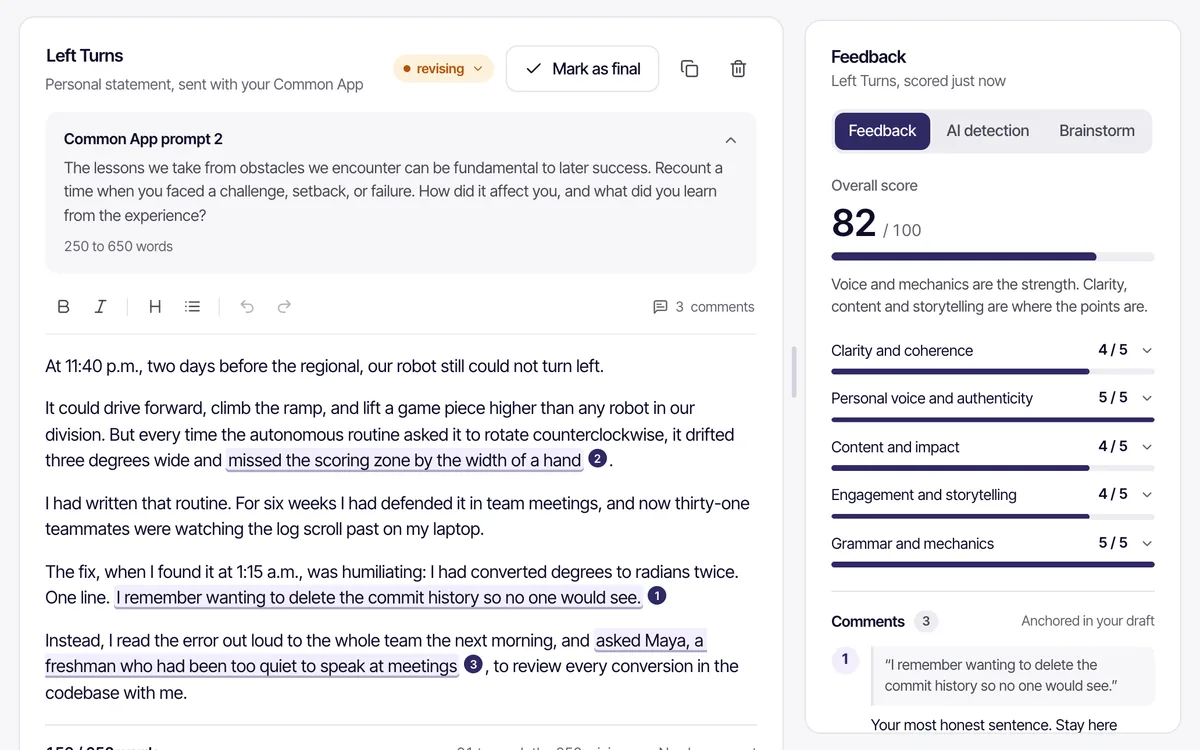
College Admissions is a workspace for drafting your essays. Every revision is scored, commented on and saved, alongside your personal statement and your other schools' supplements.
- A score out of 100 on every draft, broken into five parts, with comments pinned to the sentences they're about
- Brainstorm ideas for any prompt from the activities and awards in your profile
- An AI-detection check before you certify your essays as your own work
- One question answered by an admissions advisor
7-day free trial · From $29/mo after · Cancel anytime
How Harvard reads these
In Harvard's words, and in its Common Data Set.
Harvard's Application Tips page, updated September 23, 2026, explains why every applicant answers the same five questions. Read together, they cover three things: what shaped you, how you'll engage with other people at Harvard, and where you're headed.
Harvard's Common Data Set rates the application essay "Considered", the same as recommendations, the interview and personal character. Harvard marks no factor "Very Important" or "Important", so read that as one of many things the committee weighs together, not as a sign that essays don't matter.
We want to ensure that every student has the same opportunity to reflect on and share how their life experiences and academic and extracurricular activities shaped them, how they will engage with others at Harvard, and their aspirations for the future.
1. Life experiences and contributing to Harvard
Harvard has long recognized the importance of enrolling a student body with a diversity of perspectives and experiences. How will the life experiences that shaped who you are today enable you to contribute to Harvard?
What it's asking
Read the second half closely. The question is how your experiences will let you contribute, so the experience is the setup and the contribution is the answer. Answers that describe a background and stop there leave out the part Harvard asked for.
"Perspectives and experiences" is broad on purpose. A perspective can come from where you grew up, a role in your family, a job, a language, a faith, a disability, or years spent on one obsession. What makes it count is that it changes how you see something and what you'd bring to a class discussion, a dorm or a team.
How to answer it
- Pick one experience. At around 100 words there is room to tell one well, not to survey several.
- Say in one sentence what it taught you to notice or do that other people often miss.
- End at Harvard with a concrete setting where that shows up: a seminar, the first-year dorm, a student group, a lab.
Mistakes to avoid
- Listing identities or hardships without saying what they let you bring.
- Generic praise of Harvard. "World-class faculty" uses up words and says nothing about you.
- Retelling your personal essay. Use a different experience, or a different side of the same one.
Example opening
Four summers of translating at my grandmother's dialysis appointments taught me that people nod when they're lost. I learned to stop, ask what she'd heard, and say it again in plainer words. In a seminar, I'll be the one who asks the question half the room is afraid to.
Written by Test Ninjas to show the approach. It is not from a real applicant, so don't borrow its details.
Brainstorm suggests angles for this question from the activities and awards in your profile. Feedback then scores each draft and leaves comments on the exact sentences that need work.
2. A time you strongly disagreed
Describe a time when you strongly disagreed with someone about an idea or issue. How did you communicate or engage with this person? What did you learn from this experience?
What it's asking
Harvard added this question so it could weigh how applicants handle opposing views. A Harvard page updated in November 2026 names it as one of the application changes meant to value applicants' "demonstrated abilities to engage constructively with different perspectives, show empathy, and participate in civil discourse."
So the topic matters less than the way you engaged. The question has three parts: the disagreement, how you communicated, and what you learned. Most of your words should go to the second and third.
How to answer it
- Choose a real disagreement about an idea or issue with a specific person: a teammate, teacher, friend or relative. "What our club should stand for" beats "which day to meet".
- Give the disagreement one or two sentences, then spend most of the answer on what you did: what you asked, what you heard, what you conceded.
- Close with what you learned, ideally something you still think about or now do differently.
Mistakes to avoid
- A story where you were right, they were wrong, and you won.
- A disagreement with no actual person in it, like arguing with an article or a policy.
- A tidy ending where everyone agrees. Staying respectfully unconvinced is fine if you learned something.
Example opening
My debate partner wanted our school to ban phones in class; I thought that punished the students who used them for translation. Instead of arguing it again, I asked her to sit with me in my ESL study hall for a week.
Written by Test Ninjas to show the approach. It is not from a real applicant, so don't borrow its details.
This answer has three parts to fit into 150 words. Feedback scores clarity, voice and storytelling on every revision, so you can see whether each part is landing.
3. Activities, work, travel or family responsibilities
Briefly describe any of your extracurricular activities, employment experience, travel, or family responsibilities that have shaped who you are.
What it's asking
This is the most open of the five. Jobs and caring for family count as much as clubs: Harvard's own application tips say such experiences "are important 'extracurricular' activities and can be detailed in the extracurricular section and discussed in essays."
Your activities list already says what you did. Use this answer for what it did to you.
How to answer it
- Choose the activity with the best story, not the most impressive title.
- Open with one specific moment from it rather than a summary of your role.
- Finish with how it shaped you: a habit, a belief, or a skill you now use somewhere else.
Mistakes to avoid
- Repeating your activities list or awards. Harvard already has them.
- Covering three activities in 150 words. One, or two that connect, is plenty.
- Skipping a job or family duties because they seem less impressive than a club.
Example opening
Saturdays at my uncle's tire shop start at 6 a.m. with the phone, because the first caller is always someone stranded. I learned to ask three questions before quoting a price, and I still do that before answering anything hard.
Written by Test Ninjas to show the approach. It is not from a real applicant, so don't borrow its details.
Brainstorm reads the activities saved in your profile and suggests ideas for this question, including jobs and family responsibilities.
4. How you'll use a Harvard education
How do you hope to use your Harvard education in the future?
What it's asking
This looks like a career question, but it's really about direction. Harvard's 2026–27 counselor newsletter says it seeks students "who will contribute to the Harvard community during their college years and to society throughout their lives."
You don't need a career plan. A problem you want to work on, and why it matters to you, is more convincing than a job title.
How to answer it
- Start from a problem or question your application already hints at.
- Connect it to what you'd do with the education: a field to study, a skill to build, a community to serve.
- Keep it honest. "Here's what I'm drawn to and why" beats a ten-year plan you can't back up.
Mistakes to avoid
- A list of prestigious careers.
- Promising to "change the world" without naming the piece of it you care about.
- A plan that has nothing to do with anything else in your application.
Example opening
My county has one pediatric dentist for 40,000 children. I want to study how health systems decide where care goes, and then work on the rural end of that decision.
Written by Test Ninjas to show the approach. It is not from a real applicant, so don't borrow its details.
Your Harvard drafts sit together with their status, next to your personal statement and every other school's supplements, so you can spot two answers telling the same story.
5. Top 3 things your roommates might like to know
Top 3 things your roommates might like to know about you.
What it's asking
The lightest question, and often the most memorable. It asks what you're like to live with: habits, quirks, what you're doing at 11 p.m.
The prompt is a list, so the answer can be one. Three short, specific items read better than three paragraphs.
How to answer it
- Write ten candidates, then keep the three that are most specific and least like anything else in your application.
- Mix them: a habit, something you'll share, and something about how you'll be to live with.
- Read it out loud. If it sounds like a résumé, start again.
Mistakes to avoid
- Achievements in disguise, like "I wake up at 5 a.m. to train for nationals."
- Inside jokes that need context the reader doesn't have.
- Anything a roommate would dread, unless you're clearly in on the joke.
Example opening
1. I narrate my cooking like a TV chef, commercial breaks included. 2. I own two kettles and will explain why. 3. If you're up at 2 a.m. stuck on a problem set, knock: I'm probably awake too.
Written by Test Ninjas to show the approach. It is not from a real applicant, so don't borrow its details.
Feedback scores personal voice and authenticity on every draft, and the AI-detection check runs before you certify your essays as your own.
Plan all five together
Five short answers leave little room, and the easiest way to waste it is telling the same story twice.
| Question | What the answer should show |
|---|---|
| 1. Life experiences and contributing to Harvard | One perspective you'd bring, and where it would show up at Harvard |
| 2. A time you strongly disagreed | How you listen, disagree and change your mind |
| 3. Activities, work, travel or family responsibilities | What you do when no one is grading you, and what it built in you |
| 4. How you'll use a Harvard education | Where you're headed and why it matters to you |
| 5. Top 3 things your roommates might like to know | What you're like to live with |
Before drafting, write one line per question: the story you'll use and what it shows. If two lines use the same story, move one. Then check that none of the five retells your Common App personal essay, which Harvard also reads.
Treat 150 words as a ceiling, not a target. Harvard says each question can be answered in about 100, and a tight 110-word answer reads better than a padded 150.
Harvard's 2026–27 supplement asks you to certify that your essays are your own work. It accepts that students "may seek help or guidance (both human and technological)" but says they "may not submit substantive content generated by other sources." Use feedback to find weak spots, then do the rewriting yourself.
Score a Harvard answer for free
Pick the question, paste your draft, and get a scored review against the 150-word limit. No account needed for your first two reviews.
Frequently asked questions
How many supplemental essays does Harvard have?
Five, all required, each with a 150-word limit, so up to 750 words in total. They're on top of the 650-word Common App personal essay. Harvard says each question can be answered in about 100 words.
Does Harvard have supplemental essays?
Yes. The Harvard Questions on the Common App include five required short answers. Your application isn't complete until you submit them.
Is there a "Why Harvard" essay?
Not as such. No question asks "Why Harvard?" directly. Question 1 (how your experiences will let you contribute to Harvard) and question 4 (how you hope to use a Harvard education) come closest, and both reward specifics over praise of the school.
Did the Harvard supplemental essays change for 2026–27?
The five questions are the same as in 2025–26. What changed is around them: the application fee is now $95, and Harvard's current pages list only the Common App (and QuestBridge), where last year's also listed the Coalition Application.
Can I use AI for my Harvard essays?
Harvard says students may seek help or guidance, "both human and technological", but "may not submit substantive content generated by other sources", and you certify that your essays are your own work. Feedback on your own draft is fine; text written for you is not.
Does Harvard have an optional essay?
There is no separate optional Harvard essay. The Common App's Additional Information section is optional; Harvard says some students use it to explain circumstances such as an illness that affected their grades.
Harvard's five answers are due January 1
Draft them with feedback on every revision, check each one for AI before you certify it, and keep every school's essays in one place.
7-day free trial · From $29/mo after · Cancel anytime
Next: how the Harvard interview works
Sources
Every date, number and prompt on this page comes from these pages, checked November 25, 2026. Admissions offices can change details during the cycle, so confirm anything time-sensitive on Harvard's own site.
- Harvard College First-Year Application Supplement 2026–2027 (PDF) ("Valid for entrance in Fall 2027")
- Harvard College: Application requirements
- Harvard College: Application tips (updated September 23, 2026)
- Harvard University: Admissions and early student experiences (last updated November 2026)
- Harvard College 2026–27 Counselor Newsletter (PDF)
- Harvard University Common Data Set 2025–26 (PDF)
- Harvard application requirements, October 2025 (Internet Archive)