The Dartmouth alumni interview
Dartmouth interviews are optional conversations with an alum or a graduating senior, arranged after you apply. You can't schedule one, not everyone gets one, and Dartmouth says not having one won't put you at a disadvantage. If an interviewer emails you, here is how it works and how to prepare.
Practice your Dartmouth interview
Pick a question, take 15 seconds to think, then answer out loud or in writing against the clock. Seven of these come from the list Dartmouth publishes of questions your interviewer will likely ask.
Tell me about yourself.
This is often where the conversation starts. Have a one-minute answer that goes beyond your activities list.
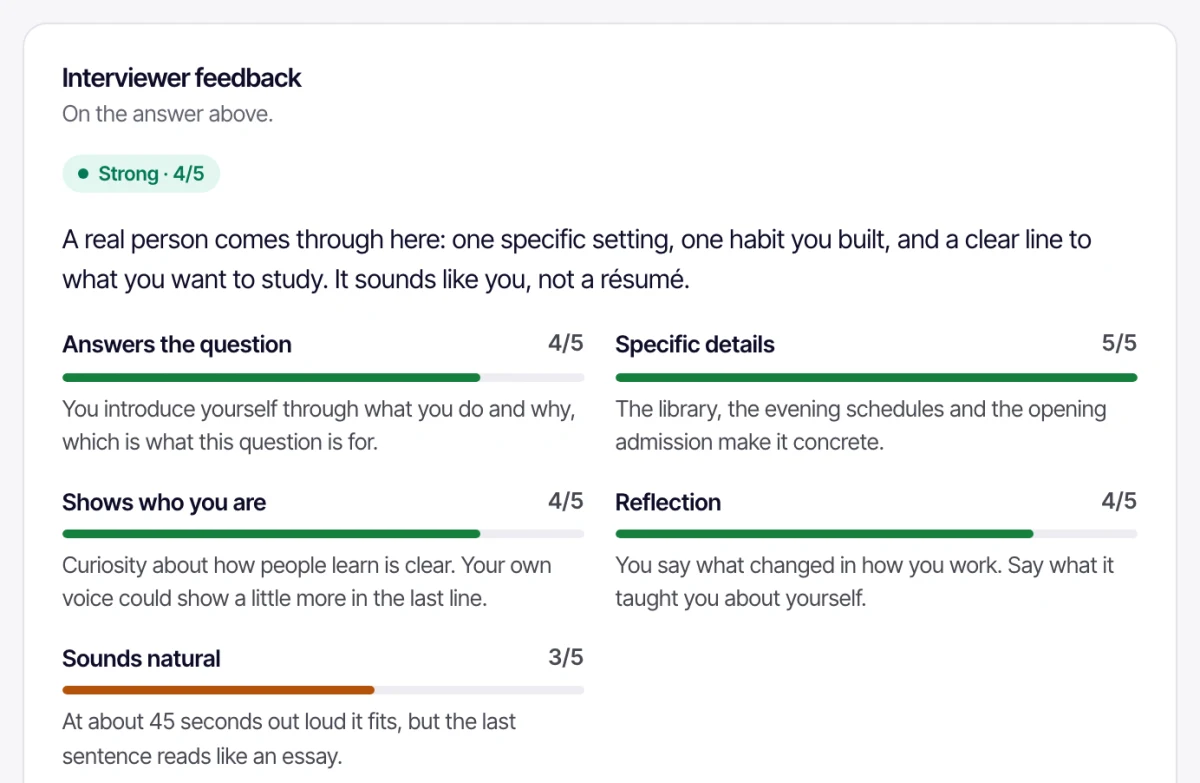
Switch to Write to get an AI interviewer's critique of your answer.
Your answers and practice history stay in this browser. An answer you send for feedback goes to our AI interviewer and isn't stored. Recordings are never uploaded and disappear when you leave the page.
Practice for Dartmouth with an AI interviewer
College Admissions has interview practice built in. Pick a school on your list, practice the questions its applicants report being asked, and get feedback on every answer.
- Questions past applicants report from each school's interviews, with sources, plus common questions worded for that school
- Feedback on every typed answer: a rating, five scored criteria, what to fix, and the follow-up an interviewer would ask
- Spoken mock interviews of 10, 15 or 20 minutes with an AI interviewer, with a report at the end
- Your essays, deadlines and chances in the same place
7-day free trial · From $29/mo after · Cancel anytime
How the Dartmouth interview works
From application to interview report.
- You apply
Once you apply, Dartmouth sends your contact information to volunteer alumni admissions ambassadors. You don't need to schedule anything.Dartmouth
- An interviewer emails you
Interviewers write to the email address on your application, and Dartmouth says their messages sometimes land in junk mail. Reply promptly either way. If you'd rather not interview, decline early so the alum can offer the time to another applicant.Dartmouth
- Timing depends on your round
Early Decision interviews are usually scheduled around November. Regular Decision interviews take place between early December and mid-February, though Dartmouth's application timeline puts Regular Decision invitations in January and February.Dartmouth
- The conversation
In person, by video or by phone. A brief résumé or activity sheet can help your interviewer but isn't required. Both you and the interviewer are prohibited from recording it.Dartmouth
- The interview report
Afterward your interviewer sends a report to the Office of Admissions. Dartmouth's alumni office tells volunteers that meeting a student and sending the report takes about an hour.Dartmouth
Does everyone get a Dartmouth interview?
No, and Dartmouth says not having one won't count against you.
Dartmouth's alumni try to interview as many applicants as they can, but alumni availability and geography mean not everyone gets one. Interviews are with alumni volunteers, and there are no on-campus interviews. Dartmouth's alumni office also invites graduating seniors to interview, which is why the admissions FAQ says an alumnus or current student may contact you.
A few groups follow different rules. QuestBridge Match applicants aren't interviewed because of the Match's short timeline, though they may be contacted if they move into Regular Decision. Applicants outside the US can submit an InitialView interview, which Dartmouth encourages. Transfer applicants don't get interviews.
Interviews are arranged after you have submitted your application. Not having an interview will not put you at a disadvantage in the admissions process.
All alumni and graduating seniors are welcome to become admissions ambassadors.
What the interview is for
A two-way conversation that also gets written up.
Dartmouth's Common Data Set rates the interview "Considered". The essay, recommendations, grades and test scores are all rated higher, at "Very Important". Dartmouth calls its interviews "both informative and evaluative". You can ask your questions, the interviewer learns about you, and the report is reviewed with the rest of your file.
Dartmouth frames an interview as a chance to add to your application. If you're offered one, it says, it "can help you learn something new about Dartmouth and allow you to add a little more of your own voice to your application."
On Dartmouth's Admissions Beat podcast, Dean Lee Coffin ran a mock interview and said his style is "to disrupt the script" so the exchange doesn't become question, answer, question, answer. Asked what makes applicants stand out, he pointed to "the authenticity they bring to their storytelling."
Questions to prepare for
Why each question comes up, and what a good answer does.
- Tell me about yourself.
This is often where the conversation starts. Have a one-minute answer that goes beyond your activities list.
- Tell me about your school: courses, teachers, favorite subject, least favorite subject?
This one is on Dartmouth's own list. On his podcast, Dean Coffin explained that asking what isn't working for you is a clue to how you learn best, so answer the least-favorite part honestly.
- Is there a project, paper, lab, etc. that you were especially proud of when you completed it?
Another from Dartmouth's list. Pick one piece of work and explain what made it hard and what you did about it.
- What's something you learned recently, in or out of class, that you keep thinking about?
It shows curiosity on your own terms. One specific idea and why it grabbed you beats a list of hard classes.
- What activities are you involved in: which are the most important to you and why?
Dartmouth lists this one too. The why is the answer, so pick the activity with the best story, whatever its title.
- What would your teachers or friends tell us about you?
From Dartmouth's list. It echoes the peer recommendation Dartmouth encourages: how do the people around you see you?
- Tell me about a time you changed your mind about something.
Dartmouth puts weight on dialogue, and one of its essay prompts asks about finding common ground. Say what moved you, not who won.
- What's a setback that taught you something?
It shows whether you reflect. Spend most of the answer on what changed afterward.
- What are your future plans: college, major, career?
On Dartmouth's list. Undecided is fine at a liberal arts college if you can say what you're drawn to and why.
- When you envision your ideal college experience, what does that look like?
Also from Dartmouth's list. Be concrete: the size of your classes, how you'd spend a term, what you'd do outdoors or on campus.
- Why Dartmouth?
Dean Coffin said that in a real interview he'd ask what attracted you to the college. Use the specifics from your 100-word essay and say why they fit you.
- What are your questions about Dartmouth?
Dartmouth says your questions give your interviewer insight into what you value and how you think. Bring two or three real ones.
How to prepare for a Dartmouth interview
Dartmouth's own tips, plus what follows from how the interview works.
Before
- Check your email often, junk folder included. Interviewers write to the address on your application.
- Reply promptly whether or not you can meet. Declining early lets the alum offer the time to someone else.
- Bring a brief résumé or activity sheet. Dartmouth says it can help but isn't required.
- Reread your Why Dartmouth answer. You may be asked the same question out loud.
During
- Arrive on time. Formal attire isn't required, but dress appropriately.
- Treat it as a conversation. Answers that open a new topic give the interviewer somewhere to follow.
- Be specific: the class, the project, the person, the moment.
- Don't record it. Dartmouth prohibits recording by students and alumni.
Questions to ask your interviewer
- What was your D-Plan like, and what did you do with your off terms?
- What surprised you most when you got to Hanover?
- Where did you find your people at Dartmouth?
- What do you wish you'd known before your first year?
After
- A short thank-you email within a day or two is a courtesy. Dartmouth's interview page doesn't mention one, so keep it to a few sentences.
- Send any application updates through your Applicant Portal, where Dartmouth adds them to your file.
- Questions or concerns about your interview go to aap@dartmouth.edu or (603) 646-6068.
Frequently asked questions
Does Dartmouth require an interview?
No. Interviews are optional and arranged after you apply. Dartmouth says not having one will not put you at a disadvantage.
How do I get a Dartmouth interview?
You don't schedule it. After you apply, Dartmouth sends your contact information to alumni volunteers, and an interviewer emails you at the address on your application. Not every applicant gets one, because of alumni availability and geography.
Who interviews Dartmouth applicants?
Alumni volunteers Dartmouth calls admissions ambassadors. Graduating Dartmouth seniors can also interview, and Dartmouth's FAQ says an alumnus or current student may contact you. There are no on-campus interviews.
When do Dartmouth interviews happen?
Early Decision interviews are usually scheduled around November. Regular Decision interviews take place between early December and mid-February.
Are Dartmouth interviews virtual?
They can be. Dartmouth offers interviews in person, by video call or by phone. Recording the conversation is prohibited.
Is the Dartmouth interview evaluative?
Yes. Dartmouth calls it both informative and evaluative, and the interviewer's report is added to your file. Its Common Data Set rates the interview "Considered".
Can international applicants use InitialView?
Yes. Dartmouth says it encourages students with InitialView interviews to submit them.
What if no one contacts me for an interview?
Nothing is lost. Dartmouth says it can't interview every applicant and that not having an interview won't put you at a disadvantage.
Still working on your Dartmouth essays?
They're due with your application on January 1. See all three questions and every choice prompt word for word, with how to answer each.
Sources
Every date, number and prompt on this page comes from these pages, checked November 26, 2026. Admissions offices can change details during the cycle, so confirm anything time-sensitive on Dartmouth's own site.
- Dartmouth Admissions: Apply to Dartmouth (Early and Regular Decision timelines, QuestBridge) (lists the 2027 Transfer Application)
- Dartmouth College Common Data Set 2025–26 (PDF) (updated April 16, 2026)
- Dartmouth Admissions: Writing Supplement prompts for the Class of 2031 (updated July 22, 2026)
- Dartmouth Admissions glossary: Peer Recommendation
- Dartmouth Admissions glossary: Alumni Interview
- Dartmouth FAQ: How do I get an interview?
- Dartmouth FAQ: Does Dartmouth accept InitialView interviews?
- Dartmouth FAQ: Are interviews required for QuestBridge Finalists?
- Dartmouth Alumni & Families: Admissions Ambassadors
- Admissions Beat podcast, Season 4 Episode 13: Interview Tips: Let Your Life Speak, transcript (linked from Dartmouth's alumni interview page)