Free CLT Practice Test (Printable PDF)
A full-length CLT practice test to print and take at home: all 120 questions in the CLT’s three sections, in test order and timed to each section’s working time. The PDF includes a bubble answer sheet, the answer key and an explanation for every question.
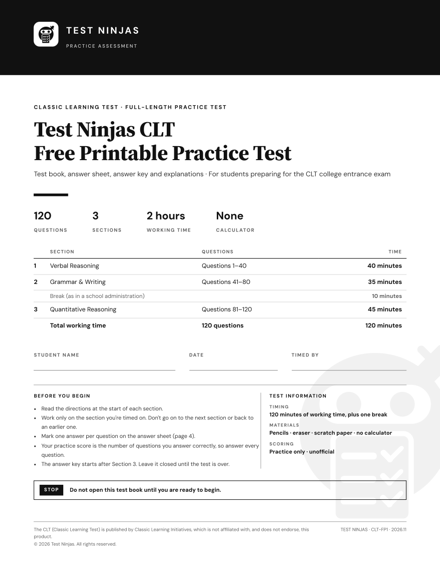
- 120 questions · 2 hours of timed testing
- All three sections in test order, each with its working time and directions
- Bubble answer sheet, answer key, scoring worksheet and an explanation for every question
- 45 pages · letter size · prints in black and white
No account needed (2.3 MB). Pages 1–33 are the test book and answer sheet; the answer key starts on page 34, so you can print the two parts separately.
What’s on the CLT practice test
The practice test has the CLT’s three core sections, with 40 questions in each, in the same order. Every question has four answer choices. Each section is timed separately, and calculators aren’t allowed. Questions are numbered from 1 to 120 so one answer sheet covers the whole test.
Section lengths, working times and the number of questions on each skill follow the CLT exam guide. The break is the one in a standard school administration; the remote test has only short stretches between sections.
How to use the PDF
The PDF is one 45-page document in two parts: the test, then the answers.
- Print pages 1–33 to take the test and set pages 34–45 aside until you finish. Every page prints well in black and white.
- Pull out the answer sheet (page 4) so you can mark answers beside the test book.
- Have a timer, pencils, an eraser and scratch paper ready. No calculator.
- Score with the answer key, then read the explanations, starting with the questions you missed or guessed.
Download the free CLT practice test PDF
Sample questions from the test
Four real questions from the practice test, with their question numbers in the test: a Verbal Reasoning question about a phrase in its paragraph, a Grammar & Writing edit to an underlined verb, and two Quantitative Reasoning questions, the first with a figure.
From “The Clockroom”, paragraph 3She did not contradict me. Instead, she removed a small brass cover and placed it in my hand. Underneath, an old thread had wound itself around a pin; each revolution tightened it slightly, making the wheel hesitate. The thread came from a cloth she had used during the previous week's cleaning. I expected embarrassment, perhaps even a speech about the treachery of age, but she merely asked for the tweezers. Her admission was so ordinary that my prepared generosity had nowhere to stand. I had wanted to forgive a failing that she had already begun to remedy.
In paragraph 3, “my prepared generosity had nowhere to stand” means that the narrator’s generosity was
- (A)an offer to share the repair that became unnecessary once the aunt found the thread.
- (B)a rehearsed willingness to forgive that the aunt’s matter-of-fact response made unnecessary.
- (C)a willingness to defend the aunt that faded when she admitted causing the fault.
- (D)a readiness to overlook the delay that the aunt interpreted as disrespect for her work.
Show the answer and explanation
Answer: (B) a rehearsed willingness to forgive that the aunt’s matter-of-fact response made unnecessary. The next sentence explains the phrase: the narrator had wanted to forgive, while the aunt had already begun correcting the problem.
From “A Printer’s Other Ledger”[3] The collection of corrections were less profitable than the advertisements, yet Vale eventually considered it the more revealing account of her business.
In sentence 3, which replacement is grammatically correct?
- (A)NO CHANGE
- (B)was
- (C)have been
- (D)are
Show the answer and explanation
Answer: (B) was. The subject is singular collection. The plural corrections belongs to an intervening of-phrase, so the past-tense verb is was.
What is the slope of the line through A(−3, 4) and B(5, −2)?
- (A)−4/3
- (B)−3/4
- (C)−1/4
- (D)3/4
Show the answer and explanation
Answer: (B) −3/4. The vertical change is −2 − 4 = −6 and the horizontal change is 5 − (−3) = 8. Thus the slope is −6/8 = −3/4.
If x + y = 7 and xy = 10, what is x² + y²?
- (A)29
- (B)39
- (C)49
- (D)69
Show the answer and explanation
Answer: (A) 29. Square the sum: 49 = x² + 2xy + y². Subtract 20 to obtain x² + y² = 29.
The full test has all 120 questions, including eight passages. Download the PDF to take it.
How to take it like test day
A practice test is only as useful as it is realistic. These rules follow the CLT’s section clocks and review rules:
- Time each section separately: 40 minutes for Verbal Reasoning, 35 minutes for Grammar & Writing and 45 minutes for Quantitative Reasoning.
- Work only on the section being timed. Inside a section you can skip a question and come back to it. When time is up, stop, and don’t return to that section.
- Check the numbers. Question numbers run from 1 to 120 through the whole test, so make sure each mark on the answer sheet matches the question you are answering.
- Answer every question. Nothing is subtracted for a wrong answer, so a careful guess is better than a blank.
- No calculator. Use the formula reference at the start of Section 3 and do your figuring in the test book or on scratch paper.
- Take one break: 10 minutes after Grammar & Writing, as in a standard school administration.
For the rules of the real test, see the CLT test day checklist.
How to score the practice test
Count the correct answers in each section with the answer key on page 35, then fill in the scoring worksheet on page 36. That gives you a number correct out of 40 for each section and out of 120 for the test.
The official CLT also reports each section from 0 to 40 and a total from 0 to 120, but those scores are equated from one test form to the next. A practice test can’t reproduce that, and this one is not calibrated to the official scale, so your number correct is a practice result, not a CLT score. Use it to compare your three sections and to track progress from one practice test to the next. To read real score reports, see how CLT scoring works and what a good CLT score is.
What to study after the practice test
Read the explanation for every question you missed or guessed first. Each one names the skill it tests, so patterns show up quickly. Then work on the sections where you lost the most points:
- Verbal Reasoning: whole-passage, details, textual analysis, evidence and analogies questions, with worked examples.
- Grammar & Writing: agreement, punctuation and sentence structure, organization, style and word choice questions, with worked examples.
- Quantitative Reasoning: algebra, geometry and mathematical reasoning questions, with worked examples.
More free CLT practice
- Timed practice on screen. The free CLT practice page has guided practice sets and a timed practice engine.
- Every question type. CLT practice questions explain each question type with examples.
- A question a day. CLT questions of the day keep skills sharp between practice tests.
- A plan to the test date. The CLT study plan comes in two-week, one-month and two-month versions.
Frequently Asked Questions
Sources
- Classic Learning Test, CLT remotely proctored testing: Three 40-item sections, timing, 0–120 scale, no calculator.
- Classic Learning Test, CLT online in-school proctoring (2026 guidance): Same core clocks, proctor-controlled advancement, and a 10-minute break after Grammar/Writing.
- Classic Learning Test, CLT 2026 Technical Report: Current content blueprint, section clocks, equated score scales and score reporting.
This is an independent Test Ninjas practice test, not an official CLT form. The CLT (Classic Learning Test) is published by Classic Learning Initiatives, which is not affiliated with, and does not endorse, Test Ninjas.