
Dartmouth supplemental essays, 2026–27
Dartmouth asks for three short answers on top of your Common App personal essay: a required 100-word Why Dartmouth response, then two 250-word responses, each picked from a list. The prompts match last year's, minus one option in question 3. Below is every prompt word for word, with what it's asking and how to answer it.
Dartmouth's 2026–27 questions
Question 1 is set. For questions 2 and 3 you pick one prompt from each list: two options for question 2, six for question 3.
- As you seek admission to Dartmouth's Class of 2031, what aspects of the college's academic program, community, and/or campus environment attract your interest? How is Dartmouth a good fit for you?Up to 100 words
- There is a Quaker saying: Let your life speak. Describe the environment in which you were raised and the impact it has had on the person you are today.Up to 250 words
- "Be yourself," Oscar Wilde advised. "Everyone else is taken." Introduce yourself.Up to 250 words
- What excites you?Up to 250 words
- Labor leader and civil rights activist Dolores Huerta recommended a life of purpose. "We must use our lives to make the world a better place to live, not just to acquire things," she said. "That is what we are put on the earth for." In what ways do you hope to make—or are you already making—an impact? Why? How?Up to 250 words
- In an Instagram post, best-selling British author Matt Haig cheered the impact of reading. "A good novel is the best invention humans have ever created for imagining other lives," he wrote. How have you experienced such insight from reading? What did you read and how did it alter the way you understand yourself and others?Up to 250 words
- The social and family interactions of wild chimpanzees have been the focus of Dame Jane Goodall's research for decades. Her understanding of animal behavior prompted the English primatologist to see a lesson for human communities as well: "Change happens by listening and then starting a dialogue with the people who are doing something you don't believe is right." Channel Dame Goodall: Tell us about a moment when you engaged in a difficult conversation or encountered someone with an opinion or perspective that was different from your own. How did you find common ground?Up to 250 words
- Celebrate your nerdy side.Up to 250 words
- "It's not easy being green…" was the frequent refrain of Kermit the Frog. How has difference been a part of your life, and how have you embraced it as part of your identity, outlook, or sense of purpose?Up to 250 words
Copied from Dartmouth's writing supplement page for the Class of 2031, updated July 22, 2026. The only change from 2025–26 is that question 3 dropped its seventh option, a Mindy Kaling Theater Lab prompt about failure. Dartmouth
Write your three Dartmouth essays with feedback on every draft
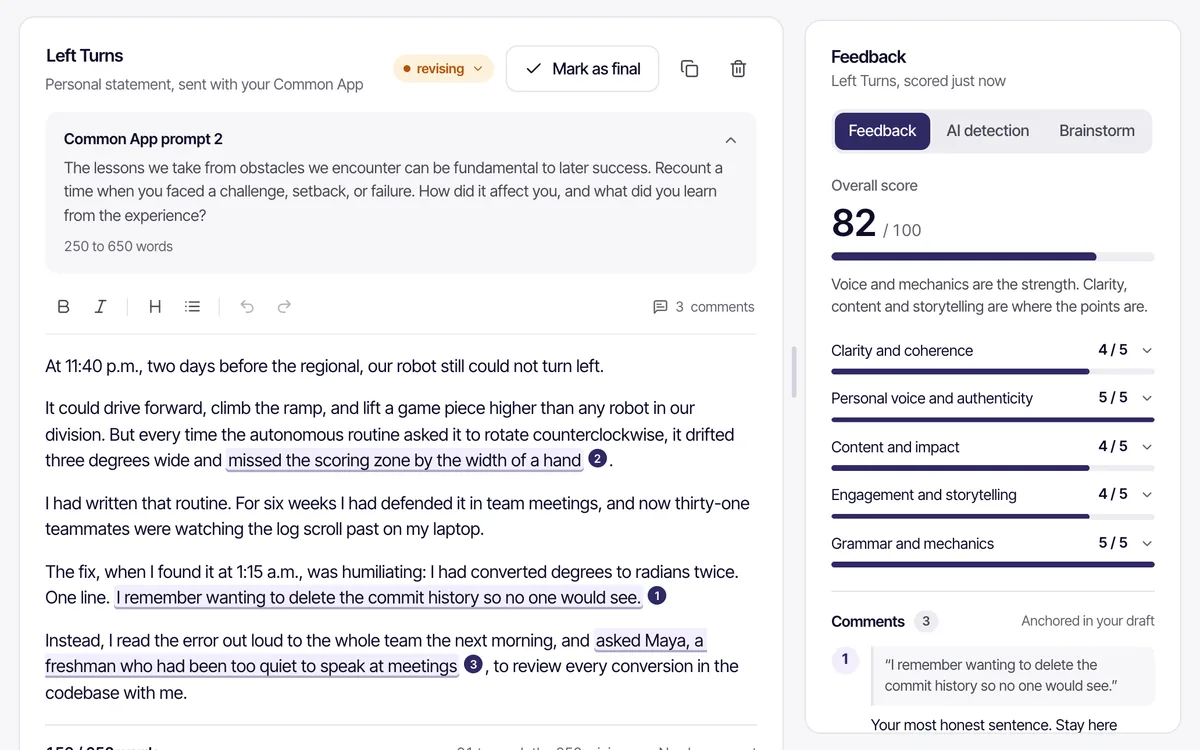
College Admissions is a workspace for drafting your essays. Every revision is scored, commented on and saved, alongside your personal statement and your other schools' supplements.
- A score out of 100 on every draft, broken into five parts, with comments pinned to the sentences they're about
- Brainstorm ideas for any prompt from the activities and awards in your profile
- An AI-detection check before you certify your essays as your own work
- One question answered by an admissions advisor
7-day free trial · From $29/mo after · Cancel anytime
How Dartmouth reads these
In Dartmouth's words, and in its Common Data Set.
Dartmouth's Common Data Set rates the application essay "Very Important", its top rating, alongside course rigor, grades, test scores, recommendations, activities and character. The interview, by comparison, is rated "Considered".
Dartmouth also reports what admitted students wrote in question 1. In December 2025, dean of undergraduate admissions Kathryn Bezella said nearly one in five early admits mentioned "ideas related to discourse", and many cited the specific academic work of the faculty. In March 2026, Dartmouth said one in three admitted students cited a culture that values dialogue and free expression. A year earlier, Bezella said, "So many students cited specific faculty members and identified classes they are drawn to by name."
Your writing lets us get to know you and we read every word. Help us envision what you'll bring to Dartmouth.
And we have a question about why Dartmouth is basically the question, and it's 100 words. And I've had students say, "I can't answer that in a hundred words." And it's like, yes, you can. Get to it. What is it about this place that resonates?
1. Why Dartmouth
As you seek admission to Dartmouth's Class of 2031, what aspects of the college's academic program, community, and/or campus environment attract your interest? How is Dartmouth a good fit for you?
What it's asking
This is Dartmouth's version of the why-us question, and it asks two things in 100 words: what draws you (the academics, the community, the campus, or a mix) and how you fit. Dean Lee Coffin has said on Dartmouth's podcast that students tell him they can't answer it in 100 words. He tells them, "yes, you can. Get to it."
Specifics carry this answer. When Dartmouth describes what admitted students wrote here, it points to named faculty and classes, dialogue and free expression, and the rural setting. Dartmouth also says it doesn't track visits or emails, and that a completed application "is all the demonstrated interest we need", so this is where your interest shows.
How to answer it
- Pick two or three specific things you'd use: a course, a professor's research, a program, a part of campus life.
- Tie each one to something you've already done, so the reader can see why it fits you.
- Cut every sentence that would work for another college. At 100 words, that is usually the first one.
Mistakes to avoid
- Praise any college could get: rankings, prestige, "world-class faculty".
- Naming ten things in a row. Two or three, each tied to you, read better.
- Describing Hanover's scenery without saying what you'd do there.
Example opening
I've spent two summers counting monarch eggs on the milkweed along my county's roads. At Dartmouth I want the field courses that take students out of the classroom, and an Outing Club trip to see a forest nobody mows.
Written by Test Ninjas to show the approach. It is not from a real applicant, so don't borrow its details.
Feedback scores every draft out of 100 and anchors comments to the sentences that need work, so you can find the lines that would fit any college and cut them first.
2. Let your life speak
There is a Quaker saying: Let your life speak. Describe the environment in which you were raised and the impact it has had on the person you are today.
What it's asking
The prompt has two parts: describe where you were raised, then show how it made you who you are today. The environment can be a place, a household, a community or a set of circumstances. The second part, its impact on you, is where most of your words should go.
Dartmouth uses the same phrase on its podcast episode about interviews, "Let Your Life Speak". There, Dean Coffin lists the threads an admissions reader hopes to learn about: "the family, the place, your school, your community, your church, your identity". Any one of those is a fair starting point.
How to answer it
- Choose one feature of your environment to build on: a neighborhood, a family business, a language at home, a long commute, a small town.
- Spend about a third of your words on the place and two thirds on what it did to you: a habit, a value, a way of seeing.
- End in the present, with the person you are today, since that is what the prompt asks for.
Mistakes to avoid
- A travel-brochure description of your hometown.
- Hardship told without what you made of it.
- Reusing the setting and story of your personal statement.
Example opening
In my town of 900 people, the library opened two afternoons a week, so I learned to read on a deadline. I still pack my Saturdays the way I packed those afternoons: three books, one question, and a ride home at five.
Written by Test Ninjas to show the approach. It is not from a real applicant, so don't borrow its details.
Brainstorm suggests angles for this prompt from the activities and awards in your profile, which helps when the place you grew up shaped what you chose to do.
3. Introduce yourself
"Be yourself," Oscar Wilde advised. "Everyone else is taken." Introduce yourself.
What it's asking
This is the most open prompt on the supplement: two words of instruction and 250 words to fill. The risk is a résumé in paragraph form. Read it as an invitation to say what the rest of your file leaves out.
Dean Coffin has described how readers boil an essay down to "what did the student talk about? How well was it described? What did we learn?" and suggests asking what headline someone would put on it. Decide your headline before you write.
How to answer it
- Write the one sentence you want a reader to say about you afterward.
- Pick two or three specifics that prove it: a habit, a conversation, an object, a moment.
- Check it against your personal statement and drop anything that repeats it.
Mistakes to avoid
- Listing your activities and awards. Dartmouth already has them.
- Opening with the Wilde quote. The prompt already did.
- Trying to cover everything. One clear picture of you is enough.
Example opening
I read the instruction manual after the thing is built. I've assembled two bookshelves, a bike and most of a canoe that way, and each time the manual explained something I'd already figured out the hard way.
Written by Test Ninjas to show the approach. It is not from a real applicant, so don't borrow its details.
Feedback scores personal voice and authenticity on every draft, so you can tell whether your introduction sounds like you or like a list.
4. What excites you?
What excites you?
What it's asking
Three words, with 250 to answer them. The prompt is open on purpose, and what you choose tells the reader as much as what you say about it.
Dartmouth's essay guidance names the qualities it hopes your writing shows, including "your passion, your intellectual curiosity". Excitement is easiest to believe when the reader sees what you do because of it.
How to answer it
- Pick something specific enough that few other applicants would choose it.
- Show the excitement in action: what you did, made, read or chased because of it.
- Say why it excites you. That reason is the part only you can write.
Mistakes to avoid
- A broad field, like "science" or "music", with nothing specific underneath.
- An answer that turns into a career plan.
- Telling the reader you're excited without showing what you do about it.
Example opening
Bus schedules. Specifically, the gap between when the 14 is supposed to arrive and when it does. I've logged it for 212 mornings, and last spring I showed the county transit board a chart of my data.
Written by Test Ninjas to show the approach. It is not from a real applicant, so don't borrow its details.
Brainstorm reads the activities and awards saved in your profile and suggests ideas for this prompt, which helps when everything feels equally exciting.
5. Making an impact
Labor leader and civil rights activist Dolores Huerta recommended a life of purpose. "We must use our lives to make the world a better place to live, not just to acquire things," she said. "That is what we are put on the earth for." In what ways do you hope to make—or are you already making—an impact? Why? How?
What it's asking
After the Huerta quote come three questions: in what ways, why and how. You can write about an impact you're already making or one you hope to make. The prompt allows either.
Scale matters less than detail. A small effect you can describe precisely, with the reason it matters to you, is more convincing than a large one described in general terms. The why is usually the hardest part and the most revealing.
How to answer it
- Choose one impact you can describe concretely: who it helped and what changed.
- Answer why: what in your life made this matter to you.
- Answer how: the steps you took or will take, including what didn't work.
Mistakes to avoid
- Big promises with no plan behind them.
- Counting hours or dollars without saying what changed.
- Skipping the why. All three of the prompt's questions need an answer.
Example opening
Our school's food pantry closed every summer, the same months my little brother's free lunch disappeared. So I asked the church next door to lend us its walk-in fridge. Last July we fed 61 families, and I learned that permission is often one polite email away.
Written by Test Ninjas to show the approach. It is not from a real applicant, so don't borrow its details.
Feedback scores content and impact on each revision and leaves comments on the exact sentences, so you can see whether the why and the how are landing.
6. Insight from reading
In an Instagram post, best-selling British author Matt Haig cheered the impact of reading. "A good novel is the best invention humans have ever created for imagining other lives," he wrote. How have you experienced such insight from reading? What did you read and how did it alter the way you understand yourself and others?
What it's asking
The Haig quote praises novels for "imagining other lives". The questions after it ask about you: how reading gave you insight, what you read, and how it changed the way you understand yourself and others.
The questions say "reading", so a novel isn't required. Name the text in a sentence or two and spend most of your words on what shifted in your thinking and how you see people differently now.
How to answer it
- Pick a reading that changed a view you held.
- Give the text one or two sentences, then show your thinking before and after.
- End with how you see yourself or someone else differently today.
Mistakes to avoid
- A book report or plot summary.
- Choosing a book to impress the reader.
- Insight that stays abstract. Tie it to a person or a moment in your life.
Example opening
I read a novel narrated by a grandmother who never learned to read, and I finished it angry at the wrong person. A week later I asked my own grandmother why she always had me read the mail aloud. She'd been hiding it for forty years.
Written by Test Ninjas to show the approach. It is not from a real applicant, so don't borrow its details.
Run the AI-detection check on your draft before it goes in, so the answer about how reading changed you reads as your own work.
7. A difficult conversation
The social and family interactions of wild chimpanzees have been the focus of Dame Jane Goodall's research for decades. Her understanding of animal behavior prompted the English primatologist to see a lesson for human communities as well: "Change happens by listening and then starting a dialogue with the people who are doing something you don't believe is right." Channel Dame Goodall: Tell us about a moment when you engaged in a difficult conversation or encountered someone with an opinion or perspective that was different from your own. How did you find common ground?
What it's asking
After the Goodall quote, the task is a story: a moment when you had a difficult conversation or met an opinion different from yours, and how you found common ground. The last question carries the weight, because the prompt assumes you got somewhere together.
Dialogue is a theme Dartmouth returns to. In March 2026 it said one in three admitted students cited a culture that values dialogue and free expression, and Kathryn Bezella praised "a willingness to listen, question, and consider counterarguments".
How to answer it
- Choose a real disagreement with a specific person about something that mattered to both of you.
- Give the disagreement two or three sentences, then spend most of the answer on what you did: what you asked, what you heard, what you conceded.
- Name the common ground exactly, even if it was small.
Mistakes to avoid
- A story where you were right and won the argument.
- Turning the other person into a caricature.
- Vague common ground, like "we agreed to disagree".
Example opening
My uncle thinks the wind farm planned for his ridge will ruin his view and his hunting. I'd written a school paper calling opponents selfish. Then I walked the ridge with him and counted the deer trails the turbine roads would cross.
Written by Test Ninjas to show the approach. It is not from a real applicant, so don't borrow its details.
This one needs a story, a turn and a resolution in 250 words. Feedback scores clarity and coherence on every revision, with comments anchored to the sentences where the thread gets lost.
8. Celebrate your nerdy side
Celebrate your nerdy side.
What it's asking
The shortest prompt on the supplement gives you permission to be enthusiastic about something specific, academic or not. Nerdy here means depth, going further into a subject than most people would bother to.
It suits how Dartmouth reads. Kathryn Bezella told The Dartmouth that, because Dartmouth offers only a liberal arts program, "you’re reading about someone’s general intellectual curiosity" in its files.
How to answer it
- Pick the thing you know more about than anyone you know.
- Show the depth with one specific detail an outsider wouldn't know.
- Let the reader see why you love it, and keep the humor if it's yours.
Mistakes to avoid
- Picking something because it sounds impressive.
- Explaining the subject instead of your relationship to it.
- Apologizing for being nerdy. The prompt asked.
Example opening
I can tell you which everyday English words came from Old Norse, and I will, unprompted. My family now plays a dinner game: someone names a word, and I guess its origin before the timer runs out. Window, egg and knife are mine.
Written by Test Ninjas to show the approach. It is not from a real applicant, so don't borrow its details.
Feedback scores engagement and storytelling and personal voice on every draft, so you can see whether your enthusiasm survives the edits.
9. Difference and identity
"It's not easy being green…" was the frequent refrain of Kermit the Frog. How has difference been a part of your life, and how have you embraced it as part of your identity, outlook, or sense of purpose?
What it's asking
Kermit's line opens a two-part question: how difference has been part of your life, and how you've embraced it as part of your identity, outlook or sense of purpose. Difference can be anything that has set you apart, such as background, beliefs, family, place, a disability or an interest.
Dartmouth's essay podcast, linked from its supplement page, discusses framing "lived experiences" in light of the Supreme Court's 2023 decision on race and identity in admissions. This prompt has room for that kind of story, told through what happened to you.
How to answer it
- Name the difference plainly in the first few sentences.
- Show one moment when it mattered, then how your view of it changed.
- Spend the second half on the embracing: what it gave you and how it shapes what you do.
Mistakes to avoid
- Stopping at the difficulty, without the embracing the prompt asks for.
- Speaking for a whole group instead of yourself.
- Repeating your personal statement if it covers the same ground.
Example opening
I'm the only left-handed cellist in my youth orchestra, so I play a borrowed, restrung instrument that sounds a little wrong. For years I hid at the back. This fall I asked to sit first chair, because the odd sound is the one people remember.
Written by Test Ninjas to show the approach. It is not from a real applicant, so don't borrow its details.
Your Dartmouth drafts sit together with their status in the essays list, next to your personal statement and every other school's supplements, so you can check this answer doesn't repeat another.
Plan all three together
You write three answers, and two of them come from lists, so choosing well is half the work.
| Question | What the answer should show |
|---|---|
| 1. Why Dartmouth | What you'd do at Dartmouth, and why it fits who you are |
| 2. Let your life speak | Where you come from, and what it built in you |
| 3. Introduce yourself | The one thing you most want a reader to know about you |
| 4. What excites you? | What you care about when nobody assigns it |
| 5. Making an impact | What you work toward, and why it matters to you |
| 6. Insight from reading | How you think, and how reading changes your mind |
| 7. A difficult conversation | How you listen and find agreement with people who see things differently |
| 8. Celebrate your nerdy side | What you go deep on just because you want to |
| 9. Difference and identity | How what sets you apart became part of who you are |
Start with question 1, since it's set. Then read all eight choice prompts and write one line for each: the story you'd tell and what it shows. Keep the two that tell the reader something new, and check that they don't overlap with each other or with your personal statement. Dartmouth counts four essays in all: your personal statement and these three.
Treat the limits as ceilings. Dean Coffin has said he stopped calling the 250-word answers essays because 250 words is a paragraph, and that the word count is "a signal from the institution that this is not meant to be a long-form piece of writing."
Get readers, then do the rewriting yourself. Dartmouth's supplement page says, "Parents and peers can be helpful editors, but at the heart of every memorable essay is the writer's authentic voice telling the story only they can tell."
Score a Dartmouth answer for free
Pick the question, paste your draft, and get a scored review against the 100-word limit. No account needed for your first two reviews.
Frequently asked questions
How many supplemental essays does Dartmouth have?
Three. Question 1 asks why Dartmouth, in 100 words or fewer. For questions 2 and 3 you pick one prompt from each list and answer in 250 words or fewer. That's up to 600 words on top of your Common App personal essay.
What is the Dartmouth "Why Dartmouth" essay?
Question 1 asks what aspects of Dartmouth's academic program, community and campus environment attract your interest, and how Dartmouth is a good fit for you, in 100 words or fewer. Dean Lee Coffin has said students can answer it in 100 words if they get straight to what resonates.
Did Dartmouth's supplemental essays change for 2026–27?
Barely. The prompts match those for the Class of 2030, with the class year updated, except that question 3 dropped its Mindy Kaling Theater Lab prompt about failure. Question 3 now has six options instead of seven.
Which Dartmouth question 3 prompt should I choose?
Any of the six. Pick the one where you have a specific story the rest of your application doesn't already tell, and that doesn't overlap with your answer to question 2.
How important are essays at Dartmouth?
Dartmouth's Common Data Set rates the application essay "Very Important", its highest rating, the same as grades, course rigor and recommendations. Its essay guidance says, "we read every word."
Can a parent or teacher help with my Dartmouth essays?
Dartmouth's supplement page says parents and peers can be helpful editors, "but at the heart of every memorable essay is the writer's authentic voice telling the story only they can tell." Get feedback, then make the changes yourself.
Dartmouth's essays are due January 1
Draft all three with feedback on every revision, check each one for AI before you submit, and keep every school's essays in one place.
7-day free trial · From $29/mo after · Cancel anytime
Next: how the Dartmouth interview works
Sources
Every date, number and prompt on this page comes from these pages, checked November 26, 2026. Admissions offices can change details during the cycle, so confirm anything time-sensitive on Dartmouth's own site.
- Dartmouth College Common Data Set 2025–26 (PDF) (updated April 16, 2026)
- Dartmouth Admissions: Writing Supplement prompts for the Class of 2031 (updated July 22, 2026)
- Dartmouth writing supplement for the Class of 2030, October 2025 (Internet Archive)
- Dartmouth Admissions glossary: Essay
- Dartmouth FAQ: What should I write my essays about?
- Dartmouth FAQ: Does it improve my chances if I demonstrate interest?
- Admissions Beat podcast, Season 6 Episode 3: The Essay, transcript (Dartmouth's admissions podcast, linked from the 2026–27 supplement page)
- Dartmouth Admissions glossary: Peer Recommendation
- The Dartmouth: Q&A with new dean of undergraduate admissions Kathryn Bezella (Jan 2025)
- Admissions Beat podcast, Season 4 Episode 13: Interview Tips: Let Your Life Speak, transcript (linked from Dartmouth's alumni interview page)
- Dartmouth News: Dartmouth Welcomes First Members of Class of 2030 (Dec 16, 2025)
- Dartmouth News: Dartmouth Offers Admission to 1,702 Undergrad Applicants (Mar 27, 2025)
- Dartmouth Admissions news: Applications Rise 2% in Second-Largest Pool in College History (Mar 30, 2026)