ASVAB Auto Information: Learn What Each System Does
Start with what a component does, then place it inside its system. Following the movement of heat, power or electrical energy helps you distinguish parts that work together but perform different jobs.
Test Ninjas Research · Updated September 29, 2026
What you’ll learn
Identify a component from its function within a system.
Separate cooling, lubrication and electrical roles.
Use the engine or vehicle type specified in a question.
Learn the method
Follow heat through the cooling system
In a conventional liquid-cooled engine, which component transfers heat from circulating coolant to passing air: the radiator, water pump or thermostat?
Name the job
The requested job is transferring heat out of the coolant. Keep that separate from moving the coolant or regulating its route.
Follow the heat path
Coolant absorbs heat near hot engine parts and circulates through the radiator. The radiator’s tubes and fins provide surface area through which energy transfers to air passing over them.
Compare the neighboring components
The water pump circulates coolant. The thermostat regulates flow to the radiator as the engine warms. They support cooling, but the radiator performs the heat-exchange job named here.
The radiator transfers heat from the coolant to the surrounding air.
Why the tempting approach fails
The water pump is in the correct system, but choosing it answers “what moves the coolant?” rather than “what transfers its heat to the air?” Match the exact function, not just the system name.
Explain it back
Why is engine oil not the best answer to a question about the radiator’s circulating fluid?
Compare your reasoning
Engine oil primarily lubricates moving parts, while the conventional radiator in this example receives coolant. Both fluids can carry heat, but their paths and primary roles differ.
Key concepts to keep handy
The example teaches one method. Open a concept below when you need a rule or a different type of example during practice.
Follow the engine’s energy path
In a conventional combustion engine, fuel releases energy that moves pistons, and the crankshaft converts their back-and-forth motion into rotation. The transmission changes the speed-and-torque relationship delivered toward the wheels. Each component has a distinct role; an answer about producing rotation is different from one about changing its ratio.
Recognize the four-stroke sequence
A four-stroke engine cycles through intake, compression, power and exhaust. A spark-ignition gasoline engine uses a spark plug to ignite the compressed mixture; a diesel engine uses compression ignition. Identify the engine type before applying a fact about fuel delivery or ignition.
Keep cooling and lubrication separate
The cooling system transfers unwanted engine heat away, commonly using circulating coolant and a radiator. Lubricating oil reduces friction and wear between moving surfaces and also carries away some heat. A question about the radiator, oil pump or thermostat tests which system performs the stated job.
Distinguish starting, charging and stopping
The battery provides electrical energy for starting; a starter motor turns the engine during cranking. In a conventional running vehicle, an alternator supplies electrical power and charges the battery. Braking converts motion into heat through friction. These processes involve different components even though they all affect whether the vehicle can move.
Topics covered in this guide
Basic engine operation and component roles
Fuel, air and ignition systems
Cooling and lubrication
Transmission and drivetrain
Brakes, tires, suspension and the charging system
Now apply what you know
Try a few questions without opening the solutions, then explain why each answer works. Use scratch paper for calculations and work without a calculator. These original, untimed questions sample the subject; the result is not an official score.
Auto Information practice: 12 questions
Work through one question at a time. Explain your approach, check the worked answer, then move on. Use scratch paper for calculations.
0 of 12 checked · 0 correct.
Progress is saved in this browser. These original study questions do not produce an official AFQT score.
Question 1: Drum-brake action
Question 1 · Drum-brake action · easy
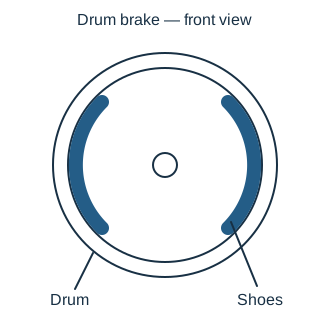
The simplified brake has curved shoes inside a drum. During braking, in which direction must the shoes move to contact the drum’s inner friction surface?
Worked answer and explanation
Answer: D. Outward toward the surrounding drum
A conventional internal-expanding drum brake pushes its shoes outward against the inside of the drum. Moving them inward would increase the clearance instead of producing contact.
Question 2: Cabin heating from coolant
Question 2 · Cabin heating from coolant · medium
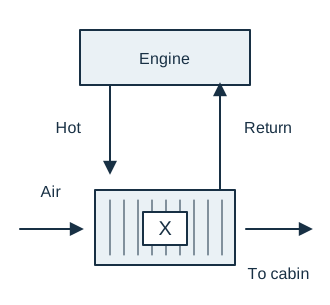
In the simplified heating circuit, hot engine coolant passes through unit X while a blower sends cabin air across it. What is X?
Worked answer and explanation
Answer: C. A heater core
A heater core is a small heat exchanger that transfers energy from hot engine coolant to air entering the passenger compartment. It does not mix coolant into that air.
Question 3: Synchronizer action
Question 3 · Synchronizer action · medium
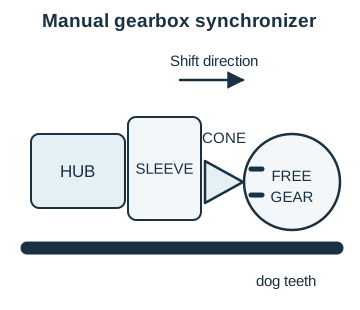
The simplified manual transmission shows a sliding sleeve approaching a freely rotating gear. Before the sleeve teeth engage the gear teeth, a cone friction surface contacts the gear. What is that cone contact meant to do?
Worked answer and explanation
Answer: A. Bring the sleeve and gear toward matching rotational speeds
Synchronizer cone friction changes relative speeds before the positive teeth engage. That reduces clash during the shift. It does not alter tooth count or clutch-pedal position; lubrication is present but draining oil is not its function.
Question 4: Valve duration and overlap
Question 4 · Valve duration and overlap · hard
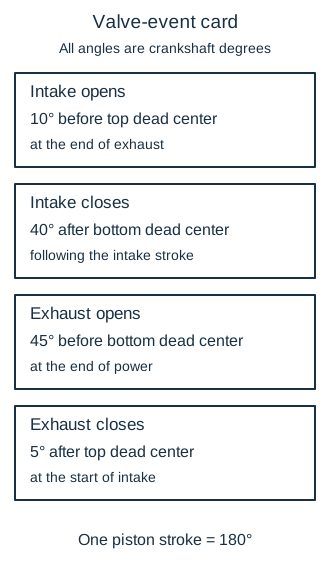
Use the valve-event card for this four-stroke engine. There are 180 crankshaft degrees from top dead center to bottom dead center. Which choice gives the intake valve’s total open duration and the overlap during which both valves are open near the exhaust-to-intake transition?
Worked answer and explanation
Answer: C. Intake duration 230°; overlap 15°
The intake valve opens 10° before top dead center and closes 40° after the next bottom dead center, giving 10 + 180 + 40 = 230°. Around the exhaust-to-intake top dead center, intake opens 10° before and exhaust closes 5° after, so overlap is 15°. Intake closing after bottom dead center is not part of this overlap.
Question 5: Turbocharger energy path
Question 5 · Turbocharger energy path · easy
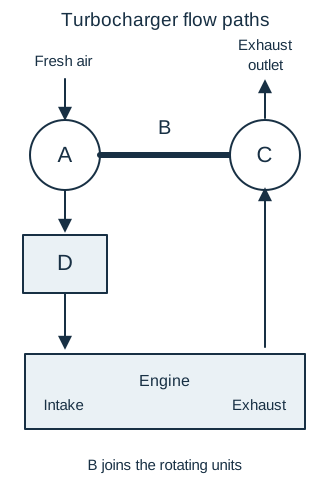
Which labeled part in this simplified turbocharger layout is driven directly by the flowing exhaust gas?
Worked answer and explanation
Answer: C. C
Exhaust from the engine flows through C, the turbine. The shared shaft B transfers its rotation to compressor A on the fresh-air side. D cools the compressed intake air and is not the exhaust-driven wheel.
Question 6: Starter engagement
Question 6 · Starter engagement · medium
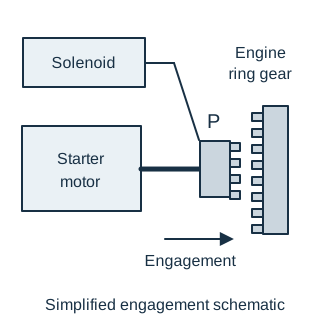
The starter schematic labels a lever-operated small gear P that moves into the engine’s ring gear when starting. What is the function of P?
Worked answer and explanation
Answer: A. To connect the starter’s rotation to the engine ring gear
P is the starter pinion. Engagement lets the starter motor turn the engine through the larger ring gear; after starting, the drive is disengaged. It is a mechanical power connection rather than a fuel or coolant component.
Question 7: Wheel alignment geometry
Question 7 · Wheel alignment geometry · medium
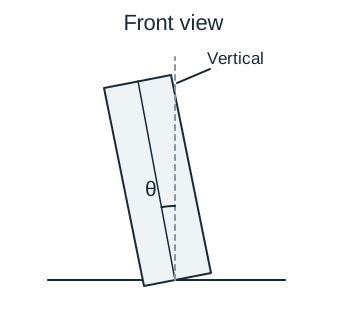
The diagram is a front view of a vehicle wheel. Which alignment angle is shown between the wheel’s centerline and a vertical reference?
Worked answer and explanation
Answer: C. Camber
Camber is the wheel’s inward or outward tilt from vertical when viewed from the front. Toe is judged from above, while caster concerns the steering axis viewed from the side. The diagram marks the wheel centerline, not the steering axis.
Question 8: Filter bypass and pressure relief
Question 8 · Filter bypass and pressure relief · hard
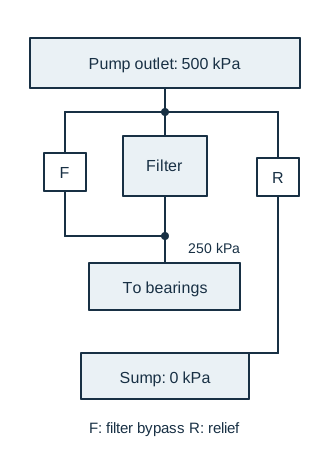
Use the stated ideal valve thresholds and gauge pressures in the diagram. Valve F opens when the pressure difference across the filter exceeds 200 kPa. Valve R opens when pump-outlet pressure exceeds 600 kPa relative to the sump. Which pair of valve states follows?
Worked answer and explanation
Answer: B. F open; R closed
The filter pressure difference is 500 − 250 = 250 kPa, so F opens. The pump outlet is only 500 kPa above the 0 kPa sump, below R’s 600 kPa threshold, so R stays closed. The valves respond to different pressure comparisons.
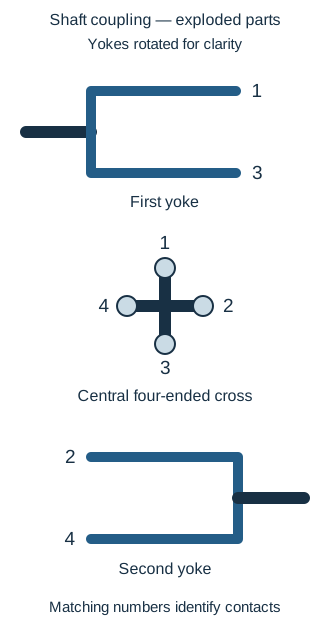
The drawing shows two forked yokes joined through a four-ended cross, allowing the shafts to operate at an angle. Which component is shown?
Worked answer and explanation
Answer: C. A universal joint
A cross-and-yoke universal joint transmits rotation between shafts whose axes meet at an angle. A splined slip joint mainly accommodates axial movement, while a differential and friction clutch have different mechanisms.
Question 10: Crank radius and piston stroke
Question 10 · Crank radius and piston stroke · medium
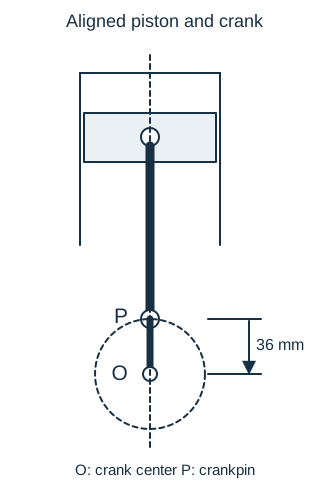
The drawing shows the crank center O and the crankpin center P at one dead-center position. The cylinder axis passes through O, and the connecting rod has fixed length. What is the piston’s full stroke from top dead center to bottom dead center?
Worked answer and explanation
Answer: C. 72 mm
At the two dead centers, the crankpin lies the same distance above and below the crank center. The connecting rod’s fixed length cancels when those piston positions are subtracted. Therefore stroke is twice the 36 mm crank radius, or 72 mm; 36 mm is only the throw radius.
Question 11: Fuel-injection locations
Question 11 · Fuel-injection locations · medium
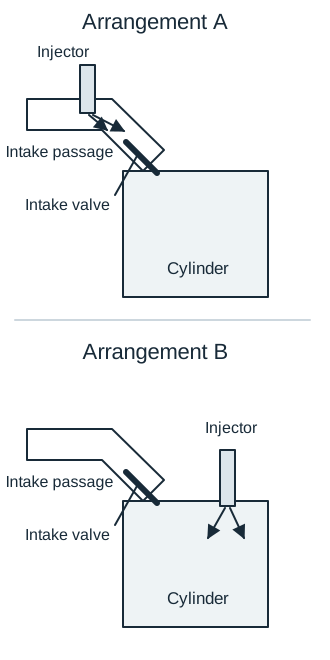
The two schematics show a gasoline injector’s position relative to an intake valve. Which arrangement injects fuel into the intake passage before it enters the cylinder?
Worked answer and explanation
Answer: A. Arrangement A only
In A, the injector sprays into the passage upstream of the intake valve: this is port injection. In B, the injector tip enters the combustion chamber and sprays there directly. Both meter fuel, but their delivery locations differ.
Question 12: Loaded alternator wiring loss
Question 12 · Loaded alternator wiring loss · hard
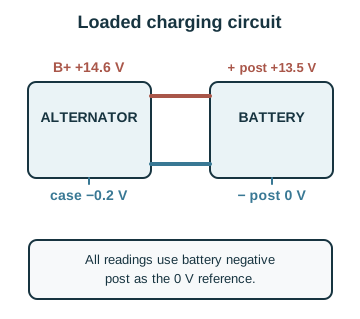
With the alternator charging under load, the diagram gives node voltages relative to the battery negative post: alternator B+ is +14.6 V, alternator case is −0.2 V, battery positive post is +13.5 V, and battery negative post is 0 V. What is the total voltage lost in the positive and return wiring between alternator and battery?
Worked answer and explanation
Answer: D. 1.3 V
The alternator produces 14.6 − (−0.2) = 14.8 V across its own terminals. The battery posts have 13.5 − 0 = 13.5 V. Their difference is 1.3 V of total external wiring loss: 1.1 V on the positive path and 0.2 V on the return. The other choices omit one path or mishandle the reference voltage.
Before moving on, choose one error you can explain. Rework that question with the solution closed, then revisit the skill in a later session to check what you remember.
Common mistakes to check
Treating every engine as a spark-ignition gasoline engine.
Confusing the battery’s starting role with the alternator’s charging role.
Mixing up coolant circulation and engine lubrication.
Choosing a component from the right system that performs the wrong function.
Organize review by system
Sketch simple paths for intake air, coolant, lubrication and drivetrain power. Name the major component at each step and its purpose. You do not need a detailed repair drawing to distinguish the function of a pump from a filter or a radiator.
Use the conditions in the question
If an item specifies a gasoline engine, hydraulic brakes or a particular drivetrain, stay within that model. Real vehicles vary; a general symptom by itself does not establish a unique real-world fault. These questions practice principles rather than replace vehicle diagnosis.
Test format and scoring reference
Auto Information is outside the AFQT. On the computer ASVAB it is tested separately from Shop Information, but the results are combined into the reported Auto and Shop score, AS, used in relevant service composites.
View Auto Information questions and time limits
Auto Information: official test format
Format
Questions and timing
Computer test, without tryouts
10 scored questions · 7 minutes without tryouts
Computer test, with tryouts
15 possible additional unscored questions · 18 minutes total with tryouts
Paper test
Combined Auto & Shop (AS): 25 questions · 11 minutes
Domain
Science & Technical
Contributes to the AFQT
No
The computer test includes unscored tryout questions in selected subtests. The longer time shown is the total for a section with tryouts, not extra time to add. These figures describe the proctored CAT-ASVAB, not untimed PiCAT or our practice sets. See the official questions and timing table and the guide to test versions.
They are separate on the computer ASVAB and combined on the paper version. Both formats report a combined Auto and Shop score, labeled AS.
No. The AFQT uses the four math and verbal subtests. Auto Information contributes to the combined AS score used in relevant job composites.
No. Begin with the major systems and component functions, then use the explanations to fill gaps. This set is designed for study and does not assume access to a workshop.
No. They illustrate automotive concepts for ASVAB practice. They do not diagnose a vehicle or provide model-specific service instructions.
Sources and materials. Subtest descriptions and timing were checked on September 29, 2026 against the Department of Defense’s What to Expect guide, sample questions and score guide. Teaching examples, diagrams and practice questions are independently authored Test Ninjas materials. Test Ninjas is not affiliated with or endorsed by the Department of Defense.