ASVAB Arithmetic Reasoning: Learn the Method, Then Practice
A word problem is easier to solve once you know what the answer must measure. Start with a worked discount-and-tax problem, learn how to check the setup, then apply that habit to rates, ratios and other arithmetic questions.
Test Ninjas Research · Updated September 29, 2026
What you’ll learn
Translate the requested quantity into a calculation.
Apply percentages to the correct starting amount.
Check the units and the reasonableness of an answer.
Learn the method
A discount followed by sales tax
A jacket costs $80. A store takes 25% off, then adds 5% sales tax to the discounted price. What is the final cost?
Name the two starting amounts
The discount uses the original $80 price. The tax uses the sale price, which you have not found yet. Write the order before doing arithmetic.
Find the sale price
25% is one-fourth. One-fourth of $80 is $20, so the discounted price is $80 − $20 = $60.
Apply the tax to $60
10% of $60 is $6, so 5% is $3. The final cost is $60 + $3 = $63.
$63. Each percentage uses the amount specified at that stage.
Why the tempting approach fails
The tempting $64 answer taxes the original $80: 5% of $80 is $4. But the problem says to tax the discounted price. Subtracting 25% and adding 5% as if both use the same base makes the same mistake.
Explain it back
If the discount stayed the same but the tax doubled to 10%, would the final cost double?
Compare your reasoning
No. The sale price stays $60. Only the tax doubles, from $3 to $6, making the final cost $66. The question changes one part of the total.
Key concepts to keep handy
The example teaches one method. Open a concept below when you need a rule or a different type of example during practice.
Name the quantity before choosing an operation
Write what the answer must describe: dollars per person, miles traveled, hours required or a remaining amount. Then label the quantities you know. A rate of 48 miles per hour multiplied by 2.5 hours gives 120 miles; dividing distance by that rate would give hours instead. The units help you decide which operation makes sense.
Keep the reference amount in percentages
A 20% discount on an $80 item is $16, leaving $64 to pay. The discount and the sale price answer different questions. Percentage change uses the original value as the denominator: a change from 40 to 50 is 10 ÷ 40 = 25%. A later 25% decrease starts from 50, so it does not reverse that increase.
Build ratios and averages from totals
If red and blue parts are in a 2:3 ratio, there are five equal shares altogether. For 35 parts, each share is seven, giving 14 red and 21 blue. For averages, use total = average × number of values. Five scores averaging 18 total 90; subtract the known scores to recover a missing one.
Add work rates, not completion times
A machine completing a batch in six hours works at one-sixth of a batch per hour. Another taking three hours works at one-third per hour. At constant rates together, they complete one-half of a batch per hour, so one batch takes two hours. This model assumes they can work independently on the same task; use the conditions the question gives.
Topics covered in this guide
Rates, distance and time
Ratios, proportions and unit conversions
Percentages, discounts and percentage change
Averages and missing totals
Work, production and multi-step word problems
Now apply what you know
Try a few questions without opening the solutions, then explain why each answer works. Use scratch paper for calculations and work without a calculator. These original, untimed questions sample the subject; the result is not an official score.
Arithmetic Reasoning practice: 12 questions
Work through one question at a time. Explain your approach, check the worked answer, then move on. Use scratch paper for calculations.
0 of 12 checked · 0 correct.
Progress is saved in this browser. These original study questions do not produce an official AFQT score.
Question 1: Mean of observations
Question 1 · Mean of observations · easy
Four parcels weigh 11, 14, 15, and 20 pounds. What is their average weight?
Worked answer and explanation
Answer: D. 15 pounds
The total weight is 11 + 14 + 15 + 20 = 60 pounds. Dividing by the four parcels gives 60 ÷ 4 = 15 pounds. Dividing by five would give 12, but there are only four observations. Fourteen is one parcel’s weight, not the mean.
Question 2: Commission above a sales threshold
Question 2 · Commission above a sales threshold · medium
A salesperson earns $420 per week plus a 6% commission on only the portion of weekly sales above $1,500. If the salesperson makes $3,900 in sales this week, what is the total pay before deductions?
Worked answer and explanation
Answer: C. $564
The commission applies to $3,900 − $1,500 = $2,400. Six percent of $2,400 is $144, so total pay is $420 + $144 = $564. The $654 choice applies the commission to all $3,900 instead of only the sales above the threshold.
Question 3: Capacity versus current contents
Question 3 · Capacity versus current contents · medium
A 96-liter tank is 3/4 full. An amount equal to 1/3 of the tank’s total capacity is removed. How many liters remain?
Worked answer and explanation
Answer: A. 40 liters
The tank initially contains 96 × 3/4 = 72 liters. The removed amount is 96 × 1/3 = 32 liters because the fraction refers to capacity. The remainder is 72 − 32 = 40 liters. Removing one third of the current 72 liters would leave 48, but that uses the wrong base.
Question 4: Covering the area outside crossing paths
Question 4 · Covering the area outside crossing paths · hard
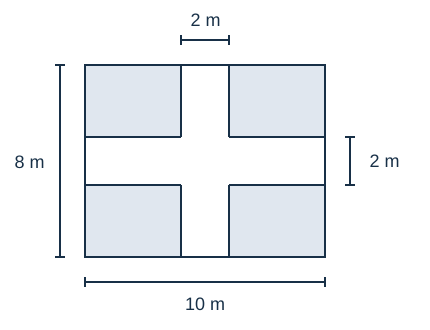
A rectangular garden is 10 meters long and 8 meters wide. Two perpendicular paths, each 2 meters wide, cross as shown. One spans the full 10-meter length and the other the full 8-meter width. Only the garden area outside the paths needs mulch. Each bag covers 9 square meters, and bags cannot be bought in fractions. With no waste, what is the fewest bags needed?
Worked answer and explanation
Answer: B. 6 bags
The garden has 80 square meters. Adding the two path areas gives 20 + 16, but their 2-by-2 intersection is counted twice, so path area is 20 + 16 − 4 = 32. The remaining area is 48 square meters. Five bags cover 45, which is too little; six cover 54, enough. Subtracting both path strips without restoring their overlap gives the incorrect smaller area 44 and would wrongly suggest that five bags suffice.
Question 5: Comparing percentage counts with equal bases
A theater sells 200 tickets in each of two weeks. Customers return 12% of the first week's tickets and 7% of the second week's tickets. How many fewer tickets are returned in the second week?
Worked answer and explanation
Answer: B. 10
The first week has 0.12 × 200 = 24 returns, and the second has 0.07 × 200 = 14. The decrease is 24 − 14 = 10 tickets. The difference between 12% and 7% is 5 percentage points; 5 is not the number of tickets.
Question 6: Proportional allocation
Question 6 · Proportional allocation · medium
Three workers agree to divide a $216 bonus in proportion to their hours on a project. They worked 3, 5, and 4 hours, respectively. How much should the worker who worked 5 hours receive?
Worked answer and explanation
Answer: C. $90
The workers contributed 3 + 5 + 4 = 12 hours altogether. The five-hour worker receives 5/12 of the bonus: $216 × 5/12 = $90. An equal three-way split would be $72, but their agreement weights the payment by hours.
Question 7: Catch-up time with a head start
Question 7 · Catch-up time with a head start · medium
A cyclist leaves a depot at 12 miles per hour. Forty-five minutes later, a scooter leaves the same depot along the same route at 18 miles per hour. Both maintain their speeds without stopping. How many minutes after the scooter leaves will it catch the cyclist?
Worked answer and explanation
Answer: C. 90 minutes
The cyclist's head start is 12 × 45/60 = 9 miles. Traveling in the same direction, the scooter closes that gap at 18 − 12 = 6 miles per hour. Catch-up takes 9/6 = 1.5 hours, or 90 minutes. Adding the 45-minute head start gives 135 minutes from the cyclist's departure, but the question measures time from the scooter's departure.
Question 8: Combining production-log rows
Question 8 · Combining production-log rows · hard
A packing log lists each line's total output, including rejected parts:
Line A: 12 cartons, 18 parts per carton; 1/6 of its parts are rejected.
Line B: 15 cartons, 16 parts per carton; 1/8 of its parts are rejected.
How many parts from the two lines are accepted altogether?
Worked answer and explanation
Answer: A. 390
Line A produces 12 × 18 = 216 parts and accepts 216 × 5/6 = 180. Line B produces 15 × 16 = 240 parts and accepts 240 × 7/8 = 210. Together they accept 180 + 210 = 390 parts. The 420 and 426 choices account for rejections on only one line, while 456 includes every rejected part.
Question 9: Redistribution that leaves the mean unchanged
Question 9 · Redistribution that leaves the mean unchanged · easy
Six jars contain an average of 12 beads each. Five beads are moved from one jar that contains at least five beads into another of the six jars. No beads or jars are added or removed. What is the new average number of beads per jar?
Worked answer and explanation
Answer: D. 12 beads
The total remains 6 × 12 = 72 beads, and there are still 6 jars. Therefore the average remains 72/6 = 12 beads per jar. Moving beads changes two individual jar counts but not the total. The 11 1/6 choice would result from removing five beads from the collection, which does not happen.
Question 10: A strict cost threshold
Question 10 · A strict cost threshold · medium
A recreation center charges $5 per visit without a pass. A monthly pass costs $18 and reduces the charge to $3 per visit that month. What is the smallest number of visits for which buying the pass costs less than paying without it?
Worked answer and explanation
Answer: C. 10
Each visit saves $5 − $3 = $2, so nine visits save exactly the $18 pass fee. At nine visits both methods cost $45; the pass is not yet cheaper. The first whole number beyond nine is ten, when the pass costs $48 and paying without it costs $50.
Question 11: Mixed quantities and a reserved portion
Question 11 · Mixed quantities and a reserved portion · medium
Three pitchers each contain 1 3/4 liters of juice. From the combined juice, 3/4 liter is reserved. The rest is divided equally among six containers. How much juice goes into each container?
Worked answer and explanation
Answer: B. 3/4 liter
The three pitchers contain 3 × 1 3/4 = 5 1/4 liters. Reserving 3/4 liter leaves 4 1/2 liters. Dividing by six gives 3/4 liter per container. The 7/8-liter choice divides all 5 1/4 liters and forgets the reserved portion.
Question 12: Fencing with required join overlap
Question 12 · Fencing with required join overlap · hard
A rectangular enclosure is 30 feet long and 20 feet wide. Two 3-foot openings need no fencing. Fencing is sold in 24-foot rolls. The installer first joins all purchased rolls into one strip, overlapping each neighboring pair by 1 foot, and then cuts that strip into the required fence runs. Apart from the overlaps, assume no material is lost. What is the fewest rolls that provide enough fencing?
Worked answer and explanation
Answer: C. 5
The perimeter is 2(30 + 20) = 100 feet. Subtracting the two openings leaves 94 feet. Joining n rolls produces 24n − (n − 1) = 23n + 1 feet. Four rolls provide only 93 feet, one foot short; five provide 116 feet and are sufficient. Simply dividing 94 by 24 and rounding up ignores the required overlaps.
Before moving on, choose one error you can explain. Rework that question with the solution closed, then revisit the skill in a later session to check what you remember.
Common mistakes to check
Solving for an intermediate quantity instead of the requested answer.
Mixing minutes with hours, or inches with feet, in the same calculation.
Dividing a percentage change by the new value rather than the original value.
Treating a ratio such as 2:3 as two-fifths without first checking which quantity is requested.
Estimate, set up, then calculate
Make a rough prediction before working out the exact answer. A discounted price must be lower than the original; travel time should increase when distance increases at the same speed. Use that prediction to catch reversed operations or misplaced decimals.
Review the setup as well as the arithmetic
After each question, identify whether the mistake came from reading, choosing a relationship or calculating. Rework the problem without the answer in view. On the actual computer test, an answer cannot be revisited after you move on, so build a brief units-and-reasonableness check into your routine.
Arithmetic Reasoning is one of the four subtests used to calculate the AFQT. It also contributes to service-specific job composites. A practice percentage is not an official AFQT percentile: the actual test uses scaled scores.
View Arithmetic Reasoning questions and time limits
Arithmetic Reasoning: official test format
Format
Questions and timing
Computer test, without tryouts
15 scored questions · 55 minutes without tryouts
Computer test, with tryouts
15 possible additional unscored questions · 113 minutes total with tryouts
Paper test
30 questions · 36 minutes
Domain
Math
Contributes to the AFQT
Yes
The computer test includes unscored tryout questions in selected subtests. The longer time shown is the total for a section with tryouts, not extra time to add. These figures describe the proctored CAT-ASVAB, not untimed PiCAT or our practice sets. See the official What to Expect page's questions and timing table and the guide to test versions.
No. The official ASVAB does not permit calculators. These practice questions are designed to be worked with scratch paper and hand calculations.
Arithmetic Reasoning asks you to solve arithmetic word problems. Mathematics Knowledge focuses on mathematical concepts and procedures such as algebra and geometry. Both contribute to the AFQT.
No. These are original Test Ninjas practice questions with explanations. They are not official, recalled or adaptive ASVAB items, and the score from this set does not predict an official percentile.
Write the requested quantity, label the units, and reconstruct the equation before recalculating. That separates a setup error from an arithmetic error and tells you what to practice next.
Sources and materials. Subtest descriptions and timing were checked on September 29, 2026 against the Department of Defense’s What to Expect guide, sample questions and score guide on officialasvab.com. Teaching examples, diagrams and practice questions are independently authored Test Ninjas materials. Test Ninjas is not affiliated with or endorsed by the Department of Defense.