ASVAB General Science: Understand What Causes the Change
General Science becomes more manageable when you connect each term to a process. Begin with an everyday heat-transfer example, then use the same cause-and-effect approach to biology, matter and Earth science.
Test Ninjas Research · Updated September 29, 2026
What you’ll learn
Connect a scientific term to its mechanism or function.
Tell apart nearby concepts such as heat and temperature.
Explain why a competing science term does not fit.
Learn the method
Identify how heat moves through a spoon
One end of a metal spoon rests in hot water. Its handle becomes warmer as energy travels through the metal. Which process transfers energy along the spoon: conduction, convection or radiation?
Identify the path being asked about
The question follows energy through the solid metal from the warmer end toward the cooler handle. It does not ask how water circulates in the cup.
Match the mechanism
Conduction transfers thermal energy through interactions within matter. The spoon stays in place while energy travels along it, which matches conduction.
Separate the other processes
Convection carries energy with the bulk motion of a fluid, such as circulating water. Radiation transfers energy through electromagnetic waves and does not require matter between the source and receiver.
Conduction transfers energy along the metal spoon.
Why the tempting approach fails
Choosing convection just because hot water is present confuses the setting with the path asked about. Several processes can occur in one situation; identify the specific transfer the question describes.
Explain it back
Why is the Sun warming your face an example of radiation rather than convection through space?
Compare your reasoning
Solar energy reaches Earth as electromagnetic radiation through space. It does not require a stream of moving air or water between the Sun and Earth.
Key concepts to keep handy
The example teaches one method. Open a concept below when you need a rule or a different type of example during practice.
Connect a biological structure to its function
Learn what a structure does as well as its name. Red blood cells carry oxygen, while the lungs exchange gases with inhaled air. Plant roots absorb water and minerals; leaves are a principal site of photosynthesis. Following the path of a substance through a system helps distinguish related terms.
Separate a physical change from a chemical change
Melting ice changes the state of water but does not create a different substance. Rusting iron forms new chemical compounds. Dissolving, melting and changing size are not automatically chemical reactions. Ask whether the identity of the material changes, rather than whether its appearance changes.
Distinguish heat, temperature and energy transfer
Temperature describes how hot or cold something is; heat is energy transferred because of a temperature difference. Conduction transfers energy through direct interactions in matter, convection involves the motion of a fluid, and radiation can transfer energy through empty space. Identify the process described before matching a term.
Organize Earth science by cause and scale
Earth’s rotation explains the daily cycle of light and dark. Its axial tilt together with its orbit explains seasons. Weather describes short-term conditions; climate concerns long-term patterns. Small distinctions like these prevent a familiar science word from replacing the actual mechanism in a question.
Topics covered in this guide
Cells, organ systems and basic life processes
Heredity, ecosystems and food relationships
Matter, atoms, mixtures and chemical changes
Energy, temperature and physical properties
Earth, weather and the solar system
Now apply what you know
Try a few questions without opening the solutions, then explain why each answer works. Use scratch paper for calculations and work without a calculator. These original, untimed questions sample the subject; the result is not an official score.
General Science practice: 12 questions
Work through one question at a time. Explain your approach, check the worked answer, then move on. Use scratch paper for calculations.
0 of 12 checked · 0 correct.
Progress is saved in this browser. These original study questions do not produce an official AFQT score.
Question 1: Particle classification
Question 1 · Particle classification · easy
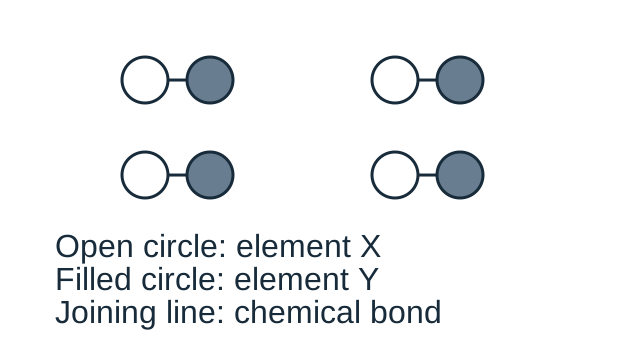
The diagram represents every particle in a sample. Different circle styles represent different elements, and a line between circles represents a chemical bond. How should this sample be classified?
Worked answer and explanation
Answer: D. A pure compound
Every particle is the same bonded pair of two different elements. One kind of compound is present, so the sample is a pure compound. Two elements within each molecule do not make the sample a mixture; a mixture would contain more than one kind of substance.
Question 2: Rain shadows
Question 2 · Rain shadows · medium
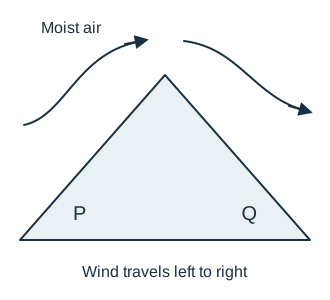
Moist air approaches the mountain from the left, as shown. Under a typical rain-shadow pattern, why is region Q often drier than region P?
Worked answer and explanation
Answer: A. Air loses moisture while rising over P, then warms as it descends toward Q
Air rising on the windward side cools and can release moisture as precipitation. The air descending on the leeward side warms, reducing its relative humidity and favoring drier conditions. The diagram does not establish a universal pressure comparison.
Question 3: Competition in a food web
Question 3 · Competition in a food web · medium
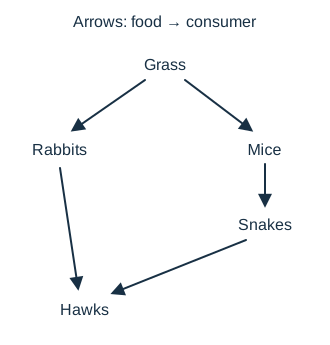
In this simplified food web, arrows point from food to the organism that eats it. Which pair directly competes for the same food resource shown?
Worked answer and explanation
Answer: C. Rabbits and mice
Both rabbits and mice receive arrows from grass, so both consume that resource. A link from mice to snakes represents feeding by a predator, not competition between them.
Question 4: Impulse and velocity
Question 4 · Impulse and velocity · hard
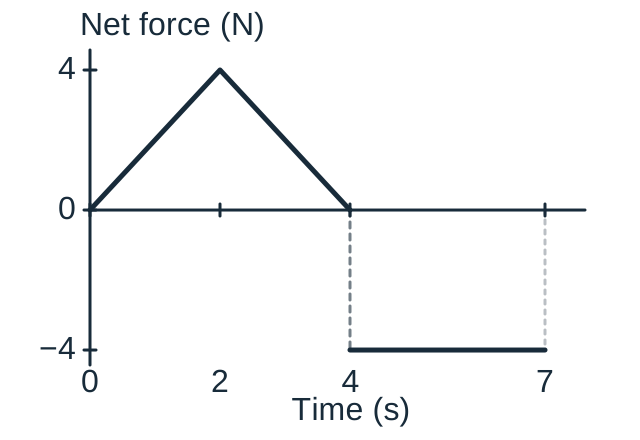
A 2 kg cart initially moves at +1 m/s. The graph shows its net force along the track. The sloping segments are straight, and the force changes instantaneously at t = 4 s. Impulse is the signed area under a force–time graph and equals the change in momentum. What is the cart’s velocity at t = 7 s?
Worked answer and explanation
Answer: B. −1 m/s
The positive triangular area is ½ × 4 s × 4 N = +8 N·s. The negative rectangular area is 3 s × (−4 N) = −12 N·s, so net impulse is −4 N·s. Initial momentum is +2 kg·m/s; final momentum is −2 kg·m/s, giving −1 m/s. The initial momentum must be included, and the triangle must not be treated as a rectangle.
Question 5: Reading a meniscus
Question 5 · Reading a meniscus · easy
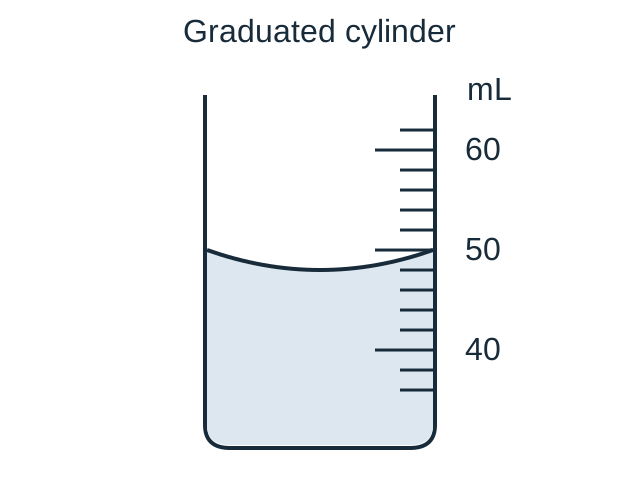
Read the bottom of the concave water meniscus at eye level. What volume does the graduated cylinder show?
Worked answer and explanation
Answer: B. 48 mL
The lowest point of the meniscus aligns with 48 mL. For water in this cylinder, the bottom of the curved surface supplies the reading, not the higher liquid edge against the wall. The labeled 40 and 50 marks and evenly spaced minor marks establish the scale.
Question 6: Reaction energy
Question 6 · Reaction energy · medium
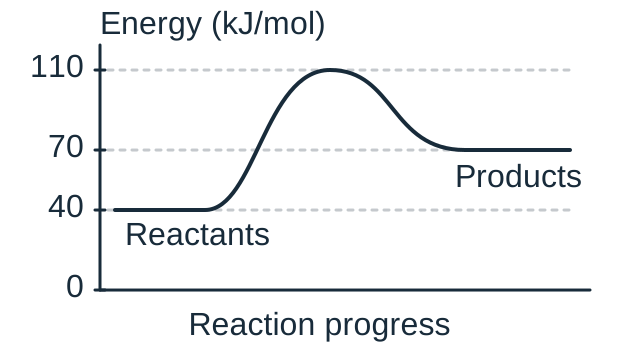
The diagram gives the relative energy of reactants and products for one reaction. What is the net energy change, products minus reactants?
Worked answer and explanation
Answer: C. +30 kJ/mol
Products are at 70 kJ/mol and reactants at 40 kJ/mol, so the net change is 70 − 40 = +30 kJ/mol. The positive value means energy is absorbed overall. The 110 kJ/mol peak determines an activation barrier; subtracting the reactant level from that peak gives 70 kJ/mol, not the net reaction change.
Question 7: Earthquake arrival intervals
Question 7 · Earthquake arrival intervals · medium
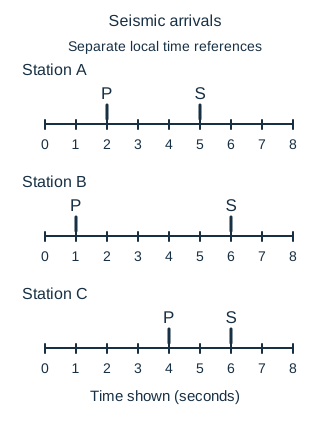
Three stations record the same shallow earthquake. Each timeline begins at a different local display reference, so compare the interval between P-wave and S-wave arrivals. Under the same wave-speed model, the shorter S–P interval indicates the nearer station. Which station is nearest the source?
Worked answer and explanation
Answer: C. Station C
The S–P intervals are 5 − 2 = 3 seconds at A, 6 − 1 = 5 seconds at B, and 6 − 4 = 2 seconds at C. C has the shortest interval. Comparing only the displayed S arrival times would miss the different P arrivals and reference offsets.
Question 8: X-linked inheritance
Question 8 · X-linked inheritance · hard
A recessive allele is on the X chromosome. A mother has one normal allele and one recessive allele; the father has a normal X and a Y. Assume each child is equally likely to be a son or daughter and each parental allele is transmitted with equal probability. What is the probability that a child has the recessive condition?
Worked answer and explanation
Answer: B. 25%
A daughter receives the father’s normal X and will not have this recessive condition. A son receives his X from the mother and has a one-half chance of receiving her recessive allele. The combined probability is 1/2 × 1/2 = 1/4, or 25%.
Question 9: Separating white light
Question 9 · Separating white light · easy
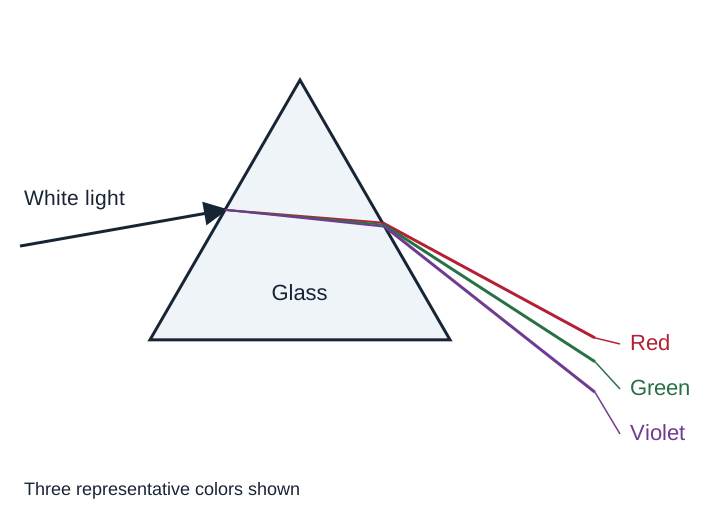
The diagram shows white light passing through a glass prism and emerging as different colors traveling in different directions. What is this separation called?
Worked answer and explanation
Answer: B. Dispersion
Dispersion separates light by wavelength because the prism’s refractive index depends on wavelength. The colors bend by different amounts. Conduction transfers energy through matter, condensation changes gas to liquid, and magnetization concerns magnetic alignment.
Question 10: Interpreting experimental data
Question 10 · Interpreting experimental data · medium
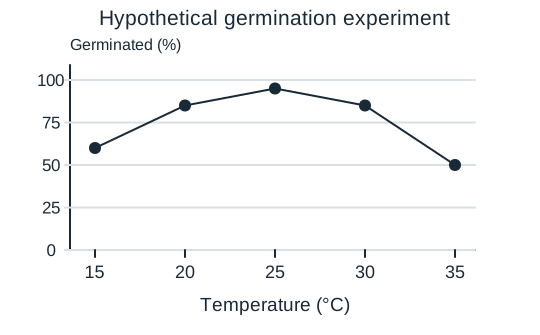
The graph shows hypothetical results from a seed-germination experiment. Each group contains 100 seeds of the same variety and receives equal water, light, and observation time. Which conclusion is supported by these results?
Worked answer and explanation
Answer: B. Of the temperatures tested, 25°C produced the highest percentage of germinated seeds
The largest plotted percentage is 95% at 25°C. This identifies the best result among the tested temperatures, not a guarantee for every seed or every possible temperature. The decline above 25°C also contradicts an always-increasing trend.
Question 11: Chromatography distance ratio
Question 11 · Chromatography distance ratio · medium
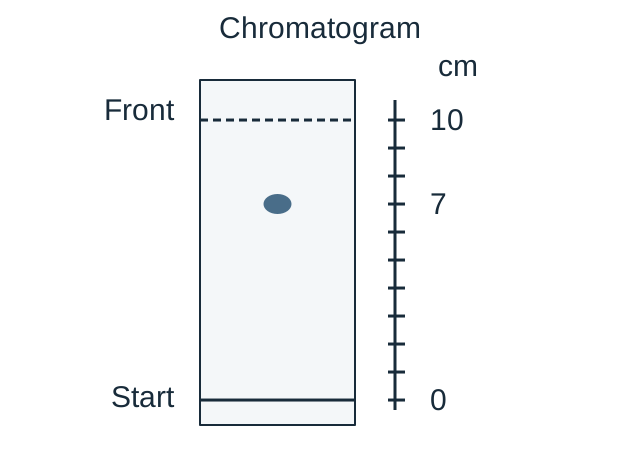
For the chromatogram shown, Rf equals the distance from the starting line to the center of the spot divided by the distance from the starting line to the solvent front. What is the spot’s Rf?
Worked answer and explanation
Answer: B. 0.70
The spot traveled 7 cm and the solvent front traveled 10 cm from the same starting line. Thus Rf = 7/10 = 0.70, with no unit because the distances divide. Using the 3 cm gap between spot and front gives the wrong numerator; reversing the ratio gives about 1.43.
Question 12: Parallax distances
Question 12 · Parallax distances · hard
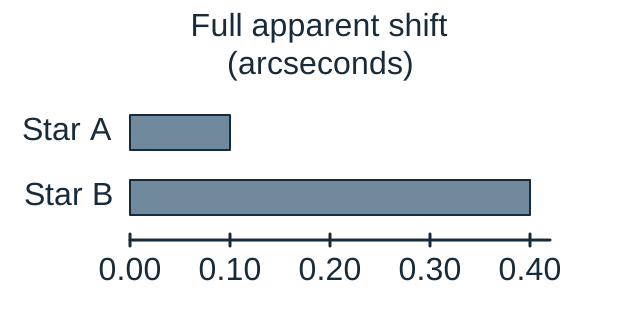
The chart gives each star’s full apparent angular shift between observations made six months apart. A star’s parallax p is half that full shift, and its distance in parsecs is 1/p when p is in arcseconds. How much farther from Earth is star A than star B?
Worked answer and explanation
Answer: C. 15 parsecs
A’s parallax is 0.10/2 = 0.05 arcsecond, giving 20 parsecs. B’s is 0.40/2 = 0.20 arcsecond, giving 5 parsecs. The difference is 15 parsecs. Using each full shift as p incorrectly gives 7.5 parsecs; a larger parallax indicates a nearer star.
Before moving on, choose one error you can explain. Rework that question with the solution closed, then revisit the skill in a later session to check what you remember.
Common mistakes to check
Confusing a structure with the process it supports.
Assuming every visible change creates a new substance.
Treating heat and temperature as interchangeable.
Explaining seasons only by distance from the Sun.
Study linked ideas in small groups
Review contrasting terms together: atom and molecule, evaporation and condensation, producer and consumer. Write one example of each. A comparison is more useful than a long list of isolated definitions because many questions turn on the difference between nearby concepts.
Use the explanation to locate the knowledge gap
After a missed item, identify whether you lacked a definition, confused two processes or misread a condition. Revisit that concept before trying another set. The examples here sample several topics; they do not exhaust everything that could appear.
Test format and scoring reference
General Science is outside the four AFQT subtests. Its score contributes to relevant service job composites, so its importance to a particular job depends on that service’s requirements. The AFQT is not the only score worth reviewing.
View General Science questions and time limits
General Science: official test format
Format
Questions and timing
Computer test, without tryouts
15 scored questions · 12 minutes without tryouts
Computer test, with tryouts
15 possible additional unscored questions · 25 minutes total with tryouts
Paper test
25 questions · 11 minutes
Domain
Science & Technical
Contributes to the AFQT
No
The computer test includes unscored tryout questions in selected subtests. The longer time shown is the total for a section with tryouts, not extra time to add. These figures describe the proctored CAT-ASVAB, not untimed PiCAT or our practice sets. See the official questions and timing table and the guide to test versions.
No. The AFQT uses the four math and verbal subtests. General Science can still contribute to the composite scores a service uses for job qualification.
The official description covers physical and biological sciences. Review foundational vocabulary and processes, including cells, body systems, matter and energy. This practice guide also includes basic Earth science review.
This set focuses on introductory concepts and ordinary scientific relationships. Review the explanations and underlying definitions rather than assuming that specialized terminology makes an answer correct.
No. They are original Test Ninjas study questions. The set is not adaptive and does not provide an official standard score.
Sources and materials. Subtest descriptions and timing were checked on September 29, 2026 against the Department of Defense’s What to Expect guide, sample questions and score guide. Teaching examples, diagrams and practice questions are independently authored Test Ninjas materials. Test Ninjas is not affiliated with or endorsed by the Department of Defense.