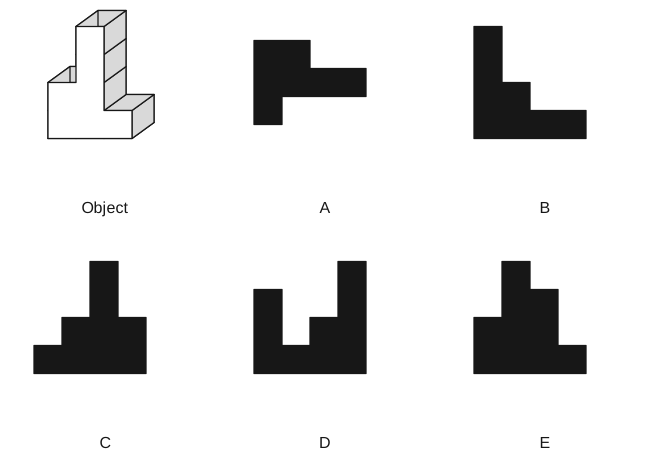
Answer A.Trace the broad face rather than the slanted extrusion edges. Its columns, from left to right in the object drawing, rise to 2, 4, 1 equal units. The correct aperture preserves those steps and proportions after rotation. The other apertures change the height or position of a step. This drill fixes the direction of passage to isolate silhouette matching.
Orthographic view recognitionTop–front–end · medium
Question 2 · medium · Orthographic view recognition
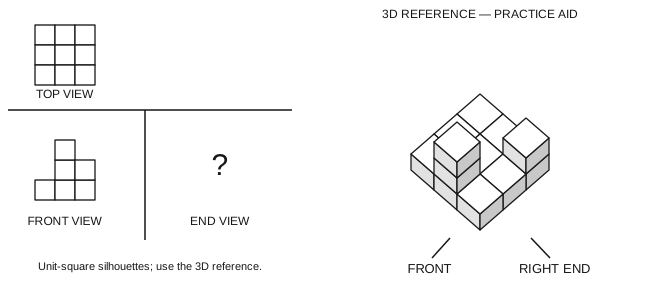
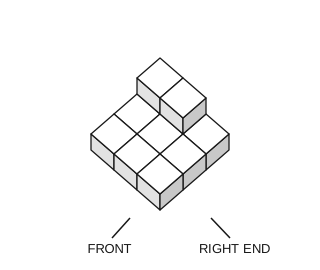
Answer B.Looking from the right collapses the left-to-right width. At each depth, keep the tallest column across that width. Reading from front to back gives heights 3, 1, 2. Only one choice preserves that profile. The 3D reference makes this silhouette drill fully specified; it is a practice aid beyond the two views used in an exam item.
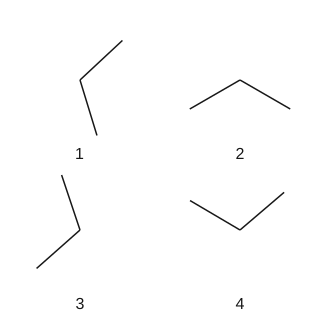
Answer C.The angle sizes are 1: 116°, 2: 120°, 3: 113°, and 4: 109°. Therefore the increasing order is 4 < 3 < 1 < 2. Mentally rotate the angles to align one ray; compare the gap to the other ray instead of the slope on the page.
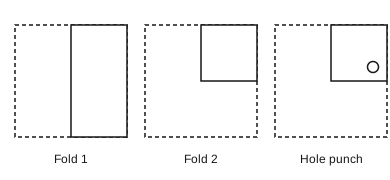
Answer C.Undo the folds in reverse order, reflecting the hole across each crease. These 2 half-folds create 4 layers at the punched location, so one punch produces 4 holes. Match their positions as well as their reflection symmetry; every choice has the same number of holes. In the four-row, four-column answer lattice, numbering from the top left starting at 1, the (row, column) positions are (2, 1), (2, 4), (3, 1), (3, 4).
Answer B.Count exposed faces cube by cube, including faces at the back and inside the steps. Do not count any face touching another cube or the tabletop. For this 11-cube assembly, the tally is 1 painted face: 2 cubes; 2 painted faces: 4 cubes; 3 painted faces: 3 cubes; 4 painted faces: 2 cubes. Thus exactly 2 cubes have 4 painted faces.
Cube nets and face relationshipsPattern folding · medium
Question 6 · medium · Cube nets and face relationships
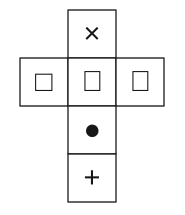
Answer A.The opposite face pairs are × / ●, □ / ⊙, ◇ / +. Opposite faces cannot share an edge. For the remaining candidates, preserve the order of the three faces around their shared corner: the valid view has ⊙ on top, ● on the left and ◇ on the right. Swapping the two side faces gives a mirror image, which rotating the cube cannot produce.
Keep building your DAT skills
Keep the momentum going. Create a free Test Ninjas account and take the next step in your DAT prep.
6 questions1 question × 6 PAT typesAnswers + worked explanations
Test Ninjas · Content checked October 23, 2026
Train a spatial method before adding speed
Try all six task types. Before selecting an answer, name the operation: compare a silhouette, reconcile views, rank angles, reverse a fold, count exposed faces or mentally fold a net. A consistent procedure is more useful than choosing the first familiar-looking picture.
Use a screen large enough to inspect the diagrams. Open the full-size image when labels or edges are difficult to see. Where separate option images are provided, inspect each candidate before selecting its label. Do not infer geometric differences from browser scaling artifacts.
Work untimed on your first attempt. After checking an answer, identify the precise feature that supports it and one feature that rules out a close alternative. Save a question if the method is still unclear, then return to it after reviewing the explanation.
These six drills introduce the task types. Keyholes use a stated orientation constraint to isolate silhouette matching; follow that constraint when comparing the options.
A method for each PAT question type
Keyholes: preserve the outline
In these constrained silhouette drills, trace the broad face and compare the relative heights and positions of its steps. Rotation preserves shape; reflection or moving one step does not. Ignore extrusion lines that do not belong to the outline being matched.
Top–front–end: reconcile views
Check each candidate against all supplied orthographic views. Width, depth and height must be consistent across views. An object that fits one projection can still introduce an extra column or omit a required height in another.
Angle ranking: compare openings
Rank the size of the opening at the vertex, independent of the length or orientation of the rays. Compare close pairs directly, then assemble the full ordering. The diagrams are constructed with distinct angles so the intended order is unambiguous.
Hole punching: unfold in reverse
Start at the final folded state and reverse one fold at a time. Reflect the hole positions across each fold line, tracking which layers were punched. A visually symmetric pattern is not sufficient unless it follows the actual sequence.
Cube counting: inventory the structure
List cubes systematically by stack and determine which faces are exposed to paint under the prompt’s rules. A shared face is not exposed. Keep supporting cubes in the count even when another cube hides part of them.
Pattern folding: track adjacency
Choose an anchor face in the net and follow the rotation of adjacent faces. Preserve which edges touch and which markings meet after folding. A mirrored arrangement may look similar but cannot be obtained by rotating the object.
Turn a missed question into a better next attempt
Identify the specific geometric operation before checking the answer. Record a trace, projection comparison, reflection sequence or cube inventory on scratch paper.
Compare your method with the explanation. Find the first step at which your representation differs; a wrong final answer may come from one reversed fold or one omitted face.
Explain why at least one close alternative fails. Use an explicit feature such as a step height, angle ordering, opposite face or hole position.
Return to a saved question after a break and reconstruct the operation before looking at the choices. Explain the answer from the diagram rather than recalling its letter.
PAT habits that cause avoidable mistakes
Rotating when you have actually reflected
A mirror image changes handedness. Keep an asymmetric feature as an anchor while mentally rotating an outline or folded object, and check that its relationship to neighboring features is preserved.
Unfolding in the original order
A sequence of folds must be reversed from last to first. Apply one reflection at a time and keep the intermediate hole positions; jumping directly to a symmetric final pattern can add or omit holes.
Counting visible squares instead of cubes
A drawing shows faces, not an inventory of blocks. Reconstruct stacks and their contacts before counting painted faces. Follow the prompt’s rule for the underside rather than assuming all six faces can be painted.
Changing methods on every angle comparison
Use the same vertex-centered comparison for each pair. Ray length and screen orientation are distractions; zoom only to make the drawing legible, not to measure pixel noise as if it were meaningful.
Frequently asked questions
Does this include all six PAT task types?
Yes. There is one question each for keyholes, top–front–end views, angle ranking, hole punching, cube counting and pattern folding.
Should I time my first attempt?
Start untimed and explain your reasoning for each choice. Use the timer after you understand the method; six examples cannot reproduce a full section’s timing demands.
What should I look for in the explanations?
Find the exact spatial relationship that determines the answer: an outline, projection, angle order, reflection, exposed face or folded adjacency. Compare that feature with the closest wrong choice.
Can I practice on a phone?
The page works on a phone, but small diagrams can make spatial comparisons harder. Use the full-size image link or a larger screen when you cannot clearly distinguish edges and labels. Avoid treating rendering artifacts as geometric clues.
Does this sample estimate a PAT score?
No. It reports correct answers on these six examples. Use the results to select a skill to practice, rather than estimate a scaled score.
Turn today’s practice into test-day confidence
Keep the momentum going. Create a free Test Ninjas account and take the next step in your DAT prep.