Reach the TOEFL band your university asks for.
Learn the English every 2026 task depends on, then practice it on real-format questions: 41 lessons, five full-length tests, 32 section tests and 1,400 practice sets, with your progress saved to your account.
Free trial, then $39 a month or $29 a month billed every three months.
- 7-day free trial
- Cancel anytime
- 90,000+ students
- 5 full-length practice tests
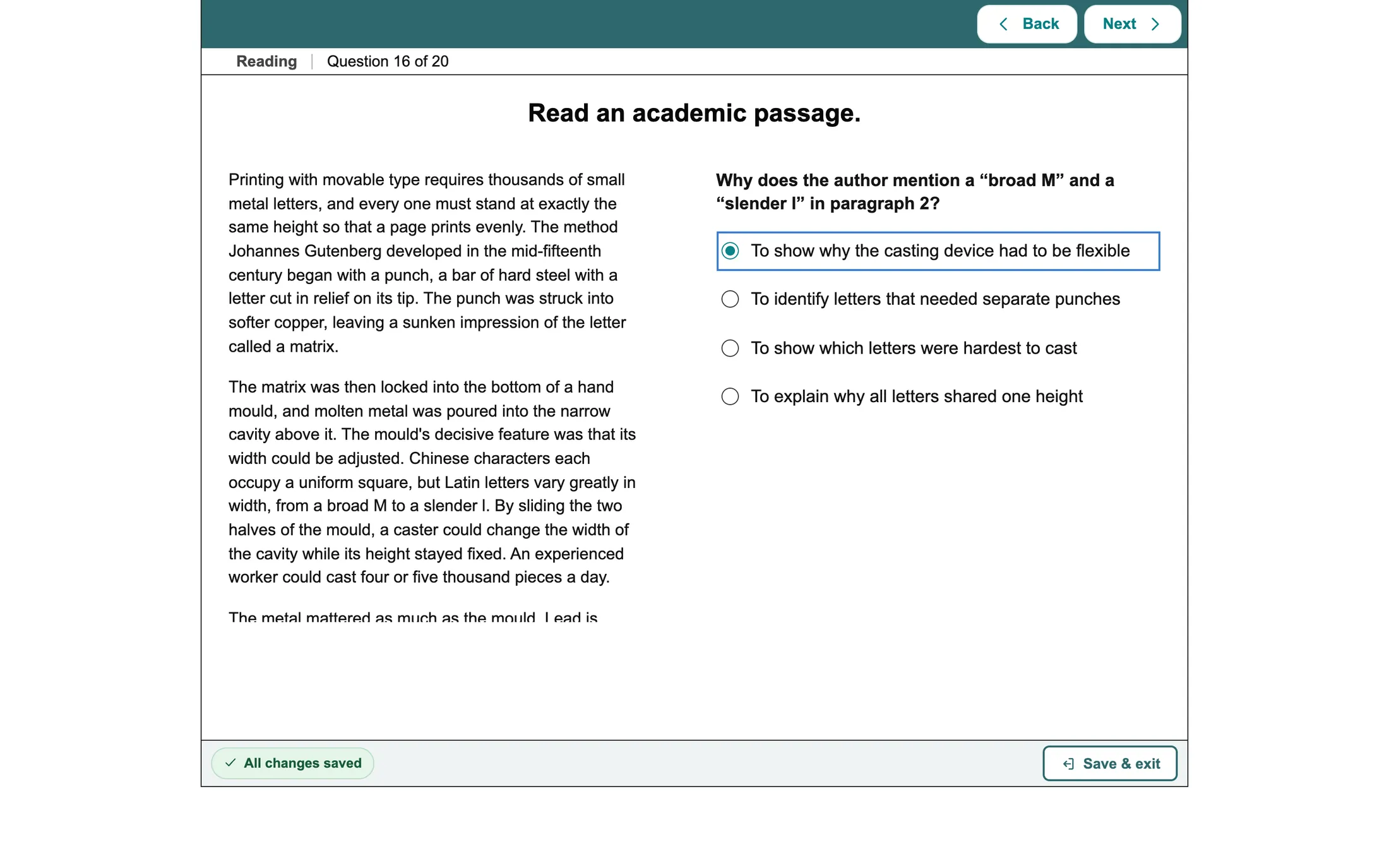
Full-length tests in the 2026 TOEFL format.
Read an Academic Passage and every other task type, in a test built like the real one.
prep essentials
Daily TOEFL practice
Today’s TOEFL set is ready. Work through reading, listening, writing and speaking, then learn from the explanations and model responses.
Your daily TOEFL practice
12 task types. A fresh set every day. Pick a section and work through today’s original tasks.
Loading your practice set…
How the TOEFL course works
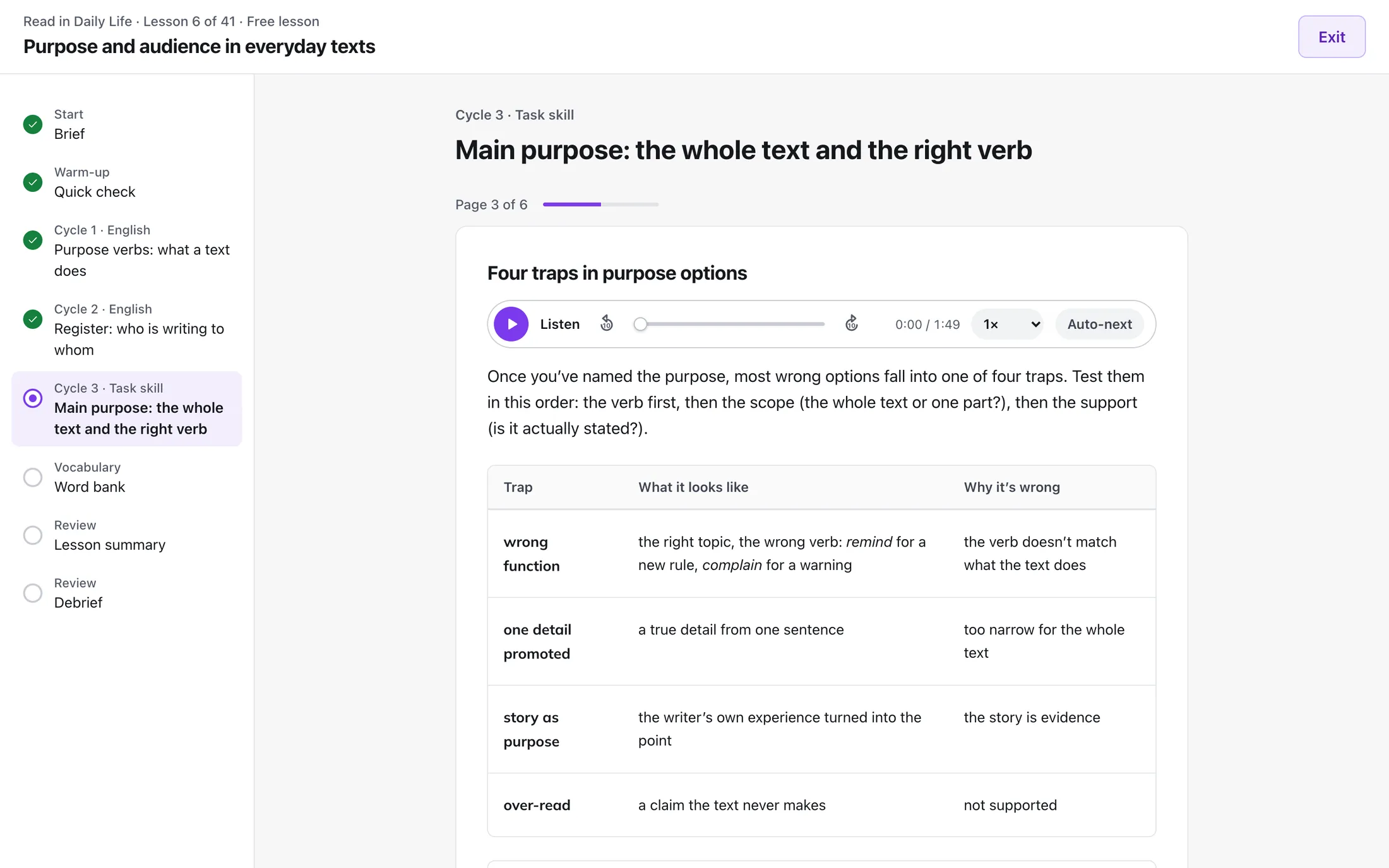
Lessons that teach the skill first
Each of the 41 lessons explains a skill on narrated teaching pages, like this one on the traps in purpose questions, then drills it on real task types. Four lessons are free to try.
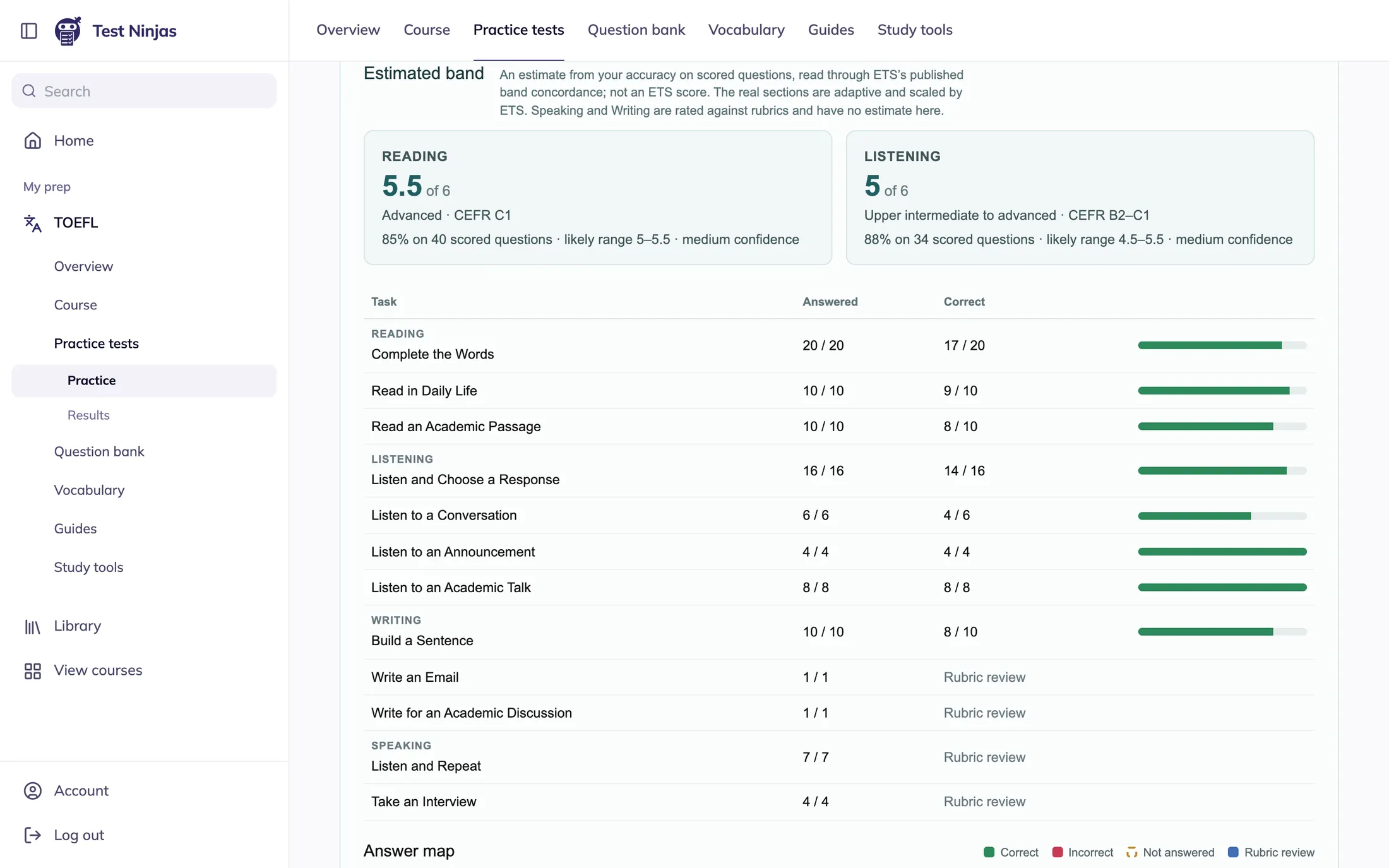
A score report for every task type
After each practice test you get estimated Reading and Listening bands and your accuracy on every task type. Writing and Speaking responses come with rubrics and model answers. Example results shown.
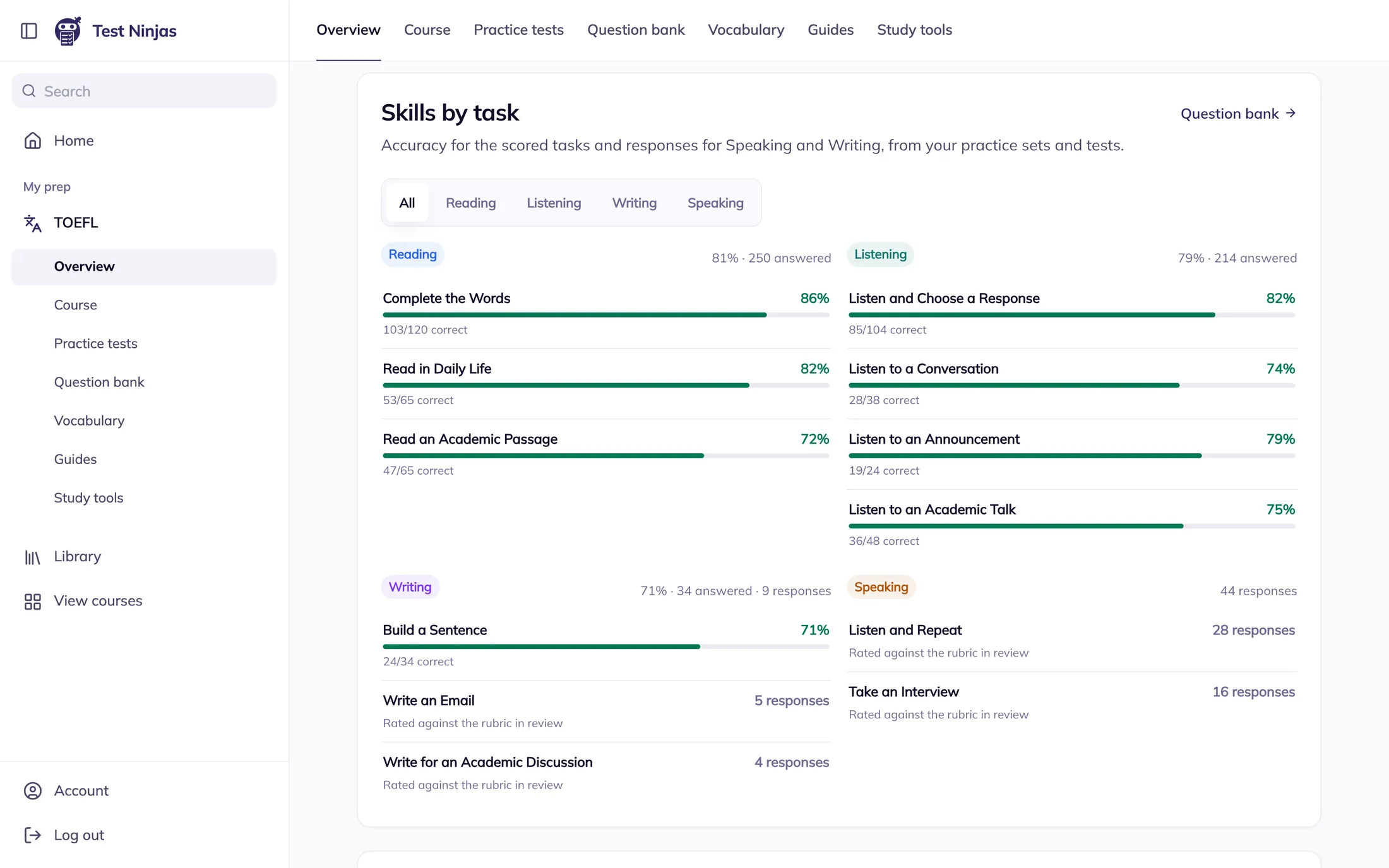
See which tasks cost you points
The dashboard tracks your accuracy on each task type across every set and test, so you always know what to practice next. Example progress shown.
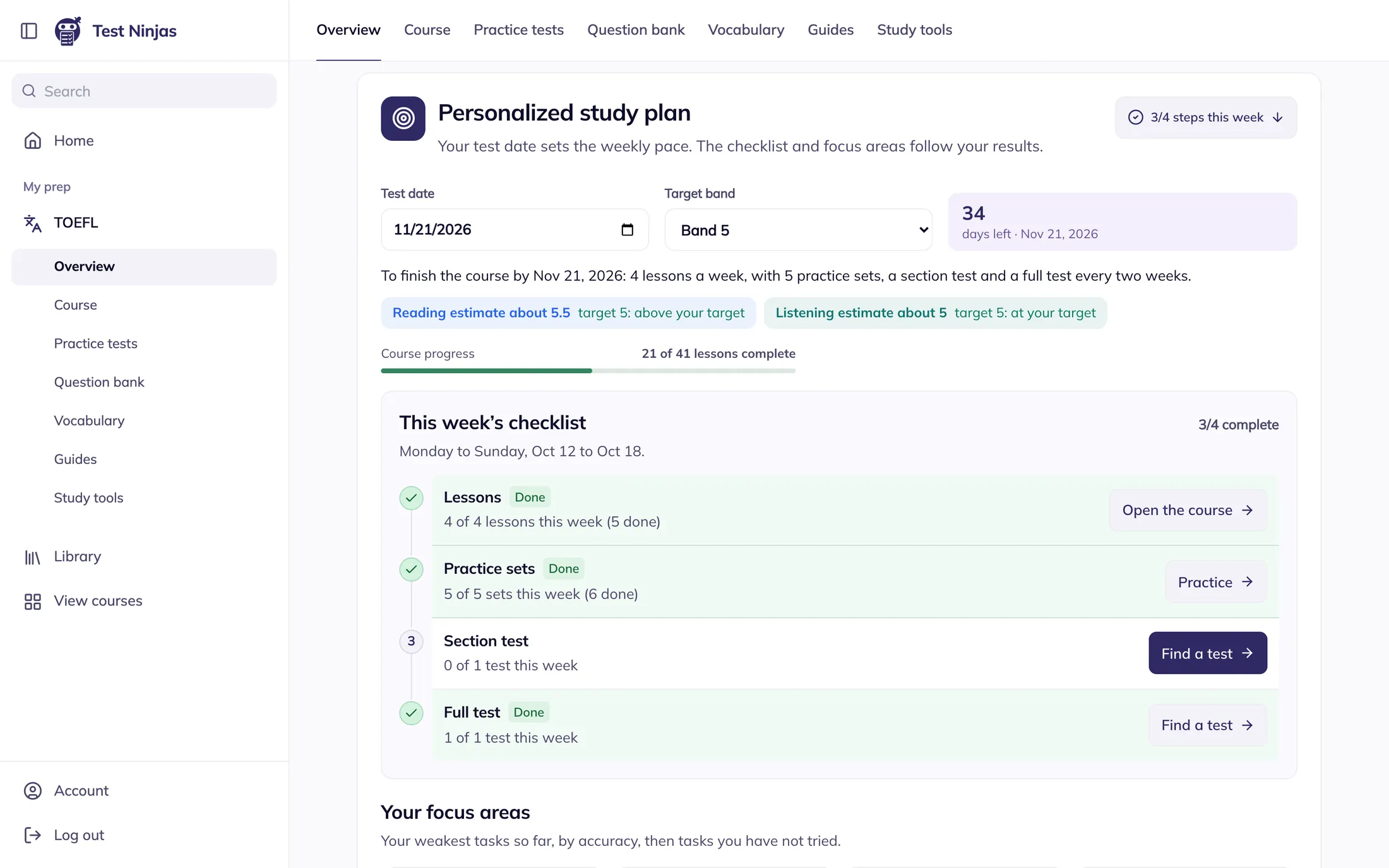
A weekly plan to your test date
Set your test date and target band, and the plan sets the pace each week: lessons, practice sets, a section test and a full test. Example plan shown.
The four TOEFL sections
Get familiar with each part of the current TOEFL iBT. Reading and Listening adapt to your performance; Writing and Speaking follow a fixed sequence.
Reading
Complete partially shown words, read everyday messages and follow academic passages.
Listening
Choose a reply, follow conversations and announcements, and understand academic talks.
Writing
Build sentences, write a purposeful email and join an academic discussion.
Speaking
Repeat spoken sentences clearly and answer interview questions with reasons and examples.
Free lessons: one for each section
Complete lessons from our TOEFL course, free and with no sign-up. Each one teaches a skill, lets you practice it, and shows you how it works on a real task.
Purpose and audience in everyday texts
Register and purpose verbs in notices, emails and posts (announce, remind, warn, request, confirm, recommend)
Start the lesson Listening · 50 minWh- questions and the replies that fit
Wh- question forms, what each one asks for, and falling intonation
Start the lesson Writing · 50 minThe task, the reader and the right tone
Email register (greetings, sign-offs, requests and word choice for formal and informal readers); stating the purpose in the first lines; closing with a next step
Start the lesson Speaking · 50 minAnswer first
Answer-first structure; past simple and present perfect for experiences (with present simple and used to for routines)
Start the lessonHow TOEFL scoring works
Each section receives a band in 0.5-point steps. Your overall band is the average of the four, rounded to the nearest half band.
Explore your scoreWorking with an old 0–120 score? The scale changed on January 21, 2026. Compare an old score
- Four section bands
- A separate band for Reading, Listening, Writing and Speaking.
- One overall band
- The average of those four section scores, rounded to the nearest half band.
- Half-band steps
- Eleven possible bands, from 1.0 through 6.0.
- CEFR reference
- A section band of 5 indicates C1 proficiency in that skill.
TOEFL guides and resources
TOEFL Reading Test Demo
Try our test engine: a short Reading section
TOEFL Listening Test Demo
Try our test engine: a short Listening section
TOEFL Writing Test Demo
Try our test engine: a short Writing section
TOEFL Speaking Test Demo
Try our test engine: a short Speaking section
Free TOEFL Practice Questions
Sample questions for all 12 task types
TOEFL Study Plan
2-week, 1-month and 2-month plans
TOEFL Vocabulary List
1,200 words in 30 themes
TOEFL Grammar Guide
120 rules with common traps
TOEFL Writing Rubric
Score levels and sample answers
TOEFL Speaking Rubric
What each level sounds like
TOEFL Questions of the Day
12 original tasks today · a fresh set tomorrow
TOEFL 2026 Changes
New format and score scale
TOEFL Score Calculator
Section bands → overall band
TOEFL Score Converter
Old 0–120 ↔ new 1–6
All TOEFL Calculators
Every TOEFL tool in one place
TOEFL Format
Sections, timing and item counts
TOEFL Score Range
The 1–6 band scale explained
What Is a Good TOEFL Score?
University requirements on the new scale
Dates, Home Edition & Retakes
Booking, the 3-day gap, 2-year validity
TOEFL vs IELTS
Which English test to take
The full TOEFL course
$0.00 due today · full access for 7 days · cancel anytime
- 41 interactive lessons with narrated teaching and drills
- 5 full-length practice tests and 32 section tests
- 1,400+ practice sets across all 12 task types
- Recorded speaking and timed writing, with rubrics and model answers
- Instant scoring and explanations for every Reading and Listening question
Applying to graduate school?
See our GRE guides and practice.
TOEFL frequently asked questions
Answers to common questions about TOEFL practice, scoring and test day.
How long is the TOEFL?
ETS lists base section times totaling about 90 minutes and recommends allowing approximately two hours to complete the test. Directions and adaptive delivery affect the total time needed.
How is the TOEFL scored?
Each of the four sections receives a band from 1.0 to 6.0 in 0.5-point steps, and your overall score is the average of those four, rounded to the nearest half band. ETS replaced the 0-120 scale on January 21, 2026.
How many questions are on the TOEFL?
120 items across the four sections, including unscored trial items in Reading and Listening. Of those, 108 are machine scored and 12 are AI scored — the Speaking responses and the two written responses.
When can I take the TOEFL?
Year round. The TOEFL runs continuously at authorized test centers — 60 or more dates a year in most locations, and 170+ in some — and the Home Edition is available roughly four days a week, nearly around the clock.
How many times can I retake the TOEFL?
There is no limit on attempts. You must wait at least 3 days between tests, and scores are valid for 2 years from the test date.
What CEFR level does a TOEFL band correspond to?
Your score report shows a CEFR level directly — one of the reasons ETS moved to this scale. ETS states that a band 5 in a section indicates C1 proficiency for that skill.
Does Test Ninjas offer TOEFL practice tests?
Yes. The TOEFL course includes 5 full-length practice tests, 32 section tests and more than 1,400 practice sets, alongside 41 interactive lessons. Free options include four complete lessons, sample questions for every task type, and a new 12-task practice set every day.
Is there a free trial of the TOEFL course?
Yes. The TOEFL plan starts with a 7-day free trial with full access, and nothing is due today. You can cancel anytime before the trial ends.
Test Ninjas Research · Updated October 1, 2026