The TOEFL Writing section has 12 items in about 23 minutes: 10 Build a Sentence items, where you put word tiles in order to form a reply, then one email (7 minutes) and one post for an academic discussion (10 minutes). The ten sentences are worth as many points as the two written responses together, so grammar matters as much as ideas.
About 23 minutes: 7 for the email, 10 for the discussion post, the rest for the sentences
Scoring
Build a Sentence 1 point each (machine-scored); email and discussion up to 5 points each (AI-scored)
Points
20 in all: 10 from the sentences, 10 from the two responses
Delivery
Linear: everyone on a test form gets the same tasks
Weight
One quarter of your overall band, like every other section
See the format for yourself: the free Writing demo runs a short Writing section in our test engine, and today’s Writing questions are a fresh set every day.
How long the Writing section is
Build a Sentence10 items · ≈6 min
→
Write an Email1 response · 7 min
→
Academic Discussion1 response · 10 min
Total: About 23 minutes · same tasks for everyone
Writing is linear: everyone on a test form gets the same 12 items. ETS estimates about 23 minutes for the section. The email has a 7-minute window and the discussion post 10 minutes, which leaves roughly 6 minutes for the ten sentences, a little over half a minute each.
The email and the discussion post each have their own time limit, so pace each one separately and keep the last minute for checking that every part of the prompt is answered.
The three tasks
ETS’s blueprint lists three Writing tasks: one grammar task scored against fixed answers, and two short written responses scored by ETS’s AI scoring.
Together they measure these skills (paraphrased from the ETS 2026 blueprint):
Rebuilding sentences of many structures with correct grammar
Writing a clear message of several sentences for a given reader and purpose
Writing a paragraph that presents a clear, well-supported argument with varied grammar and vocabulary
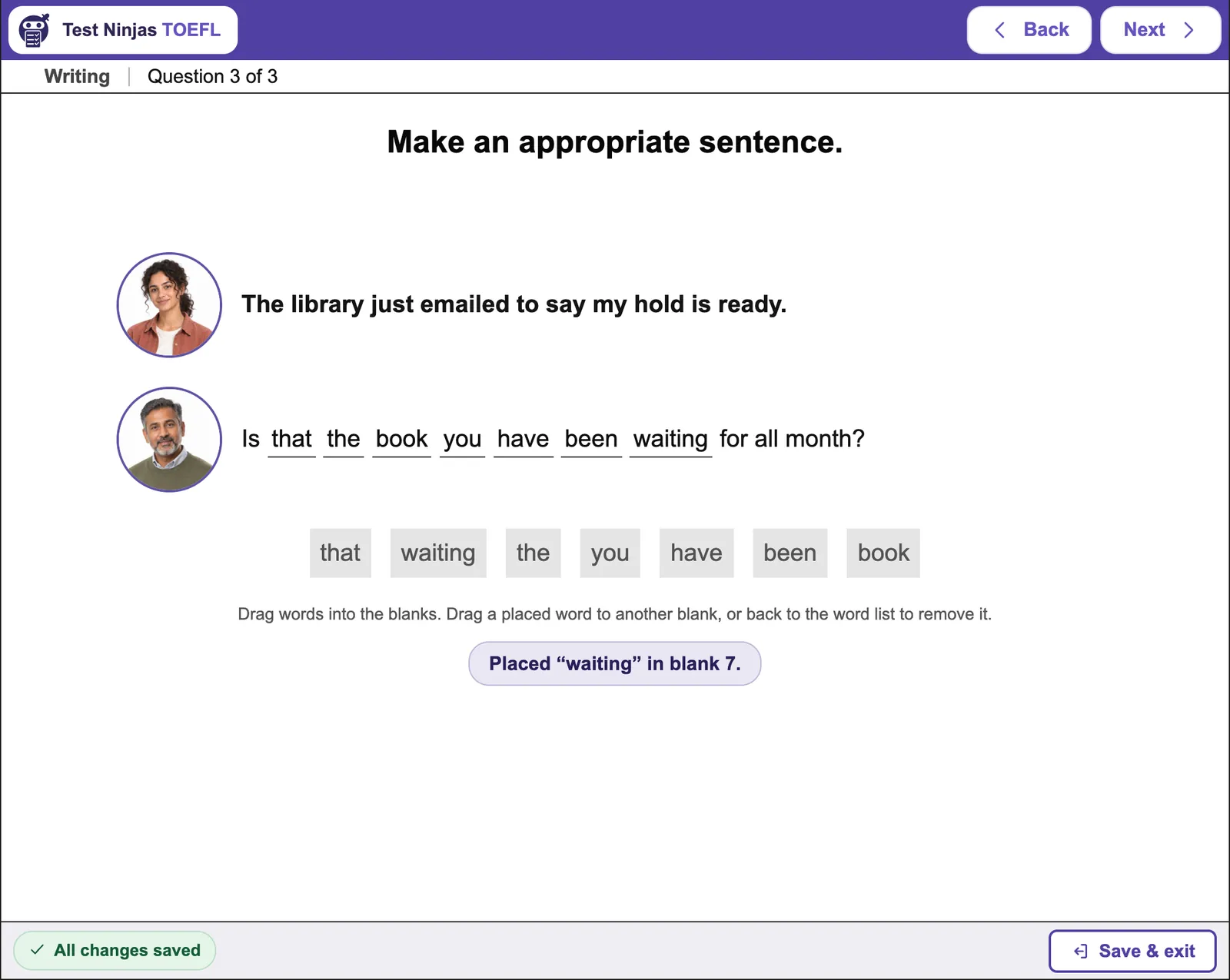
Build a Sentence in the Test Ninjas practice engine: a reply completed from word tiles placed in the slots.
One person says a line; you build the reply by placing word and phrase tiles into slots around a few fixed words. Some items include one extra tile that has no place.
Tip: Find the verb and the question pattern first. Embedded questions (“Do you know where it is?”) keep statement word order, which is where most extra tiles catch people.
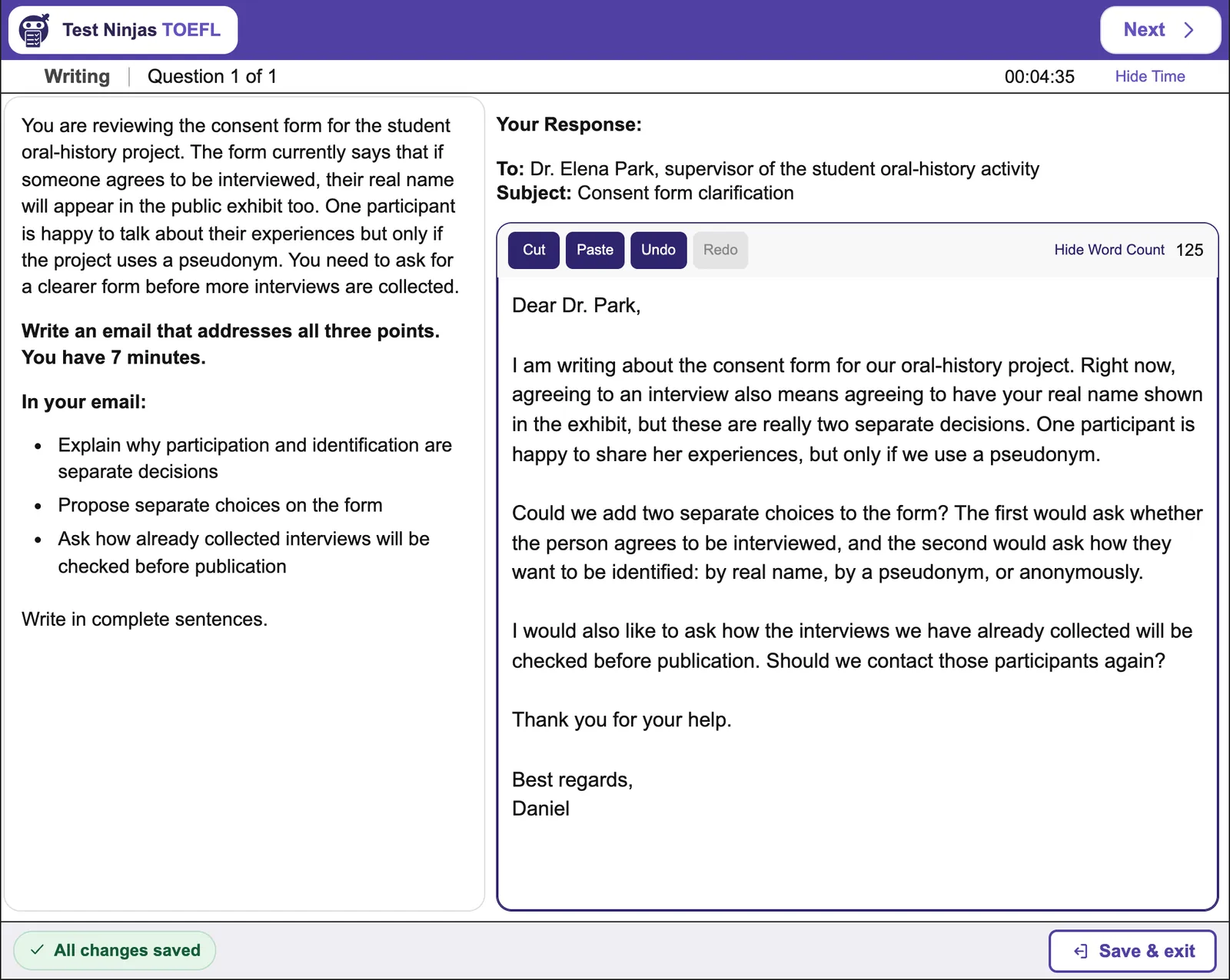
Write an Email in the Test Ninjas practice engine: a 125-word email to Dr. Park about a consent form, with the word count and the clock showing.
A short situation, the person you are writing to and three things your email must do. There is no fixed word count, but every point must be covered.
Tip: Cover the three points in order, about one short paragraph each, in a polite tone that fits the reader. A missing point costs more than plain vocabulary.
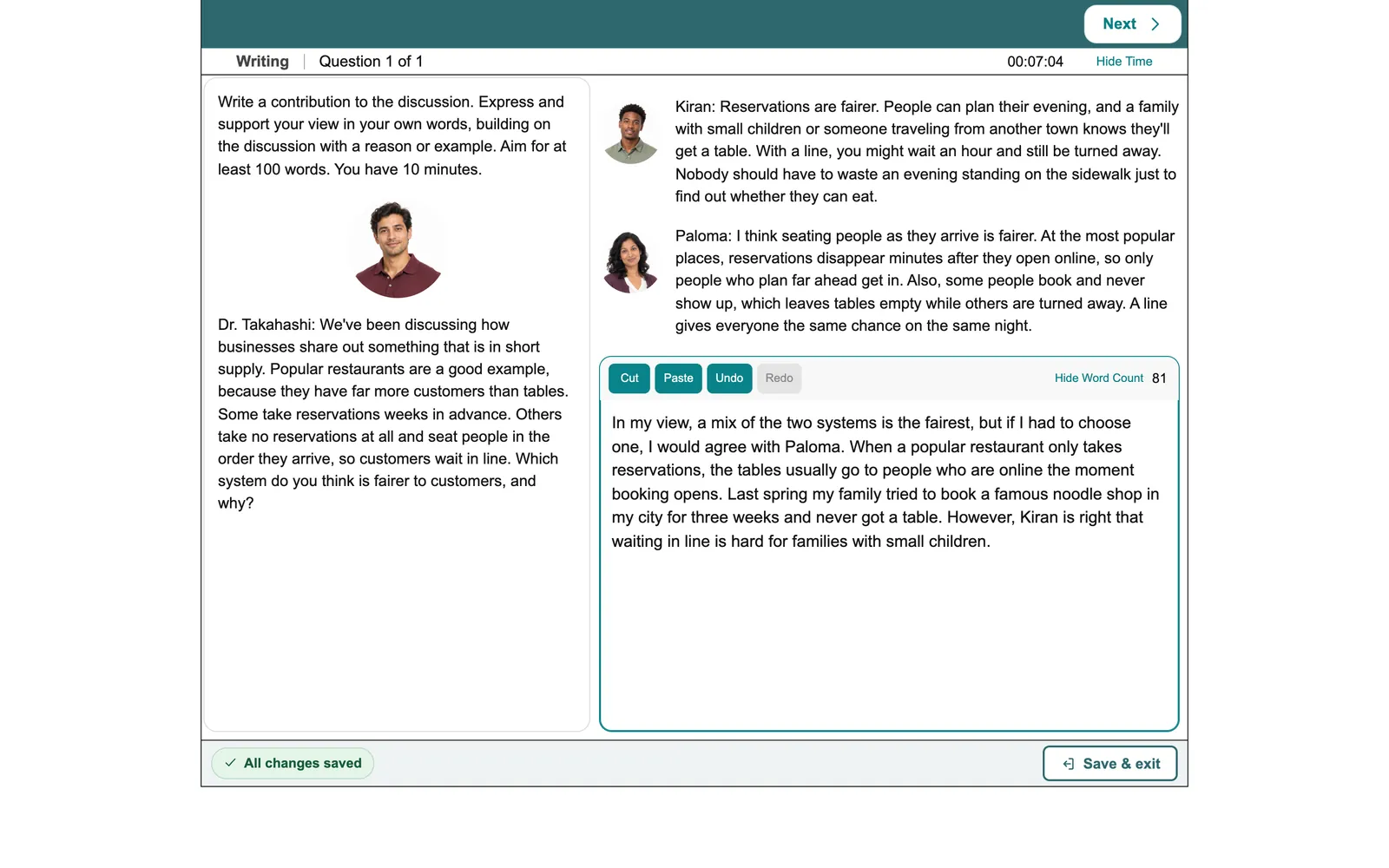
Write for an Academic Discussion in the Test Ninjas practice engine: a professor’s question and two classmates’ posts beside an 81-word response in progress, with the clock at 7:04.
A professor’s question and two classmates’ posts. You write your own contribution; the directions suggest at least 100 words.
Tip: State your position in the first sentence, then add a reason or example the classmates have not already given.
These are original practice sets in the current format, from the same bank as our free practice pages. Build a Sentence is checked automatically. For the email and the discussion post, write your response, then compare it with the model and the checklist. You don’t need an account.
Build a Sentence
1 question
Someone saysHi there. Is there something I can help you with?
Arrange the words and phrases to complete the response. Fill every blank and use each tile no more than once.
Would you happen to know whichon?
Tap a tile to place it; tap a filled blank to take the tile back. One tile is not needed.
Show the correct sentence
Would you happen to know which floor the course reserves are on?
After 'Would you happen to know which', the question is embedded, so it keeps statement order: 'which floor' + subject 'the course reserves' + verb 'are', with the preposition 'on' left at the end. 'Does' is the surplus tile: an affirmative embedded question takes no do-support (*'which floor does the course reserves are on'), and 'reserves' is plural in any case. Only a negative embedded question keeps do-support (doesn't/didn't), because 'not' needs it, as in 'why the café doesn't open on Mondays'; be, have and modals stay in any embedded question, after the subject, as in 'where I can get a copy'. *'which floor are the course reserves on' keeps direct-question order inside the embedded question.
Structure: Would you happen to know which + [floor] + [the] [course reserves] + [are] + on? Embedded wh-clause with a stranded preposition; 'does' is surplus.
Last Friday you deposited your paycheck at your credit union's branch before the posted 3 p.m. cutoff. The credit union held the money for two days, and meanwhile an automatic rent payment pushed your account below zero, triggering an overdraft fee. In six years as a member, you have never had one. Write to the member services manager.
In your email:
Describe what happened to your deposit.
Ask the credit union to reconsider the fee.
Suggest how members could be warned about holds in the future.
Write an email that addresses all three points. You have 7 minutes.
00:07:00
Show the model response and checklist
Check your response: does it…
Model response (one good answer — yours can differ)
Dear Ms. Haddad,
I am writing about an overdraft fee charged to my checking account on Monday. Last Friday I deposited my paycheck at the Main Street branch at about 1:30 p.m., well before the 3 p.m. cutoff. I expected the money to be available that evening, but it was held for two days. In the meantime, my automatic rent payment went through, and the account dropped below zero.
I understand that holds are sometimes necessary, but nobody at the counter mentioned one, and my receipt did not show it. I have been a member for six years without a single overdraft, so I would be grateful if you could reconsider the fee as a one-time courtesy.
For the future, it might help to print the release date on deposit receipts or to send a text alert whenever a hold is placed. That way, members could move money before a payment fails.
Thank you for your time,
Daniel Mensah
Write for an Academic Discussion: More routes or more frequent buses
1 question
Dr. NakamuraTransit planners often face a hard choice when their budget is limited. They can spread their buses across many routes so that almost every neighborhood has some service, even if a bus comes only once an hour. Or they can concentrate buses on fewer, busier routes so that one arrives every ten minutes, even though some areas lose service completely. Which approach do you think a city should choose, and why?
MirelaI'd choose to cover as many neighborhoods as possible. Public transportation is a public service, and people who live far from the center pay taxes too. Some, like teenagers or people who can't afford a car, have no other way to get around. For them, even one bus an hour can mean getting to a job or a doctor.
RahulI think frequent service matters more. If a bus comes once an hour, people have to plan their whole day around the schedule, and missing one means a long wait. Anyone with a choice will simply drive. Frequent buses on main roads attract many more riders, and that's what a transit system needs to justify its budget.
Write a contribution to the discussion. Express and support your view in your own words, building on the discussion with a reason or example. Aim for at least 100 words. You have 10 minutes.
00:10:00
Aim for at least 100 words.
Show the model response and checklist
Check your response: does it…
Model response (one good answer — yours can differ)
I'd choose frequency, and I think it actually serves Mirela's riders better than a thin network does. Consider what an hourly bus means in practice. If you arrive at a stop at a random moment, you wait thirty minutes on average, and if your trip needs a transfer to a second hourly route, a twenty-minute ride can easily take two hours. A teenager or a worker without a car can't build a life around that, so they end up asking for rides or not going at all. With a bus every ten minutes, nobody needs a timetable, and a transfer costs a few minutes instead of most of an hour. Mirela is correct that people in outer areas pay taxes too, but spreading the buses so thinly that no route is useful doesn't really serve them. The fairer goal is service people can actually rely on, even if some of them have to walk farther to reach it.
In ETS’s blueprint each Build a Sentence item is worth 1 point and each written response up to 5, so the ten sentences and the two responses each account for 10 of the section’s 20 points. Sentence building is also the easiest part to improve: it rewards exact control of English word order, and it can be drilled in a way essay writing cannot.
Short responses, scored for structure and accuracy
The email and the discussion post are AI-scored for features such as coherence and grammar. Both are short, so a clear structure that answers every part of the prompt matters more than length or rare words. The long independent essay was retired in 2023, and templates built for it fit neither task.
Practice each task with its own time limit
Practice arranging sentences quickly, completing an email in seven minutes and contributing to an academic discussion in ten. Leave a moment at the end of each response to check that you answered every requested point.
What your Writing band means
Writing is reported as a band from 1.0 to 6.0 in half-band steps, and each band maps to a CEFR level. The descriptions below paraphrase ETS’s CEFR descriptors for Writing. Select a band to see what it means for your whole score and how to raise it.
TOEFL Writing bands, CEFR levels and what they describe
Want a plan built for you? The Test Ninjas TOEFL course has step-by-step lessons for every Writing task, timed practice and full-length practice tests with band estimates.
ETS replaced the TOEFL iBT on January 21, 2026. Most older prep material describes the previous version, used from July 2023 until then. Here is how the Writing section compares.
TOEFL Writing: the previous test and the 2026 test
Until January 2026
Since January 21, 2026
Tasks
Integrated Writing + Academic Discussion
Build a Sentence (10) + Write an Email + Academic Discussion
Time
About 29 minutes
About 23 minutes
Integrated task
Read a passage, hear a lecture, write for 20 minutes
Removed
Scoring
Human raters plus automated scoring
Sentences machine-scored; email and discussion AI-scored
Not a long one. The independent essay was retired in July 2023, and the 2026 test also dropped the Integrated Writing task. Writing now has two short responses, an email and an Academic Discussion post, alongside ten Build a Sentence items.
About 23 minutes: 7 minutes for the email, 10 minutes for the Academic Discussion post, and roughly 6 minutes for the ten Build a Sentence items.
A grammar task: one person says a line, and you build the reply by placing word tiles into slots around a few fixed words. There are ten items, each worth 1 point and scored against fixed correct answers.
Each Build a Sentence item is worth 1 point and is machine-scored; the email and the Academic Discussion post are worth up to 5 points each and are AI-scored. That makes 20 points, reported as a band from 1.0 to 6.0 in half-band steps.
The email has no fixed word count; what matters is covering all three points the prompt lists. For the Academic Discussion, the directions suggest at least 100 words.
No. Writing and Speaking are linear: everyone taking a given form gets the same tasks. Only Reading and Listening route test takers to easier or harder modules.
The test used until January 2026 had an Integrated Writing task (read, listen, then write for 20 minutes) and an Academic Discussion, in about 29 minutes. The current section keeps the Academic Discussion, replaces Integrated Writing with an email, and adds ten Build a Sentence items, in about 23 minutes.
Sources
Official pages checked for this guide. Last reviewed October 2026.