Your future in
medicine starts here.
Meet your MCAT prep essentials. Free daily questions, clear study guides, and helpful tools for the next step toward medical school.
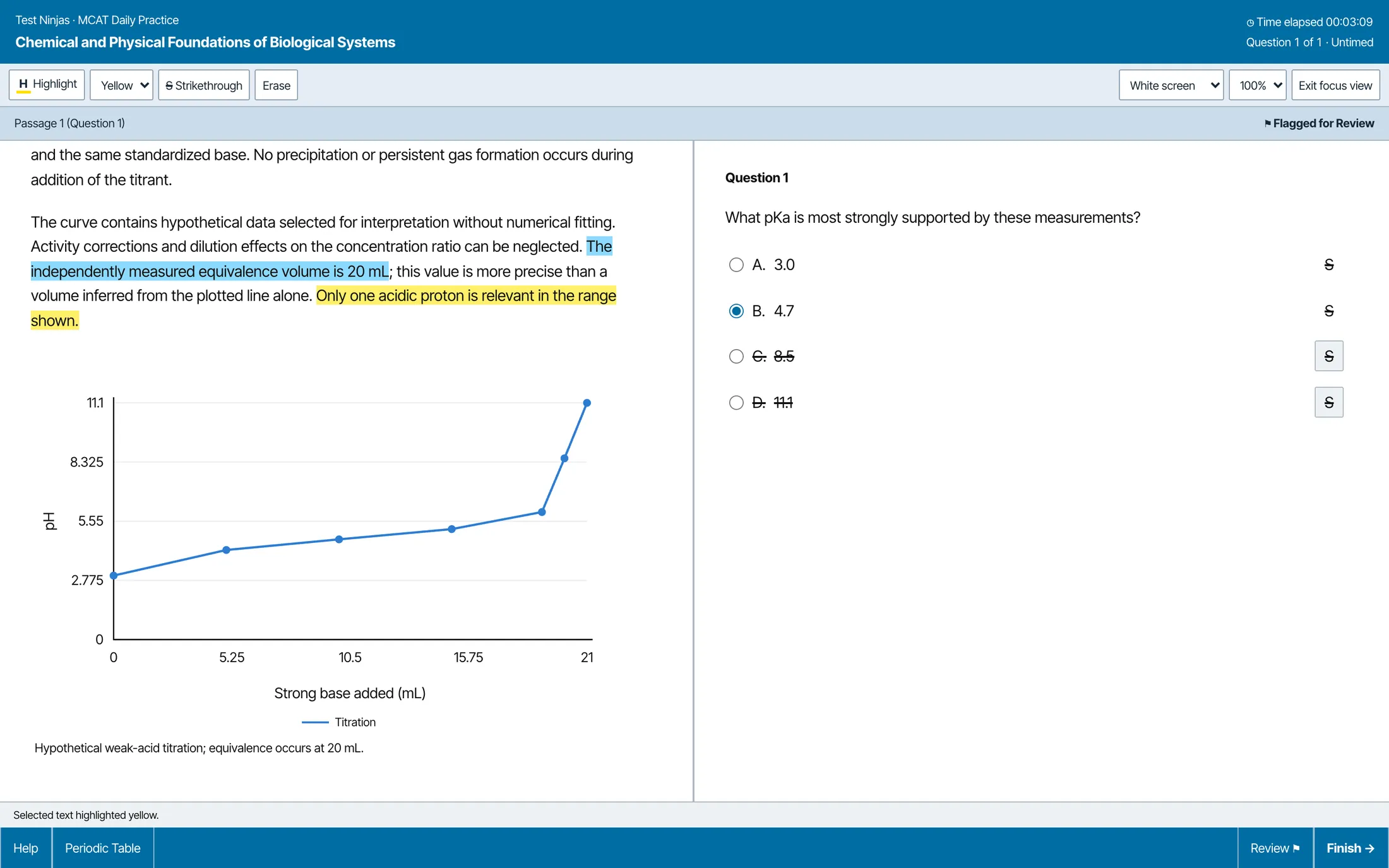
A free MCAT question every day.
Passages and figures with the exam’s highlight, strikethrough and flag tools.
Admission Test
A little practice. Every day.
Today’s MCAT question is ready. Read carefully, choose your answer, then work through the explanation and the reasoning behind each choice.
Explore the daily practice and question typesFour sections. One next step.
The MCAT brings together science, critical reading and reasoning. Get familiar with the knowledge and skills behind each separately timed section.
Chemistry & Physics
Apply chemistry, physics and biochemistry to biological systems, experiments and data.
Critical Analysis
Read humanities and social science passages, follow arguments and draw supported conclusions.
Biology & Biochemistry
Connect molecules, cells and organ systems with the experiments that explain how they work.
Psychology & Sociology
Explore behavior, social systems and research methods through studies and real-world examples.
Your score,
made clearer.
Each section is scored from 118 to 132. The four section scores carry equal weight and add together to make your total.
Explore your scorePut your total in context. Percentile ranks show how a score compares with other test results. See the percentile table
- Four section scores
- Chem/Phys, CARS, Bio/Biochem and Psych/Soc each receive a score from 118 to 132.
- One total score
- Your four section scores are added together, from 472 through 528.
- Scaled scores
- Scores account for small differences in difficulty between test forms.
- Percentile ranks
- Compare a score with the reference group in the published AAMC rank table.
Good questions. Clear answers.
MCAT Registration and Fees
Booking steps, 2027 fees and confirmation checks.
MCAT Score Release
2027 release lookup, result access and score reporting.
MCAT Practice Questions
Six questions across all four sections
MCAT CARS Practice: 1 Passage, 6 Questions
One passage with six questions
MCAT Question of the Day
Original daily practice with full explanations
MCAT Format
Sections, timing and question counts
MCAT Score Calculator
Section scores → total and percentile
All MCAT Calculators
Every MCAT tool in one place
What Is a Good MCAT Score?
Benchmarks against real school data
MCAT Score Range
The 472–528 scale explained
MCAT Percentiles
Every total and its percentile rank
MCAT Test Dates 2027
The testing calendar and deadlines
See the bigger picture.
Put your coursework alongside your test preparation. Explore our free science GPA and overall GPA calculators.
A few things you
might be wondering.
Answers to common questions about the Medical College Admission Test.
How long is the MCAT?
The MCAT has 6 hours and 15 minutes of actual testing time across four sections. Total seated time is 7 hours 30 minutes once the tutorial, the three optional breaks, the void question and the survey are added — and check-in is additional on top of that, so plan for most of a working day.
How many questions are on the MCAT?
There are 230 multiple-choice questions in total: 59 in Chem/Phys, 53 in CARS, 59 in Bio/Biochem, and 59 in Psych/Soc. Most are attached to passages, with a smaller number of standalone discrete questions in every section except CARS, which is entirely passage-based.
What is a good MCAT score?
A total of 500 sits near the middle of all test takers. Students who go on to matriculate at U.S. MD programs average about 512, so that is a more useful benchmark than the overall median if medical school is the goal. What counts as competitive ultimately depends on the schools on your list.
How many times can I take the MCAT?
The AAMC allows up to three attempts in a single testing year, four attempts across two consecutive years, and seven attempts in a lifetime. Voided exams and no-shows count toward these limits, so book a date you intend to keep.
What coursework does the MCAT assume?
The MCAT is built on introductory biology, general and organic chemistry, physics, biochemistry, psychology, and sociology. Most pre-med students complete that foundation before beginning dedicated MCAT preparation, because the exam tests application of the material rather than first exposure to it.
Does Test Ninjas offer MCAT practice tests?
We offer a free original MCAT question of the day, with 365 questions rotating across all four sections, along with guides and calculators. Full-length MCAT practice tests are not currently available.
Are the MCAT daily questions original?
Yes. The questions, passages, and illustrative datasets are original Test Ninjas practice material, organized around the AAMC content framework. Each answer includes a worked explanation and a rationale for every choice. These are independent practice questions, not official AAMC exam items.
Test Ninjas Research · Updated September 14, 2026