Try one question in each of six DAT subject areas. Review the concept, passage evidence or spatial rule behind each answer, then choose your next study priority.
Practice questions
0:00
For visual questions, use the full-size diagram link if needed. Some PAT answers are images; inspect their geometry before selecting a label.
0 correct / 0 checked0 of 6 completed · Progress stays in this browser.
Cellular respirationBiology · medium
Question 1 · medium · Cellular respiration
Answer and explanation
Answer D.Glycolysis includes substrate-level phosphorylation, which transfers phosphate directly to ADP without ATP synthase. Electron transport and oxygen diffusion do not themselves attach phosphate to ADP.
Limiting reactantsGeneral chemistry · medium
Question 2 · medium · Limiting reactants
Answer and explanation
Answer B.The aluminum can produce 0.80 × 2/4 = 0.40 mol Al₂O₃, whereas the oxygen could produce 0.90 × 2/3 = 0.60 mol. Aluminum is limiting, so the smaller product amount is the maximum yield.
Curved-arrow notationOrganic chemistry · easy
Question 3 · easy · Curved-arrow notation
Answer and explanation
Answer B.A full-headed curved arrow tracks an electron pair from its source to its destination. Here the oxygen lone pair supplies both electrons of the new bond to the proton.
Main idea: kelp restorationReading comprehension · medium
Answer C.Grazer barriers improved early survival, but storms still prevented some protected populations from persisting. The passage therefore distinguishes successful establishment from the additional conditions needed for a reproducing, self-sustaining forest.
Algebra: linear equationsQuantitative reasoning · medium
Question 5 · medium · Algebra: linear equations
Answer and explanation
Answer C.Multiply every term by 12 to clear the denominators: 3(3x − 2) − 2(x + 1) = 48. Expanding gives 9x − 6 − 2x − 2 = 48, so 7x = 56 and x = 8.
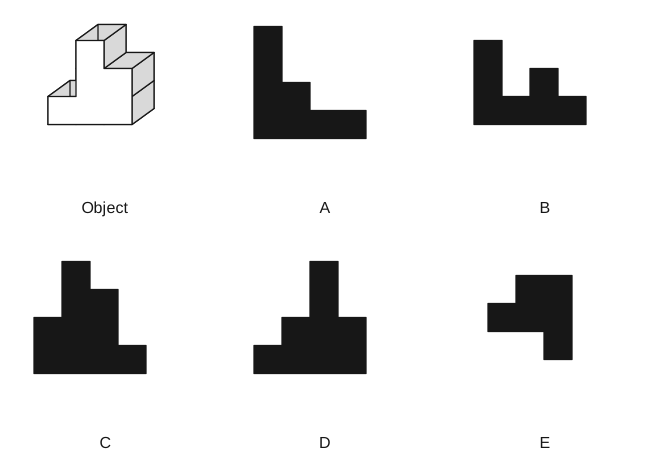
Answer E.Trace the broad face rather than the slanted extrusion edges. Its columns, from left to right in the object drawing, rise to 1, 3, 2 equal units. The correct aperture preserves those steps and proportions after rotation. The other apertures change the height or position of a step. This drill fixes the direction of passage to isolate silhouette matching.
Keep building your DAT skills
Keep the momentum going. Create a free Test Ninjas account and take the next step in your DAT prep.
6 questionsAcademic subjects + PATAnswers + worked explanations
Test Ninjas · Content checked October 23, 2026
Find a weakness, then practice it deliberately
Work through six examples: biology, general chemistry, organic chemistry, reading comprehension, quantitative reasoning and perceptual ability. Each question tests a different kind of reasoning, so focus on your method rather than comparing subject scores from a single item.
For science, state the mechanism or relationship before choosing an answer. Read the kelp-restoration passage for its main point. For the algebra problem, define the unknown and solve the equation. In the keyhole diagram, trace the required outline and follow the stated direction-of-passage constraint.
Review the explanations, including answers you guessed correctly. Save an uncertain question and record what you would do differently next time. The dedicated PAT sample offers six different visual questions, one for each task type.
This six-question sample highlights different skills. It does not cover the full DAT content outline or estimate a scaled score.
What is included in these DAT practice questions
Natural Sciences — 3 questions
Try one question each on cellular respiration, limiting reactants and curved-arrow notation. Identify what moves or changes in each process before applying a remembered rule.
Reading Comprehension — 1 question
Read a short passage about kelp restoration and identify its main idea. Choose an answer that reflects the whole passage rather than one memorable detail.
Quantitative Reasoning — 1 question
Solve a linear equation and check your result against the original relationship. Keep the requested variable in view through each algebraic step.
Perceptual Ability — 1 question
Compare a keyhole silhouette with the object under the stated orientation constraint. The dedicated PAT sample adds a different example for each of the six visual task types.
Turn a missed question into a better next attempt
Before revealing the answer, record why your chosen option works. If you guessed, save the question even if your guess was correct.
Classify the error: missing knowledge, misread condition, wrong setup, arithmetic, or an unsupported inference. Fixing the cause matters more than memorizing a letter.
Use the worked explanation to reconstruct the solution without looking at the choices. Explain why your original answer fails.
Revisit saved questions in a later session. Reset only after recording your first attempt; immediate recognition is not the same as independent mastery.
How to review different kinds of DAT errors
Remembering a term without applying its definition
For science, state the defining property that separates your answer from the nearest distractor. If the explanation introduces a concept you cannot explain, return to the underlying topic before collecting more question attempts.
Importing facts into a reading passage
A true scientific statement may still be the wrong reading answer if the passage does not establish it. Identify whether the prompt asks what is stated, implied or used as evidence.
Trusting a picture’s first impression
For a keyhole question, trace the outline under the stated orientation constraint. A shape that looks familiar can fail because one step has moved or one dimension no longer matches.
Frequently asked questions
How should I use a six-question DAT sample?
Try each subject, then use the explanations to choose a study priority. One question per area is a quick introduction, not enough evidence to rank your subject readiness.
Does this cover every organic chemistry topic?
No. This sample includes one curved-arrow question. Use the full content outline when planning organic chemistry preparation.
Is the reading passage full section length?
No. It is a short passage for practicing main-idea reasoning. Longer practice is needed to develop reading endurance and pacing.
How does this relate to the PAT practice page?
This page includes one keyhole question. The dedicated PAT sample has six different visual questions, one per task type. Saved progress is separate on each page.
Will this calculate a DAT Academic Average?
No. The progress display reports accuracy on this sample and cannot be converted into an Academic Average.
Turn today’s practice into test-day confidence
Keep the momentum going. Create a free Test Ninjas account and take the next step in your DAT prep.