An equation states that two expressions have the same value. Solving keeps that equality true while isolating the unknown. A clear first equation often saves more time than faster arithmetic on a poorly chosen setup.
Test Ninjas Research · Updated September 29, 2026
What you will practice
Define the unknown before writing an equation.
Apply each operation to the entire relevant expression.
Verify a solution or inequality with a test value.
Suggested pace: 10 minutes on examples · 10–15 minutes on questions · 5 minutes on review. Take a second session if a method needs more work.
Keep in mind: Perform the same operation on both sides, then verify in the original statement.
Method 1 of 4
Translate the quantities before solving
Give the unknown a name and a unit. Separate a one-time fixed amount from an amount charged or produced repeatedly. “Three more than twice x” is 2x + 3; “three times the sum of x and 2” is 3(x + 2). Parentheses preserve that difference.
Define the variable in a short sentence.
Build an expression for each side of the equality.
Solve, then answer the story using the variable’s units.
Worked example
A rental costs $9 plus $4 per hour. The total is $37. How many hours were rented?
Let h be the number of rental hours.
9 + 4h = 37.
Subtract 9: 4h = 28. Divide by 4: h = 7.
Answer: 7 hours
Check it: The hourly charge is $4/hour × 7 hours = $28. Adding the $9 fixed fee gives the stated $37 total.
Now try it without looking back
A $5 fee plus $3 per hour totals $20. Write an equation and find the hours.
Check your reasoning
5 + 3h = 20, so 3h = 15 and h = 5 hours. Check: 5 + 3 × 5 = 20.
Common mistake: Dividing 37 by 4 before removing the fixed fee treats the fee as another hourly charge.
Method 2 of 4
Distribute and collect like terms
Distribution multiplies every term inside a pair of parentheses. Once parentheses are gone, combine terms with the same variable and power. Then move variable terms to one side and constants to the other using equal operations.
Distribute carefully, including any negative sign.
Combine like terms on each side.
Isolate the variable and substitute the result into the original equation.
Worked example
Solve 3(x − 2) + 4 = 2x + 9.
Distribute: 3x − 6 + 4 = 2x + 9.
Combine constants: 3x − 2 = 2x + 9.
Subtract 2x and add 2: x = 11.
Answer: x = 11
Check it: Left side: 3(11 − 2) + 4 = 31. Right side: 2(11) + 9 = 31.
Now try it without looking back
Expand 2(x − 3). Which terms get multiplied by 2?
Check your reasoning
Both terms: 2x − 6. The factor outside the parentheses applies to the whole expression inside.
Common mistake: Writing 3(x − 2) as 3x − 2 distributes to only one term. The entire parenthesized expression is multiplied by 3.
Method 3 of 4
Clear fraction denominators without skipping terms
Multiplying every term on both sides by a common denominator turns a fractional equation into an equivalent equation with simpler arithmetic. Multiplication must reach each term, including any whole-number term.
Find a common multiple of the denominators.
Multiply every term by that common denominator.
Solve the resulting equation and check the original fractions.
Worked example
Solve x/3 + x/2 = 10.
A common denominator for 3 and 2 is 6.
Multiply every term by 6: 2x + 3x = 60.
5x = 60, so x = 12.
Answer: x = 12
Check it: 12/3 + 12/2 = 4 + 6 = 10.
Now try it without looking back
Multiply every term of x/2 + 1 = 4 by 2. What equation results?
Check your reasoning
x + 2 = 8, so x = 6. Multiplying only the fraction would change the equality.
Common mistake: Multiplying only the left side by 6 changes the equation. The 10 must become 60 as well.
Method 4 of 4
Reverse an inequality when dividing by a negative
An inequality compares order, not equality. Adding the same amount preserves order; multiplying or dividing by a negative reverses it. Test a value from your proposed solution set and keep track of whether the endpoint is included.
Isolate the variable using the same operations on both sides.
Reverse the comparison if you multiply or divide by a negative number.
Test one included value and, when helpful, the boundary.
Worked example
Solve −2x + 5 < 13.
Subtract 5: −2x < 8.
Divide by −2 and reverse the sign: x > −4.
The strict comparison excludes x = −4.
Answer: x > −4
Check it: x = 0 gives 5 < 13, which is true. At x = −4 the sides are both 13, so the boundary is excluded.
Now try it without looking back
Solve −3x > 12. Does x = −5 satisfy the result?
Check your reasoning
x < −4. Dividing by −3 reverses the sign, and x = −5 works because 15 > 12.
Common mistake: Reversing the sign when merely adding or subtracting a negative is unnecessary. The reversal is tied to multiplication or division by a negative.
Practice equations and inequalities
Keep one operation per line until the process is reliable. Checking the original equation can catch distribution, sign, and transcription errors together.
Work the first six questions with the explanations closed. Review any missed or guessed answers before continuing with the other six. If you cannot set up a problem, return to its method above and try again from a blank page.
Equations and inequalities: 12 practice questions
Work through one question at a time. Explain your approach, check the worked answer, then move on. Use scratch paper for calculations.
0 of 12 checked · 0 correct.
Progress is saved in this browser. These original study questions do not produce an official AFQT score.
Question 1: Reading closed and open interval endpoints
Question 1 · Reading closed and open interval endpoints · easy
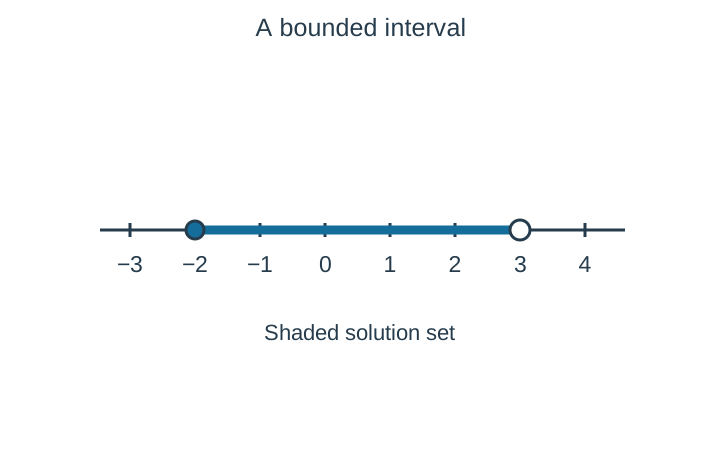
The number line shades all values from −2 to 3, with a filled circle at −2 and an open circle at 3. Which listed value belongs to the shaded solution set?
Worked answer and explanation
Answer: B. −2
The filled endpoint includes −2, whereas the open endpoint excludes 3. The shaded set is −2≤x<3. Of the four choices, only −2 is in that set; −3 and 4 lie outside it.
Question 2: Least integer in an inequality
Question 2 · Least integer in an inequality · medium
What is the least integer x that satisfies −2(3x − 4) ≤ 20?
Worked answer and explanation
Answer: C. −2
Distribute to get −6x + 8 ≤ 20, then subtract 8: −6x ≤ 12. Dividing by −6 reverses the inequality, giving x ≥ −2. Therefore −2 is the least permitted integer. Two also satisfies the inequality but is not the least, while −3 and −4 do not satisfy it.
Question 3: Parameter producing an identity
Question 3 · Parameter producing an identity · medium
For which value of k does 3(2x − 1) = 6x + k hold for every real x?
Worked answer and explanation
Answer: B. −3
Distribute to obtain 6x − 3 = 6x + k. Subtracting 6x leaves −3 = k, so k must be −3. At that value the two sides match for every real x. The 3 choice loses the minus sign, while k = 0 would omit the constant term entirely.
Question 4: A difference determined by a sum and product
Question 4 · A difference determined by a sum and product · hard
Two positive numbers have a sum of 19 and a product of 84. What is the positive difference between them?
Worked answer and explanation
Answer: A. 5
The positive factor pair 7 and 12 has both the required product, 84, and the required sum, 19. Their positive difference is 12 − 7 = 5. Another method uses (a − b)² = (a + b)² − 4ab = 19² − 4(84) = 25, so |a − b| = 5. The choices 7 and 12 give the individual numbers rather than their difference.
Question 5: Solutions represented by two parallel lines
Question 5 · Solutions represented by two parallel lines · easy
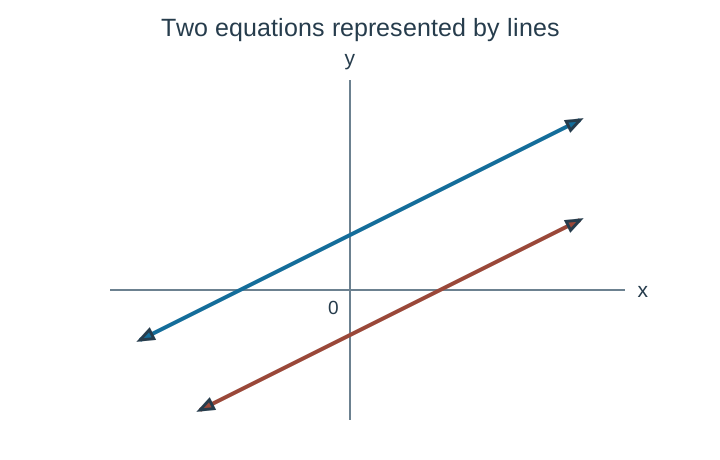
The graph shows two distinct parallel straight lines representing two equations in x and y. How many ordered pairs solve both equations at once?
Worked answer and explanation
Answer: A. 0
A simultaneous solution would be a point on both lines. Distinct parallel lines do not intersect, so there is no common ordered pair. Each individual line has many points, but none belongs to both.
Question 6: Choosing a constant to fit a solution
Question 6 · Choosing a constant to fit a solution · medium
The equation 0.3x + b = 0.7x − 0.8 has the solution x = −2. What is b?
Worked answer and explanation
Answer: A. −1.6
Substitute −2 for x: −0.6 + b = −1.4 − 0.8 = −2.2. Adding 0.6 to both sides gives b = −1.6. The constant −0.8 is already present in the equation and does not by itself balance the different x terms.
Question 7: A product of consecutive even integers
Question 7 · A product of consecutive even integers · medium
Two consecutive positive even integers have a product of 168. What is their sum?
Worked answer and explanation
Answer: D. 26
Write the integers as n and n + 2. Then n² + 2n − 168 = 0, which factors as (n − 12)(n + 14) = 0. Positivity selects n = 12, so the integers are 12 and 14 and their sum is 26. The choices 12 and 14 are individual integers rather than the requested sum.
Question 8: Integer solutions in an open interval
Question 8 · Integer solutions in an open interval · hard
How many integers x satisfy |x − 1/2| < 7/2?
Worked answer and explanation
Answer: A. 6
The inequality gives −7/2 < x − 1/2 < 7/2, so −3 < x < 4. The integers are −2, −1, 0, 1, 2, and 3: six values. The strict inequality excludes both −3 and 4. Counting one or both endpoints incorrectly gives seven or eight.
Question 9: Rearranging a quotient formula
Question 9 · Rearranging a quotient formula · easy
If v = (p + q)/t and t ≠ 0, which expression equals p?
Worked answer and explanation
Answer: A. vt − q
Multiply by t to get vt = p + q, then subtract q: p = vt − q. The plus-q choice undoes the addition in the wrong direction. Multiplying (v − q) by t also multiplies q unnecessarily, and dividing v by t repeats the original division instead of undoing it.
Question 10: Counting integers in an intersection of inequalities
Question 10 · Counting integers in an intersection of inequalities · medium
How many integers x satisfy both x/2 − 1 < 3 and 2x + 3 ≥ 7?
Worked answer and explanation
Answer: B. 6
The first inequality gives x < 8. The second gives x ≥ 2. Their intersection contains the integers 2, 3, 4, 5, 6 and 7, for a total of 6. Including 8 ignores the strict first inequality; excluding 2 ignores the inclusive second inequality.
Question 11: A parameter that makes a linear system inconsistent
Question 11 · A parameter that makes a linear system inconsistent · medium
For which value of k does the system 3x + 2y = 7 and 6x + ky = 9 have no solution?
Worked answer and explanation
Answer: C. 4
Doubling the first equation gives 6x + 4y = 14. When k = 4, the second equation has exactly the same left side but requires it to equal 9, which is impossible. For each other listed k, subtracting the doubled first equation leaves a nonzero coefficient of y, so the equations have one solution. A zero determinant alone would not distinguish no solution from identical equations; the constants differ here.
Question 12: Reciprocals of consecutive integers
Question 12 · Reciprocals of consecutive integers · hard
Two consecutive positive integers have reciprocals whose sum is 5/6. What is the smaller integer?
Worked answer and explanation
Answer: B. 2
Let the smaller integer be n. Then 1/n + 1/(n + 1) = 5/6. Multiplication by 6n(n + 1) gives 5n² − 7n − 6 = 0, or (5n + 3)(n − 2) = 0. The positive integer solution is n = 2, and 1/2 + 1/3 = 5/6 checks it. The other root, −3/5, is neither positive nor an integer; 3 is the larger integer, not the requested one.