Geometry problems become easier when you identify what is being measured. A border needs a length, a covering needs an area, and a container’s capacity needs a volume. The unit of the answer is an early clue to the correct method.
Test Ninjas Research · Updated September 29, 2026
What you will practice
Decide whether the answer measures length, area or volume.
Identify the radius, perpendicular height or hypotenuse.
Track squared and cubed units through scaling.
Suggested pace: 10 minutes on examples · 10–15 minutes on questions · 5 minutes on review. Take a second session if a method needs more work.
Keep in mind: Lengths use units, areas use square units, and volumes use cubic units.
Method 1 of 4
Separate perimeter from area
Perimeter measures the boundary; area measures the region inside it. For a rectangle, perimeter is 2(length + width), while area is length × width. Mark all outer edges if the shape is irregular instead of counting an interior dividing line as part of the boundary.
Decide whether the task concerns an edge or a surface.
List the needed dimensions with matching units.
Use the relevant formula and label the result with linear or square units.
Worked example
A rectangular garden is 12 feet long and 7 feet wide. How much fence surrounds it, and what area does it cover?
Fence length = 12 + 7 + 12 + 7 = 38 feet.
Area = 12 × 7 = 84 square feet.
The same dimensions answer two different measurement questions.
Answer: 38 feet of fence; 84 square feet of area
Check it: 84 feet would be a length, so it cannot be the correctly labeled area.
Now try it without looking back
A rectangle is 8 feet by 3 feet. Find its perimeter and area, including units.
Check your reasoning
Perimeter: 2(8 + 3) = 22 feet. Area: 8 × 3 = 24 square feet. The units distinguish the two quantities.
Common mistake: Multiplying length by width for a fencing question measures the wrong feature, even if the arithmetic is correct.
Method 2 of 4
Use a perpendicular height and the correct circle measure
Triangle area is one half of base × perpendicular height. A slanted side is not automatically the height. For a circle, the radius reaches from the center to the edge and is half the diameter; use radius in both A = πr² and C = 2πr.
Identify the base and the perpendicular distance to it for a triangle.
Convert diameter to radius before using a circle formula.
Keep π exact unless the question specifies an approximation.
Worked example
A circular sign has a diameter of 10 inches. What is its area in terms of π?
Radius = 10 ÷ 2 = 5 inches.
Area = π × 5².
Area = 25π square inches.
Answer: 25π square inches
Check it: The diameter is twice the radius. Using 10 as the radius would make the area four times too large.
Now try it without looking back
A circle has diameter 8 inches. What radius goes into the area formula?
Check your reasoning
4 inches. Its area is π × 4² = 16π square inches; using 8 as the radius would quadruple the area.
Common mistake: Squaring the diameter in πr² gives 100π here. Reading the dimension label matters as much as remembering the formula.
Method 3 of 4
Use the Pythagorean relationship only for right triangles
For a right triangle, a² + b² = c², where c is the hypotenuse opposite the right angle. Add the squared legs to find the hypotenuse. Subtract a squared known leg from c² to find the other leg, then take the square root.
Identify the right angle and the side opposite it.
Write the equation using the correct side as c.
Solve for the missing squared length, then take its positive square root.
Worked example
A 13-foot ladder reaches a wall 12 feet above the ground. The wall and level ground form a right angle. How far is the foot of the ladder from the wall?
The ladder is the hypotenuse: x² + 12² = 13².
x² = 169 − 144 = 25.
x = 5 feet.
Answer: 5 feet
Check it: 5² + 12² = 25 + 144 = 169 = 13². A leg must be shorter than the 13-foot hypotenuse.
Now try it without looking back
A right triangle has legs of 6 and 8. What is the hypotenuse?
Check your reasoning
10. Its square is 6² + 8² = 100, so the positive length is √100 = 10.
Common mistake: 13 − 12 = 1 subtracts lengths directly. The relationship concerns squares of lengths, not their simple sum.
Method 4 of 4
Track dimensions through volume and scaling
A rectangular prism has volume length × width × height. If every length of a similar shape is multiplied by a scale factor k, area changes by k² and volume by k³. A conversion to different measurement units follows the same dimensional rule.
Convert all dimensions to a common unit.
Multiply the three perpendicular dimensions for a rectangular prism.
For scaling questions, apply one factor per dimension.
Worked example
A box measures 2 feet by 3 feet by 4 feet. A similar box has every dimension doubled. What is the larger box’s volume?
Original volume = 2 × 3 × 4 = 24 cubic feet.
New dimensions are 4 feet, 6 feet, and 8 feet.
New volume = 4 × 6 × 8 = 192 cubic feet, or 24 × 2³.
Answer: 192 cubic feet
Check it: Doubling three dimensions multiplies volume by 8, not by 2.
Now try it without looking back
Every length of a box is tripled. By what factor does its volume change?
Check your reasoning
27, because all three dimensions change: 3 × 3 × 3. Its surface area would scale by 9 instead.
Common mistake: One square foot equals 144 square inches, not 12: both length dimensions are multiplied by 12. For cubic units, there are three conversion factors.
Practice geometry and measurement
Sketch a diagram, label only the stated measurements, and mark any right angles. Do not infer an equal side or a perpendicular line merely from how a drawing looks.
Work the first six questions with the explanations closed. Review any missed or guessed answers before continuing with the other six. If you cannot set up a problem, return to its method above and try again from a blank page.
Geometry and measurement: 12 practice questions
Work through one question at a time. Explain your approach, check the worked answer, then move on. Use scratch paper for calculations.
0 of 12 checked · 0 correct.
Progress is saved in this browser. These original study questions do not produce an official AFQT score.
Question 1: Rectangle with a triangular cutout
Question 1 · Rectangle with a triangular cutout · easy
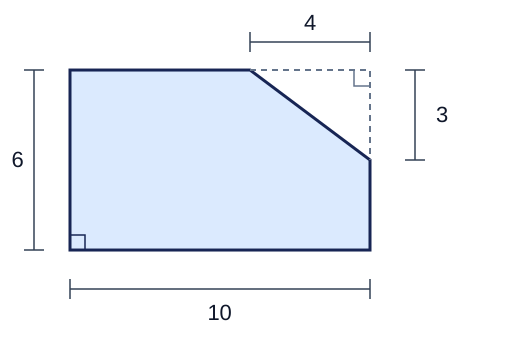
The shaded region is formed by removing the right-triangular corner from a 10-unit-by-6-unit rectangle. The removed triangle has perpendicular legs of 4 units and 3 units, as labeled. What is the area of the shaded region?
Worked answer and explanation
Answer: C. 54 square units
The full rectangle has area 10 × 6 = 60 square units. The removed right triangle has area (1/2) × 4 × 3 = 6. The remaining area is 60 − 6 = 54. Subtracting 4 × 3 without halving treats the cutout as a rectangle and gives the incorrect 48.
Question 2: Area determined by side midpoints
Question 2 · Area determined by side midpoints · medium
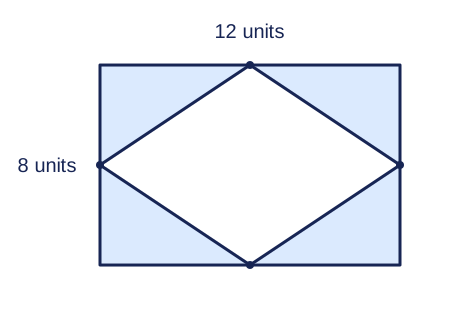
The rectangle is 12 units long and 8 units wide. The midpoint of each side is joined to the midpoints of the two adjacent sides, as shown. What is the total area of the four shaded corner regions?
Worked answer and explanation
Answer: B. 48 square units
Each corner is a right triangle whose legs are half the rectangle’s side lengths: 6 units and 4 units. Each has area (1/2) × 6 × 4 = 12 square units. The four corners total 4 × 12 = 48 square units. The full rectangle has area 96; 24 counts only two of the four congruent corner triangles.
Question 3: Radius and tangent form a right triangle
Question 3 · Radius and tangent form a right triangle · medium
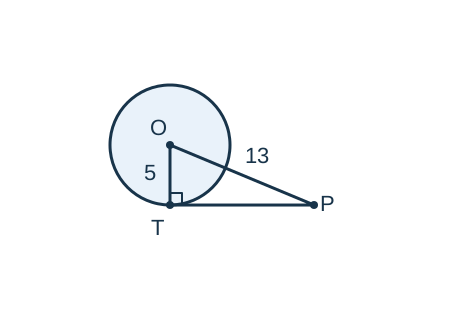
Circle O has radius 5 units, and OP = 13 units. PT is tangent to the circle at T, as shown. A radius drawn to a point of tangency is perpendicular to the tangent there. What is the length of PT?
Worked answer and explanation
Answer: B. 12 units
OT is a radius, so OT = 5. The stated tangent property makes triangle OTP right at T, with hypotenuse OP = 13. Therefore PT² = 13² − 5² = 169 − 25 = 144, giving PT = 12 units. Subtracting the lengths 13 − 5 gives 8, but the Pythagorean relation subtracts their squares.
Question 4: Area of a notched rectangle
Question 4 · Area of a notched rectangle · hard
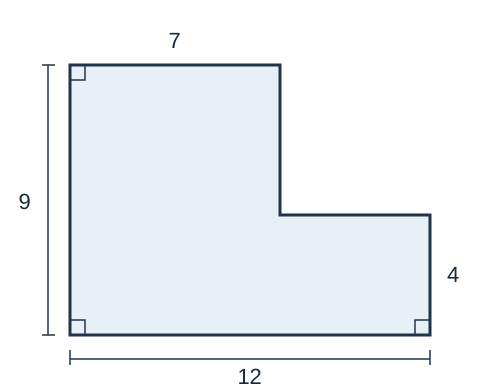
The L-shaped region shown has perpendicular adjacent boundary segments. The labeled lengths are in units. What is its area?
Worked answer and explanation
Answer: C. 83 square units
Treat the shape as a 12-by-9 rectangle with a corner removed. The missing corner is 12 − 7 = 5 units wide and 9 − 4 = 5 units high. Subtract its area: 12 × 9 − 5 × 5 = 83 square units. The 108 choice includes the missing corner; 25 is the removed area alone.
Question 5: Regular polygon side length
Question 5 · Regular polygon side length · easy
A regular hexagon has a perimeter of 42 centimeters. How long is each side?
Worked answer and explanation
Answer: B. 7 centimeters
A regular hexagon has six equal sides. Each side is 42 ÷ 6 = 7 centimeters. Six is the number of sides, not their length. Dividing by three gives 14 but counts only half of the hexagon’s sides.
Question 6: Area covered by overlapping rectangles
Question 6 · Area covered by overlapping rectangles · medium
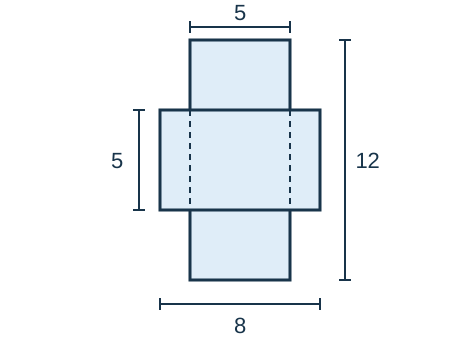
A 12-unit-by-5-unit rectangle and an 8-unit-by-5-unit rectangle overlap in exactly a 5-unit-by-5-unit square, as shown. What is the area covered by at least one of the rectangles?
Worked answer and explanation
Answer: B. 75 square units
The rectangles have areas 12 × 5 = 60 and 8 × 5 = 40. Adding them counts their 5 × 5 = 25 square units of overlap twice. Subtract that overlap once: 60 + 40 − 25 = 75 square units. The choice 100 retains double counting, while 50 subtracts the overlap twice and leaves out the region both rectangles cover.
Question 7: Subtract a semicircular cutout from a rectangle
Question 7 · Subtract a semicircular cutout from a rectangle · medium
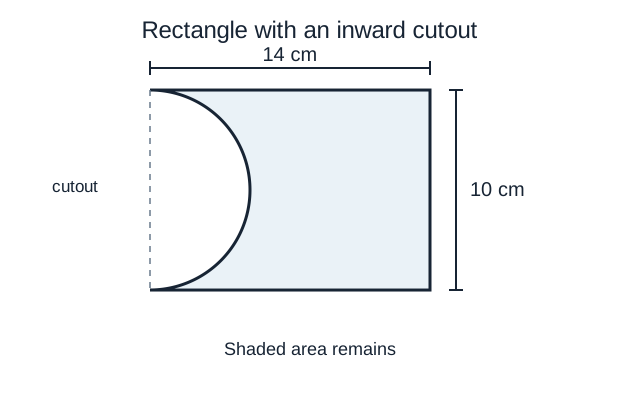
A 14 cm by 10 cm rectangle has a semicircular cutout removed from its interior along one 10 cm side, as shown. The cutout has diameter 10 cm. Using π = 3.14, what area remains?
Worked answer and explanation
Answer: B. 100.75 cm²
The rectangle area is 14 × 10 = 140 cm². The cutout radius is 10/2 = 5 cm, so its area is (1/2)(3.14)(5²) = 39.25 cm². The remaining area is 140 − 39.25 = 100.75 cm². The 61.5 cm² choice removes a full circle; 140 cm² ignores the cutout; 179.25 cm² adds it.
Question 8: The area of a circle inside an inscribed square
Question 8 · The area of a circle inside an inscribed square · hard
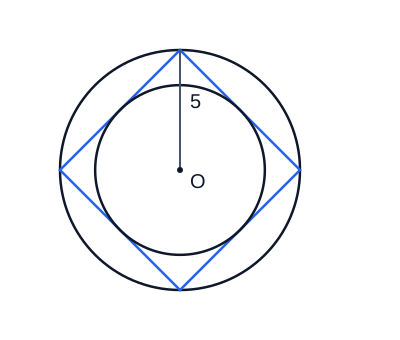
A square has all four vertices on a circle of radius 5 units. A smaller circle is inscribed in the square, touching all four sides, as shown. What is the area of the smaller circle?
Worked answer and explanation
Answer: B. 25π/2 square units
The square’s diagonal is the outer circle’s diameter, 10. If its side is s, then s² + s² = 10², so s² = 50. The inner circle’s diameter is s, giving radius squared s²/4 = 50/4. Its area is therefore π × 50/4 = 25π/2 square units. Using 25π would give the area of the outer circle rather than the smaller one.
Question 9: Isosceles-triangle perimeter
Question 9 · Isosceles-triangle perimeter · easy
An isosceles triangle has two equal sides of length 7.5 centimeters each and a base of length 6 centimeters. What is its perimeter?
Worked answer and explanation
Answer: D. 21 centimeters
Add all three sides: 7.5 + 7.5 + 6 = 21 centimeters. The 13.5 choice counts only one equal side, 15 omits the base, and 18 treats all sides as equal to the base.
Question 10: Rhombus perimeter from both diagonals
Question 10 · Rhombus perimeter from both diagonals · medium
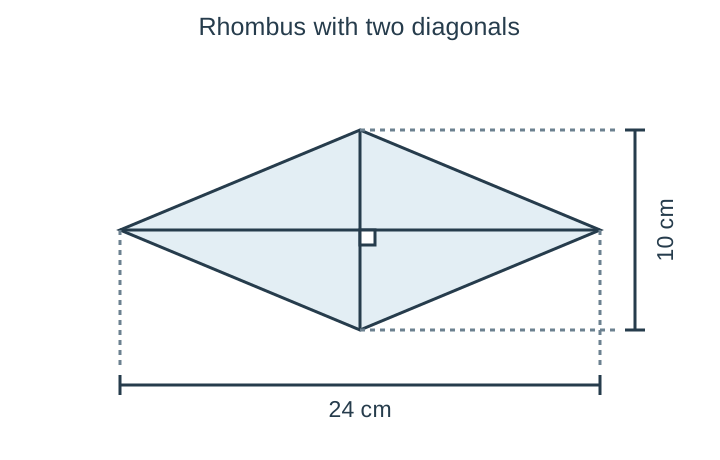
The rhombus shown has diagonals of 10 cm and 24 cm. Its diagonals bisect each other at right angles. What is the perimeter of the rhombus?
Worked answer and explanation
Answer: D. 52 cm
Half-diagonals measure 5 cm and 12 cm. They are the perpendicular legs of a right triangle whose hypotenuse is one rhombus side. The side is √(5²+12²)=13 cm, so the four equal sides total 52 cm. Adding the diagonals does not give the boundary length.
Question 11: Area of a sector from its central angle
Question 11 · Area of a sector from its central angle · medium
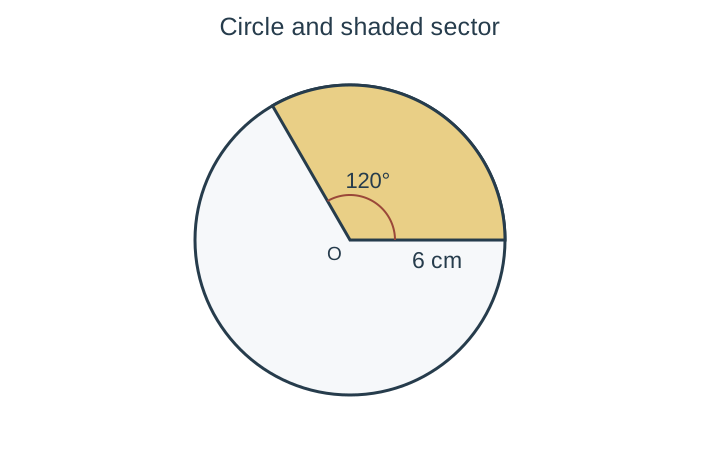
The shaded sector has radius 6 cm and central angle 120°. What is its area?
Worked answer and explanation
Answer: B. 12π cm²
The 120° sector is 120/360=1/3 of a full circle. The circle’s area is π×6²=36π cm², so the sector area is 12π cm². Multiplying the radius instead of its square would confuse a length with an area.
Question 12: A square fitted into a right triangle
Question 12 · A square fitted into a right triangle · hard
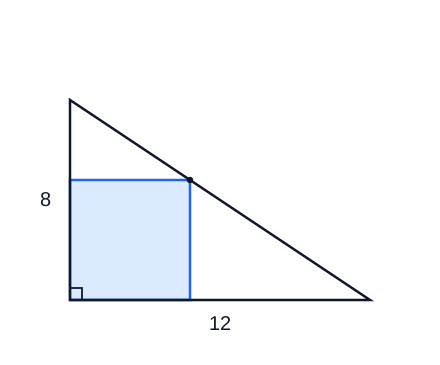
A right triangle has perpendicular legs of 12 units and 8 units. A square shares the triangle’s right-angle vertex, with two sides lying along those legs and its opposite vertex on the hypotenuse, as shown. What is the square’s area?
Worked answer and explanation
Answer: C. 23.04 square units
Let the square’s side be s. The small triangle above the square is similar to the whole triangle, so (8 − s)/s = 8/12. Multiplying gives 12(8 − s) = 8s, hence 96 = 20s and s = 4.8. The square’s area is 4.8² = 23.04 square units. Using a fixed fraction of the triangle’s 48-square-unit area, such as one half, is not justified by this placement.