Brown supplemental essays, 2026–27
Brown asks four required essays on top of your Common App personal essay: two of 150–250 words and two of 100–150 words. This year Brown dropped its very short answers, including the one-sentence Why Brown, and added a question about the Open Curriculum. Below is every prompt word for word, including the PLME and Brown|RISD essays, with what each is asking and how to answer it.
Brown's 2026–27 questions
Four required essays for every applicant, two of 150–250 words and two of 100–150. PLME and Brown|RISD Dual Degree applicants write extra essays, listed after the four. The three PLME essays are new this year and are due with your application, with no extensions.
- "There is something distinctive about Brown students. It is a blend of intellectual curiosity, creativity, and humility. A commitment to collaboration. An openness to new ideas and perspectives. A desire to make the world better. And it is resilience: the ability to recover and thrive after experiencing difficulties." From President Christina Paxson's 2025 Convocation Address. How will you use these characteristics or others to shape your approach to the Open Curriculum?150–250 words
- Students entering Brown often find that making their home on College Hill naturally invites reflection on where they came from. Share how an aspect of your growing up has inspired or challenged you, and what unique contributions this might allow you to make to the Brown community.150–250 words
- If you could teach a class on any one thing, whether academic or otherwise, what would it be?100–150 words
- Brown students care deeply about their work and the world around them. Students find contentment, satisfaction, and meaning in daily interactions and major discoveries. Whether big or small, mundane or spectacular, tell us about something that brings you joy.100–150 words
- Why medicine?Up to 250 words
- Why PLME?Up to 250 words
- Tell us something about yourself, beyond your interest in medicine, that you think will make you a great doctor.Up to 250 words
- The Brown | RISD Dual Degree Program draws on the complementary strengths of Brown University and Rhode Island School of Design (RISD) to provide students with the opportunity to explore and engage with diverse spheres of academic and creative inquiry. Considering your understanding of the academic programs at Brown and RISD, describe how and why the specific blend of RISD's experimental, immersive art and design program and Brown's wide-ranging courses and curricula could constitute an optimal undergraduate education for you. Reflect on how you might integrate or synthesize content, approaches, and methods from these two distinct learning experiences. Additionally, how might you contribute to the Dual Degree community and its commitment to interdisciplinary work?Up to 650 words
Copied from Brown's How to Apply page, which lists "our essays for the 2026-2027 application cycle." The page says four essays are required, but its PLME and Brown|RISD sections still say "in addition to the three essays required of all first-year applicants", left over from last year's three-essay supplement. Brown
Reminder: Brown allows AI only for spelling and grammar checks. Write and revise every answer yourself.
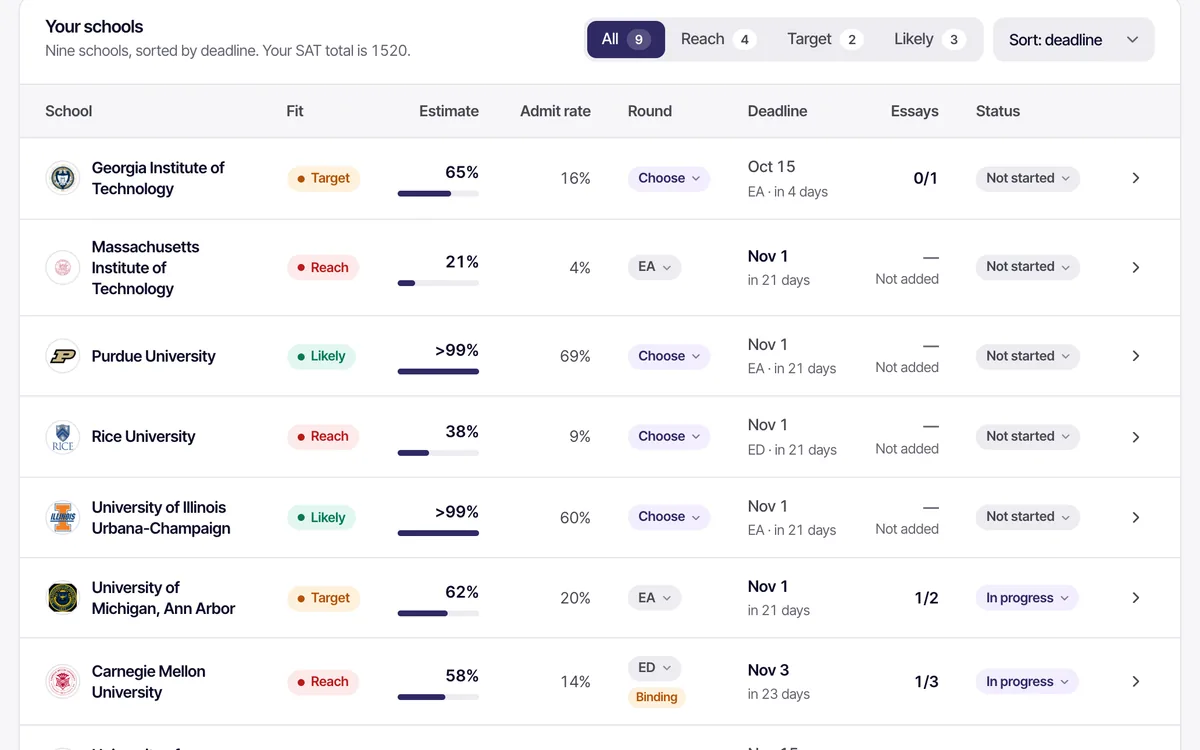
Keep your Brown essays and deadlines in one place
Brown doesn't allow AI with your application writing, so do the writing and rewriting yourself. College Admissions keeps everything around it organized.
- Every school's essays in one list, with each draft's status
- Each school's deadline and round, with the days left counted down
- An admission estimate for each school, marked reach, target or likely
- One question answered by an admissions advisor
7-day free trial · From $29/mo after · Cancel anytime
How Brown reads these
In Brown's words, and in its Common Data Set.
Brown's Common Data Set rates the application essay "Very Important", its top rating, the same as rigor, GPA, test scores, recommendations, talent and character. Brown also says your accomplishments as a high school student will have the most influence on its decision, so the essays work alongside your transcript.
For 2026–27 Brown cut two short answers, "What three words best describe you?" and "In one sentence, Why Brown?" Its dean of admission, Logan Powell, told The Brown Daily Herald that AI wasn't the reason, though the team "certainly considered how AI could have been used to generate responses to those questions." Brown doesn't run essays through AI checkers; Powell said readers look for "consistency and authenticity."
We would rather have an essay with a misplaced comma that has a really genuine heartfelt narrative rather than a perfectly grammatically-correct essay that doesn’t tell us anything about the applicant themselves
the content of all essays, short-answer questions and any other material submitted by an applicant must be the work of that individual.
1. The Open Curriculum and the qualities Paxson named
"There is something distinctive about Brown students. It is a blend of intellectual curiosity, creativity, and humility. A commitment to collaboration. An openness to new ideas and perspectives. A desire to make the world better. And it is resilience: the ability to recover and thrive after experiencing difficulties." From President Christina Paxson's 2025 Convocation Address. How will you use these characteristics or others to shape your approach to the Open Curriculum?
What it's asking
The quote is the setup. The question is the last sentence, which asks how you'll approach the Open Curriculum. Brown has no core requirements outside your concentration, so you build your own course of study. Brown wants to see how you'd make those choices, and the qualities in the quote are a lens you can use. The prompt also lets you name others.
Read the speech the quote comes from. Paxson told new students that the Open Curriculum "is designed to encourage intellectual exploration, which means taking risks," and asked each of them to shop at least one course in a subject they knew nothing about. An answer that shows how you'd take that kind of risk, and how you'd recover if it went badly, answers the question Brown asked.
How to answer it
- Pick one or two of the qualities, or one of your own, and tie each to something you've actually done.
- Name what you'd do with the freedom: a course far outside your comfort zone, two fields you'd combine, a concentration you're unsure about.
- Show how that quality would guide a real choice, including what you'd do if the risk didn't pay off.
Mistakes to avoid
- Walking through all six qualities in the quote. You have 250 words at most.
- Praising the Open Curriculum in general terms without saying what you'd take.
- Presenting a fixed four-year schedule. The question asks how you'll explore.
Example opening
Our robotics arm couldn't lift a tennis ball at my first qualifier, and we lost in round one. Rebuilding it taught me to treat a bad result as data. At Brown I want to do that on purpose, starting with a linguistics course, a subject I know nothing about.
Written by Test Ninjas to show the approach. It is not from a real applicant, so don't borrow its details.
2. An aspect of your growing up
Students entering Brown often find that making their home on College Hill naturally invites reflection on where they came from. Share how an aspect of your growing up has inspired or challenged you, and what unique contributions this might allow you to make to the Brown community.
What it's asking
There are two parts. First, an aspect of your growing up and how it inspired or challenged you. Second, what it lets you contribute at Brown. The second part is easy to forget, and it's half the question.
"An aspect" is narrow on purpose: a place, a family role, a language, a tradition, a job, a neighborhood. Brown's dean of admission pointed to this question when he talked about AI in October 2026: "There is no way that AI can tell a compelling story about a student’s personal experiences because it doesn’t know their story." Detail only you know is what Brown is reading for.
How to answer it
- Choose one aspect of your upbringing, not your whole childhood.
- Show one scene or detail, then say plainly how it inspired or challenged you.
- Spend the last third on Brown: a contribution in a class, a dorm, a student group or Providence that follows from it.
Mistakes to avoid
- A life story that never reaches Brown.
- Retelling your Common App personal essay. Use another side of your background.
- Contributions so general they'd fit anyone, like "bringing a unique perspective."
Example opening
In my town the only books for sale sat on the pharmacy's spinner rack. I read whatever came in, which is how a 1970s western and a field guide to mushrooms ended up on my nightstand the same week. I learned to get curious about whatever's in front of me.
Written by Test Ninjas to show the approach. It is not from a real applicant, so don't borrow its details.
3. A class you'd teach
If you could teach a class on any one thing, whether academic or otherwise, what would it be?
What it's asking
Last year this was a very short answer capped at 100 words. Now it's an essay of 100 to 150 words, so Brown expects more than a course title. Say what you'd teach and why you're the one to teach it.
"Academic or otherwise" means anything counts. When Brown first added the question in 2023, its news office reported that the new questions drew answers from admitted students who "conveyed remarkable creativity and a passion for exploring interdisciplinary solutions." A subject that joins two of your interests fits that well.
How to answer it
- Pick a subject you could talk about for an hour without notes.
- Give the class a concrete shape: a title, a first session, one thing students would do.
- End with why it matters to you, so the class tells Brown something about you.
Mistakes to avoid
- Picking something impressive you don't really know.
- A syllabus with no personal reason behind it.
- A joke answer with nothing underneath it.
Example opening
Course title: Fixing Things You Weren't Supposed to Open. Week one, everyone brings a broken appliance. We take it apart, name every part, and only then look up the manual. I learned this on my grandfather's toaster, which still works.
Written by Test Ninjas to show the approach. It is not from a real applicant, so don't borrow its details.
4. Something that brings you joy
Brown students care deeply about their work and the world around them. Students find contentment, satisfaction, and meaning in daily interactions and major discoveries. Whether big or small, mundane or spectacular, tell us about something that brings you joy.
What it's asking
Brown kept this question from last year but cut it from 200–250 words to 100–150. That leaves room for one thing, told well.
"Mundane or spectacular" is permission to pick something small. Joy has come up in how Brown describes the students it admits: in 2022 its dean said admitted students "continued to try to find opportunities for joy." A small, specific joy tells the reader more than a big, vague one.
How to answer it
- Pick one specific thing, ideally something you do or notice often.
- Describe it closely enough that the reader can see it.
- Say in a sentence why it matters to you.
Mistakes to avoid
- A big achievement dressed up as joy.
- Words like "passion" and "fulfillment" with no scene behind them.
- Using the same story as another Brown essay.
Example opening
Every Sunday my little brother and I time the line for bread at the farmers market, then argue about whether it was worth it. It always was. Eleven Sundays in, we have a spreadsheet and a ranking of every loaf.
Written by Test Ninjas to show the approach. It is not from a real applicant, so don't borrow its details.
5. PLME: Why medicine?
Why medicine?
What it's asking
PLME is Brown's eight-year program that takes you from the undergraduate college to the Warren Alpert Medical School. Committing to it in high school is a big decision, and this question asks whether you've thought hard about medicine itself.
Brown describes PLME as a program "for students who are committed to a career in medicine and who also want a broad liberal arts education." Show that commitment with something you've seen or done. A statement of intent alone won't carry 250 words.
How to answer it
- Start from one experience that made medicine concrete for you: a patient, a shift, a family illness, a lab.
- Say what it showed you about the work of a doctor.
- Connect it to the kind of doctor you want to become.
Mistakes to avoid
- "I've always wanted to help people" with nothing behind it.
- Listing every shadowing hour. One moment explained beats a résumé.
- A family story that never gets to your own reasons.
Example opening
The night my aunt was discharged, the resident sat on the edge of her bed and drew the medication schedule on a napkin. That napkin stayed on our fridge for a year. I want to be the doctor who makes the plan make sense.
Written by Test Ninjas to show the approach. It is not from a real applicant, so don't borrow its details.
6. PLME: Why PLME?
Why PLME?
What it's asking
This is your Why Brown essay for medicine. PLME pairs the Open Curriculum with Brown's medical school, and Brown says PLME students can choose any of its nearly 100 concentrations, in the sciences, humanities, social sciences or behavioral sciences.
Brown also notes that many of its students reach medical school without PLME. So say why the combined eight-year program fits you: what you'd study beside medicine and why that would make you a better doctor.
How to answer it
- Name what you'd study outside the sciences, or alongside them, and why.
- Explain why committing now to Brown's medical school suits you.
- Keep it about PLME. Your Open Curriculum essay already covers Brown in general.
Mistakes to avoid
- Making the direct path into medical school your main reason.
- Generic praise of Brown's reputation in medicine.
- Repeating your Why medicine? answer.
Example opening
I want to study medicine and Portuguese side by side. Half the patients at the clinic where I volunteer speak it, and I've watched appointments go sideways in translation. PLME would let me treat the language as part of my training.
Written by Test Ninjas to show the approach. It is not from a real applicant, so don't borrow its details.
7. PLME: What will make you a great doctor
Tell us something about yourself, beyond your interest in medicine, that you think will make you a great doctor.
What it's asking
The key words are "beyond your interest in medicine." Brown wants a trait, habit or experience from the rest of your life, and how it will carry into medicine.
PLME pairs medical training with a broad liberal arts education, so a quality you built through music, a job, a sport or caring for family is a natural fit for this question.
How to answer it
- Pick one quality that has nothing to do with science on its face: patience, humor, listening, steadiness.
- Prove it with a short story from outside medicine.
- End with how that quality will show up with patients.
Mistakes to avoid
- Another medical story. The prompt asks you to go beyond medicine.
- A list of virtues without evidence.
- Overstating, as in "this will make me the perfect doctor."
Example opening
Three years of calling bingo at my grandmother's senior center taught me to read a room: who's lost, who's bored, who can't hear. I slow down for the back table. Every doctor has a back table.
Written by Test Ninjas to show the approach. It is not from a real applicant, so don't borrow its details.
8. Brown|RISD Dual Degree essay
The Brown | RISD Dual Degree Program draws on the complementary strengths of Brown University and Rhode Island School of Design (RISD) to provide students with the opportunity to explore and engage with diverse spheres of academic and creative inquiry. Considering your understanding of the academic programs at Brown and RISD, describe how and why the specific blend of RISD's experimental, immersive art and design program and Brown's wide-ranging courses and curricula could constitute an optimal undergraduate education for you. Reflect on how you might integrate or synthesize content, approaches, and methods from these two distinct learning experiences. Additionally, how might you contribute to the Dual Degree community and its commitment to interdisciplinary work?
What it's asking
This is the longest Brown essay, and it has three tasks: why the blend of RISD's art and design program and Brown's courses is the right education for you, how you'd combine content and methods from the two, and what you'd add to the Dual Degree community.
You submit the same essay with both your Brown and RISD applications, and only students admitted to both schools are considered for the program, so it has to make sense to readers at each. Brown decides Dual Degree applications only in Regular Decision, and it notes that PLME and RISD's Architecture major can't be part of the Dual Degree.
How to answer it
- Name the RISD major and Brown concentration you're considering, and a question that needs both.
- Describe a piece of your own work that already mixes making and studying.
- Close with what you'd contribute to the Dual Degree community, which the prompt asks for directly.
Mistakes to avoid
- Treating the two schools as separate halves with no link between them.
- Writing only for Brown or only for RISD. Both schools read it.
- Skipping the last question about contributing to the Dual Degree community.
Example opening
My ceramics teacher made us weigh our glazes to the tenth of a gram. Chemistry class made me ask why the reds kept failing. I want to spend five years at that intersection: RISD's studios for the making, Brown's labs for the why.
Written by Test Ninjas to show the approach. It is not from a real applicant, so don't borrow its details.
Plan all four together
Four essays in two length ranges. Decide which story goes where before you draft.
| Question | What the answer should show |
|---|---|
| 1. The Open Curriculum and the qualities Paxson named | How you'd use Brown's freedom to explore, and what you'd do when it gets hard |
| 2. An aspect of your growing up | Where you come from and what it lets you give |
| 3. A class you'd teach | What you know deeply and how you'd share it |
| 4. Something that brings you joy | What delights you when nothing is at stake |
| 5. PLME: Why medicine? | Why you, specifically, want to practice medicine |
| 6. PLME: Why PLME? | What you'd do with eight years at Brown |
| 7. PLME: What will make you a great doctor | A quality from outside medicine you'd bring to it |
| 8. Brown|RISD Dual Degree essay | Why you need both schools, and what you'd make of them |
Before drafting, write one line per prompt: the story you'll use and what it shows. Two pairs tend to overlap. The Open Curriculum essay and the class you'd teach both pull toward academics, and the growing-up essay and the joy essay both pull toward home. Give each one different material, and keep all four apart from your Common App personal essay.
Brown sets a minimum as well as a maximum: 150 to 250 words for the first two essays and 100 to 150 for the last two. Land inside each range.
Brown's AI rule is strict. AI "is not permitted under any circumstances in conjunction with application content," though Brown allows it "to assist with spelling and grammar review." Ask a teacher, counselor or friend to read your drafts, and do every rewrite yourself.
Frequently asked questions
How many supplemental essays does Brown have?
Four, all required: two of 150–250 words and two of 100–150 words, so 500 to 800 words in total, on top of the 650-word Common App personal essay. PLME applicants write three more essays of up to 250 words each, and Brown|RISD Dual Degree applicants write one of up to 650 words.
Did Brown's supplemental essays change for 2026–27?
Yes. Brown added a question about the Open Curriculum built on a quote from President Christina Paxson's 2025 convocation address, and dropped two short answers, "What three words best describe you?" and "In one sentence, Why Brown?" The class you'd teach went from a 100-word short answer to a 100–150 word essay, the growing-up essay now runs 150–250 words, and the joy essay is 100–150. The PLME essays changed too.
Is there a "Why Brown" essay?
Not anymore. Brown removed its one-sentence Why Brown question for 2026–27. The Open Curriculum essay comes closest, since it asks how you'd approach Brown's curriculum, and PLME applicants also answer "Why PLME?"
Can I use AI for my Brown essays?
Only for spelling and grammar. Brown's policy says AI "is not permitted under any circumstances in conjunction with application content" and that every essay must be your own work. Brown's dean of admission told The Brown Daily Herald that Brown doesn't use AI checkers and reads for consistency and authenticity.
Does Brown have a video essay or interview?
Brown has no interviews. It encourages an optional video introduction of up to 90 seconds instead, uploaded in the Brown Applicant Portal or sent through Glimpse or InitialView, by November 4 for Early Decision and January 7 for Regular Decision. Brown says videos aren't evaluated for production quality.
When are the PLME essays due?
With your application: November 1 for Early Decision or January 5 for Regular Decision. Brown says it can't offer extensions for the PLME essays.
Does the Brown|RISD essay go to both schools?
Yes. You apply to Brown and RISD separately and submit the same Dual Degree essay with both applications. Only students admitted to both schools are considered, and Dual Degree applications are decided in Regular Decision.
Brown's essays are due January 5
Keep all four drafts and their status in one list, next to Brown's January 5 deadline and every other school you're applying to.
7-day free trial · From $29/mo after · Cancel anytime
Next: Brown deadlines and decision dates
Sources
Every date, number and prompt on this page comes from these pages, checked November 26, 2026. Admissions offices can change details during the cycle, so confirm anything time-sensitive on Brown's own site.
- Brown Undergraduate Admission: How to Apply (essay questions, fee, deadlines) (lists "our essays for the 2026-2027 application cycle")
- Brown How to Apply, 2025–26 essays, December 2025 (Internet Archive)
- Brown University Common Data Set 2025–2026 (Office of Institutional Research)
- Brown FAQ: Admission Process (deadlines, interviews, reply date)
- Brown: Integrity in the Application Process (AI policy)
- The Brown Daily Herald: Why Brown does not use third party AI checkers in evaluating admissions essays (Oct 15, 2026) (read via Internet Archive copy, web.archive.org/web/20261015051548)
- Office of the President: Remarks at Brown's 262nd Opening Convocation (Sept 2, 2025)
- Brown Office of College Admission: 2026–27 Counselor Newsletter (PDF)
- Brown News: Brown admits 879 early decision students to the Class of 2027 (Dec 20, 2022)
- Brown News: Brown admits 898 early decision students to the Class of 2028 (Dec 15, 2023)
- Brown: Program in Liberal Medical Education (PLME)
- Brown FAQ: Special Programs (PLME, Brown|RISD)
- Brown: Brown|RISD Dual Degree
- Brown: Admission by the Numbers (Class of 2030) (figures as of September 2026)
- Brown: Video Introduction
- Brown FAQ: Video Introduction
- Brown: Application Checklist for First-Year Applicants (deadlines, forms, important dates)