
Penn supplemental essays, 2026–27
Penn asks every applicant two short answers, a thank-you note and a question about community, plus one prompt for the undergraduate school you apply to. Each runs 50 to 200 words, on top of your personal statement. Below is each prompt word for word, what it's asking, how to answer it, and a place to get feedback on your draft.
Penn's 2026–27 questions
Two prompts every applicant answers, plus one for the undergraduate school you apply to. Each takes 50 to 200 words.
- Write a short thank-you note to someone you have not yet thanked and would like to acknowledge. (We encourage you to share this note with that person, if possible, and reflect on the experience!)50–200 words
- How will you explore community at Penn? Consider how Penn will help shape your perspective, and how your experiences and perspective will help shape Penn.50–200 words
- Penn Nursing intends to meet the health needs of society in a global and multicultural world by preparing its students to impact healthcare by advancing science. Why are you applying to Nursing, where do you see yourself professionally in the future, and how will you contribute to our mission of promoting equity in healthcare?50–200 words
- The College of Arts and Sciences is designed to foster discovery and connection. Describe something you are curious about—something you'd like to learn more about or find a new approach to—and how you might pursue that curiosity in the College.50–200 words
- Wharton prepares its students to make an impact by applying business methods and economic theory to real-world problems, including economic, political, and social issues. Discuss a current issue of importance to you and how you hope a Wharton education would help you explore it.50–200 words
- Penn Engineering prepares its students to become leaders in technology by combining a strong foundation in the natural sciences and mathematics with depth of study in focused disciplinary majors. Describe how you plan to pursue your engineering interests at Penn, particularly within the intended major you selected.50–200 words
Copied from Penn's 2026–27 Short Answer and Essay Prompts page. Applicants to Penn's coordinated dual-degree and specialized programs (Huntsman, LSM, M&T, NHCM, VIPER and VIC) answer the same three prompts, writing the school prompt about their single-degree choice, plus one to three program essays of up to 200 or 400 words each, listed on the same page. Penn
Write your Penn essays with feedback on every draft
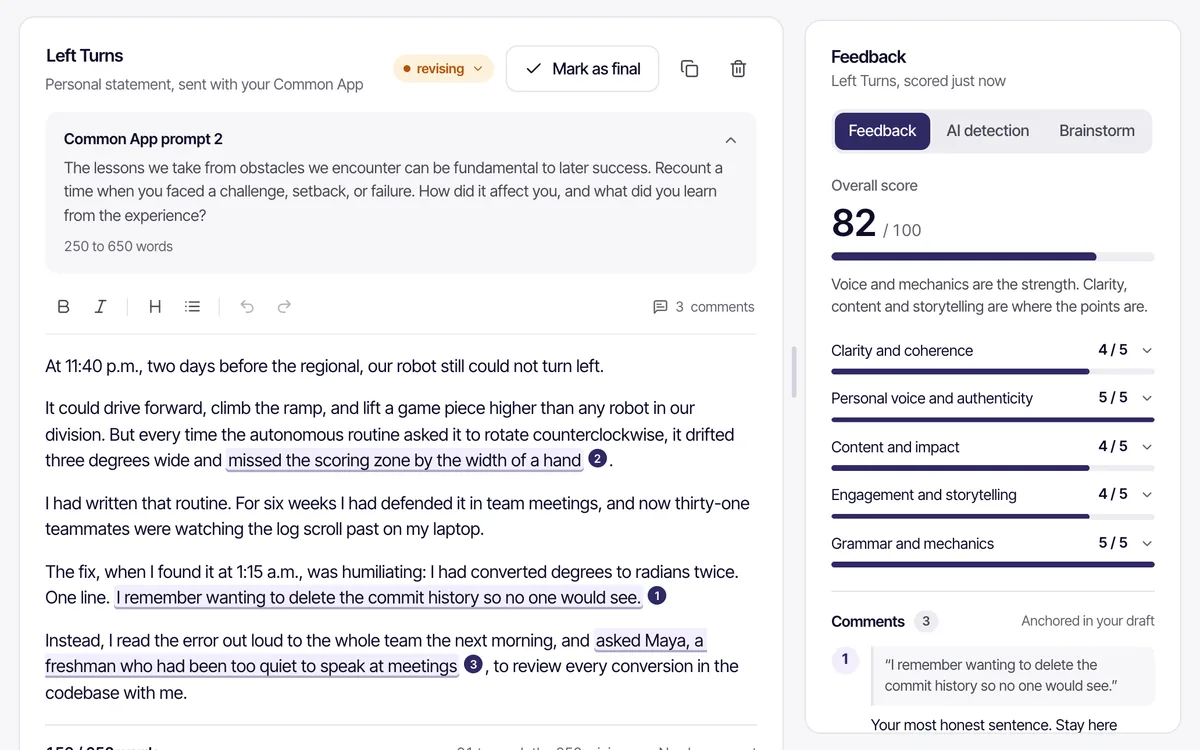
College Admissions is a workspace for drafting your essays. Every revision is scored, commented on and saved, alongside your personal statement and your other schools' supplements.
- A score out of 100 on every draft, broken into five parts, with comments pinned to the sentences they're about
- Brainstorm ideas for any prompt from the activities and awards in your profile
- An AI-detection check before you certify your essays as your own work
- One question answered by an admissions advisor
7-day free trial · From $29/mo after · Cancel anytime
How Penn reads these
In Penn's words, and in its Common Data Set.
Penn's writing page says the short answers show the committee how you consider others, how you think about community, what motivates your academic goals and what draws you to Penn. It asks you to be precise about why you're applying to Penn and why you chose your undergraduate school.
Penn's Common Data Set rates the application essay Very Important, alongside course rigor, GPA, recommendations and character. Test scores are rated Considered. Penn also ended its alumni conversations starting with the 2025–26 cycle, and its 2026–27 requirements list no interview. Penn says the writing section is where you decide what to tell the committee, and that it reads your words carefully.
Penn’s short answer prompts are designed to provide our committee with information we find valuable in understanding how you consider others, how you think about community, what motivates your academic aspirations, and what draws you to Penn.
We like to say, if someone who knows you came across your writing without your name on it, would they know you wrote it?
1. A thank-you note
Write a short thank-you note to someone you have not yet thanked and would like to acknowledge. (We encourage you to share this note with that person, if possible, and reflect on the experience!)
What it's asking
Penn added this prompt in 2022 to bring gratitude into the application. Dean Whitney Soule told applicants then not to overthink it, and wrote that Penn framed the prompt so it could be answered "quickly, briefly, and freely."
Write it as a real note, addressed to the person, in your own voice. After reading the Class of 2027's notes, Penn said they showed students' "openness, receptivity, and generosity." The prompt asks for someone you haven't thanked yet, so pick a person and a moment you've never put into words.
How to answer it
- Choose one person you haven't thanked yet and one specific thing they did.
- Address them directly and tell that one moment, with the details only the two of you would know.
- Say what changed because of them, such as something you now do, believe or try. Penn encourages you to share the note with them if you can.
Mistakes to avoid
- Writing about yourself with the person as a backdrop. Keep the focus on what they did.
- Choosing someone you've already thanked. The prompt asks for someone you have not yet thanked.
- Overthinking it. Penn's Dean wrote that there is no wrong way to respond to this prompt.
Example opening
Dear Mr. Haddad, you probably don't remember the October morning you let me wait in the copy room after I missed my bus again. You handed me a stapler and a stack of programs. It was the first job anyone trusted me with.
Written by Test Ninjas to show the approach. It is not from a real applicant, so don't borrow its details.
Feedback scores personal voice and authenticity on every draft, and the AI-detection check lets you test your note before you submit it.
2. Exploring community at Penn
How will you explore community at Penn? Consider how Penn will help shape your perspective, and how your experiences and perspective will help shape Penn.
What it's asking
This prompt runs in two directions. The second sentence asks how Penn will shape your perspective and how your experiences will shape Penn. An answer that covers only one direction leaves half the prompt unanswered.
Penn's own review questions include "How do you contribute to the communities you are currently part of?" and "How do you hope to contribute to the Penn community?" So start from a community you're part of now, and carry what you do there to a specific place at Penn. Penn's writing tips ask for that kind of detail, such as classes, research, or a group or club you want to join.
How to answer it
- Name one community you belong to now and what you do in it, in two or three sentences.
- Pick one or two specific places at Penn where that would continue, such as a College House, a student group or a program in Philadelphia.
- Use your last lines on the other direction, how being at Penn might change the way you see something.
Mistakes to avoid
- Listing clubs from Penn's website with no link to anything you've done.
- Writing only about what you'll give, or only about what you'll get. The prompt asks for both.
- Repeating your school-specific answer. Keep this one about people and places, and leave your academic plans to the school prompt.
Example opening
In my grandmother's kitchen, Sunday dinner is a debate club with dumplings. I learned to argue without raising my voice and to change my mind out loud. At Penn I want to find that table again in a College House, and save a seat for whoever wasn't invited.
Written by Test Ninjas to show the approach. It is not from a real applicant, so don't borrow its details.
Your Penn drafts sit together with their status in the essays list, next to your personal statement and other schools' supplements, so you can check that your community answer and your school answer tell different stories.
3. School of Nursing: why nursing, and your future in it
Penn Nursing intends to meet the health needs of society in a global and multicultural world by preparing its students to impact healthcare by advancing science. Why are you applying to Nursing, where do you see yourself professionally in the future, and how will you contribute to our mission of promoting equity in healthcare?
What it's asking
The prompt packs three questions into 200 words. Why nursing, where do you see yourself professionally, and how will you contribute to equity in healthcare? Penn reworded this prompt for 2026–27 and kept all three parts, so plan roughly a third of your words for each.
Penn suggests reviewing the school's mission and approach to equity, and Penn Nursing describes itself as a school that "values evidence-based science and health equity." Show that you understand both the science nurses advance and the equity work the prompt names.
How to answer it
- Start with the experience that made nursing, specifically, your choice.
- Name a professional direction, even a tentative one, such as a specialty, a setting or a group of patients you want to serve.
- Tie that direction to one concrete equity problem you've seen or studied, and what you'd do about it.
Mistakes to avoid
- Answering only why you want to help people. Penn also asks where you see yourself and how you'll advance equity.
- Rankings and praise of Penn Nursing. The school knows its reputation.
- A general line about equity with no example behind it.
Example opening
At the free clinic where I volunteer, there is one blood-pressure cuff for the whole building, and the Spanish forms are photocopies of photocopies. I want to be the nurse who fixes the forms first, then studies why the clinic has one cuff.
Written by Test Ninjas to show the approach. It is not from a real applicant, so don't borrow its details.
Feedback scores every draft out of 100 across five parts, including content and impact, so you can tell whether why nursing, your future and equity each get their share of 200 words.
4. College of Arts and Sciences: something you're curious about
The College of Arts and Sciences is designed to foster discovery and connection. Describe something you are curious about—something you'd like to learn more about or find a new approach to—and how you might pursue that curiosity in the College.
What it's asking
This prompt is new for 2026–27. Last year's version asked what you're curious about and how you'd take advantage of the arts and sciences. This one asks you to describe one curiosity and how you might pursue it in the College.
The College also introduced a new curriculum this year, built on Foundations, Distribution and Major requirements. Penn suggests looking at the College's departments and areas of study, so name the courses, departments or research where your question could take shape.
How to answer it
- State the curiosity as a question, specific enough that a professor could tell you where to start.
- Show where it came from and what you've already done to chase it, such as a book, a project or a conversation.
- Point to where you'd pursue it in the College, such as a department, a course, a research program or two fields you'd combine.
Mistakes to avoid
- Naming a whole field ("I'm curious about biology") instead of a question.
- A course list with no thread back to your curiosity.
- Reusing last year's College answer. The prompt changed for 2026–27.
Example opening
Why does the creek behind my school smell different after rain upstream? I've logged readings with a $20 test kit for two years. In the College I want to take that question into earth science labs and environmental history, and find out who decided where the pipes go.
Written by Test Ninjas to show the approach. It is not from a real applicant, so don't borrow its details.
Brainstorm suggests curiosities to write about from the activities and awards in your profile, so you can start from something you've already chased.
5. Wharton: a current issue that matters to you
Wharton prepares its students to make an impact by applying business methods and economic theory to real-world problems, including economic, political, and social issues. Discuss a current issue of importance to you and how you hope a Wharton education would help you explore it.
What it's asking
The prompt has two parts, a current issue that matters to you and how a Wharton education would help you explore it. The issue can be economic, political or social. Penn's framing is real-world problems, so pick something current and concrete.
Wharton says its students learn by starting with "a problem or concrete example" before turning to theory, and 24% of the classes needed to graduate must be taken in Penn's other schools. Lead with the problem, then name the tools and courses you'd use to work on it.
How to answer it
- Pick an issue you've seen up close or followed for a while, narrow enough to explain in two sentences.
- Say why it matters to you, with one fact or moment that shows you've looked into it.
- Connect it to what you'd study, such as a Wharton concentration, a business fundamentals course or courses in Penn's other schools.
Mistakes to avoid
- A huge topic like inequality or climate change with no specific angle.
- Writing about a career plan or a startup idea when the prompt asks about an issue.
- Listing Wharton's rankings or famous alumni.
Example opening
Our corner pharmacy closed in March, and my neighbor now takes two buses for insulin. I mapped every pharmacy that closed near me and found the same pattern of rent and reimbursement. At Wharton I want to learn why pharmacy margins collapse, and what keeps survivors open.
Written by Test Ninjas to show the approach. It is not from a real applicant, so don't borrow its details.
Feedback scores clarity and coherence on every draft and anchors comments to the sentences that drift from your issue into general praise of Wharton.
6. Penn Engineering: your intended major
Penn Engineering prepares its students to become leaders in technology by combining a strong foundation in the natural sciences and mathematics with depth of study in focused disciplinary majors. Describe how you plan to pursue your engineering interests at Penn, particularly within the intended major you selected.
What it's asking
The prompt points to the intended major you selected on your application, so this answer should be about that major in particular. Penn suggests reviewing your major's curriculum for specific courses, labs or research opportunities that connect to your interests.
Penn Engineering offers 11 undergraduate majors and two degrees, the Bachelor of Science in Engineering and the Bachelor of Applied Science. Saying where your interest sits among them, and what you'd do in that major, shows you've done that reading.
How to answer it
- Start with the engineering problem or project that drew you to this major.
- Name two or three specifics from the major's curriculum, such as a course, a lab or a research group.
- End with what you'd want to build or study by graduation.
Mistakes to avoid
- Writing about engineering in general when the prompt asks about your selected major.
- Dropping professors' names without saying what you'd do with their work.
- Rehashing your activities list. Use one project and what it taught you.
Example opening
My first solar charger melted its own wires. Fixing it taught me more about heat than any class had. In electrical engineering at Penn I want to study power systems that fail safely, and take the lab courses that would let me design one.
Written by Test Ninjas to show the approach. It is not from a real applicant, so don't borrow its details.
Feedback scores engagement and storytelling on every draft, so you can see whether your project reads as a story or as a list of parts.
Plan all three together
Three short answers, each with its own job. The easiest way to waste words is telling the same story twice.
| Question | What the answer should show |
|---|---|
| 1. A thank-you note | Whom you notice, and how you say thank you |
| 2. Exploring community at Penn | Where you'd belong at Penn, and what you'd bring to it |
| 3. School of Nursing: why nursing, and your future in it | Why nursing, where you're headed, and how you'd make care fairer |
| 4. College of Arts and Sciences: something you're curious about | What you wonder about, and where you'd chase it at Penn |
| 5. Wharton: a current issue that matters to you | A real problem you care about, and how you'd study it |
| 6. Penn Engineering: your intended major | What you'd study in your major, and why |
Give each answer its own territory. The thank-you note is about another person, the community answer is about people and places at Penn, and the school answer is about what you'd study. Penn asks you to be precise about why Penn and why your school, so split that work between the last two without repeating yourself.
Penn says you don't need to summarize the rest of your application in your short answers. Use them for what the committee can't see anywhere else. Treat 200 words as a ceiling. Penn lowered the minimum from 150 to 50 words this year and kept the maximum.
Penn's integrity page allows help, including AI tools used to organize your thoughts or check your grammar, and rules out responses an AI tool generated. Penn's simple test is whether you could explain, in a conversation, how you arrived at what you wrote.
Score a Penn answer for free
Pick the question, paste your draft, and get a scored review against the 200-word limit. No account needed for your first two reviews.
Frequently asked questions
How many supplemental essays does Penn have?
Three for most applicants. Every first-year applicant answers the thank-you note and the community prompt, plus one prompt for the undergraduate school they apply to. Each is 50 to 200 words, so up to 600 words in all. Applicants to coordinated dual-degree and specialized programs add one to three program essays.
What are the Penn supplemental essay word limits?
50 to 200 words for each of the three prompts. Last year the range was 150 to 200, so Penn lowered the minimum for 2026–27 and kept the maximum.
Is there a "Why Penn" essay?
Not by that name. Penn asks you to be precise about why you're applying to Penn and to your chosen school, and the community prompt and your school prompt are where that goes. Penn's tips ask for specifics such as classes, research opportunities and groups you want to join.
Did the Penn supplemental essays change for 2026–27?
Partly. The thank-you note and community prompts keep their wording, and each now runs 50 to 200 words instead of 150 to 200. The College of Arts and Sciences prompt is new, the Nursing, Wharton and Engineering prompts were reworded, and the dual-degree program essays changed.
Which school prompt do I answer if I'm applying to a dual-degree program?
The prompt for your single-degree school choice. Penn says your interest in the coordinated dual-degree or specialized program belongs in that program's own essays.
Can I use AI for my Penn essays?
For help, yes. Penn says using a tool, including an AI tool, to organize your thoughts or check your grammar doesn't compromise your application, while submitting responses an AI tool generated would. Penn's test is whether you could explain how you arrived at what you wrote, in your own words.
Does Penn have an interview?
No. Penn ended its optional alumni conversations starting with the 2025–26 cycle, and its 2026–27 application requirements list none. Penn says it reads your writing carefully.
Do I have to send the thank-you note to the person?
No. Penn encourages you to share the note with that person, if possible, and reflect on the experience. What's required is submitting it with your application.
Penn's essays are due January 5
Draft all three with feedback on every revision, check each one for AI before you submit, and keep every school's essays in one place.
7-day free trial · From $29/mo after · Cancel anytime
Next: Penn deadlines and decision dates
Sources
Every date, number and prompt on this page comes from these pages, checked November 26, 2026. Admissions offices can change details during the cycle, so confirm anything time-sensitive on Penn's own site.
- Penn Admissions: Writing (2026-27 Short Answer and Essay Prompts)
- Penn Admissions: Application Requirements
- Penn Admissions: What's Changing for Penn's 2026-2027 Application
- Penn Admissions: Preparing Your Application (comprehensive review)
- Penn Admissions: Integrity and AI Use in the Admissions Process
- University of Pennsylvania Common Data Set 2025–26 (PDF) (linked from Penn Institutional Research & Analysis; dated June 2026)
- Penn Admissions writing page with 2025-26 prompts, November 2025 (Internet Archive)
- Penn Admissions Blog: Opening a new application cycle with gratitude (Aug 1, 2022)
- Penn Admissions Blog: Welcome, Admitted Class of 2027! (Mar 30, 2023)
- Wharton Undergraduate: Flexible curriculum
- Penn Engineering: Undergraduate programs
- Penn Nursing: Learn about Penn Nursing (BSN application)
- The Daily Pennsylvanian: Penn to end alumni admissions conversations for upcoming application cycle (Jul 18, 2025)
- The Daily Pennsylvanian opinion: Penn stopped talking to its applicants (Aug 27, 2026) (opinion column; confirms the interview was still discontinued)