Cornell supplemental essays, 2026–27
Cornell dropped its university-wide essay for 2026–27, so you answer only the prompts for the one college or school you apply to. That means one to six essays and 550 to 1,000 words, depending on the college. Below is every prompt word for word, with what it's asking, how to answer it, and a place to get feedback on your draft.
Cornell's 2026–27 questions
Grouped by college. Find yours and answer only those prompts; there is no university-wide question this year.
- What interests you about the major you selected? Tell us about experiences (both in and outside of the classroom), questions, and goals that influenced your choice.Up to 350 words
- What draws you to Cornell’s College of Agriculture and Life Sciences (CALS)? Reflect on the learning, community, or impact opportunities that matter most to you, and share how they align with Cornell CALS (as you understand it currently).Up to 350 words
- Describe how your interests connect to architecture. Include an example of a creative project, design experience, or personal passion that sparked your interest in pursuing a 5-year professional degree in architecture. Reflect on how this experience shaped your understanding of the field and your motivation to study architecture.Up to 650 words
- Submit an artist statement describing your creative interests and practice. Address how your work reflects your artistic voice, influences, and process, and how studying art at Cornell AAP would support and expand your practice. (You will also be prompted to upload a copy to your Slideroom portal.)Up to 650 words
- Describe your interest in urban and regional studies. Discuss experiences, ideas, or issues that have shaped your interest in cities, communities, and regional systems, and explain how URS at Cornell aligns with your academic and career goals.Up to 650 words
- At the College of Arts and Sciences, your education is yours to shape. Describe an intellectual passion, question, or idea that has captured your attention—whether it emerges from your studies or extends beyond your coursework. What specific aspects of our liberal arts curriculum would you draw on to explore and connect your varied interests?Up to 650 words
- Discuss your interest in pursuing a major in policy at the Cornell Jeb E. Brooks School of Public Policy and what draws you to this field of study. You are encouraged to consider including details related to your personal experiences, values, academic influences, or extracurricular activities that have shaped your perspective and future goals.Up to 650 words
- Please describe why you are interested in being considered for the Brooks School DC Start program.Up to 350 words
- What kind of a business student are you? Using your personal, academic, or volunteer/work experiences, describe the topics or issues that you care about and why they are important to you. Your response should convey how your interests align with the school to which you are applying within the Cornell SC Johnson College of Business (Charles H. Dyson School of Applied Economics and Management or the Cornell Peter and Stephanie Nolan School of Hotel Administration).Up to 650 words
- Fundamentally, engineering is the application of math, science, and technology to solve complex problems. Why do you want to study engineering?Up to 200 words
- Why do you think you would love to study at Duffield Engineering?Up to 200 words
- What brings you joy?Up to 100 words
- What do you believe you will contribute to the Duffield Engineering community beyond what you've already detailed in your application? What unique voice will you bring?Up to 100 words
- What is one activity, club, team, organization, work/volunteer experience, or family responsibility that is especially meaningful to you? Please briefly tell us about its significance for you.Up to 100 words
- What is one award you have received, or achievement you have attained, that has meant the most to you? Please briefly describe its importance to you.Up to 100 words
- The College of Human Ecology prepares students to respond to human needs through an education organized around the interconnected issues that profoundly affect individuals, communities, and the institutions that shape our lives. Think about an extracurricular/community engagement/work experience that most closely connects you to the CHE mission and your intended choice of major. Tell us what that experience taught you about your broader community and its needs, and the impact you can make. How will your intended CHE major help you make that impact? (Refer to our essay application tips as you write your essay.)Up to 550 words
- Using your personal, academic, or volunteer/work experiences, describe the topics or issues that you care about and why they are important to you. Your response should show us that your interests align with the ILR School.Up to 650 words
Copied from Cornell's enrollment FAQ "What are the essay questions for the Fall 2027 application?" and checked against each college's admissions page. Where the two differ slightly in wording, we use the FAQ, which names the Fall 2027 cycle. Cornell
Write your Cornell essays with feedback on every draft
College Admissions is a workspace for drafting your essays. Every revision is scored, commented on and saved, alongside your personal statement and your other schools' supplements.
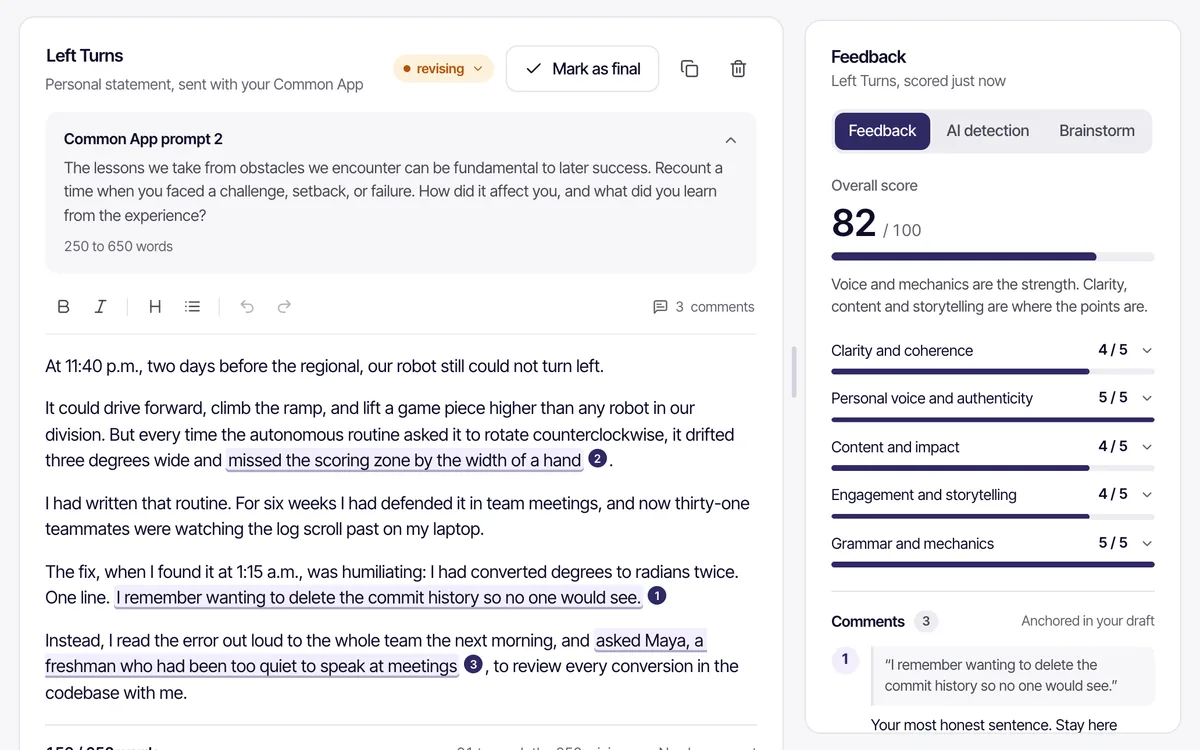
- A score out of 100 on every draft, broken into five parts, with comments pinned to the sentences they're about
- Brainstorm ideas for any prompt from the activities and awards in your profile
- An AI-detection check before you certify your essays as your own work
- One question answered by an admissions advisor
7-day free trial · From $29/mo after · Cancel anytime
How Cornell reads these
In Cornell's words, and in its Common Data Set.
Cornell removed its 350-word university-wide question for 2026–27 because, its director of undergraduate admissions told The Sun, the college-specific essays were enough to show a student's fit. Each college's readers want to know why their program, and why you.
Cornell's Common Data Set rates the application essay "Very Important", the same as rigor, recommendations, activities, talent and character. Cornell doesn't track demonstrated interest. Its FAQ says applicants can show their fit and interest through the essay questions in the application.
Researching this and expressing your interest in one of the colleges/schools through the program-specific essay is one of the most important parts of your application to Cornell.
Understanding the college or school you want to attend — including its curriculum, academic areas, and educational approach — will help in writing your college-specific essay.
1. CALS question 1: Why your major
What interests you about the major you selected? Tell us about experiences (both in and outside of the classroom), questions, and goals that influenced your choice.
What it's asking
CALS admits you directly into one of its 20-plus majors, so this answer is about that major. Last year CALS asked a single 500-word question. For 2026–27 it splits the major and the college into two 350-word answers, and this is the major half.
The prompt names three kinds of evidence: experiences in and outside class, questions, and goals. Questions count. CALS says its strongest candidates have many interests, often spread across more than one CALS major, so an open question you're still chasing is worth showing.
How to answer it
- Start with one specific experience that pulled you toward the major: a lab, a job, a garden, a data set.
- Name the question it left you with, and what you've done since to chase it.
- Finish with a goal and how this major's training gets you there.
Mistakes to avoid
- Describing the major in general terms. CALS knows what its majors are.
- Spending words on why CALS. Question 2 asks that, so keep the college pitch there.
- A list of activities with no thread between them.
Example opening
The test strips said our well water was fine. The tomatoes disagreed. Two summers of soil tests later, I still can't explain why my grandmother's plot yields half what the neighbor's does. That unanswered question is why I chose a plant science major.
Written by Test Ninjas to show the approach. It is not from a real applicant, so don't borrow its details.
Brainstorm suggests angles for this question from the activities and awards in your profile, so you can see which one best explains your choice of major.
2. CALS question 2: Why CALS
What draws you to Cornell’s College of Agriculture and Life Sciences (CALS)? Reflect on the learning, community, or impact opportunities that matter most to you, and share how they align with Cornell CALS (as you understand it currently).
What it's asking
This is the why-CALS answer. The prompt lists three kinds of opportunity, learning, community and impact, and asks which matter most to you. One or two, explored properly, beat a quick tour of all three.
"As you understand it currently" tells you CALS isn't expecting expertise. It wants evidence you've looked. CALS's page suggests hearing from current students, including its CALS Ambassadors, as you work out your reasons for applying, and it lists your reasons for choosing CALS among the things it weighs.
How to answer it
- Choose the one or two opportunities that matter most to you and say why in a sentence each.
- Tie each to something real at CALS that you found on its own pages or heard from its students.
- Say what you'd bring to that part of CALS, so the match runs both ways.
Mistakes to avoid
- Praise that would fit any college, like "world-class faculty."
- Repeating question 1. That answer covered your major; this one covers the college around it.
- A list of ten resources with no reason attached to any of them.
Example opening
I've spent three summers at a farmers market where half the vendors are over seventy. When CALS described its work as meeting the needs of communities near and far, I pictured our market in ten years, and the part I want to play in keeping it open.
Written by Test Ninjas to show the approach. It is not from a real applicant, so don't borrow its details.
Feedback scores content and impact on every draft and anchors comments to the sentences that could describe any college, so you know what to replace.
3. Architecture (B.Arch)
Describe how your interests connect to architecture. Include an example of a creative project, design experience, or personal passion that sparked your interest in pursuing a 5-year professional degree in architecture. Reflect on how this experience shaped your understanding of the field and your motivation to study architecture.
What it's asking
AAP now gives each of its three majors its own prompt. This one has three parts: how your interests connect to architecture, one example that sparked that interest, and what the example taught you about the field. The example is required, so pick one you can describe in detail.
B.Arch is a five-year professional degree, and AAP's page says applicants should present evidence of creative ability and commitment to the field. You also submit a 15–20 slide portfolio and a recorded video interview of up to three minutes by the application deadline, answering three set questions, including why you want to study architecture. Let the essay go deeper than the video can.
How to answer it
- Pick one project or experience and tell it in enough detail that a reader can picture the work.
- Say what it changed in how you see buildings, cities or design.
- End with why a five-year professional degree, beyond a general interest in design.
Mistakes to avoid
- Retelling your portfolio slide by slide.
- Starting with a childhood love of building blocks and staying there.
- Writing about famous buildings instead of your own work.
Example opening
The bus shelter outside my school had a roof that dripped onto the bench. I spent a semester tracking where people actually stood, then built a cardboard model with the bench moved two feet. Nobody rebuilt the shelter, but I stopped seeing buildings as finished.
Written by Test Ninjas to show the approach. It is not from a real applicant, so don't borrow its details.
Your Cornell draft sits in the essays list with its status, next to your personal statement, so you can check the two don't tell the same design story.
4. Fine Arts (BFA)
Submit an artist statement describing your creative interests and practice. Address how your work reflects your artistic voice, influences, and process, and how studying art at Cornell AAP would support and expand your practice. (You will also be prompted to upload a copy to your Slideroom portal.)
What it's asking
This is an artist statement, and it's new for 2026–27. It asks for your creative interests and practice, then three things about your work: voice, influences and process. The last part asks how AAP's art program would support and expand what you do. You also upload the statement to SlideRoom with your portfolio.
AAP lists what it looks for in BFA applicants: form, content, rigor, drive, empathy and passion. Form and content line up with this prompt: a visual language informed by who you are, and a creative voice informed by your ideas and experiences.
How to answer it
- Describe what you make and why, in plain language, with one or two pieces as anchors.
- Name real influences and say what you took from each.
- Close with what you want to try at Cornell. AAP describes its BFA students as both artists and scholars who take courses across the university, so classes outside the studio count.
Mistakes to avoid
- Art-world jargon that hides what you actually do.
- A statement that doesn't match the portfolio it's uploaded with.
- Influences listed as names with nothing about what you learned from them.
Example opening
I paint on the backs of receipts from my mother's store because the paper fades within a year. My work is about what we keep and what we let go of. Lately I scan the receipts before they vanish, and I want to learn what printmaking can do with that.
Written by Test Ninjas to show the approach. It is not from a real applicant, so don't borrow its details.
Feedback scores clarity and coherence and personal voice on every draft, which is where artist statements tend to slip into jargon.
5. Urban and Regional Studies (URS)
Describe your interest in urban and regional studies. Discuss experiences, ideas, or issues that have shaped your interest in cities, communities, and regional systems, and explain how URS at Cornell aligns with your academic and career goals.
What it's asking
Two halves: what shaped your interest in cities, communities and regional systems, and how URS at Cornell fits your academic and career goals. "Regional systems" is a hint that URS looks past a single city to how places connect.
AAP says it pays particular attention to how URS applicants articulate their interest in urban and regional themes, and above all looks for enthusiasm and curiosity about urban and regional issues. Its page describes social science methods and hands-on work with residents beyond the classroom.
How to answer it
- Open with a place you know and an issue in it you've watched up close: housing, transit, a closed factory, a flood plan.
- Show how you've looked into it: a conversation, a map, some data, a public meeting.
- Tie it to URS's methods and community work, then to the goal you're aiming at.
Mistakes to avoid
- General statements about cities being exciting.
- Dropping the regional part when your story has one.
- A career goal with no link to the experiences above it.
Example opening
Our county's only bus route stops at the mall and not the hospital. I learned this sitting next to a neighbor who rides two hours each way for dialysis. I started mapping routes against clinic addresses, and the gaps looked less like accidents than decisions.
Written by Test Ninjas to show the approach. It is not from a real applicant, so don't borrow its details.
Brainstorm draws ideas for this prompt from the activities in your profile, such as volunteering, jobs or local projects that touch housing, transit or planning.
6. Arts and Sciences: An intellectual passion
At the College of Arts and Sciences, your education is yours to shape. Describe an intellectual passion, question, or idea that has captured your attention—whether it emerges from your studies or extends beyond your coursework. What specific aspects of our liberal arts curriculum would you draw on to explore and connect your varied interests?
What it's asking
New wording for 2026–27. Two parts: one passion, question or idea that has caught you, and the specific parts of the A&S curriculum you'd use to explore it and connect it to your other interests.
"Connect" is the key word. A&S says you pick up to two areas of interest on the application, don't declare a major until the end of sophomore year, and do much of your coursework outside your major. The prompt asks how you'd use that freedom.
How to answer it
- Pick one question or idea and show where it came from and what you've done with it.
- Name two or three parts of A&S you'd use, such as a second field, a minor, research or study abroad, and say what each adds.
- Show how a second interest changes the way you'd chase the first.
Mistakes to avoid
- Listing majors without saying what joins them.
- Writing a career plan. The prompt asks about ideas.
- Course names you haven't looked up.
Example opening
Why does my grandmother count in Tagalog but argue in English? I asked her, then my Spanish teacher, then a linguistics podcast. The answers pulled me toward linguistics and psychology at once, and I want a college where I don't have to choose.
Written by Test Ninjas to show the approach. It is not from a real applicant, so don't borrow its details.
Feedback scores engagement and storytelling and content and impact on each draft, with comments on the sentences where the curriculum half goes vague.
7. Brooks School: Why policy
Discuss your interest in pursuing a major in policy at the Cornell Jeb E. Brooks School of Public Policy and what draws you to this field of study. You are encouraged to consider including details related to your personal experiences, values, academic influences, or extracurricular activities that have shaped your perspective and future goals.
What it's asking
New wording for 2026–27. It asks about your interest in a policy major at Brooks and what draws you to the field, and suggests four kinds of evidence: experiences, values, academic influences and activities.
Brooks has two majors, Public Policy and Health Care Policy. Its page says successful applicants clearly explain why they're drawn to public policy broadly and to their chosen major specifically, and have reflected on how Brooks fits their values and goals.
How to answer it
- Start with a policy problem you've seen up close and what it showed you.
- Say which Brooks major you're choosing and why that one.
- End with the perspective or goal the major would build on.
Mistakes to avoid
- Writing about politics or a campaign without getting to policy.
- Skipping the major. Brooks asks about both the field and your chosen major.
- Big promises about fixing the system without a specific problem.
Example opening
When our district cut the late bus, kids from my apartment complex started missing practice, then class. I spent junior year organizing rides and counting who was left out. The district restored one route. I want to learn why it took a spreadsheet to make the obvious count.
Written by Test Ninjas to show the approach. It is not from a real applicant, so don't borrow its details.
Policy essays tend to make a case. Feedback scores clarity and coherence and content and impact on each draft, so you can see whether yours holds together.
8. Brooks School: DC Start
Please describe why you are interested in being considered for the Brooks School DC Start program.
What it's asking
New for 2026–27, and only for Brooks applicants who indicate DC Start on the Common App. DC Start is a first-semester residential program in Washington, D.C., for incoming Public Policy and Health Care Policy majors, with a full semester of Brooks coursework and a project with a community policy partner.
So the question is why you'd want to start college in Washington rather than Ithaca, and what you'd do with that semester.
How to answer it
- Name what you want from a semester in Washington that campus can't offer.
- Connect it to the policy problem in your main Brooks essay without repeating it.
- Mention the partner project and the kind of work you'd want to do on it.
Mistakes to avoid
- Writing about the city's sights.
- Repeating your main essay.
- Treating it as an internship. DC Start is a full semester of coursework, with a project alongside.
Example opening
I've read every state hearing transcript on our water rates, but I've never watched a bill move. Starting in Washington, I'd see the process I've only read about, and I'd want my partner project to be with a group working on utility costs for renters.
Written by Test Ninjas to show the approach. It is not from a real applicant, so don't borrow its details.
The essays list shows your Brooks drafts together with their status, so you can check the DC Start answer adds something the main essay doesn't.
9. SC Johnson College of Business (Dyson or Nolan)
What kind of a business student are you? Using your personal, academic, or volunteer/work experiences, describe the topics or issues that you care about and why they are important to you. Your response should convey how your interests align with the school to which you are applying within the Cornell SC Johnson College of Business (Charles H. Dyson School of Applied Economics and Management or the Cornell Peter and Stephanie Nolan School of Hotel Administration).
What it's asking
The same prompt as last year. You apply to one school, Dyson (Applied Economics and Management) or Nolan (Hotel Administration), and the answer has to fit that school.
Both schools say they like to see students who articulate a strong match with the school's mission and opportunities. Dyson stresses making a positive impact in your community or globally. Nolan notes that about half its first-year students have work or service experience. Both also require a resume, so the essay doesn't need to repeat it.
How to answer it
- Answer the first question directly: what kind of business student are you? One sentence you'll then prove.
- Back it with one or two experiences and the issue you care about inside them.
- Tie that issue to the mission of Dyson or Nolan specifically.
Mistakes to avoid
- A business essay you could send to any school.
- Mixing up the two schools, or writing about both.
- Retelling your resume line by line.
Example opening
I'm the business student who reads the back of the menu. At my aunt's diner I learned the food cost of every plate, and why the cheapest one loses money. Hospitality, to me, is the math under the warmth, and I want to learn both at Nolan.
Written by Test Ninjas to show the approach. It is not from a real applicant, so don't borrow its details.
Brainstorm reads the jobs, activities and awards in your profile and suggests angles for this prompt, so your answer can lean on experience the resume only lists.
10. Duffield Engineering long essay 1: Why engineering
Fundamentally, engineering is the application of math, science, and technology to solve complex problems. Why do you want to study engineering?
What it's asking
Duffield applicants write six answers: two long essays of up to 200 words and four short answers of up to 100. They're the same six questions as last year, now under the Duffield name. This first one asks why engineering, using Duffield's own definition: math, science and technology applied to complex problems.
First-year Duffield students start a common curriculum and apply to a major in their second year, so you don't need a branch yet. Duffield says it's interested in how you approach complex questions and explore new ideas.
How to answer it
- Open with a problem you tried to solve and the math or science you used.
- Say what solving it, or failing to, taught you about how you like to think.
- End with what you want to learn to do next.
Mistakes to avoid
- Leading with salary or a job title.
- A childhood fascination with no recent evidence.
- Spending words restating the definition in the prompt.
Example opening
Our robotics arm kept dropping the cup at the same angle. It took three weeks and a lot of trigonometry to find out the gripper flexed under load. To me, engineering is being wrong in a measurable way until you aren't.
Written by Test Ninjas to show the approach. It is not from a real applicant, so don't borrow its details.
Feedback scores every draft out of 100 and comments on specific sentences, so you can see which lines earn their place in a 200-word answer.
11. Duffield Engineering long essay 2: Why Duffield
Why do you think you would love to study at Duffield Engineering?
What it's asking
This is the why-Cornell answer for engineers. The wording, "love to study," is warm on purpose, and it asks about fit.
Duffield asks applicants how they'd use Cornell's interdisciplinary opportunities and collaborative culture, and describes a community grounded in excellence, purpose, innovation, communication and collaboration. Its page also describes Global Start Cantabria, where a small group of first-years spends the first semester in Santander, Spain.
How to answer it
- Pick two specifics you'd actually use, such as the common first-year curriculum or Global Start Cantabria.
- Say what each would let you do that you can't do now.
- Show how you'd add to the collaborative culture Duffield describes.
Mistakes to avoid
- Prestige or rankings as the reason.
- Specifics you haven't checked on Duffield's own pages.
- Repeating the why-engineering answer.
Example opening
I build better in a group than alone, which I learned the hard way when my solo drone project sat in pieces for a month. Duffield's common first year means I'd work beside future chemical and civil engineers before I pick a major, and that's the mix I want.
Written by Test Ninjas to show the approach. It is not from a real applicant, so don't borrow its details.
The essays list keeps all six Duffield drafts together with their status, next to your personal statement, so you can spot a story told twice.
12. Duffield short answer 1: What brings you joy?
What brings you joy?
What it's asking
The shortest prompt Cornell has, and the most open. In 100 words it's a chance to show a side of you the rest of the application doesn't.
Duffield says your involvement outside class reveals your passions and commitments, and that there is no right or wrong activity. Joy doesn't have to be about engineering.
How to answer it
- Pick one specific joy. Small is fine: a sound, a routine, a person, a place.
- Show it in a moment instead of a summary.
- Let one sentence say why it matters to you.
Mistakes to avoid
- Turning it into another engineering essay.
- A list of five things in 100 words.
- Abstractions like "learning" or "helping others" with no scene.
Example opening
Saturday mornings, my little brother and I take apart whatever the neighbors left on the curb. Last week it was a toaster. He names every part he doesn't know. I've stopped correcting him, because his names are better.
Written by Test Ninjas to show the approach. It is not from a real applicant, so don't borrow its details.
Feedback scores personal voice and authenticity on each draft, and the AI-detection check runs on any draft before you submit.
13. Duffield short answer 2: What you'll contribute
What do you believe you will contribute to the Duffield Engineering community beyond what you've already detailed in your application? What unique voice will you bring?
What it's asking
Note "beyond what you've already detailed." This answer is for something new: a perspective, a habit, a background, a role you play in groups.
Duffield says it wants to understand how you engage with others and embrace diverse perspectives. Your voice is what you'd add to a team or a classroom.
How to answer it
- Name one thing you'd bring that isn't in your activities list.
- Give one example of it in action.
- Say where it would show up at Duffield: a team, a study group, a dorm.
Mistakes to avoid
- Repeating your biggest activity.
- Claiming a voice without showing it.
- Generic traits like "hard-working."
Example opening
I'm the one who asks the dumb question. On my physics team, I asked why we assumed no friction. The room went quiet, then we redid the problem. I'll bring that question to every Duffield study group, along with the snacks.
Written by Test Ninjas to show the approach. It is not from a real applicant, so don't borrow its details.
Brainstorm suggests ideas from your profile, which also shows you what's already covered, so this answer can go somewhere new.
14. Duffield short answer 3: A meaningful activity
What is one activity, club, team, organization, work/volunteer experience, or family responsibility that is especially meaningful to you? Please briefly tell us about its significance for you.
What it's asking
Pick one. The prompt's list is broad on purpose: jobs, volunteering and family responsibilities count the same as clubs, and Duffield's page lists family responsibilities among the involvement it looks at.
The question asks what the activity means to you. What you accomplished is already in your activities list.
How to answer it
- Choose the activity with the best story, even if it isn't the biggest title.
- Open with a specific moment from it.
- Spend the last sentence or two on why it matters.
Mistakes to avoid
- Repeating the activity's description from your activities list.
- Picking the most impressive activity if it isn't the most meaningful.
- Covering two activities in 100 words.
Example opening
Every Tuesday I pick up my sister from daycare and we take the long way home past the train yard. She's four and wants to know how everything works. Explaining couplings to a four-year-old is the best engineering training I've had.
Written by Test Ninjas to show the approach. It is not from a real applicant, so don't borrow its details.
Feedback scores engagement and storytelling on every revision and points to the sentences that summarize where they could show.
15. Duffield short answer 4: An award or achievement
What is one award you have received, or achievement you have attained, that has meant the most to you? Please briefly describe its importance to you.
What it's asking
The prompt says award or achievement, so it doesn't need to be a prize. A first paycheck or finally passing a hard class counts.
The question is what it meant to you. Your awards list already says what you won.
How to answer it
- Pick the one that meant the most, even if it's not the biggest.
- Say in a sentence what it took to get there.
- Say why it matters to you now.
Mistakes to avoid
- Picking the biggest award by default.
- Listing other awards in passing.
- Describing the competition instead of what it meant.
Example opening
My proudest result is a C-plus. I failed the first chemistry test of sophomore year, then went to office hours every week until May. The C-plus on the final was the first grade I'd fully earned. I still go to office hours.
Written by Test Ninjas to show the approach. It is not from a real applicant, so don't borrow its details.
Brainstorm reads the awards and activities saved in your profile and suggests which could carry this answer, including ones that aren't prizes.
16. Human Ecology: An experience tied to the CHE mission
The College of Human Ecology prepares students to respond to human needs through an education organized around the interconnected issues that profoundly affect individuals, communities, and the institutions that shape our lives. Think about an extracurricular/community engagement/work experience that most closely connects you to the CHE mission and your intended choice of major. Tell us what that experience taught you about your broader community and its needs, and the impact you can make. How will your intended CHE major help you make that impact? (Refer to our essay application tips as you write your essay.)
What it's asking
New for 2026–27, with a 550-word limit, down from 600. It asks for one experience outside class that connects you to CHE's mission and your intended major, then three things: what it taught you about your community's needs, the impact you can make, and how your CHE major helps you make it.
CHE's October 2026 tips say to answer directly and specifically in the context of CHE's mission and your choice of major, and to use your own voice, not generic templates. Its requirements page says competitive candidates show a strong, clearly articulated connection to the college mission.
How to answer it
- Choose one experience and tell it briefly.
- Spend the most words on what it taught you about a community's needs.
- Close by naming your CHE major and how it would help you make the impact you described.
Mistakes to avoid
- An experience with no link to your intended major.
- Writing about yourself and leaving out the community.
- A template essay. CHE asks for your own voice and point of view.
Example opening
At the food pantry, I noticed families skipped the fresh produce. It wasn't taste. Half of them had no working stove. That's when nutrition stopped being about food for me and became about kitchens, rent and time, and why I want to study it at Human Ecology.
Written by Test Ninjas to show the approach. It is not from a real applicant, so don't borrow its details.
Feedback scores content and impact and clarity on each draft, and its sentence-level comments show where the mission or major link goes missing.
17. ILR School: Issues you care about
Using your personal, academic, or volunteer/work experiences, describe the topics or issues that you care about and why they are important to you. Your response should show us that your interests align with the ILR School.
What it's asking
The same prompt as last year. It asks for the issues you care about, drawn from your own experience, and then for the link to ILR, which studies people and policies in the workplace.
ILR says no activity or club matters more than others, because every experience requires you to work with people. What matters most is how your experiences helped you understand the importance of ILR topics, which its page lists as ranging from leadership and the impact of technology on work to negotiations and workers' rights.
How to answer it
- Start with an experience at work, school or home where people, power or fairness came into it.
- Name the issue it raised and why you care.
- Connect it to what ILR studies. ILR suggests reviewing course offerings in all of its departments.
Mistakes to avoid
- A general essay on fairness with no workplace angle.
- Leaving out the ILR link the prompt asks for.
- Assuming only a labor-union story counts.
Example opening
My manager at the pizza place scheduled closers to open the next morning, every week. Nobody complained, because everyone needed the hours. I started tracking our shifts in a notebook. I wanted to know why a schedule could feel like a policy.
Written by Test Ninjas to show the approach. It is not from a real applicant, so don't borrow its details.
If you're adapting an issues essay for several schools, the essays list shows each school's drafts and status next to your personal statement, so ILR gets its own version.
Plan your Cornell essays
Most of the work is choosing the right college and writing for its readers.
| Question | What the answer should show |
|---|---|
| 1. CALS question 1: Why your major | What draws you to your major, in your own experience |
| 2. CALS question 2: Why CALS | Which parts of CALS you'd use, and why they fit you |
| 3. Architecture (B.Arch) | Why architecture, through one piece of your own work |
| 4. Fine Arts (BFA) | Your voice, influences and process as an artist |
| 5. Urban and Regional Studies (URS) | The issue that pulls you to cities and regions, and where URS fits |
| 6. Arts and Sciences: An intellectual passion | A real intellectual interest, and how you'd build on it in A&S |
| 7. Brooks School: Why policy | Why policy, and why your Brooks major |
| 8. Brooks School: DC Start | Why you want to start your policy education in Washington |
| 9. SC Johnson College of Business (Dyson or Nolan) | Your business interests, and why Dyson or Nolan fits them |
| 10. Duffield Engineering long essay 1: Why engineering | How you think about problems, and why engineering |
| 11. Duffield Engineering long essay 2: Why Duffield | What you'd do at Duffield, specifically |
| 12. Duffield short answer 1: What brings you joy? | Something you love that the rest of the application doesn't show |
| 13. Duffield short answer 2: What you'll contribute | What you'd add to Duffield that isn't on your list |
| 14. Duffield short answer 3: A meaningful activity | Why one activity matters to you |
| 15. Duffield short answer 4: An award or achievement | What achievement means to you |
| 16. Human Ecology: An experience tied to the CHE mission | How one experience ties your community, your major and CHE's mission together |
| 17. ILR School: Issues you care about | The workplace issues you care about, and why ILR fits |
Choose your college first. You apply to one, and your prompts, word counts and readers all follow from it. Cornell's advice is to research that college's curriculum, academic areas and approach before you write, and it warns that choosing a college for its acceptance rate can work against you.
The Cornell supplement is a separate, second submission inside the Common App. You can send it after the Common App, but Cornell encourages you to submit it by the deadline, so check that both went through. Cornell offers no personal interviews except the recorded video B.Arch applicants submit, which makes these essays the main place you speak for yourself.
Cornell's policy allows AI for researching colleges, brainstorming topics and checking grammar and spelling. It rules out AI that outlines, drafts, writes or translates your responses, and any person writing or rewriting them, and you agree to that when you submit. Use feedback to find weak spots, then do the rewriting yourself.
Score a Cornell answer for free
Pick the question, paste your draft, and get a scored review against the 350-word limit. No account needed for your first two reviews.
Frequently asked questions
How many supplemental essays does Cornell have?
It depends on your college. Duffield Engineering asks six: two of up to 200 words and four of up to 100. CALS asks two of up to 350 words. Every other college asks one, from 550 to 650 words, plus a 350-word DC Start answer for Brooks applicants who want that program.
Does Cornell still have a university-wide essay?
No. Cornell removed its 350-word university-wide question for 2026–27. Its director of undergraduate admissions told The Cornell Daily Sun that the college-specific essays were enough to show a student's fit.
Is there a "Why Cornell" essay?
No prompt has that name. Most of them ask why your college: CALS question 2, Duffield's second long essay, and the SC Johnson, ILR, Brooks and Arts and Sciences prompts all ask how your interests fit that college or school. Write about the college you're applying to, with specifics from its own pages.
Did the Cornell supplemental essays change for 2026–27?
Yes. The university-wide question is gone. CALS now asks two 350-word questions instead of one of 500 words, AAP has a separate prompt for each major, Arts and Sciences and Brooks have new wording, Brooks added a DC Start question, and Human Ecology's limit dropped from 600 to 550 words. The SC Johnson and ILR prompts are unchanged, and Engineering asks the same six questions under the Duffield name.
Can I use AI for my Cornell essays?
Cornell says using AI to research colleges, brainstorm topics or check grammar and spelling is fine. Using it to outline, draft, write or translate your essays is not, and neither is having anyone write or rewrite them. When you submit, you agree you didn't use unacceptable help.
Can I apply to more than one Cornell college?
No. You apply to one college or school and answer only its prompts. Choose the one that fits your interests; Cornell warns that picking a college for its acceptance rate can work against you.
Does Cornell interview applicants?
Only B.Arch applicants, by recorded video. They answer three set questions in a video of up to three minutes and submit it with their portfolio by the application deadline. Cornell offers no personal interviews for any other undergraduate program, so your essays are where you speak for yourself.
When are the Cornell essays due?
With your application: November 1 for Early Decision and January 2 for Regular Decision. Cornell lets you send the supplement after the Common App but encourages you to submit it by the deadline. It's a separate submission, so check that both went through.
Cornell's essays are due January 2
Draft your college's prompts with feedback on every revision, check each one for AI before you submit, and keep every school's essays in one place.
7-day free trial · From $29/mo after · Cancel anytime
Next: Cornell deadlines and decision dates
Sources
Every date, number and prompt on this page comes from these pages, checked November 26, 2026. Admissions offices can change details during the cycle, so confirm anything time-sensitive on Cornell's own site.
- Cornell Enrollment FAQ: What are the essay questions for the Fall 2027 application?
- Cornell Admissions: Applying to the College of Agriculture and Life Sciences
- Cornell Admissions: Applying to the College of Architecture, Art, and Planning
- Cornell AAP: Undergraduate admissions, Architecture (portfolio and video interview) (mentions Fall 2027)
- Cornell Admissions: Applying to the College of Arts & Sciences
- Cornell Admissions: Applying to the Duffield College of Engineering
- Cornell Admissions: Applying to the College of Human Ecology
- Cornell Admissions blog: College of Human Ecology applicant tips (Oct 12, 2026)
- Cornell Admissions: Applying to the Brooks School of Public Policy
- Cornell Admissions: Applying to the SC Johnson College of Business (Dyson and Nolan)
- Cornell Admissions: Applying to the School of Industrial and Labor Relations
- The Cornell Daily Sun: Cornell removes universitywide essay question for Fall 2027 applicants (Aug 20, 2026)
- Cornell Undergraduate Admissions: QuestBridge applicants (timeline and FAQs) (undated; some dates match the 2025–26 page)
- Cornell University Common Data Set 2025–26 (PDF; spreadsheet version also checked)
- Cornell Enrollment FAQ: Does Cornell give preference to applicants who have demonstrated interest?
- Cornell Enrollment FAQ: Which college or school at Cornell will offer me the best chance of admission?
- Cornell Enrollment FAQ: Can prospective students use generative AI to help with their application?
- Cornell Undergraduate Admissions: Receiving help with your application
- Cornell Enrollment FAQ: Does Cornell require personal interviews?
- Cornell Admissions blog: Preparing for your Cornell application (Aug 4, 2026) ("Cornell University’s application is open for Fall 2027 applicants!")
- Cornell Undergraduate Admissions: First-year applicants (deadlines, materials, decision timing)
- Cornell first-year writing supplement prompts for Fall 2026 entry, October 2025 (Internet Archive)