
Yale supplemental essays, 2026–27
Yale asks Common App and Coalition applicants for five pieces of writing: one 200-word answer, three short takes of up to 200 characters, and one 400-word essay from a choice of three prompts. Yale dropped its Why Yale question this year. Below is each prompt word for word, what it's asking, and how to answer it.
Yale's 2026–27 questions
One 200-word answer for every applicant, three short takes and one 400-word essay from a choice of three. Yale dropped its Why Yale question this year and cut the short takes from four to three.
- Tell us about a topic or idea that excites you and is related to one or more academic areas you selected above. Why are you drawn to it?Up to 200 words
- If you could teach any college course, write a book, or create an original piece of art of any kind, what would it be?Up to 200 characters
- What is one aspect of yourself that you hope to grow or develop during college?Up to 200 characters
- What is something about you that is not included anywhere else in your application?Up to 200 characters
- Reflect on a time you discussed an issue important to you with someone holding an opposing view. Why did you find the experience meaningful?Up to 400 words
- Reflect on your membership in a community to which you feel connected. Why is this community meaningful to you? You may define community however you like.Up to 400 words
- Reflect on an element of your personal experience that you feel will enrich your college. How has it shaped you?Up to 400 words
Copied from Yale's essay topics page, which labels them the 2026-2027 essay topics. Before the 200-word question you pick up to three academic areas from Yale's list, which takes no writing. QuestBridge applicants answer only the academic areas and the 200-word question, on the Yale QuestBridge Questionnaire. Yale
Write your Yale essays with feedback on every draft
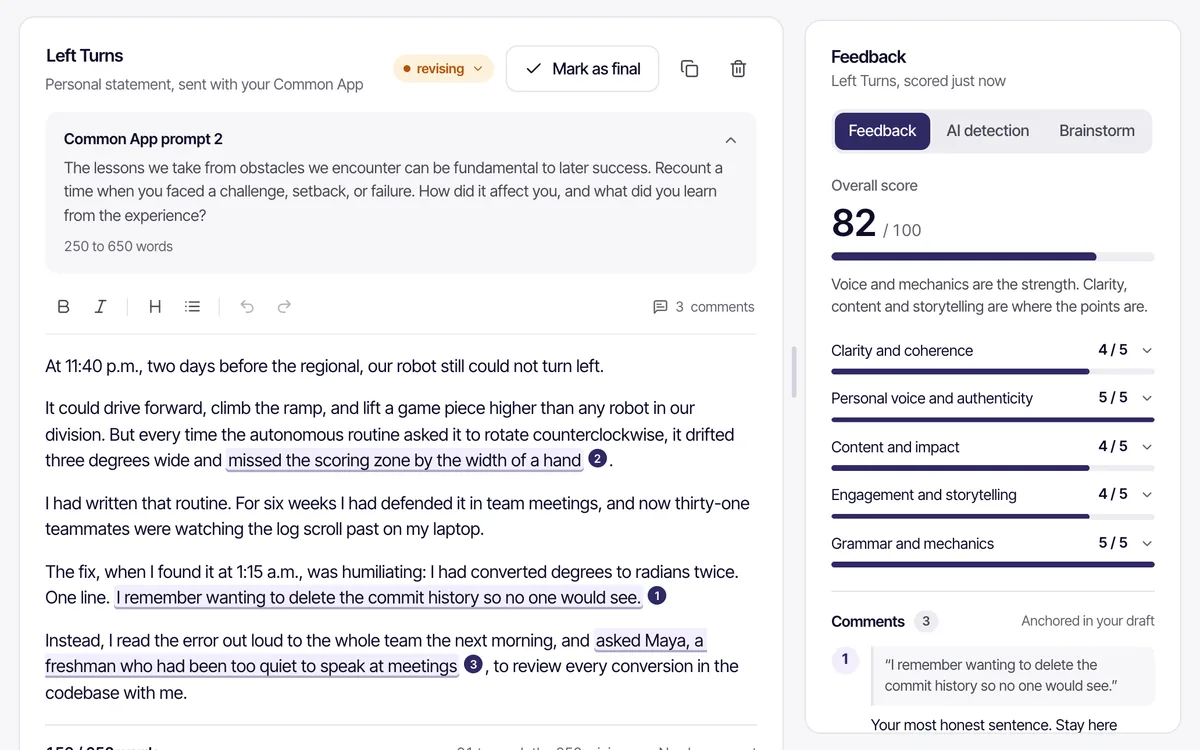
College Admissions is a workspace for drafting your essays. Every revision is scored, commented on and saved, alongside your personal statement and your other schools' supplements.
- A score out of 100 on every draft, broken into five parts, with comments pinned to the sentences they're about
- Brainstorm ideas for any prompt from the activities and awards in your profile
- An AI-detection check before you certify your essays as your own work
- One question answered by an admissions advisor
7-day free trial · From $29/mo after · Cancel anytime
How Yale reads these
In Yale's words, its admissions officers' podcast, and its Common Data Set.
Yale's What Yale Looks For page says the short essays are how the application gets at the personal side of you, and asks for responses that are thoughtful, reflective and in your own voice. Its essay advice page says your perspective on a topic matters far more than the topic itself.
This year's changes came from the admissions officers who read the answers. On their podcast in August 2026, they said they dropped the Why Yale question because most responses still didn't tell them anything new about the applicant. They asked you to leave the job of connecting you to Yale to them. The podcast says its views are the hosts' own.
Yale's Common Data Set rates the application essay Very Important, the same as course rigor, GPA, class rank, recommendations, activities, talent and character. The interview and test scores are rated Considered.
Your perspective – the lens through which you view your topic – is far more important than the specific topic itself.
If an essay doesn’t sound like the person who writes it, it cannot serve very well as a personal statement.
1. A topic or idea that excites you
Tell us about a topic or idea that excites you and is related to one or more academic areas you selected above. Why are you drawn to it?
What it's asking
This answer hangs on the up to three academic areas you pick from Yale's list just before it. The setup says Yale students have time to explore before committing to a major, and Yale's admissions officers note on their podcast that students declare at the end of sophomore year. So your topic can sit inside one area or connect two.
The last sentence carries the weight. The officers have said the most common pitfall is an encyclopedia entry on the topic, and one said he likes to see question marks here, meaning questions you're still asking. Spend your words on why it grabs you.
How to answer it
- Pick a topic narrow enough to explain in two sentences, and tie it to at least one area you selected.
- Spend most of the 200 words on why it pulls you in: where it started, what you've done about it, what you still don't know.
- End on an open question you'd want to chase in college.
Mistakes to avoid
- Summarizing the topic like a textbook. Yale knows what it is.
- Listing Yale courses, professors or labs. This year Yale asks you to leave that connecting to its readers.
- Choosing an area because it sounds impressive. Pick the one you'd talk about unprompted.
Example opening
Why does Tagalog have a word for the day after tomorrow when English doesn't? I started a notebook of untranslatable words at my grandmother's kitchen table. Now I want to know whether the words a language has change what its speakers notice.
Written by Test Ninjas to show the approach. It is not from a real applicant, so don't borrow its details.
Brainstorm suggests ideas for this question from the activities and awards in your profile, so you can start from something you've actually done.
2. A course, book or work of art you'd create
If you could teach any college course, write a book, or create an original piece of art of any kind, what would it be?
What it's asking
This short take grew out of an older Yale question about teaching a new Yale course. Yale's admissions officers said on their podcast that the old version drew gimmicky answers that were clever but not very revealing. The new one gives you three ways in: a course, a book or a piece of art.
With about 35 words, the title does most of the work. One officer said she's a big fan of answers that name the college course, and another said ambitious, imaginative answers to the art option can be some of the most interesting.
How to answer it
- Choose one of the three options. Don't try to cover all of them.
- Give it a specific title.
- Use the remaining characters to hint at why it's yours.
Mistakes to avoid
- A joke with nothing behind it.
- A course that just repeats the name of your intended major.
- Spending characters restating the question.
Example opening
Course: Bus Stop Ethnography. Ride every route in my city, track who waits longest and why, and read the schedule as a map of who the city plans for.
Written by Test Ninjas to show the approach. It is not from a real applicant, so don't borrow its details.
Feedback scores every draft out of 100 across five parts, including clarity and coherence, so you can tell whether a tiny answer still says something about you.
3. Something about yourself you hope to grow
What is one aspect of yourself that you hope to grow or develop during college?
What it's asking
This is the one new question this year. Yale's admissions officers said on their podcast that it keeps one part of the dropped Why Yale answer they liked, the excitement applicants showed about how they might grow in college. They also said they don't want it to become a one-for-one replacement for Why Yale.
Read the words they chose. One aspect, with no superlative. Yourself, so it needn't be a career goal. During college, so it needn't be about Yale. An officer said the answer can be serious or small, academic or social, and that it's fine if it would fit any college.
How to answer it
- Name one specific thing you want to get better at or change.
- Add a few words on why it matters to you now.
- Read it back. It should sound like a person who expects to change.
Mistakes to avoid
- Naming Yale programs or traditions. The officers said those examples aren't needed.
- A strength in disguise, like wanting to stop being such a perfectionist.
- Something so broad it could describe anyone, like becoming a better person.
Example opening
Being bad at things in public. I've only joined clubs I was already good at. In college I want to try improv, flop, and show up again the next week.
Written by Test Ninjas to show the approach. It is not from a real applicant, so don't borrow its details.
Feedback scores personal voice and authenticity on every draft, with comments anchored to the exact sentence, which matters when every word counts.
4. Something not anywhere else in your application
What is something about you that is not included anywhere else in your application?
What it's asking
Yale's admissions officers call this short take the wild card. On their podcast they said they wrote it after failing to come up with anything better, and decided to open the question all the way up.
When it first appeared in 2022, an officer described it as a chance to take 35 words and tell something fun about yourself. She added that it isn't the Common App's Additional Information section, which is where circumstances that affected your record belong.
How to answer it
- List what the rest of your application already covers.
- Pick a fact, habit or interest that appears nowhere on that list.
- Make it concrete enough to picture.
Mistakes to avoid
- Repeating an activity or award.
- Explaining a grade or a gap. That goes in Additional Information.
- Reaching for something impressive. Small and specific works here.
Example opening
I've kept every fortune-cookie fortune since sixth grade, ranked by how wrong it turned out. Most wrong so far: You will enjoy a long journey by sea. I get seasick.
Written by Test Ninjas to show the approach. It is not from a real applicant, so don't borrow its details.
Your Yale drafts sit together in the essays list with their status, next to your personal statement, so you can check that this short take covers something nothing else does.
5. An issue you discussed with someone who disagreed
Reflect on a time you discussed an issue important to you with someone holding an opposing view. Why did you find the experience meaningful?
What it's asking
All three essay prompts start with reflect, and Yale's admissions officers say that's on purpose. They rewrote this one in 2023 because many answers spent their space retelling the exchange or explaining why the writer was right and the other person wrong.
An officer said the prompt is no invitation to argue for your beliefs. Put your words into the second question, why the conversation mattered to you. Yale's What Yale Looks For page names respect for differences and open-mindedness among the qualities it looks for.
How to answer it
- Pick a real conversation with a specific person about an issue you care about.
- Keep the setup short, then spend most of the essay on what you heard and what it changed in you.
- Answer the why directly: what you now understand, value or do differently.
Mistakes to avoid
- A debate recap in which you win.
- Turning the other person into a caricature.
- A tidy ending where everyone agrees. You can still disagree and have learned something.
Example opening
My uncle and I argued about whether our town should let the paper mill expand. He works there. I had started a petition against it. Halfway through dinner he stopped arguing and asked whether I'd ever been inside. I hadn't. That Saturday, he gave me a tour.
Written by Test Ninjas to show the approach. It is not from a real applicant, so don't borrow its details.
Feedback scores content and impact, and engagement and storytelling, on every revision, so you can see whether the why gets more of your 400 words than the argument does.
6. A community you feel connected to
Reflect on your membership in a community to which you feel connected. Why is this community meaningful to you? You may define community however you like.
What it's asking
Yale's admissions officers said the strongest answers show how being around people who share something important with you makes you who you are. In 2023 they removed older wording about working to enhance a community, because applicants took it as a call to describe service projects and leadership roles.
There's a balance to strike. Give enough about the community to picture it, then spend the rest on you. An officer said good answers often show how your relationship with the group has changed over time. Online communities can work, though the officers warned against suggesting you only find community on a screen.
How to answer it
- Choose a community you can describe in two sentences: a band, a congregation, a neighborhood, a shift crew, a team.
- Show one moment that captures your place in it.
- Explain why it matters to you, and how that has changed.
Mistakes to avoid
- A history of the group or a list of its events.
- A leadership résumé. The officers moved this prompt away from that.
- A closing paragraph about the Yale clubs you'll join. The officers said you don't need one.
Example opening
Every Sunday at 6 a.m., eleven of us unload the food bank truck before the line forms. Nobody asks where you go to school. Mr. Okafor is seventy-one and still lifts more boxes than I do, and he's the reason I started showing up early.
Written by Test Ninjas to show the approach. It is not from a real applicant, so don't borrow its details.
Brainstorm reads the activities in your profile and suggests communities you could write about, including ones outside school if you've listed them.
7. An experience that will enrich your college
Reflect on an element of your personal experience that you feel will enrich your college. How has it shaped you?
What it's asking
Read the wording closely. When Yale added this prompt in 2023, an admissions officer pointed out that it says enrich your college rather than enrich your college experience. It asks what you'd add to a campus where students learn from each other.
An officer suggested starting with something you've experienced that not everyone your age has. You don't need to argue that it will enrich the college. Most of your words belong to the second question, how it shaped you. The officers added that even a hard experience can be an asset because of what it gave you.
How to answer it
- Ask yourself what you've lived through, learned or carried that most classmates haven't.
- Show it in one or two scenes instead of a summary of your life.
- Spend the second half on how it shaped what you notice, value or do.
Mistakes to avoid
- Promising that your experience will transform campus.
- A hardship told without what it gave you.
- Retelling your Common App essay. Pick a different experience or a different side of it.
Example opening
I was the only one in my family who could read the forms. By eleven I was booking my dad's MRI and disputing the hospital bill. I learned to read fine print as self-defense, and to ask the question everyone in the waiting room is thinking.
Written by Test Ninjas to show the approach. It is not from a real applicant, so don't borrow its details.
The AI-detection check runs on your draft before you submit. Yale treats submitting AI-generated content as application fraud, so make sure every sentence is yours.
Plan all five answers together
Space is tight, and the easiest way to waste it is telling the same story twice.
| Question | What the answer should show |
|---|---|
| 1. A topic or idea that excites you | How your mind works when nobody assigns the topic |
| 2. A course, book or work of art you'd create | What you'd make if no one limited you |
| 3. Something about yourself you hope to grow | That you expect college to change you |
| 4. Something not anywhere else in your application | One thing about you that no other part of the file shows |
| 5. An issue you discussed with someone who disagreed | How you handle disagreement with someone you respect |
| 6. A community you feel connected to | Where you belong, and what you take from it |
| 7. An experience that will enrich your college | What your experience lets you bring to a room |
Before drafting, write one line per answer: the story you'll use and what it shows. Check that no two lines use the same story and that none retells your Common App essay. The three short takes and the 400-word essay should each show a different side of you.
Pick the essay prompt that fits the story you most want Yale to hear. Yale's admissions officers said in 2025 that all three prompts were producing helpful, reflective answers and that none had emerged as the better choice.
Leave Yale out of it. This year the officers asked applicants not to squeeze a why-Yale paragraph into other answers, since connecting you to Yale is their job. Yale's AI policy allows AI for grammar, spelling or early topic ideas, and treats submitting AI-written content as application fraud.
Score a Yale answer for free
Pick the question, paste your draft, and get a scored review against the 200-word limit. No account needed for your first two reviews.
Frequently asked questions
How many supplemental essays does Yale have?
Common App and Coalition applicants write five pieces: a 200-word answer about a topic or idea that excites you, three short takes of up to 200 characters each, and one 400-word essay chosen from three prompts. You also pick up to three academic areas from a list. QuestBridge applicants answer only the academic areas and the 200-word question.
Does Yale have a Why Yale essay?
Not in 2026–27. Yale dropped the question this year. Its admissions officers said most answers didn't tell them anything new about applicants, and asked you not to work a why-Yale into your other answers.
Did the Yale supplemental essays change for 2026–27?
Yes. The 125-word Why Yale question is gone, and the short takes went from four to three. Yale dropped What inspires you? and the question about someone who has influenced you, and added one about an aspect of yourself you hope to grow during college. The 200-word question and the three 400-word essay prompts are unchanged.
How long are Yale's short takes?
Up to 200 characters each, which Yale says is about 35 words. The limit counts characters, so check your length in the application itself.
Which Yale essay prompt should I choose?
The one that fits the story you most want to tell. Yale's admissions officers said in 2025 that all three prompts were producing helpful, reflective answers and that none had emerged as the better choice.
Can I use AI for my Yale essays?
Only in limited ways. Yale says using AI to check grammar or spelling, or for general advice or topic ideas at the start, isn't fraud. Submitting the substantive content or output of an AI tool is application fraud and can lead to a revoked admission.
Yale's essays are due January 2
Draft all five with feedback on every revision, check each one for AI before you submit, and keep every school's essays in one place.
7-day free trial · From $29/mo after · Cancel anytime
Next: how the Yale interview works
Sources
Every date, number and prompt on this page comes from these pages, checked November 26, 2026. Admissions offices can change details during the cycle, so confirm anything time-sensitive on Yale's own site.
- Yale Admissions: Essay topics (2026-2027) ("Review the 2026-2027 essay topics for all applications")
- Yale Admissions: Essays (advice and 2026-27 topics)
- Yale Admissions: What Yale looks for
- Yale Admissions: AI policy
- Inside the Yale Admissions Office podcast: Application Update 2026-2027 (Aug 17, 2026) (hosts say views are their own)
- Inside the Yale Admissions Office podcast: Application Update 2025-2026 (Jul 31, 2025) (earlier cycle)
- Inside the Yale Admissions Office podcast: Application Update 2024-2025 (Aug 12, 2024) (earlier cycle; prompts discussed are unchanged)
- Inside the Yale Admissions Office podcast, episode 33: 2023-2024 Application Update (Aug 14, 2023) (earlier cycle; essay prompts discussed are unchanged)
- Inside the Yale Admissions Office podcast, episode 27: 2022-2023 Application Update (Aug 3, 2022) (earlier cycle)
- Yale essay topics, 2025-2026 (Internet Archive, Nov 2025)
- Yale University Common Data Set 2025-26 (PDF)