
Princeton supplemental essays, 2026–27
Princeton asks every applicant six questions: one academic essay that depends on your degree (A.B. or B.S.E.), two Your Voice essays and three 50-word answers, up to 1,150 words in all. One Your Voice essay now needs 400 to 500 words. You also send a graded written paper from an English, social studies or history class. Below is each prompt word for word, with what it asks and how to answer it.
Princeton's 2026–27 questions
Every applicant answers six prompts. You write one academic essay (A.B. and undecided, or B.S.E.), two Your Voice essays and three More About You answers. The wording matches last year's, and the lived-experience essay now asks for 400 to 500 words.
- As a research institution that also prides itself on its liberal arts curriculum, Princeton allows students to explore areas across the humanities and the arts, the natural sciences, and the social sciences. What academic areas most pique your curiosity, and how do the programs offered at Princeton suit your particular interests?Up to 250 words
- Please describe why you are interested in studying engineering at Princeton. Include any of your experiences in or exposure to engineering, and how you think the programs offered at the University suit your particular interests.Up to 250 words
- Princeton values community and encourages students, faculty, staff and leadership to engage in respectful conversations that can expand their perspectives and challenge their ideas and beliefs. As a prospective member of this community, reflect on how your lived experiences will impact the conversations you will have in the classroom, the dining hall or other campus spaces. What lessons have you learned in life thus far? What will your classmates learn from you? In short, how has your lived experience shaped you?400–500 words
- Princeton has a longstanding commitment to understanding our responsibility to society through service and civic engagement. How does your own story intersect with these ideals?Up to 250 words
- What is a new skill you would like to learn in college?Up to 50 words
- What brings you joy?Up to 50 words
- What song represents the soundtrack of your life at this moment?Up to 50 words
Copied from Princeton's Princeton-specific Questions page, which lists "the questions for the 2026-27 application cycle." Each prompt on that page ends with its word limit in parentheses. Princeton also requires a graded written paper; see the plan and questions below. Princeton
Write your Princeton essays with feedback on every draft
College Admissions is a workspace for drafting your essays. Every revision is scored, commented on and saved, alongside your personal statement and your other schools' supplements.
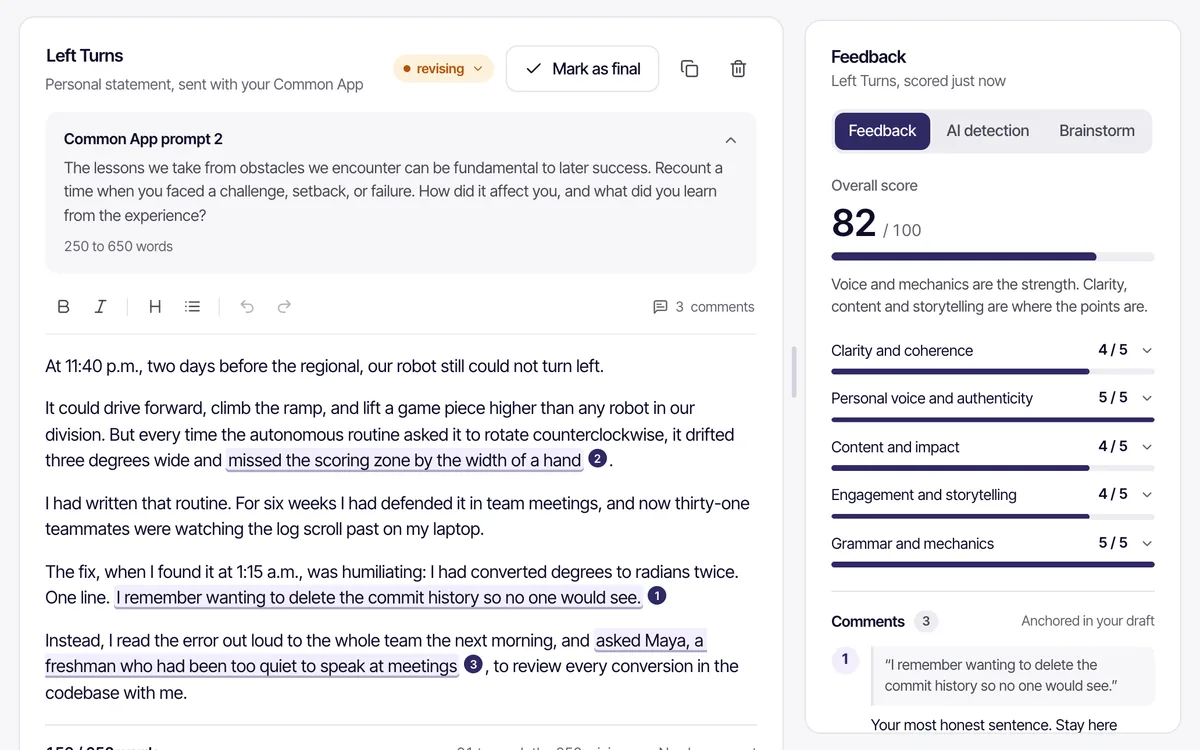
- A score out of 100 on every draft, broken into five parts, with comments pinned to the sentences they're about
- Brainstorm ideas for any prompt from the activities and awards in your profile
- An AI-detection check before you certify your essays as your own work
- One question answered by an admissions advisor
7-day free trial · From $29/mo after · Cancel anytime
How Princeton reads these
In Princeton's words, and in its Common Data Set.
Princeton's Common Data Set rates the application essay "Very Important", its highest rating, alongside rigor, grades, class rank, test scores, recommendations, activities, talent and character. The interview is rated "Considered".
Dean of Admission Karen Richardson, writing to applicants for the Class of 2031 in September 2026, called the essays the most personal part of your application and asked you to give yourself enough time that your voice comes through. Princeton's tips page asks you to write "in a style that reflects your own voice."
In some ways, the essays are the most personal part of your application. They are your opportunity to authentically present who you are, how you think about things and what you hope to gain as a college student.
We are not looking for perfect. We’re looking for authentic.
1. Academic interests (A.B. and undecided)
As a research institution that also prides itself on its liberal arts curriculum, Princeton allows students to explore areas across the humanities and the arts, the natural sciences, and the social sciences. What academic areas most pique your curiosity, and how do the programs offered at Princeton suit your particular interests?
What it's asking
The question has two halves. First, the academic areas that pique your curiosity. Second, how Princeton's programs suit those interests. Weak answers cover the first half and wave at the second.
Princeton frames it around a liberal arts curriculum, so you can name more than one field. Dean Karen Richardson notes that every senior completes a thesis or capstone project, so an interest you could imagine researching for a year reads as a real fit.
How to answer it
- Pick one or two areas and say where the curiosity started: a class, a book, a problem you couldn't let go of.
- Name the Princeton programs that match, such as a department, one of its more than 50 minors, or a first-year seminar, and say what you'd do there.
- Tie the two together. Explain why that program suits the question you care about.
Mistakes to avoid
- A list of six departments with one line each.
- Praise for Princeton's reputation or rankings. The prompt asks about programs and your interests.
- Describing a field in general terms without saying what draws you to it.
Example opening
In ninth grade I mapped every bus route in my city and found that the slowest ones ran through the poorest neighborhoods. I want to study how cities decide where transit goes, starting in urban studies and ending, I hope, with a thesis on my hometown's routes.
Written by Test Ninjas to show the approach. It is not from a real applicant, so don't borrow its details.
Brainstorm suggests angles for this question from the activities and awards in your profile, so you can see which academic interest your record already supports.
2. Why engineering (B.S.E.)
Please describe why you are interested in studying engineering at Princeton. Include any of your experiences in or exposure to engineering, and how you think the programs offered at the University suit your particular interests.
What it's asking
Princeton asks for three things here. It wants to know why you're interested in engineering, what experience or exposure got you there, and how its programs suit your interests. The middle part is where your answer gets specific.
Exposure counts as well as formal experience. A repair job, a robotics team, a coding project or a summer helping a relative build something all qualify. Princeton's recommended course of study lists calculus, physics and chemistry for students interested in engineering, so use the essay for what you've built on top of the coursework.
How to answer it
- Open with one engineering moment: a problem you tried to solve and what happened.
- Say what it taught you about the kind of engineering you want to do.
- Name the Princeton department or program that fits, and what you'd want to work on there.
Mistakes to avoid
- Opening with a dictionary definition of engineering.
- Listing competitions and awards that already appear in your activities list.
- Writing about engineering in general with nothing about Princeton's programs.
Example opening
Our school's 3D printer jammed every third print, and nobody knew why. I logged every failure in a spreadsheet for a semester until I found the cause, humidity in the supply closet. That's the engineering I like best, patient detective work on real machines.
Written by Test Ninjas to show the approach. It is not from a real applicant, so don't borrow its details.
Feedback scores each version out of 100 across clarity and coherence, personal voice and authenticity, content and impact, engagement and storytelling, and grammar and mechanics, with comments on the exact sentences that need work.
3. How your lived experience shapes campus conversations
Princeton values community and encourages students, faculty, staff and leadership to engage in respectful conversations that can expand their perspectives and challenge their ideas and beliefs. As a prospective member of this community, reflect on how your lived experiences will impact the conversations you will have in the classroom, the dining hall or other campus spaces. What lessons have you learned in life thus far? What will your classmates learn from you? In short, how has your lived experience shaped you?
What it's asking
Princeton added this question in the summer of 2023, after the Supreme Court struck down affirmative action in admissions, The Daily Princetonian reported. It asks how your lived experience will shape the conversations you have in the classroom, the dining hall and other campus spaces.
Princeton's own summary is the last line, "In short, how has your lived experience shaped you?" It wants the lessons and what your classmates would learn from you. Dean Karen Richardson has described the student Princeton hopes for as "a new person to sit with in the dining hall or a partner to engage in late-night discussions about the world." Write toward that person.
How to answer it
- Choose one or two experiences that changed how you see something. Family, work, faith, a move, a community or a long obsession all count.
- Give real space to the lessons. With 400 to 500 words you have room for a scene and for what you made of it.
- End in a campus conversation, such as a precept, a dining-hall table or a late-night argument, and show what you'd add to it.
Mistakes to avoid
- Stopping short of 400 words. Princeton now asks for 400 to 500.
- Listing identities or hardships without saying what they taught you or what you'd bring.
- Retelling your personal essay. Use a different experience, or a different side of the same one.
Example opening
At my family's laundromat I learned that people tell you everything while the dryer runs. I learned to ask one more question than seems polite. In a precept on immigration policy, I'd be the one asking who actually waits in those lines.
Written by Test Ninjas to show the approach. It is not from a real applicant, so don't borrow its details.
This essay asks for lessons, for what classmates would learn from you, and for how your experience shaped you. Feedback scores every draft and anchors comments to the sentences that need work, so you can see which part is thin.
4. Service and civic engagement
Princeton has a longstanding commitment to understanding our responsibility to society through service and civic engagement. How does your own story intersect with these ideals?
What it's asking
The question asks how your own story intersects with service and civic engagement. Princeton calls this a longstanding commitment and wants to see where responsibility to others already shows up in your life. Your volunteer hours are already in your activities list.
Service can be informal. One admitted student told The Daily Princetonian he wrote about helping at his parents' restaurant "as a kind of service to my community, rather than a more traditional form of community service." Princeton's tips also ask you to tell it "if you’ve had a job or a responsibility in your home."
How to answer it
- Start with your story: a place, a responsibility or a moment where you acted for someone other than yourself.
- Say what it showed you about what you owe the people around you.
- Say in one concrete sentence how that would carry into your time at Princeton.
Mistakes to avoid
- A volunteer résumé with hours and titles.
- A rescue story where the people you helped are props.
- Big claims about changing the world with nothing personal behind them.
Example opening
Every Sunday I translate the parish bulletin into Tagalog for my lola and six of her friends. It started as a chore. Now I notice who's missing from Mass and call them that afternoon. Service, I've learned, is mostly noticing.
Written by Test Ninjas to show the approach. It is not from a real applicant, so don't borrow its details.
Brainstorm reads the activities and awards saved in your profile and suggests ideas for this question, including jobs and family responsibilities you may not think of as service.
5. A new skill to learn in college
What is a new skill you would like to learn in college?
What it's asking
Princeton introduces its three short questions with "There are no right or wrong answers. Be yourself!" One admitted student told The Daily Princetonian these questions let her add personality that the rest of the application doesn't always show.
Fifty words is two or three sentences. Name a skill and give one specific reason you want it.
How to answer it
- Pick a skill you actually want, academic or not.
- Give the one-sentence reason behind it.
- Add a detail only you would write.
Mistakes to avoid
- A skill chosen to sound impressive.
- Spending half your words restating the question.
- Repeating your academic essay.
Example opening
Glassblowing. I've watched my uncle repair old windows for years, and I want to understand the material from the other end, when it's still liquid and anything could go wrong.
Written by Test Ninjas to show the approach. It is not from a real applicant, so don't borrow its details.
Your Princeton drafts sit together with their status, next to your personal statement and every other school's supplements, so your short answers don't repeat your longer essays.
6. What brings you joy
What brings you joy?
What it's asking
The plainest question in the application. Admitted students have named it to The Daily Princetonian as one of the parts they enjoyed writing.
A small, real joy says more about you in 50 words than a large abstract one. Show it happening.
How to answer it
- Write down five small joys and pick the most specific.
- Show it happening in one moment.
- Read it aloud. If it could be anyone's, change it.
Mistakes to avoid
- Abstract answers like family, learning or helping others with no detail.
- Turning it into an achievement.
- Going over 50 words.
Example opening
The first ten minutes after a snowfall, before anyone has walked on it. I wake my little brother, we pull boots on over pajamas, and we make the first tracks to the mailbox and back.
Written by Test Ninjas to show the approach. It is not from a real applicant, so don't borrow its details.
Feedback scores personal voice and authenticity on every draft, and the AI-detection check flags a draft before you submit it.
7. The soundtrack of your life right now
What song represents the soundtrack of your life at this moment?
What it's asking
The words that matter are "at this moment". Princeton asks about now, so pick the song for this year of your life.
The title takes a few words. The reason is the answer, so say what in the song matches where you are.
How to answer it
- Pick the song you'd honestly choose this year.
- Name one line, sound or memory that ties it to your life now.
- Stop once you've said why. Fifty words go fast.
Mistakes to avoid
- A song picked to impress a reader.
- Quoting long lyrics, which uses up your words.
- Spending your words on the song's history.
Example opening
"Here Comes the Sun." My dad plays it badly every morning before an early shift, on a guitar missing a string. Senior year has felt like a long winter, and I keep hearing that song through the wall.
Written by Test Ninjas to show the approach. It is not from a real applicant, so don't borrow its details.
Run AI detection on each short answer, and track every draft's status in your essays list next to your other schools' supplements.
Plan all six, plus the paper
Six answers and a graded paper give you room to show different sides of you. The easiest mistake is telling the same story twice.
| Question | What the answer should show |
|---|---|
| 1. Academic interests (A.B. and undecided) | What you want to learn, and why Princeton is where you'd learn it |
| 2. Why engineering (B.S.E.) | How you think like an engineer, and where you'd do it at Princeton |
| 3. How your lived experience shapes campus conversations | What your life has taught you, and what you'd bring to a conversation at Princeton |
| 4. Service and civic engagement | Where your sense of responsibility to others comes from |
| 5. A new skill to learn in college | Your curiosity outside your main interests |
| 6. What brings you joy | What you're like when nobody's grading you |
| 7. The soundtrack of your life right now | Where you are in your life right now |
Before drafting, write one line per prompt with the story you'll use and what it shows. Your academic essay covers your interests, the two Your Voice essays cover your experience and your sense of service, and the three 50-word answers show you on an ordinary day. If two lines share a story, move one.
Watch the limits. The lived-experience essay needs at least 400 words and no more than 500. The other limits are ceilings, and a tight 40-word answer reads better than a padded 50.
Your graded written paper is due with your application. Princeton wants a paper from an English, social studies or history course from your last three years of school, at least one page long, with the prompt, your grade and any comments. It is "most interested in seeing expository, thesis-driven analytical writing." Last year's page said one to two pages was enough. You can upload the paper with the Common App or send it through your applicant portal, by email or by mail. If you can't provide one, Princeton will still review your application, with less information to go on.
Princeton asks you to certify that your essays are your own work, and says it may withdraw the application or revoke the admission of a student whose essays were written by another source. Dean Richardson's advice for this cycle is to steer clear of AI tools when you write your essays. Use feedback to find weak spots, then do the rewriting yourself.
Score a Princeton answer for free
Pick the question, paste your draft, and get a scored review against the 250-word limit. No account needed for your first two reviews.
Frequently asked questions
How many supplemental essays does Princeton have?
Six for each applicant. You answer one 250-word academic prompt (A.B. and undecided, or B.S.E.), a 400–500-word essay on your lived experience, a 250-word essay on service, and three 50-word answers. That's up to 1,150 words, plus a graded written paper.
Did the Princeton supplemental essays change for 2026–27?
The wording is the same as in 2025–26. The lived-experience essay went from "500 words or fewer" to 400–500 words, so it now has a minimum. The graded paper guidelines changed too. Princeton now asks for at least one page with the prompt and grade, where last year's page said one to two pages was enough.
Is there a "Why Princeton" essay?
Not by that name. The A.B. prompt asks how Princeton's programs suit your interests, and the B.S.E. prompt asks why you want to study engineering at Princeton. Both reward named programs over praise for the school.
What is the Princeton graded written paper?
A paper from an English, social studies or history course in your last three years of school, with the prompt, your grade and any teacher comments. It must be at least one page and originally written in English. Princeton says it helps assess your "written expression in an academic setting." It's due with your application.
What if I don't have a graded paper?
Ask your teachers or counselor for one from your last three years of school. If you can't provide one, Princeton will still review your application, with less information to go on.
Can I use AI for my Princeton essays?
Princeton's dean of admission advises against it, and you certify that your essays are your own work. Princeton says it may withdraw the application or revoke the admission of a student whose essays were written by another source. Feedback on a draft you wrote is fine. Text written for you breaks that certification.
Do A.B. and B.S.E. applicants answer different questions?
Only the academic prompt differs. A.B. and undecided applicants write about the academic areas that pique their curiosity, and B.S.E. applicants write about why they want to study engineering at Princeton. Everyone answers the same Your Voice and More About You questions.
Princeton's essays are due January 1
Draft them with feedback on every revision, check each one for AI before you submit, and keep every school's essays in one place.
7-day free trial · From $29/mo after · Cancel anytime
Next: how the Princeton interview works
Sources
Every date, number and prompt on this page comes from these pages, checked November 26, 2026. Admissions offices can change details during the cycle, so confirm anything time-sensitive on Princeton's own site.
- Princeton Admission: Princeton-specific Questions ("the questions for the 2026-27 application cycle")
- Princeton Admission: Graded Written Paper
- Princeton Admission: First-Year Application Checklist (components, interview)
- Princeton Admission: Helpful Tips
- Princeton Admission: Before You Apply (recommended course of study)
- Princeton Admission FAQs: graded written paper
- Princeton Admission blog: Authentically You: Application Essays and AI, by Dean Karen Richardson (Sep 1, 2026) (written for applicants to the Class of 2031)
- Princeton Admission blog: Testing, Rigor, AI, and What Are We Really Looking For? by Dean Karen Richardson (Aug 18, 2025) (written during the 2025–26 cycle)
- Princeton University Common Data Set 2025–26 (PDF, Internet Archive copy of July 10, 2026) (ir.princeton.edu returns 403 to fetchers; its CDS page still listed 2025-2026 as the latest on Nov 4, 2026)
- The Daily Princetonian: Early action decisions released, marking next phase of student body expansion (Dec 18, 2023)
- The Daily Princetonian: Early action decisions released for the Class of 2029 (Dec 16, 2024)
- The Daily Princetonian: Princeton releases early action decisions for the Class of 2030 (Dec 12, 2025) (article dated Fri, Dec 12, 2025, 12:26 a.m.; decisions came "on Thursday", Dec 11)
- The Daily Princetonian: Princeton releases regular decision results for Class of 2030 (Mar 27, 2026)
- Princeton-specific Questions, October 2025 (Internet Archive) (the 2025-26 questions)
- Princeton Graded Written Paper guidelines, October 2025 (Internet Archive) (the 2025-26 guidelines)