Columbia supplemental essays, 2026–27
Columbia asks six required questions on top of your personal essay: a list of up to 100 words and five short answers of up to 150 words each. Columbia College and Columbia Engineering applicants answer the same set. Only the list question's wording changed from last year. Below is each one word for word, what it's asking, how to answer it, and a place to get feedback on your draft.
Columbia's 2026–27 questions
Six required questions, the same for Columbia College and Columbia Engineering. The list has a 100-word cap and each short answer has 150.
- List the titles of texts, resources and outlets that have contributed to your intellectual development outside of academic courses, including but not limited to books, journals, websites, podcasts, essays, plays, presentations, videos, museums and other content that you enjoy.Up to 100 words
- Tell us about an aspect of your life so far or your lived experience that is important to you, and describe how it has shaped the way you would learn from and contribute to Columbia's multidimensional and collaborative environment.Up to 150 words
- At Columbia, students representing a wide range of perspectives are invited to live and learn together. In such a community, questions and debates naturally arise. Please describe a time when you did not agree with someone and discuss how you engaged with them and what you took away from the interaction.Up to 150 words
- In college/university, students are often challenged in ways that they could not anticipate. Please describe a situation in which you have navigated through adversity and discuss how you changed as a result.Up to 150 words
- Why are you interested in attending Columbia University? We encourage you to consider the aspect(s) that you find unique and compelling about Columbia.Up to 150 words
- What attracts you to your preferred areas of study at Columbia College or Columbia Engineering?Up to 150 words
Copied from Columbia's "2026-2027 Columbia-Specific Questions" page, updated July 28, 2026. Its instructions mention "six short answer questions" but list five after the list question, so you answer six questions in all. Columbia's separate Member Questions, such as your reasons for continuing your education in the United States, collect factual information and "are not considered an essay." Columbia
Write all six Columbia answers with feedback on every draft
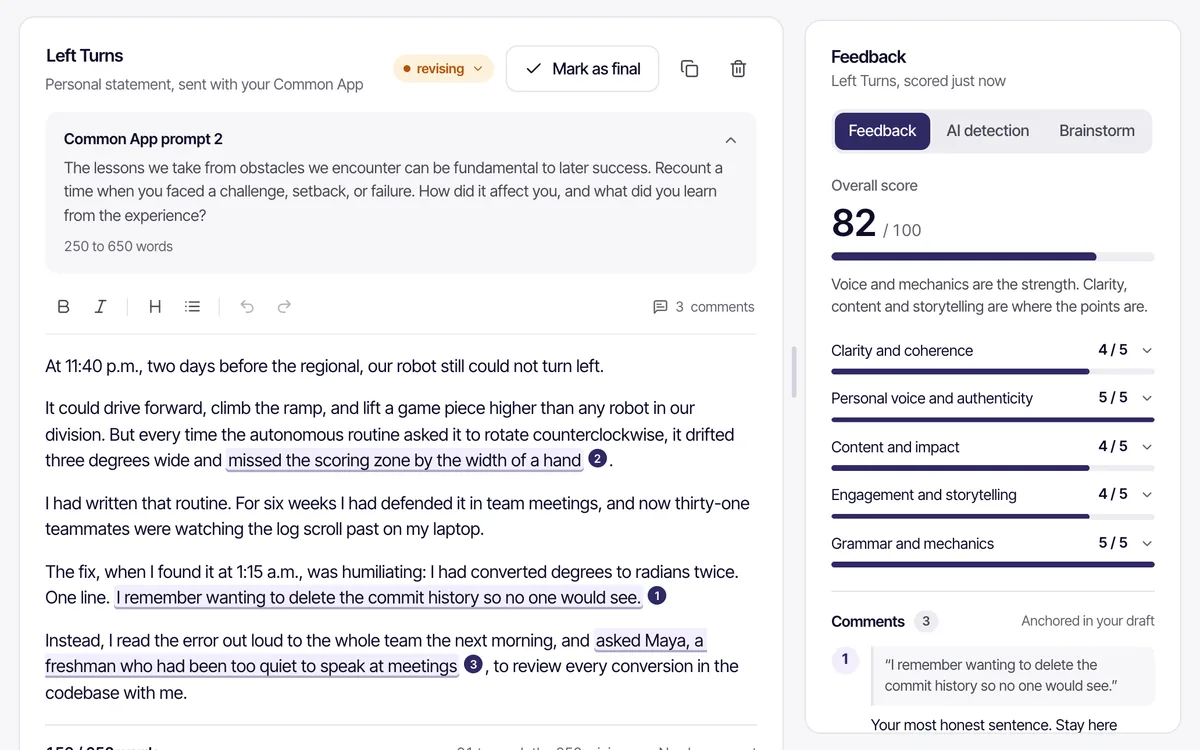
College Admissions is a workspace for drafting your essays. Every revision is scored, commented on and saved, alongside your personal statement and your other schools' supplements.
- A score out of 100 on every draft, broken into five parts, with comments pinned to the sentences they're about
- Brainstorm ideas for any prompt from the activities and awards in your profile
- An AI-detection check before you certify your essays as your own work
- One question answered by an admissions advisor
7-day free trial · From $29/mo after · Cancel anytime
How Columbia reads these
In Columbia's words, and in its Common Data Set.
Columbia calls these questions its writing supplement and says it reviews them "as an essential part of our holistic and contextual review." Its process page says admissions officers read them for your intellectual interests and for how your curiosity and sense of community would show up on campus.
Columbia's Common Data Set rates the application essay "Very Important", the same as rigor, GPA, class rank, recommendations, extracurriculars and character. Test scores are "Considered", and the interview is "Not Considered" because Columbia no longer interviews. With testing optional this year, your writing is one of the few places Columbia hears from you directly.
We read your responses to our Columbia-specific application questions to gain insight into your intellectual interests and the ways your expressions of curiosity and sense of community might translate to Columbia’s campus.
These questions provide insight to your intellectual curiosity, habits of mind, love of learning and sense of self.
1. Texts and resources outside class
List the titles of texts, resources and outlets that have contributed to your intellectual development outside of academic courses, including but not limited to books, journals, websites, podcasts, essays, plays, presentations, videos, museums and other content that you enjoy.
What it's asking
This one is a list, and Columbia's instructions keep it that way. Separate items with commas or semicolons, skip numbering, and leave out author names, subtitles and explanations. The only thing you control is which titles go on it.
Columbia's process page says it looks for curiosity, including "openness to cross-disciplinary scholarship, diverse perspectives and new ideas." A good list shows range and real habits: what you read, watch, listen to and visit when no one assigns it. The 2026–27 wording asks you to "List the titles" where last year's said "List a selection", so name specific works, shows and places.
How to answer it
- Write down everything you've read, watched, listened to or visited in the last two years that you still think about.
- Cut anything you couldn't talk about for a minute, and anything you'd add only because it sounds impressive.
- Keep a mix of the formats the prompt names, such as books, podcasts, plays and museums, and check the total against the 100-word cap.
Mistakes to avoid
- Adding explanations, author names or subtitles. Columbia says none are needed.
- Padding the list with famous titles you haven't finished.
- A list that's all one format or one subject, unless that depth is the point of your whole application.
Example opening
Braiding Sweetgrass; Radiolab; The Glass Menagerie; 3Blue1Brown; the Tenement Museum; Rest of World; Invisible Cities; Hidden Brain; The Gene; Numberphile; the Noguchi Museum; Hamnet; Planet Money
Written by Test Ninjas to show the approach. It is not from a real applicant, so don't borrow its details.
Your Columbia list sits in the essays list with your five short answers, your personal statement and other schools' supplements, so you can see whether the titles back up the interests you write about elsewhere.
2. An aspect of your life and how it shaped you
Tell us about an aspect of your life so far or your lived experience that is important to you, and describe how it has shaped the way you would learn from and contribute to Columbia's multidimensional and collaborative environment.
What it's asking
The question has two halves. First, an aspect of your life or lived experience that matters to you. Second, how it shapes the way you would learn from and contribute to Columbia's "multidimensional and collaborative environment." The second half is where most drafts run short.
Columbia's process page says it wants to know "who you are as an individual shaped by your background, personal values and experiences" and asks "What might your voice contribute?" So pick something that changes how you work with other people, and show both directions: what you'd learn from classmates and what you'd bring.
How to answer it
- Choose one aspect: a place, a responsibility, a language, a tradition or a long-running interest.
- Give it two or three sentences, with one concrete detail only you would know.
- Spend the rest on a setting at Columbia where it would matter, such as a Core Curriculum seminar, a lab group or your residence hall, and say what you'd take from others there as well as what you'd add.
Mistakes to avoid
- Describing the experience and stopping before you get to Columbia.
- Writing only about what you'd contribute. The prompt also asks how you'd learn from others.
- Retelling your personal essay in a shorter form.
Example opening
My grandfather's hardware store had one rule: nobody leaves without the right part, even if we have to call a competitor. I spent Saturdays phoning rival stores for strangers. In a Core seminar, I'll be the one who asks where an idea came from before arguing with it.
Written by Test Ninjas to show the approach. It is not from a real applicant, so don't borrow its details.
Brainstorm suggests angles for this question from the activities and awards in your profile. Feedback then scores each draft and comments on the sentences where the Columbia half of your answer goes thin.
3. A time you didn't agree with someone
At Columbia, students representing a wide range of perspectives are invited to live and learn together. In such a community, questions and debates naturally arise. Please describe a time when you did not agree with someone and discuss how you engaged with them and what you took away from the interaction.
What it's asking
Columbia added a question about learning from disagreement when it revised its supplement for the 2025–26 cycle, Spectator reported, and the wording is unchanged for 2026–27. It has three parts: the disagreement, how you engaged with the person, and what you took away.
The setup frames disagreement as part of daily life on campus, where "questions and debates naturally arise." Columbia's process page lists "a willingness to interrogate personal beliefs and belief systems" among the signs of curiosity it looks for. The strongest answers show you listening and testing your own view.
How to answer it
- Pick a real disagreement with a specific person about something that mattered to both of you.
- State the disagreement in one or two sentences, then spend most of the answer on how you engaged: what you asked, what you heard, what you conceded.
- End with what you took away, and keep it honest if neither of you changed your mind.
Mistakes to avoid
- A story where you were right and the other person came around.
- An argument with a policy, a book or the internet. The prompt asks about someone.
- A neat ending that skips what was hard about the conversation.
Example opening
Maya wanted our robotics team to drop the rookie bracket so we could compete higher. I thought we'd lose our ninth graders. Instead of another group-chat fight, I proposed a deal: she'd run one practice her way, I'd run one mine, and the team would vote.
Written by Test Ninjas to show the approach. It is not from a real applicant, so don't borrow its details.
This answer has three jobs in 150 words. Feedback scores every revision on clarity and coherence, content and impact, and storytelling, with comments anchored to the sentences that need work, so you can see which part is thin.
4. Navigating adversity
In college/university, students are often challenged in ways that they could not anticipate. Please describe a situation in which you have navigated through adversity and discuss how you changed as a result.
What it's asking
Read the two verbs: navigated and changed. Most of your words belong to those, with the situation itself kept short. Columbia ties the question to college, where students "are often challenged in ways that they could not anticipate," so it wants to see how you handle the unexpected.
Adversity doesn't have to be a crisis. A setback in a class, a team, a job or your family can work if it truly tested you. Columbia's review is contextual and weighs "systemic and situational barriers and advantages", and the context in this answer can help it do that.
How to answer it
- Describe the situation in two or three plain sentences.
- Show what you did, step by step, including what didn't work at first.
- Finish with a specific change in you: a habit, a belief or a way you now handle problems.
Mistakes to avoid
- Spending most of the answer on the hardship itself.
- Ending with a line like "and that made me stronger" instead of a specific change.
- Using the same story as your personal essay or your lived-experience answer.
Example opening
In the spring of junior year, my family moved into my aunt's one-bedroom, and my desk became the city bus. I learned to study in 25-minute stretches between stops, then taught two classmates the same routine. I still plan my week around the 14 bus.
Written by Test Ninjas to show the approach. It is not from a real applicant, so don't borrow its details.
Feedback scores personal voice and authenticity on every draft. Run the AI-detection check before you submit, since Columbia asks you to attest that everything in your application is accurate and authentic.
5. Why Columbia
Why are you interested in attending Columbia University? We encourage you to consider the aspect(s) that you find unique and compelling about Columbia.
What it's asking
Columbia tells you what it reads for here. Its process page lists knowledge of Columbia as a quality it looks for, with examples: "knowledge of and enthusiasm for the Core Curriculum, our traditional campus in an urban setting and any other aspect(s) that you find unique and compelling about Columbia." The prompt repeats that last phrase.
The same page says Columbians tend to have "an appetite for communal learning and deliberate critical discourse, and a delight for the adventures that New York City provides." So show that you understand what sets Columbia apart and why it suits you. Reasons that would fit any top university don't do that.
How to answer it
- List three things about Columbia you couldn't get at most universities, such as the Core, a program or a New York connection.
- Keep the one or two you can tie to something you've already done or want to do.
- Write it as fit: what that feature is, and what you'd do with it.
Mistakes to avoid
- Rankings, prestige or "world-class faculty."
- A tour of New York City with no link to your studies or interests.
- Repeating your areas-of-study answer. Save majors and departments for question 6.
Example opening
The Core Curriculum and the city around it are why I'm applying. I've spent two summers sitting in on night court in Brooklyn and reading Plato on the train home. At Columbia I'd do both on purpose, arguing about justice in seminar and then watching it downtown.
Written by Test Ninjas to show the approach. It is not from a real applicant, so don't borrow its details.
Your Columbia drafts sit together in the essays list with their status, next to your personal statement and other schools' supplements, so you can catch your Why Columbia and areas-of-study answers making the same point.
6. Your preferred areas of study
What attracts you to your preferred areas of study at Columbia College or Columbia Engineering?
What it's asking
The prompt names both schools because you apply to one of them. Columbia's FAQ says applicants must choose either Columbia College or Columbia Engineering. If you're applying to Columbia College, write about the fields you want to study there. If you're applying to Columbia Engineering, write about the engineering or applied-science areas you'd pursue.
"What attracts you" asks for the why behind the field. Show where the interest started and what you've done with it, then what you'd use at Columbia. Columbia says it expects Columbia Engineering applicants to have coursework in physics and calculus, so an engineering answer can point to that preparation where it fits.
How to answer it
- Name the area or areas plainly in the first sentence. If you're undecided, name the two or three fields that pull you.
- Trace the interest to something you did: a project, a class, a job or a question you couldn't drop.
- Close with what you'd do with it at Columbia, such as a research question or a sequence of courses.
Mistakes to avoid
- Listing majors without saying what draws you to them.
- Writing a second Why Columbia answer. Keep this one on the field.
- Claiming interests your activities and courses don't support.
Example opening
Our town's water tower leaked for six years before anyone measured how much. I did, with a borrowed flow meter and what I'd learned in AP Physics. That gap between knowing a structure is failing and getting someone to fix it is why I want to study civil engineering.
Written by Test Ninjas to show the approach. It is not from a real applicant, so don't borrow its details.
Brainstorm pulls ideas for this question from the activities and awards in your profile, so your field connects to things Columbia can already see in your application. Feedback then scores content and impact on each draft.
Plan all six together
A list and five short answers give Columbia many angles on you. Telling the same story twice wastes one.
| Question | What the answer should show |
|---|---|
| 1. Texts and resources outside class | What you explore on your own, and how widely |
| 2. An aspect of your life and how it shaped you | One part of your life and how it shapes the way you work with others |
| 3. A time you didn't agree with someone | How you handle disagreement with the person in front of you |
| 4. Navigating adversity | How you respond when things go wrong, and what stuck |
| 5. Why Columbia | That you know what sets Columbia apart and why it fits you |
| 6. Your preferred areas of study | What you want to study, why, and what you've already done about it |
Before drafting, write one line per question: the story you'll use and what it shows. Questions 2, 3 and 4 (lived experience, disagreement, adversity) can easily pull the same story, so give each its own. Keep question 5 on Columbia and question 6 on your field.
Use the list to back up the rest. If you write about urban planning in question 6, a few titles on the list should show you follow it on your own. 150 words is the maximum, and a tight 120-word answer is fine.
Columbia says students may use "a wide range of resources, tools and support," but "we expect that all submitted application materials are your own original work and reflect your authentic voice." You also attest to the accuracy and authenticity of everything you submit. Use feedback to find weak spots, then do the rewriting yourself.
Score a Columbia answer for free
Pick the question, paste your draft, and get a scored review against the 100-word limit. No account needed for your first two reviews.
Frequently asked questions
How many supplemental essays does Columbia have?
Six questions, all required: a list of up to 100 words and five short answers of up to 150 words each, so up to 850 words in total. They're on top of the personal essay in the Common App or the Coalition Application.
Does Columbia have a "Why Columbia" essay?
Yes. Question 5 asks "Why are you interested in attending Columbia University?" and encourages you to consider what you find "unique and compelling" about Columbia, in 150 words or fewer. Question 6 asks separately what attracts you to your preferred areas of study.
Did the Columbia supplemental essays change for 2026–27?
Barely. The list question now begins "List the titles of texts" where last year's began "List a selection of texts." The five short-answer questions are word for word the same as in 2025–26, the cycle when Columbia added its disagreement question, according to Spectator.
Are the questions different for Columbia College and Columbia Engineering?
No. Columbia publishes one set for both. Question 6 names both schools because you apply to only one. Columbia's FAQ says applicants must choose either Columbia College or Columbia Engineering, so answer it for the school you chose.
How do I format the Columbia list question?
Columbia asks for a list of items separated by commas or semicolons, in any order and without numbering. You don't need to italicize or underline titles, and no author names, subtitles or explanatory remarks are needed. The limit is 100 words.
Can I use AI for my Columbia essays?
Columbia says students may use a wide range of resources, tools and support, but it expects "all submitted application materials are your own original work and reflect your authentic voice." Before you submit, you confirm that you agree to its accuracy and authenticity statement.
Are Columbia's Member Questions essays?
No. Columbia says the Member Questions collect factual and logistical information, asked of all applicants, such as the activities that interest you, your reasons for continuing your education in the United States, and whether you'll submit a portfolio. It says the responses "are not considered an essay."
Columbia's six answers are due January 1
Draft them with feedback on every revision, check each one for AI before you attest that it's your own, and keep every school's essays in one place.
7-day free trial · From $29/mo after · Cancel anytime
Next: Columbia deadlines and decision dates
Sources
Every date, number and prompt on this page comes from these pages, checked November 26, 2026. Admissions offices can change details during the cycle, so confirm anything time-sensitive on Columbia's own site.
- Columbia Undergraduate Admissions: Columbia-Specific Application Questions (2026–2027) ("2026-2027 Columbia-Specific Questions", updated July 28, 2026. Internet Archive copy of Nov 8, 2026)
- Columbia-Specific Questions for 2025–2026 (Internet Archive, Dec 2025)
- Columbia Undergraduate Admissions: First-Year Applicants (dates and deadlines) (Says "The Early Decision application deadline for Fall 2027 is approaching." Read via the Internet Archive copy of Oct 20, 2026; the live site blocks automated requests)
- Columbia Undergraduate Admissions: Understanding the Process (how applications are reviewed) (Undated live page. Internet Archive copy of Oct 20, 2026)
- Columbia Undergraduate Admissions: FAQs, page 1 (decision timing, Mid-Year Reports, one school only) (Internet Archive copy of Oct 20, 2026)
- Columbia Undergraduate Admissions: Accuracy and Authenticity Statement (Internet Archive copy of Oct 8, 2026)
- Columbia College and Columbia Engineering Common Data Set 2025–26 (PDF) (Latest published; early decision counts are for the class entering fall 2025 (Class of 2029))
- Columbia Daily Spectator: Columbia is the last Ivy League university to remain indefinitely test-optional (Oct 23, 2025) (Reports the 2025–26 supplement revision that added the disagreement question)