Cells detect information, relay it through regulated pathways, and decide whether to change activity or divide.
Topics
6
Introduction
Introduction
Cells detect information, relay it through regulated pathways, and decide whether to change activity or divide.
Communication begins with selective reception and continues through relays whose amplification, feedback, and termination shape the response.
Cell-cycle control applies the same logic to division: internal and external signals pass through checkpoints before DNA replication or chromosome separation proceeds.
01
signal route plus receptor
selective reception
02
relay and amplification
cellular response
03
feedback sign
stability or reinforcement
04
checkpoint inputs
cell-cycle transition
Current exam guidance:Aligned to the current 2026–27 AP Biology course framework, including scientific practices, data analysis, and model-based reasoning.
4.1
Cell Communication
How do communication route and receptor compatibility jointly determine which cells respond to a signal?
Short answer
A signal can travel by contact, local release, or long-distance transport, but arrival is not enough: only a target cell with a compatible receptor can begin the corresponding intracellular response.
Know firstPhospholipid-bilayer organization · Protein shape and noncovalent interactions · Concentration gradients and diffusion
Route controls arrival; receptors control eligibility
Cells exchange information through several spatial arrangements. Proteins or channels can connect neighboring cells directly; a released regulator can diffuse through nearby extracellular space; a neuron can release a signal across a narrow junction; and a circulating regulator can reach distant tissues. These categories describe how information travels. They do not rank signals by strength, and distance alone does not determine a molecule’s identity or effect.
At the receiving cell, selective response depends on a compatible receptor. Ligand binding changes receptor activity because molecular shape, charge, and chemical interactions make some pairings more favorable than others. Cells B and D in the authored model receive the same ligand concentration as cells A and C, yet lack the compatible receptor and remain near baseline. That comparison separates exposure from reception.
Conserved signaling components across diverse organisms can contribute evidence for shared ancestry when sequence, structure, and function are compared. A similar outcome by itself is weaker evidence because distinct pathways can converge on the same response. The four-route picture is an AP-level classification: real tissues combine diffusion, fluid flow, degradation, binding proteins, and receptor abundance.
Teaching figure
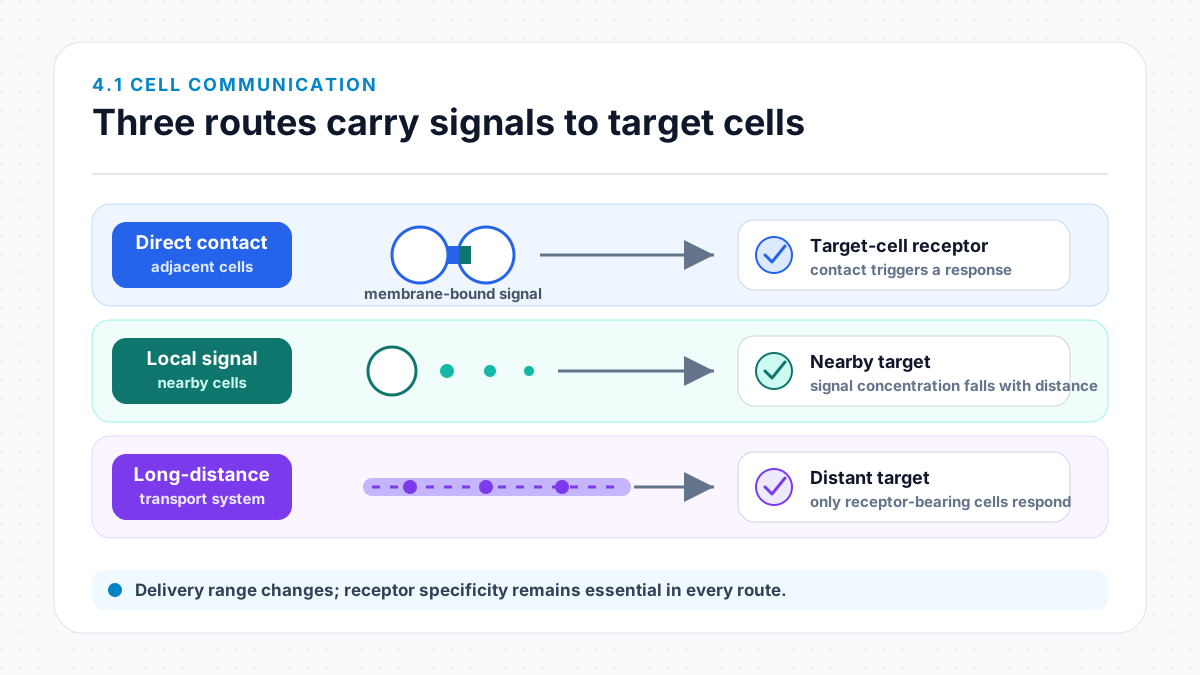
Communication begins with distance and delivery
Direct contact keeps signaling partners adjacent, local signals diffuse nearby, and long-distance signals travel through a transport system. Every route still depends on a compatible receptor in the target cell.
Use this visual to see
Compare delivery range without confusing signal distance with receptor specificity.
What it cannot show
Three parallel rows end at receptor-bearing target cells. The diagram compares alternative signaling routes; it does not show a single signal moving through all three routes or represent physical scale.
Test Ninjas · Original educational diagram
Classify the route without inferring the response
Route
Spatial relationship
Signal path
Boundary
Direct contact
adjacent cells
junction or matching surface proteins
does not require release into circulation
Paracrine
nearby target cells
local extracellular diffusion
range depends on context, not a fixed distance
Synaptic
defined postsynaptic target
axon transmission followed by local release
long axon does not make the released signal endocrine
Endocrine
often distant targets
circulating fluid
only receptor-compatible cells respond
One ligand field, four receiving cells
Ligand arrival creates an opportunity for binding, but only the compatible receptor converts that extracellular condition into receptor activation; the downstream reporter therefore rises in A and C and stays near baseline in B and D.
Arrival and receptor compatibility are separate gatesUse route arrows and receptor symbols to distinguish signal exposure from target-cell response.
The cells and values are synthetic. The model omits receptor abundance, binding kinetics, ligand degradation, pathway crosstalk, and stochastic cell-to-cell variation, so it demonstrates a logical gate rather than a universal quantitative law.
Accessible summary
A two-state table compares four cells before and after 8 nM ligand. A and C carry receptor R and rise from about 1.0 to 3.8 and 3.6. B and D lack R and remain from 0.9 to 1.0.
Test whether exposure alone explains response
Does equal ligand exposure produce equal reporter response across the four synthetic cell groups?
Test whether exposure alone explains response dataset
Cell group
Receptor R
Ligand (nM)
Mean normalized response
SD
A
present
8
3.8
0.2
B
absent
8
1
0.1
C
present
8
3.6
0.3
D
absent
8
0.9
0.1
Analysis
The two receptor-positive groups exceed the prespecified response threshold of 2.0, while both receptor-negative groups remain near the ligand-free baseline. The pattern is consistent with receptor-dependent selectivity under the model conditions.
Limitations
The synthetic summary does not identify a natural ligand, quantify binding affinity, establish that R is sufficient in every cell context, or distinguish every downstream relay. Replicates, receptor verification, vehicle controls, and viability would be required in an experiment.
Provided accessible table
Test whether exposure alone explains response accessible table
Cell group
Receptor R
Ligand (nM)
Mean response
SD
A
present
8
3.8
0.2
B
absent
8
1
0.1
C
present
8
3.6
0.3
D
absent
8
0.9
0.1
Keep these three ideas
Communication categories describe how a signal travels, not whether every exposed cell responds.
Compatible receptors make response selective among cells sharing the same environment.
A response difference supports receptor dependence only within stated controls and cannot reveal every downstream step.
Keep reading Unit 4: Cell Communication and Cell Cycle
You just read the first topic free. Your free trial opens the rest of this unit, every AP Biology unit, and all 19 AP courses.