Now readingIntroduction
0%
AP Biology · Framework 2026-27
Unit 8

Ecology

Ecology links organism responses, population rates, community interactions, energy flow, biodiversity, and disturbance across explicit spatial and temporal boundaries.

Topics
7

Introduction

Ecology links organism responses, population rates, community interactions, energy flow, biodiversity, and disturbance across explicit spatial and temporal boundaries.

Start every analysis by defining the system, units, denominator, and time scale. Energy enters, moves through biomass, and dissipates; atoms cycle. Population and community patterns emerge from demographic flows, feedback, and species interactions.

Observational change is not automatically causal. Matched references, pretreatment trends, replication, detection controls, and bounded recovery metrics determine what ecosystem evidence can support.

01
cue detection

organism response

02
energy capture and respiration

trophic transfer

03
demographic flows and density

population change

04
species interactions and disturbance

community composition

Current exam guidance: Aligned to the current 2026–27 AP Biology course framework, including scientific practices, data analysis, and model-based reasoning.
8.1

Responses to the Environment

How do environmental cues produce regulated responses that can affect fitness?

Short answer

Receptors detect cues, signaling networks process them, and physiological or behavioral outputs alter interaction with the environment within evolved limits.
Know firstCell signaling · Feedback · Natural selection

Separate cue detection, response, and evolutionary consequence

A response begins when a sensory or molecular receptor detects a cue. A relay changes neural, hormonal, or cellular activity, producing movement, timing, communication, or physiology. Taxis is directed movement relative to a stimulus; kinesis changes activity without directional orientation. A circadian rhythm is an endogenous oscillation entrained by cues, not simply any repeated behavior.

In the synthetic choice arena, 32 of 50 observations occur on the cue side after equal starting positions and side randomization. The preference fraction is 0.64. That pattern is consistent with a cue-associated response, but it does not identify the receptor or prove taxis if speed, side bias, or repeated individuals are uncontrolled. A short-term response in individuals is not itself population evolution.

Scientific source
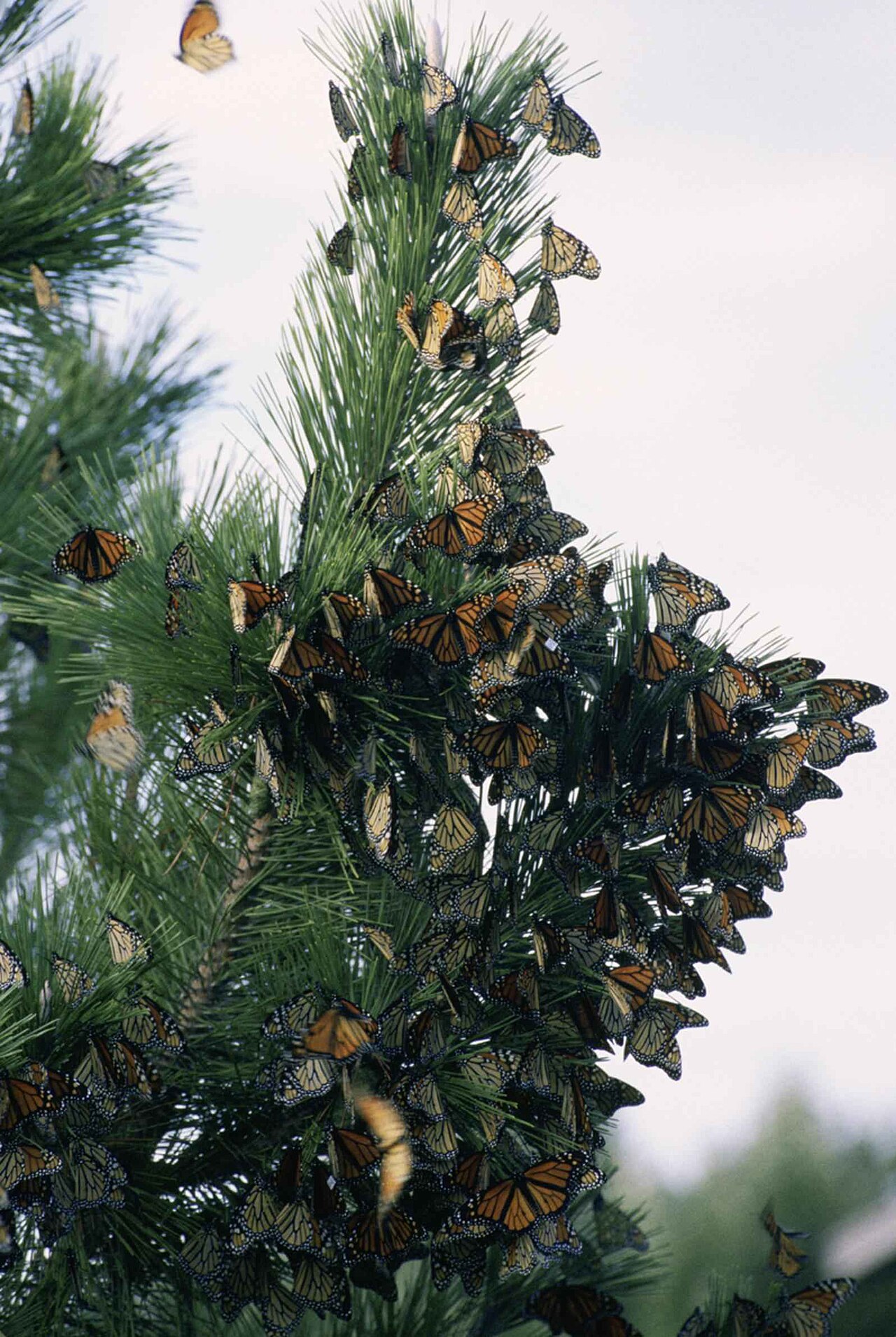
Dense group of orange-and-black monarch butterflies resting together during migration.

Migration is a response across space and time

Migrating monarchs integrate environmental cues with inherited sensory, physiological, and behavioral systems. The photograph shows the population-scale result; experiments are needed to isolate which cue and receptor guide a particular movement.

Use this visual to see
Connect a visible behavioral pattern to the receptor–relay–response mechanism developed in the lesson.
What it cannot show
A single aggregation photograph cannot identify navigation cues, measure individual fitness, or show whether every butterfly followed the same route.

Gene Nieminen, U.S. Fish and Wildlife Service · Public domain · Wikimedia Commons item record

Trace a cue through response and evidence

Cue detection changes a regulated output that shifts observed location under the modeled conditions.

Cue-associated distribution is not a complete mechanismConnect observation to a bounded response claim.
arena
cue
32
control
18
total
50
causal chain
steps
sensor · relay · response · possible fitness consequence

Non-color encodings: cue uses solid outline; control uses dashed outline; counts printed

Entities

  • cue side
  • control side
  • 50 pooled observations
  • sensor-relay-response chain

Rules

  • Use total observations as denominator.
  • Side assignment is randomized.
  • Distribution alone does not identify sensory mechanism.
Trace a cue through response and evidence states
Stateidcuecontroltotalsteps
1arena321850—
2causal-chain———["sensor","relay","response","possible fitness consequence"]

Classify the response carefully

PatternDefinition
taxisdirected movement relative to cue
kinesisactivity changes without direction
circadian rhythmendogenous cycle entrained by cues

Keep these three ideas

  • A cue acts through receptors and relays.
  • Taxis, kinesis, and rhythms describe different patterns.
  • Behavioral observations require controls before causal claims.

Keep reading Unit 8: Ecology

You just read the first topic free. Your free trial opens the rest of this unit, every AP Biology unit, and all 19 AP courses.

  • 8.1 Responses to the EnvironmentRead
  • 8.2 Energy Flow Through Ecosystems
  • 8.3 Population Ecology
  • 8.4 Effect of Density on Populations
  • 8.5 Community Ecology
  • 8.6 Biodiversity
  • 8.7 Disruptions in Ecosystems
Start my free 7 days →$0.00 due today · cancel anytime · score guarantee

Practice AP Biology in the real test engine.

Free practice set: timed, the same engine as our full-length tests, every answer explained.