Renaissance and Exploration
Renaissance culture and Atlantic expansion grew from urban wealth, text networks, political competition, maritime experience, and institutions that could finance repeated action. Those conditions created capacity; rulers, merchants, scholars, artists, and communities decided how to use it.
- Exam weight
- 10–15%
- Topics
- 11
- Visual studies
- 4
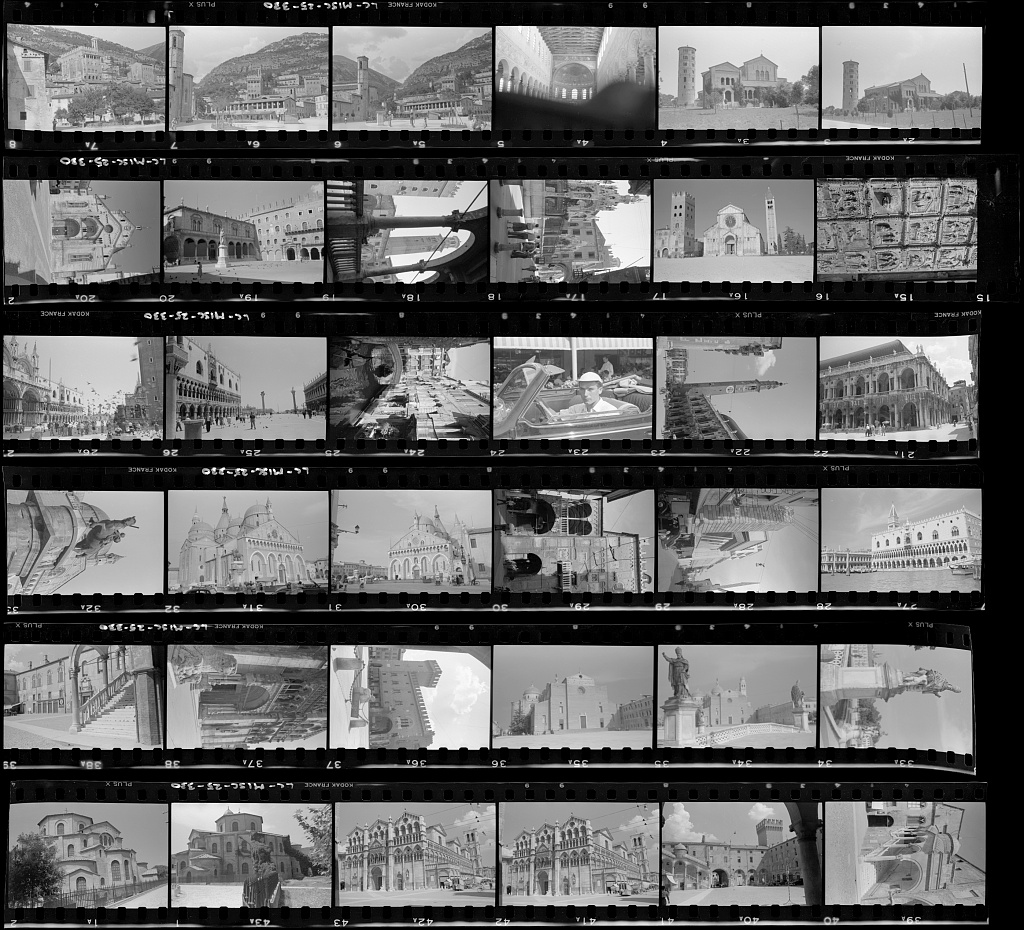
Why did cultural and maritime change accelerate after c. 1450?
Commercial cities, courts, universities, and workshops gave patrons and specialists resources for cultural production.
Print and maritime tools lowered selected costs, while finance and political rivalry turned knowledge into repeatable projects.
Overseas encounters then joined exchange to conquest, epidemic disease, imperial law, and coerced labor shaped by non-European agency.
How the changes connect
- Urban wealth supports patronage and learning
- Print and navigation widen practical capacity
- Rival states and merchants finance repeated expansion
- Colonial institutions redirect exchange through coercion
Compare the cases
| Case | How it worked | What made it distinct |
|---|---|---|
| Italian Renaissance | Urban courts, classical study, civic competition | Concentrated patronage |
| Northern Renaissance | Christian humanism and print networks | Reform-oriented circulation |
| Atlantic expansion | Finance, ships, states, and local encounters | Global consequences |
Read the chapter image
Which frames emphasize civic display, movement, or commerce, and what evidence would be needed to connect those spaces to Renaissance patrons?
Contextualizing Renaissance and Discovery
Why did cultural experimentation and Atlantic expansion intensify in parts of Europe from the fifteenth century?
Late-medieval Europe already contained commercial cities, courts, universities, Mediterranean exchange, church institutions, and Atlantic seafaring. Change accelerated where those foundations supplied money, texts, technical knowledge, and political sponsors; no single date separated a “medieval” world from a new one.
Florence, Venice, Milan, Rome, and other cities concentrated merchant wealth and political rivalry that patrons could direct toward education, buildings, art, and public reputation. Urban institutions supplied cultural capacity and incentives. Greek and Latin works moved through manuscript collections, scholars, migration, schools, and then print shops that made selected texts easier to reproduce. Renaissance learning grew through transmission systems rather than sudden rediscovery.
Portuguese and Castilian sailors, merchants, and rulers learned through island settlement, coastal trade, mapping, winds, and repeated voyages before sustained oceanic empires. Atlantic expansion rested on accumulated practice and finance. Renaissance and Atlantic change intensified where wealth and institutions created capacity, while rivalry and political choice directed that capacity toward particular cultural and maritime projects.
Evidence worth keeping
Know what each example demonstrates, not only its name.
Italian city-states
- What happened
- Florence, Venice, Milan, Rome, and other cities concentrated merchant wealth and political rivalry that patrons could direct toward education, buildings, art, and public reputation.
- What it proves
- Urban institutions supplied cultural capacity and incentives.
- Use it for
- Italian city-states works best near the start of an evidence paragraph. Establish when and where it occurred, then use the example to show that urban institutions supplied cultural capacity and incentives. Follow it with Text and print networks to distinguish the immediate development from the system that made it matter.
- Do not overclaim
- Italian city-states shows that Urban institutions supplied cultural capacity and incentives. It remains one bounded example and cannot represent every region or group.
Text and print networks
- What happened
- Greek and Latin works moved through manuscript collections, scholars, migration, schools, and then print shops that made selected texts easier to reproduce.
- What it proves
- Renaissance learning grew through transmission systems rather than sudden rediscovery.
- Use it for
- Compare Text and print networks with Italian city-states and explain why the shared measure matters.
- Do not overclaim
- Text and print networks shows that Renaissance learning grew through transmission systems rather than sudden rediscovery. It remains one bounded example and cannot represent every region or group.
Iberian Atlantic experience
- What happened
- Portuguese and Castilian sailors, merchants, and rulers learned through island settlement, coastal trade, mapping, winds, and repeated voyages before sustained oceanic empires.
- What it proves
- Atlantic expansion rested on accumulated practice and finance.
- Use it for
- A qualified paragraph can end with Iberian Atlantic experience. Contrast its setting or outcome with Italian city-states, then state what the difference prevents you from claiming. The evidence still belongs in the argument because atlantic expansion rested on accumulated practice and finance.
- Do not overclaim
- Iberian Atlantic experience shows that Atlantic expansion rested on accumulated practice and finance. It remains one bounded example and cannot represent every region or group.
Use on the exam
Renaissance and Atlantic change intensified where wealth and institutions created capacity, while rivalry and political choice directed that capacity toward particular cultural and maritime projects.
Do not describe Europe in 1450 as culturally dormant or Atlantic waters as empty space awaiting Europeans.
Bottom line: Build the paragraph around the relationship between Italian city-states and Text and print networks; use Iberian Atlantic experience to qualify how widely the explanation applies. If the paragraph becomes a list, return to one comparison: what changes between Italian city-states and Text and print networks, and what boundary does Iberian Atlantic experience place on the answer? That final boundary keeps a useful generalization from becoming an overclaim.
Italian Renaissance
How did urban competition and humanist study change elite culture in Renaissance Italy?
Italian cities joined commercial wealth to republican, princely, guild, and church patronage. Humanists used ancient texts to teach rhetoric, history, ethics, and public service, while artists combined classical forms with religious subjects, observation, geometry, and workshop skill.
Medici, guild, civic, and church patrons commissioned art and architecture for devotion, family memory, status, and political legitimacy. Competition among patrons created durable markets and institutions for culture. Teachers and officials used classical rhetoric and history to prepare elite men for administration and public argument, while women writers and patrons worked within tighter institutional limits. Humanism connected textual study to education and political service.
Artists and workshop mathematicians developed methods for organizing depth that expanded visual choices alongside anatomy, classical form, and inherited religious conventions. Renaissance art changed through learned practice, not isolated genius. Urban institutions and patronage changed elite culture by rewarding humanist education and new visual methods, although Renaissance participation remained unequal and religious purposes persisted.
Evidence worth keeping
Know what each example demonstrates, not only its name.
Florentine patronage
- What happened
- Medici, guild, civic, and church patrons commissioned art and architecture for devotion, family memory, status, and political legitimacy.
- What it proves
- Competition among patrons created durable markets and institutions for culture.
- Use it for
- Choose Florentine patronage when you need concrete support rather than another general statement. Describe the development in one sentence and spend the next sentence on the link: Competition among patrons created durable markets and institutions for culture. The comparison with Civic humanism can show whether that mechanism was isolated or repeated.
- Do not overclaim
- Florentine patronage shows that Competition among patrons created durable markets and institutions for culture. It remains one bounded example and cannot represent every region or group.
Civic humanism
- What happened
- Teachers and officials used classical rhetoric and history to prepare elite men for administration and public argument, while women writers and patrons worked within tighter institutional limits.
- What it proves
- Humanism connected textual study to education and political service.
- Use it for
- Compare Civic humanism with Florentine patronage and explain why the shared measure matters.
- Do not overclaim
- Civic humanism shows that Humanism connected textual study to education and political service. It remains one bounded example and cannot represent every region or group.
Linear perspective
- What happened
- Artists and workshop mathematicians developed methods for organizing depth that expanded visual choices alongside anatomy, classical form, and inherited religious conventions.
- What it proves
- Renaissance art changed through learned practice, not isolated genius.
- Use it for
- Use Linear perspective to define how far the claim reaches. Give its date, place, and affected group before explaining the boundary. It can qualify Florentine patronage and Civic humanism because renaissance art changed through learned practice, not isolated genius. This supports a precise “although” clause instead of a universal statement.
- Do not overclaim
- Linear perspective shows that Renaissance art changed through learned practice, not isolated genius. It remains one bounded example and cannot represent every region or group.
Use on the exam
Urban institutions and patronage changed elite culture by rewarding humanist education and new visual methods, although Renaissance participation remained unequal and religious purposes persisted.
Do not equate humanism with atheism or treat church patronage as the opposite of Renaissance culture.
Bottom line: Build the paragraph around the relationship between Florentine patronage and Civic humanism; use Linear perspective to qualify how widely the explanation applies. If the paragraph becomes a list, return to one comparison: what changes between Florentine patronage and Civic humanism, and what boundary does Linear perspective place on the answer? That final boundary keeps a useful generalization from becoming an overclaim.
Northern Renaissance
Why did Renaissance learning take different forms north of the Alps?
Northern courts, towns, universities, devotional movements, and commercial networks received Italian practices through travel and print but adapted them to local languages, education, religion, and artistic markets. The result was comparison and selective borrowing, not a delayed copy of Italy.
Erasmus compared manuscripts and languages to clarify Christian texts and criticize clerical ignorance while remaining committed to reform within Christianity. Philology could turn humanist method toward religious renewal. Thomas More used an imagined society to expose tensions over property, punishment, work, belief, and government without supplying a simple political program. Humanist writing could make familiar institutions open to comparison.
Painters used layered oil technique, detailed interiors, portraiture, and devotional symbolism for courtly, urban, and religious patrons. Different markets and practices shaped a northern visual language. Northern Renaissance culture combined humanist textual methods with devotional reform, vernacular print, and detailed visual traditions shaped by regional institutions.
Evidence worth keeping
Know what each example demonstrates, not only its name.
Erasmus and textual criticism
- What happened
- Erasmus compared manuscripts and languages to clarify Christian texts and criticize clerical ignorance while remaining committed to reform within Christianity.
- What it proves
- Philology could turn humanist method toward religious renewal.
- Use it for
- Use Erasmus and textual criticism as direct support. Name the actor, action, result, and the link between them.
- Do not overclaim
- Erasmus and textual criticism shows that Philology could turn humanist method toward religious renewal. It remains one bounded example and cannot represent every region or group.
More’s Utopia
- What happened
- Thomas More used an imagined society to expose tensions over property, punishment, work, belief, and government without supplying a simple political program.
- What it proves
- Humanist writing could make familiar institutions open to comparison.
- Use it for
- This case helps you move from example to pattern. Set More’s Utopia beside Erasmus and textual criticism, identify one shared measure, and explain the difference in policy, setting, or power that affected the outcome. Keep the comparison tied to the claim: Humanist writing could make familiar institutions open to comparison.
- Do not overclaim
- More’s Utopia shows that Humanist writing could make familiar institutions open to comparison. It remains one bounded example and cannot represent every region or group.
Netherlandish oil painting
- What happened
- Painters used layered oil technique, detailed interiors, portraiture, and devotional symbolism for courtly, urban, and religious patrons.
- What it proves
- Different markets and practices shaped a northern visual language.
- Use it for
- Netherlandish oil painting is the evidence to use when the first two cases make the argument sound too broad. Explain the apparent exception, then decide whether it weakens the claim or narrows its scope. The key analytical point is that different markets and practices shaped a northern visual language.
- Do not overclaim
- Netherlandish oil painting shows that Different markets and practices shaped a northern visual language. It remains one bounded example and cannot represent every region or group.
Use on the exam
Northern Renaissance culture combined humanist textual methods with devotional reform, vernacular print, and detailed visual traditions shaped by regional institutions.
Avoid the false contrast of a secular Italian Renaissance and a uniformly religious northern one.
Bottom line: Build the paragraph around the relationship between Erasmus and textual criticism and More’s Utopia; use Netherlandish oil painting to qualify how widely the explanation applies. The evidence sequence matters. Let Erasmus and textual criticism establish the problem, More’s Utopia show the operative mechanism, and Netherlandish oil painting supply the most defensible qualification. End by naming the actor whose choices carried the mechanism forward or blocked it.
Printing
When did printing change European debate, and what still limited its reach?
Printing changed communication when metal type, presswork, paper, ink, skilled labor, credit, authors, booksellers, and transport worked as one system. It lowered the cost of repeating some texts and accelerated controversy, but printers still selected markets and authorities still censored.
Mid-fifteenth-century workshops coordinated movable metal type, durable ink, paper, presses, compositors, proofing, and substantial finance to produce repeated pages. An invention mattered through organized production and skilled labor. Printers issued pamphlets, devotional works, news, manuals, and literature in languages beyond Latin for markets larger than universities and courts. Format, price, and language could widen circulation without creating universal literacy.
Reformers used pamphlets and images while Catholic and Protestant authorities licensed presses, banned works, punished printers, and published competing arguments. Print increased the speed of conflict but did not determine belief. Printing transformed debate when a production and distribution network made selected arguments repeatable, while literacy, cost, censorship, oral culture, and market choice continued to limit reception.
Evidence worth keeping
Know what each example demonstrates, not only its name.
Gutenberg shop system
- What happened
- Mid-fifteenth-century workshops coordinated movable metal type, durable ink, paper, presses, compositors, proofing, and substantial finance to produce repeated pages.
- What it proves
- An invention mattered through organized production and skilled labor.
- Use it for
- Gutenberg shop system works best near the start of an evidence paragraph. Establish when and where it occurred, then use the example to show that an invention mattered through organized production and skilled labor. Follow it with Vernacular and cheaper print to distinguish the immediate development from the system that made it matter.
- Do not overclaim
- Gutenberg shop system shows that An invention mattered through organized production and skilled labor. It remains one bounded example and cannot represent every region or group.
Vernacular and cheaper print
- What happened
- Printers issued pamphlets, devotional works, news, manuals, and literature in languages beyond Latin for markets larger than universities and courts.
- What it proves
- Format, price, and language could widen circulation without creating universal literacy.
- Use it for
- Compare Vernacular and cheaper print with Gutenberg shop system and explain why the shared measure matters.
- Do not overclaim
- Vernacular and cheaper print shows that Format, price, and language could widen circulation without creating universal literacy. It remains one bounded example and cannot represent every region or group.
Confessional print and censorship
- What happened
- Reformers used pamphlets and images while Catholic and Protestant authorities licensed presses, banned works, punished printers, and published competing arguments.
- What it proves
- Print increased the speed of conflict but did not determine belief.
- Use it for
- Use Confessional print and censorship to qualify the claim by naming the condition or group that differs.
- Do not overclaim
- Confessional print and censorship shows that Print increased the speed of conflict but did not determine belief. It remains one bounded example and cannot represent every region or group.
Use on the exam
Printing transformed debate when a production and distribution network made selected arguments repeatable, while literacy, cost, censorship, oral culture, and market choice continued to limit reception.
Do not claim Gutenberg invented all printing or that the press automatically caused literacy or the Reformation.
Bottom line: Build the paragraph around the relationship between Gutenberg shop system and Vernacular and cheaper print; use Confessional print and censorship to qualify how widely the explanation applies. Prioritize explanation over name-dropping: connect Gutenberg shop system to Vernacular and cheaper print, then state exactly why Confessional print and censorship confirms, complicates, or limits that connection. The explanation after each example should be longer than the label itself.
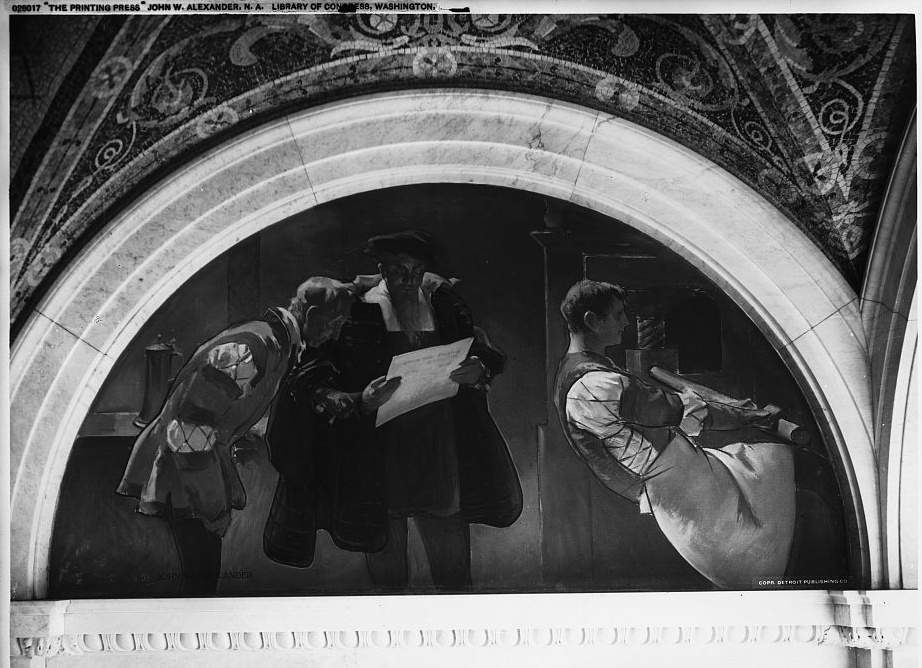 Visual study 02
John White Alexander mural, reproduced c. 1896–1912
Study the source before reading the analysis
A nineteenth-century mural reconstructs a print shop as a coordinated workplace. Compositors, press operators, paper, type, ink, capital, and distribution all had to align before a text could reach readers.
List the jobs and materials visible or implied. Which claim about sixteenth-century readership would still require other evidence?
New Monarchies
How did late-fifteenth-century monarchs make royal government more dependable without becoming all-powerful?
Rulers emerging from dynastic conflict sought regular revenue, trained councils, courts, and military forces. They expanded central capacity through bargains with nobles, towns, representative bodies, and churches; stronger government did not mean uniform control over composite territories.
The Spanish monarchs strengthened royal councils, used religious policy for dynastic consolidation, completed the Granada war, and pursued coercive conversion and expulsion. Centralization could combine bargaining, war, administration, and persecution. Henry VII used councils, bonds, legal process, and close management of revenue after civil war rather than relying on a mythical all-powerful Star Chamber. Dependable monarchy grew through routine fiscal and legal practices.
French kings used the taille and standing forces while still negotiating privileges, provincial differences, noble interests, and church relations. Regular revenue expanded capacity without eliminating local limits. New monarchies became more dependable by institutionalizing finance, law, and service while bargaining with powerful groups; religious uniformity and war could strengthen rule while generating coercion and debt.
Evidence worth keeping
Know what each example demonstrates, not only its name.
Ferdinand and Isabella
- What happened
- The Spanish monarchs strengthened royal councils, used religious policy for dynastic consolidation, completed the Granada war, and pursued coercive conversion and expulsion.
- What it proves
- Centralization could combine bargaining, war, administration, and persecution.
- Use it for
- Use Ferdinand and Isabella as direct support. Name the actor, action, result, and the link between them.
- Do not overclaim
- Ferdinand and Isabella shows that Centralization could combine bargaining, war, administration, and persecution. It remains one bounded example and cannot represent every region or group.
Tudor council finance
- What happened
- Henry VII used councils, bonds, legal process, and close management of revenue after civil war rather than relying on a mythical all-powerful Star Chamber.
- What it proves
- Dependable monarchy grew through routine fiscal and legal practices.
- Use it for
- Pair Tudor council finance with Ferdinand and Isabella. Hold the question constant—power, labor, citizenship, markets, or another relevant category—and explain whether the second case confirms the same mechanism or changes it. The useful inference is that dependable monarchy grew through routine fiscal and legal practices.
- Do not overclaim
- Tudor council finance shows that Dependable monarchy grew through routine fiscal and legal practices. It remains one bounded example and cannot represent every region or group.
Valois taxation
- What happened
- French kings used the taille and standing forces while still negotiating privileges, provincial differences, noble interests, and church relations.
- What it proves
- Regular revenue expanded capacity without eliminating local limits.
- Use it for
- A qualified paragraph can end with Valois taxation. Contrast its setting or outcome with Ferdinand and Isabella, then state what the difference prevents you from claiming. The evidence still belongs in the argument because regular revenue expanded capacity without eliminating local limits.
- Do not overclaim
- Valois taxation shows that Regular revenue expanded capacity without eliminating local limits. It remains one bounded example and cannot represent every region or group.
Use on the exam
New monarchies became more dependable by institutionalizing finance, law, and service while bargaining with powerful groups; religious uniformity and war could strengthen rule while generating coercion and debt.
Do not treat composite monarchies as modern nation-states or centralization as complete obedience.
Bottom line: Build the paragraph around the relationship between Ferdinand and Isabella and Tudor council finance; use Valois taxation to qualify how widely the explanation applies. If the paragraph becomes a list, return to one comparison: what changes between Ferdinand and Isabella and Tudor council finance, and what boundary does Valois taxation place on the answer? That final boundary keeps a useful generalization from becoming an overclaim.
Technological Advances and the Age of Exploration
Why did new maritime capacity produce sustained exploration only in particular political and commercial settings?
Ocean travel required a package of ship design, route knowledge, observation, charts, finance, crews, ports, and sponsors. Many techniques had Mediterranean, Islamic, Asian, and earlier European histories; Iberian mariners combined and refined them through practice.
Caravels offered maneuverability for coastal reconnaissance, while larger carracks carried more people and cargo across long routes; rigs and hulls involved tradeoffs rather than one superior design. Vessel choices had to match route, cargo, and political purpose. Mariners combined magnetic direction, portolan and later charts, latitude observations, soundings, and dead reckoning while tolerating substantial uncertainty. Navigation reduced risk through several imperfect knowledge systems.
Repeated voyages down and around Africa taught sailors seasonal winds and the volta do mar, supported by royal licenses, merchants, island bases, and accumulated reports. Practical learning and institutions turned tools into sustained capacity. Maritime technologies enabled expansion only when route learning, skilled crews, finance, and state-commercial sponsorship converted technical possibility into repeated voyages.
Evidence worth keeping
Know what each example demonstrates, not only its name.
Ship design
- What happened
- Caravels offered maneuverability for coastal reconnaissance, while larger carracks carried more people and cargo across long routes; rigs and hulls involved tradeoffs rather than one superior design.
- What it proves
- Vessel choices had to match route, cargo, and political purpose.
- Use it for
- Use Ship design as direct support. Name the actor, action, result, and the link between them.
- Do not overclaim
- Ship design shows that Vessel choices had to match route, cargo, and political purpose. It remains one bounded example and cannot represent every region or group.
Charts, compass, and astronomy
- What happened
- Mariners combined magnetic direction, portolan and later charts, latitude observations, soundings, and dead reckoning while tolerating substantial uncertainty.
- What it proves
- Navigation reduced risk through several imperfect knowledge systems.
- Use it for
- Pair Charts, compass, and astronomy with Ship design. Hold the question constant—power, labor, citizenship, markets, or another relevant category—and explain whether the second case confirms the same mechanism or changes it. The useful inference is that navigation reduced risk through several imperfect knowledge systems.
- Do not overclaim
- Charts, compass, and astronomy shows that Navigation reduced risk through several imperfect knowledge systems. It remains one bounded example and cannot represent every region or group.
Portuguese route learning
- What happened
- Repeated voyages down and around Africa taught sailors seasonal winds and the volta do mar, supported by royal licenses, merchants, island bases, and accumulated reports.
- What it proves
- Practical learning and institutions turned tools into sustained capacity.
- Use it for
- Use Portuguese route learning to qualify the claim by naming the condition or group that differs.
- Do not overclaim
- Portuguese route learning shows that Practical learning and institutions turned tools into sustained capacity. It remains one bounded example and cannot represent every region or group.
Use on the exam
Maritime technologies enabled expansion only when route learning, skilled crews, finance, and state-commercial sponsorship converted technical possibility into repeated voyages.
Do not claim Europeans independently invented every tool or that maritime capacity made conquest inevitable.
Bottom line: Build the paragraph around the relationship between Ship design and Charts, compass, and astronomy; use Portuguese route learning to qualify how widely the explanation applies. A sound response should establish the relationship with Ship design, check it against Charts, compass, and astronomy, and use Portuguese route learning only for the limit it can actually prove. State the causal verb directly instead of leaving the reader to infer why the cases belong together.
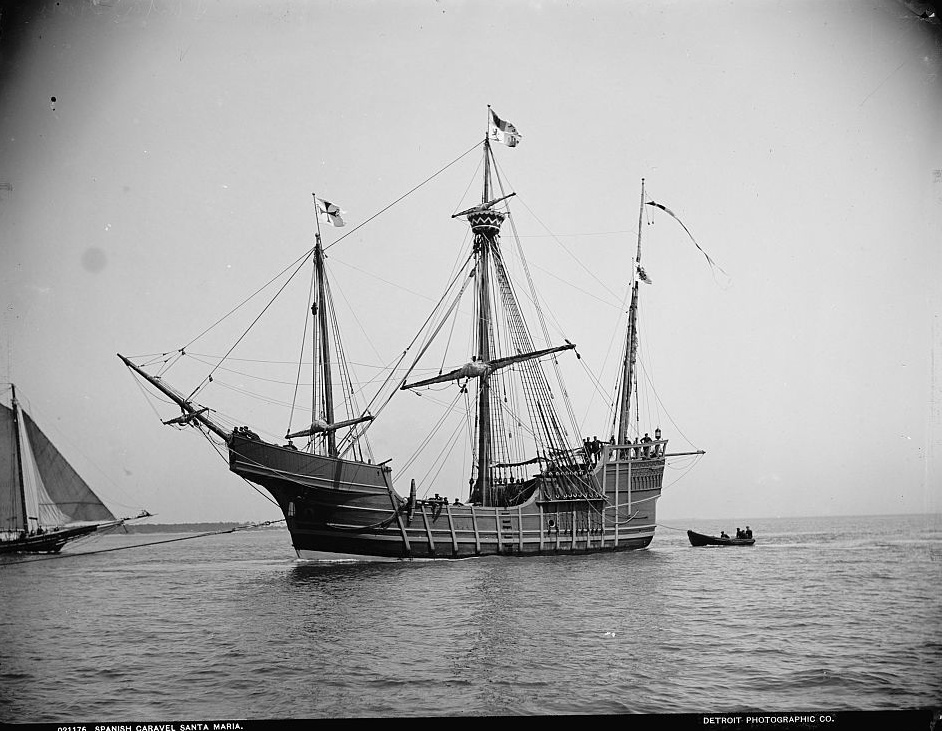 Visual study 03
Edward H. Hart photograph, 1893
Study the source before reading the analysis
The 1893 replica lets a reader inspect hull size, masts, rigging, deck space, and the labor implied by sailing. It also turns Columbus into a commemorative subject four centuries after the voyage.
Which design features could affect range or maneuvering, and which claims about the 1492 voyage cannot be recovered from a replica?
Rivals on the World Stage
Why did European powers keep investing in overseas competition after early voyages proved costly and uncertain?
Overseas routes promised commodities, customs revenue, strategic ports, and advantages over rivals. Rulers and merchants spread risk through treaties, charters, private force, and joint investment, yet paper claims depended on local allies, markets, states, and resistance.
Spain and Portugal used papal claims and a 1494 bilateral line to manage rivalry between themselves, although neither agreement created control over oceans or other peoples. Diplomatic rules could coordinate competitors without settling sovereignty on the ground. Dutch and English governments granted companies trading privileges and coercive authority in exchange for private capital, ships, administration, and strategic service. Corporate institutions joined profit seeking to state power and risk sharing.
Northern rivals attacked shipping, seized selected ports, formed alliances, and entered Asian and Atlantic markets rather than simply inheriting Iberian empires. Competition rewarded continued investment and institutional experimentation. European powers reinvested because commercial and strategic rivalry made overseas access valuable, while treaties and chartered companies spread cost; local political conditions still determined what claims became effective.
Evidence worth keeping
Know what each example demonstrates, not only its name.
Treaty of Tordesillas
- What happened
- Spain and Portugal used papal claims and a 1494 bilateral line to manage rivalry between themselves, although neither agreement created control over oceans or other peoples.
- What it proves
- Diplomatic rules could coordinate competitors without settling sovereignty on the ground.
- Use it for
- Use Treaty of Tordesillas as direct support. Name the actor, action, result, and the link between them.
- Do not overclaim
- Treaty of Tordesillas shows that Diplomatic rules could coordinate competitors without settling sovereignty on the ground. It remains one bounded example and cannot represent every region or group.
Chartered companies
- What happened
- Dutch and English governments granted companies trading privileges and coercive authority in exchange for private capital, ships, administration, and strategic service.
- What it proves
- Corporate institutions joined profit seeking to state power and risk sharing.
- Use it for
- Compare Chartered companies with Treaty of Tordesillas and explain why the shared measure matters.
- Do not overclaim
- Chartered companies shows that Corporate institutions joined profit seeking to state power and risk sharing. It remains one bounded example and cannot represent every region or group.
Dutch and English challenges
- What happened
- Northern rivals attacked shipping, seized selected ports, formed alliances, and entered Asian and Atlantic markets rather than simply inheriting Iberian empires.
- What it proves
- Competition rewarded continued investment and institutional experimentation.
- Use it for
- Dutch and English challenges is the evidence to use when the first two cases make the argument sound too broad. Explain the apparent exception, then decide whether it weakens the claim or narrows its scope. The key analytical point is that competition rewarded continued investment and institutional experimentation.
- Do not overclaim
- Dutch and English challenges shows that Competition rewarded continued investment and institutional experimentation. It remains one bounded example and cannot represent every region or group.
Use on the exam
European powers reinvested because commercial and strategic rivalry made overseas access valuable, while treaties and chartered companies spread cost; local political conditions still determined what claims became effective.
Do not draw later empires backward or treat European agreements as consent from Indigenous, African, or Asian societies.
Bottom line: Build the paragraph around the relationship between Treaty of Tordesillas and Chartered companies; use Dutch and English challenges to qualify how widely the explanation applies. A sound response should establish the relationship with Treaty of Tordesillas, check it against Chartered companies, and use Dutch and English challenges only for the limit it can actually prove. State the causal verb directly instead of leaving the reader to infer why the cases belong together.
Colonial Expansion and Columbian Exchange
How did movement of organisms become a mechanism of conquest, settlement, and global economic change?
Transatlantic contact moved pathogens, people, crops, and animals through colonial routes. Biological transfer was not a neutral exchange: disease interacted with war and political disruption, while colonial institutions directed land and labor toward settlement and commodity production.
Old World pathogens caused severe Indigenous mortality in successive regional outbreaks, weakening communities amid invasion, forced movement, food disruption, and political conflict. Disease changed demographic and military conditions without acting as an independent conqueror. Maize and potatoes entered existing farming and food systems in Europe, Africa, and Asia, where local cultivators selected how and when to adopt them. Transfers could support population and dietary change through local decisions.
Sugar, cattle, horses, wheat, and other organisms changed land use, transport, labor demand, and ecology under colonial property and extraction systems. Institutions converted biological transfer into unequal economic power. The Columbian Exchange reshaped populations and production because organisms moved through conquest, settlement, and labor systems; biological effects remained regional and politically mediated.
Evidence worth keeping
Know what each example demonstrates, not only its name.
Epidemic disease
- What happened
- Old World pathogens caused severe Indigenous mortality in successive regional outbreaks, weakening communities amid invasion, forced movement, food disruption, and political conflict.
- What it proves
- Disease changed demographic and military conditions without acting as an independent conqueror.
- Use it for
- Use Epidemic disease as direct support. Name the actor, action, result, and the link between them.
- Do not overclaim
- Epidemic disease shows that Disease changed demographic and military conditions without acting as an independent conqueror. It remains one bounded example and cannot represent every region or group.
American food crops
- What happened
- Maize and potatoes entered existing farming and food systems in Europe, Africa, and Asia, where local cultivators selected how and when to adopt them.
- What it proves
- Transfers could support population and dietary change through local decisions.
- Use it for
- Compare American food crops with Epidemic disease and explain why the shared measure matters.
- Do not overclaim
- American food crops shows that Transfers could support population and dietary change through local decisions. It remains one bounded example and cannot represent every region or group.
Plantation crops and animals
- What happened
- Sugar, cattle, horses, wheat, and other organisms changed land use, transport, labor demand, and ecology under colonial property and extraction systems.
- What it proves
- Institutions converted biological transfer into unequal economic power.
- Use it for
- Use Plantation crops and animals to qualify the claim by naming the condition or group that differs.
- Do not overclaim
- Plantation crops and animals shows that Institutions converted biological transfer into unequal economic power. It remains one bounded example and cannot represent every region or group.
Use on the exam
The Columbian Exchange reshaped populations and production because organisms moved through conquest, settlement, and labor systems; biological effects remained regional and politically mediated.
Do not use one hemispheric death percentage or claim disease alone conquered American empires.
Bottom line: Build the paragraph around the relationship between Epidemic disease and American food crops; use Plantation crops and animals to qualify how widely the explanation applies. Keep the paragraph chronological: set up Epidemic disease, explain the change with American food crops, and finish by deciding whether Plantation crops and animals narrows the claim. Dates should mark a change in conditions, not sit beside an event as decoration.
The Slave Trade
What turned existing forms of bondage into a vast racialized transatlantic system?
Plantation demand joined European shipping and finance to African political conflicts, coastal commerce, forts, colonial sale, and law. Captured people experienced deliberate coercion while resisting aboard ships, through flight and revolt, and by sustaining family, knowledge, and culture.
Portuguese plantation production on São Tomé used enslaved African labor before the largest American systems, linking sugar profits to repeated coerced transport. A plantation commodity could create durable demand for racialized bound labor. European merchants negotiated with and pressured varied African states and intermediaries around coastal markets and fortified posts while remaining dependent on inland political conditions. The system joined multiple actors with unequal responsibility rather than one uniform African or European agent.
Ships, credit, insurance, provisioning, sale markets, and colonial laws carried captives across the Atlantic and converted people into inheritable property. Commercial and legal institutions made forced transport scalable and racial slavery durable. Atlantic slavery expanded when plantation demand, maritime finance, political commerce, and colonial law formed a repeatable system, while enslaved people continually acted against the conditions imposed on them.
Evidence worth keeping
Know what each example demonstrates, not only its name.
São Tomé sugar
- What happened
- Portuguese plantation production on São Tomé used enslaved African labor before the largest American systems, linking sugar profits to repeated coerced transport.
- What it proves
- A plantation commodity could create durable demand for racialized bound labor.
- Use it for
- Use São Tomé sugar as direct support. Name the actor, action, result, and the link between them.
- Do not overclaim
- São Tomé sugar shows that A plantation commodity could create durable demand for racialized bound labor. It remains one bounded example and cannot represent every region or group.
Coastal trade and forts
- What happened
- European merchants negotiated with and pressured varied African states and intermediaries around coastal markets and fortified posts while remaining dependent on inland political conditions.
- What it proves
- The system joined multiple actors with unequal responsibility rather than one uniform African or European agent.
- Use it for
- Compare Coastal trade and forts with São Tomé sugar and explain why the shared measure matters.
- Do not overclaim
- Coastal trade and forts shows that The system joined multiple actors with unequal responsibility rather than one uniform African or European agent. It remains one bounded example and cannot represent every region or group.
Middle Passage and colonial sale
- What happened
- Ships, credit, insurance, provisioning, sale markets, and colonial laws carried captives across the Atlantic and converted people into inheritable property.
- What it proves
- Commercial and legal institutions made forced transport scalable and racial slavery durable.
- Use it for
- Use Middle Passage and colonial sale to qualify the claim by naming the condition or group that differs.
- Do not overclaim
- Middle Passage and colonial sale shows that Commercial and legal institutions made forced transport scalable and racial slavery durable. It remains one bounded example and cannot represent every region or group.
Use on the exam
Atlantic slavery expanded when plantation demand, maritime finance, political commerce, and colonial law formed a repeatable system, while enslaved people continually acted against the conditions imposed on them.
Do not reduce captive people to passive victims, use graphic suffering as explanation, or assign collective blame without naming institutions and actors.
Bottom line: Build the paragraph around the relationship between São Tomé sugar and Coastal trade and forts; use Middle Passage and colonial sale to qualify how widely the explanation applies. The evidence sequence matters. Let São Tomé sugar establish the problem, Coastal trade and forts show the operative mechanism, and Middle Passage and colonial sale supply the most defensible qualification. End by naming the actor whose choices carried the mechanism forward or blocked it.
The Commercial Revolution
How did new financial and commercial institutions change who could organize production and exchange?
Long-distance enterprise faced delayed payment, uncertain information, transport risk, and large capital needs. Banks, negotiable credit, partnerships, companies, and commercial farming helped coordinate those problems while also redistributing access to land, work, and political privilege.
Bills of exchange, deposits, bookkeeping, public banks, and merchant credit moved payments and recorded obligations across cities without requiring every transaction to use coin. Financial instruments enlarged coordination by managing time, distance, and trust. Transferable shares and state charters pooled capital for repeated voyages while granting selected merchants legal privilege and sometimes coercive authority. Enterprise could combine private investment with public power.
Landlords and farmers consolidated or leased land for market production in varied regional processes that changed common rights, labor needs, and rural bargaining. Commercial growth could raise output while making access to land less secure for some households. Commercial institutions increased the scale of exchange by coordinating capital, risk, and land, but their gains rested on legal privilege and produced uneven effects on workers, consumers, and rural communities.
Evidence worth keeping
Know what each example demonstrates, not only its name.
Banking and credit
- What happened
- Bills of exchange, deposits, bookkeeping, public banks, and merchant credit moved payments and recorded obligations across cities without requiring every transaction to use coin.
- What it proves
- Financial instruments enlarged coordination by managing time, distance, and trust.
- Use it for
- Use Banking and credit as direct support. Name the actor, action, result, and the link between them.
- Do not overclaim
- Banking and credit shows that Financial instruments enlarged coordination by managing time, distance, and trust. It remains one bounded example and cannot represent every region or group.
Chartered companies
- What happened
- Transferable shares and state charters pooled capital for repeated voyages while granting selected merchants legal privilege and sometimes coercive authority.
- What it proves
- Enterprise could combine private investment with public power.
- Use it for
- This case helps you move from example to pattern. Set Chartered companies beside Banking and credit, identify one shared measure, and explain the difference in policy, setting, or power that affected the outcome. Keep the comparison tied to the claim: Enterprise could combine private investment with public power.
- Do not overclaim
- Chartered companies shows that Enterprise could combine private investment with public power. It remains one bounded example and cannot represent every region or group.
Commercial agriculture and enclosure
- What happened
- Landlords and farmers consolidated or leased land for market production in varied regional processes that changed common rights, labor needs, and rural bargaining.
- What it proves
- Commercial growth could raise output while making access to land less secure for some households.
- Use it for
- Use Commercial agriculture and enclosure to qualify the claim by naming the condition or group that differs.
- Do not overclaim
- Commercial agriculture and enclosure shows that Commercial growth could raise output while making access to land less secure for some households. It remains one bounded example and cannot represent every region or group.
Use on the exam
Commercial institutions increased the scale of exchange by coordinating capital, risk, and land, but their gains rested on legal privilege and produced uneven effects on workers, consumers, and rural communities.
Do not announce a finished modern capitalist economy or claim enclosure instantly removed all peasants.
Bottom line: Build the paragraph around the relationship between Banking and credit and Chartered companies; use Commercial agriculture and enclosure to qualify how widely the explanation applies. The evidence sequence matters. Let Banking and credit establish the problem, Chartered companies show the operative mechanism, and Commercial agriculture and enclosure supply the most defensible qualification. End by naming the actor whose choices carried the mechanism forward or blocked it.
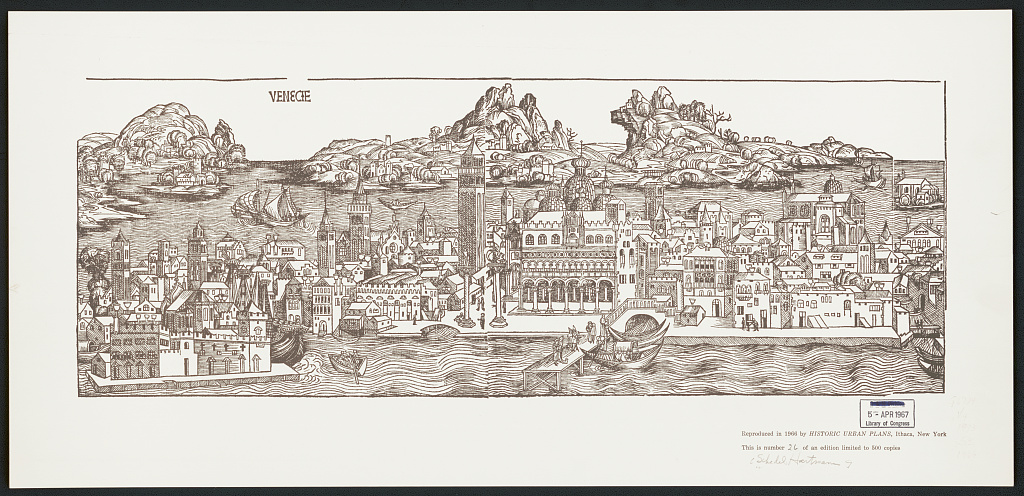 Visual study 04
Panoramic print of Venice, 1966 reproduction
Study the source before reading the analysis
The panorama directs attention to the physical setting behind Venetian commerce: navigable water, concentrated settlement, landing places, warehouses, workshops, and institutions close enough to exchange information and credit. The reproduced historic view makes the city legible as a system rather than presenting one ship as the cause of prosperity.
Trace a cargo from the lagoon into the city. Which workers and institutions would handle it before a merchant could profit?
Causation in the Renaissance and Age of Discovery
Which conditions made Renaissance culture and Atlantic expansion possible, and which choices determined their form?
A causal explanation should separate capacity from direction. Wealth, texts, workshops, ships, and finance made projects possible; political competition and commercial goals selected projects; non-European states and peoples constrained what happened after contact.
Cities, courts, guilds, and churches concentrated resources and rewarded particular writers, teachers, architects, and artists. Institutions explain cultural capacity better than a list of famous individuals. Presses widened the reproduction of selected knowledge while ships, charts, skilled crews, and route learning lowered some barriers to travel. Technology changed feasible action without choosing its purpose or guaranteeing success.
Iberian, Dutch, English, French, and other sponsors pursued prestige, revenue, security, belief, and market access through different arrangements. Competition directed investment and produced feedback from early gains and losses. Institutions and accumulated knowledge supplied the strongest enabling conditions, while rivalry and actor choice directed Renaissance patronage and Atlantic expansion into unequal and regionally varied forms.
Evidence worth keeping
Know what each example demonstrates, not only its name.
Patronage institutions
- What happened
- Cities, courts, guilds, and churches concentrated resources and rewarded particular writers, teachers, architects, and artists.
- What it proves
- Institutions explain cultural capacity better than a list of famous individuals.
- Use it for
- Patronage institutions works best near the start of an evidence paragraph. Establish when and where it occurred, then use the example to show that institutions explain cultural capacity better than a list of famous individuals. Follow it with Print and navigation systems to distinguish the immediate development from the system that made it matter.
- Do not overclaim
- Patronage institutions shows that Institutions explain cultural capacity better than a list of famous individuals. It remains one bounded example and cannot represent every region or group.
Print and navigation systems
- What happened
- Presses widened the reproduction of selected knowledge while ships, charts, skilled crews, and route learning lowered some barriers to travel.
- What it proves
- Technology changed feasible action without choosing its purpose or guaranteeing success.
- Use it for
- Compare Print and navigation systems with Patronage institutions and explain why the shared measure matters.
- Do not overclaim
- Print and navigation systems shows that Technology changed feasible action without choosing its purpose or guaranteeing success. It remains one bounded example and cannot represent every region or group.
State-commercial rivalry
- What happened
- Iberian, Dutch, English, French, and other sponsors pursued prestige, revenue, security, belief, and market access through different arrangements.
- What it proves
- Competition directed investment and produced feedback from early gains and losses.
- Use it for
- Bring in State-commercial rivalry after the main claim is established. Its job is not to reverse the argument automatically, but to identify the group, region, or condition for which the pattern worked differently. Use it to show that competition directed investment and produced feedback from early gains and losses.
- Do not overclaim
- State-commercial rivalry shows that Competition directed investment and produced feedback from early gains and losses. It remains one bounded example and cannot represent every region or group.
Use on the exam
Institutions and accumulated knowledge supplied the strongest enabling conditions, while rivalry and actor choice directed Renaissance patronage and Atlantic expansion into unequal and regionally varied forms.
Avoid the “gold, God, and glory” list unless each motive is connected to a specific institution and action.
Bottom line: Build the paragraph around the relationship between Patronage institutions and Print and navigation systems; use State-commercial rivalry to qualify how widely the explanation applies. Prioritize explanation over name-dropping: connect Patronage institutions to Print and navigation systems, then state exactly why State-commercial rivalry confirms, complicates, or limits that connection. The explanation after each example should be longer than the label itself.
Choose the evidence that can support the claim
Select the examples you would rely on. This is an evidence check, not a scored question.
Atlantic expansion accelerated when states and merchants linked maritime knowledge to repeatable finance and coercive institutions.
Sample argument
Model thesisChange accelerated because commercial cities and monarchies could fund scholars, printers, ships, and repeated voyages, while political rivalry directed that capacity toward cultural prestige and overseas access; technology lowered barriers but did not determine the goals or outcomes.
- Context: late-medieval cities, universities, trade, and reform already existed.
- Capacity: wealth, patronage, print, navigation, and state finance.
- Direction: dynastic and commercial rivalry selected projects.
- Constraint: non-European states and peoples shaped access and conquest.
- Qualification: change was uneven and retained religious and medieval institutions.
Check what you can explain
Mark an item only when you can explain the cause or relationship without looking back.