Age of Reformation
Religious division endured because theology moved through print, jurisdiction, property, political protection, and local institutions. Catholic and Protestant reformers reorganized worship and discipline while dynastic rivalry and social conflict turned some confessional disputes into war.
- Exam weight
- 10–15%
- Topics
- 8
- Visual studies
- 4
Why did religious reform produce durable political division?
Criticism of church practice and Christian humanism already circulated before Luther’s dispute.
Print accelerated argument, but political protection and local institutions determined which reforms survived.
Confessional states disciplined worship and households while dynastic and territorial interests repeatedly crossed religious lines.
How the changes connect
- Reform criticism finds wider print networks
- Rulers and cities protect selected confessions
- Churches reorganize worship, schooling, and property
- War and settlement harden some boundaries
Compare the cases
| Case | How it worked | What made it distinct |
|---|---|---|
| Lutheran reform | Territorial protection and preaching | Durable state churches |
| Reformed traditions | Urban and international networks | Stricter communal discipline |
| Catholic renewal | Trent, orders, education, and art | Institutional reform without Protestant doctrine |
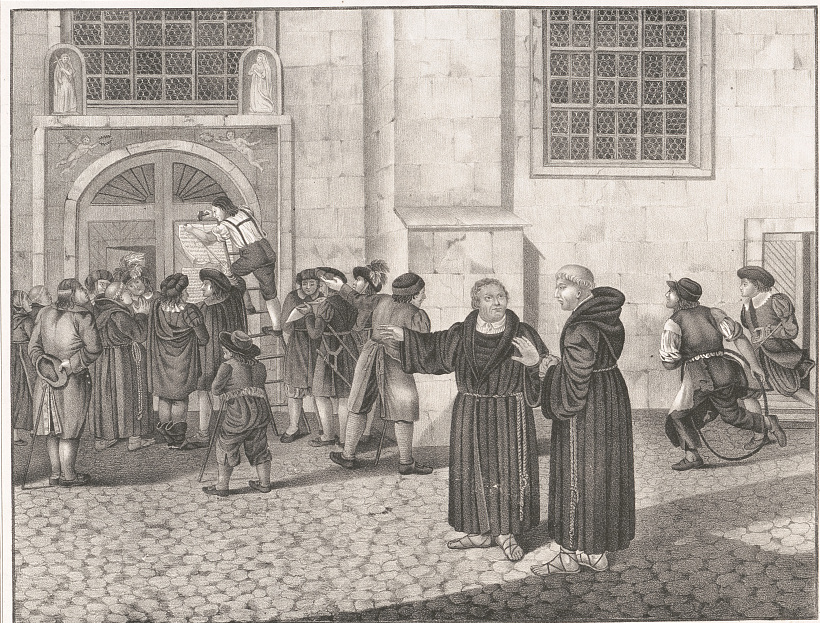
Read the chapter image
How does the artist build Luther’s authority, and what contemporary evidence would be needed to verify the event?
Contextualizing 16th- and 17th-Century Challenges and Developments
Why did calls for religious reform create a durable institutional rupture in the sixteenth century?
Criticism of clerical education, wealth, discipline, and authority long predated Luther. Sixteenth-century rupture became durable because humanist textual work and print widened controversy while rulers, councils, churches, and households made competing reforms part of law and ordinary practice.
Erasmus and other scholars compared languages and manuscripts, criticized clerical failures, and promoted educated Christian renewal without intending a separate Protestant church. Reform had intellectual and devotional foundations before 1517. Pamphlets, images, vernacular scripture, sermons, and songs moved arguments among universities, towns, courts, and congregations faster than older enforcement could contain them. Communication widened participation but did not determine conviction.
Princes and cities assessed reform through church property, appointments, courts, alliances, and authority as well as personal belief. Political institutions made selected confessions durable in territory. Religious reform produced lasting rupture when older criticism acquired a larger public and political jurisdictions embedded rival theologies in churches, schools, law, and household discipline.
Evidence worth keeping
Know what each example demonstrates, not only its name.
Christian humanism
- What happened
- Erasmus and other scholars compared languages and manuscripts, criticized clerical failures, and promoted educated Christian renewal without intending a separate Protestant church.
- What it proves
- Reform had intellectual and devotional foundations before 1517.
- Use it for
- Christian humanism works best near the start of an evidence paragraph. Establish when and where it occurred, then use the example to show that reform had intellectual and devotional foundations before 1517. Follow it with Print and preaching to distinguish the immediate development from the system that made it matter.
- Do not overclaim
- Christian humanism shows that Reform had intellectual and devotional foundations before 1517. It remains one bounded example and cannot represent every region or group.
Print and preaching
- What happened
- Pamphlets, images, vernacular scripture, sermons, and songs moved arguments among universities, towns, courts, and congregations faster than older enforcement could contain them.
- What it proves
- Communication widened participation but did not determine conviction.
- Use it for
- This case helps you move from example to pattern. Set Print and preaching beside Christian humanism, identify one shared measure, and explain the difference in policy, setting, or power that affected the outcome. Keep the comparison tied to the claim: Communication widened participation but did not determine conviction.
- Do not overclaim
- Print and preaching shows that Communication widened participation but did not determine conviction. It remains one bounded example and cannot represent every region or group.
Jurisdictional conflict
- What happened
- Princes and cities assessed reform through church property, appointments, courts, alliances, and authority as well as personal belief.
- What it proves
- Political institutions made selected confessions durable in territory.
- Use it for
- Use Jurisdictional conflict to define how far the claim reaches. Give its date, place, and affected group before explaining the boundary. It can qualify Christian humanism and Print and preaching because political institutions made selected confessions durable in territory. This supports a precise “although” clause instead of a universal statement.
- Do not overclaim
- Jurisdictional conflict shows that Political institutions made selected confessions durable in territory. It remains one bounded example and cannot represent every region or group.
Use on the exam
Religious reform produced lasting rupture when older criticism acquired a larger public and political jurisdictions embedded rival theologies in churches, schools, law, and household discipline.
Do not make the break inevitable or rank Catholic and Protestant communities by a simple reform-versus-corruption scale.
Bottom line: Build the paragraph around the relationship between Christian humanism and Print and preaching; use Jurisdictional conflict to qualify how widely the explanation applies. The evidence sequence matters. Let Christian humanism establish the problem, Print and preaching show the operative mechanism, and Jurisdictional conflict supply the most defensible qualification. End by naming the actor whose choices carried the mechanism forward or blocked it.